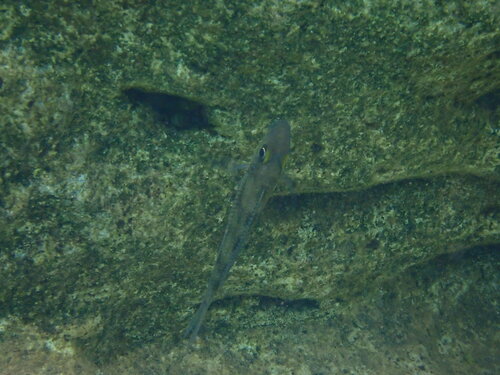
Taxonomy & naming
George Albert Boulenger described this fish in 1901 as Asprotilapia leptura, working from material collected during J.E.S. Moore's Tanganyika expeditions; the type locality is on the lake, and the unique holotype sits in the Natural History Museum, London. The species name leptura comes from Greek roots meaning "slender-tailed," a fair description of its elongate build and thin caudal peduncle.
Where it belongs at the genus level is genuinely unsettled, and a careful reader should know it. Boulenger erected Asprotilapia as a monotypic genus for this one fish. In his 2003 systematic revision of Tanganyikan cichlids, Tetsumi Takahashi synonymized Asprotilapia under the larger genus Xenotilapia, so much of the literature and nearly all of the aquarium trade now call it Xenotilapia leptura. Eschmeyer's Catalog of Fishes, however, currently lists the valid name as Asprotilapia leptura Boulenger 1901 (following Konings), and the IUCN assesses it under that name with Xenotilapia leptura as the synonym; FishBase carries it under Xenotilapia. The two names refer to the same fish; we use Xenotilapia leptura here while noting Asprotilapia leptura as the equally defensible alternative. Either way it is a member of the tribe Ectodini, the "sand-dwelling" radiation that also contains Ophthalmotilapia, Callochromis, Enantiopus and the rest of Xenotilapia.
Morphology
This is a small, streamlined cichlid. Maximum recorded length is about 4.3 in total length, with most adults reaching roughly 4 in. The body is noticeably more elongated than that of its dished-faced Xenotilapia cousins, and the defining feature is the mouth: under-slung and angled downward, the upper jaw overhanging the lower so the fish can plane algae off rock surfaces while holding its body almost parallel to the substrate.
Coloration is understated rather than gaudy — a pale, often pearly or greyish-tan base, frequently broken by a row of faint dark blotches or a broken lateral band along the flank, with subtle iridescent flecking in the fins that catches light. Several geographic populations are traded under locality tags such as 'Cameron Bay', 'Tembwe' and 'Kafungi', and they differ modestly in shade and finnage. Sexual dimorphism is weak: males and females look much alike, with males tending to grow slightly larger and to color up more strongly at breeding time; reliable sexing usually comes from behavior at spawning rather than from color. The species superficially resembles the "papilio" group of Xenotilapia but is distinguished by its more elongate body, plainer pattern, and its herbivorous mouth.
Habitat
Xenotilapia leptura is a lacustrine endemic — found in Lake Tanganyika and nowhere else on Earth. The IUCN describes it as widely distributed along all shores of the lake, spanning the four riparian nations, though some hobby sources note an apparent gap in the south-east. It is a fish of the rocky littoral: clear-water coastlines strewn with large boulders and broken rock, where it characteristically hangs head-down against the sides of stones in the well-lit shallows where algal growth is richest. It is reported to move up from somewhat deeper water when breeding, apparently to give its brood better-oxygenated conditions.
The water it lives in is hard and alkaline, like all of Tanganyika. FishBase summarizes its envelope as pH roughly 7.5–8.5, general hardness from about 15 dH upward, and temperatures around 75–79 °F; the open lake itself runs more strongly alkaline still, on the order of pH 8.6–9.3. That combination of strong buffering, stable warmth and high oxygen is the chemical signature of the lake itself, and it is the baseline any keeper has to reproduce. Because the species is tied to the rocky shallows rather than deep or open water, its fate is bound up with the condition of the shoreline — a point that matters for conservation.
Feeding
Trophically, Xenotilapia leptura is the odd one out in its lineage. Where most Xenotilapia are sand-sifting micro-carnivores that winnow invertebrates from the substrate, this species is a grazing herbivore — the IUCN flatly calls it "a rocky grazer." It works the "aufwuchs" — the biofilm of filamentous and single-celled algae, with the associated micro-invertebrates, that coats sunlit rock — and FishBase records it feeding on both filamentous and unicellular algae. Independent dietary surveys of Tanganyikan cichlids place it firmly in the rock-grazing, algae-and-phytoplankton guild, and its calculated trophic level of about 2.0 confirms a near-pure plant diet.
Its feeding behavior has a second mode worth noting. Females in particular form schools — small groups up to aggregations of several hundred fish — and these shoals will move off the rocks to feed in open water when plankton is available, switching from scraping to mid-water picking. That flexibility, grazer by default and planktivore by opportunity, lets a modestly sized fish exploit two food sources and is part of why it occurs so widely along the shore.
Mating
Outside of breeding, Xenotilapia leptura is a sociable, largely peaceful schooling fish; the large female shoals described above are its normal social unit. Aggression is mild and flares mainly when a pair claims a breeding territory. When the time comes to spawn, a pair separates from the school and defends a small patch of substrate, and the species is reported to move up from deeper water into shallower, better-oxygenated rock for the event. Males color up and court within the territory, and pairing is the prelude to the shared brood care that follows — a system in which both sexes invest, rather than the male-display-only mating of many lek-breeding Ectodini.
Breeding
Reproduction is the most interesting chapter. The species is a biparental mouthbrooder — both parents carry the brood, a strategy that has evolved repeatedly within the Xenotilapia lineage (documented by Kidd and colleagues, 2012) and contrasts with the maternal-only mouthbrooding typical of most African cichlids. Eggs are laid and fertilized on the defended patch of bottom, then taken up into the mouth; observations consistent across hobby and biotope sources describe the female collecting the clutch first, with the male picking up any eggs she cannot gather. The female broods the developing eggs initially and then transfers the brood to the male at roughly day 8–10, after which both parents continue to guard the free-swimming fry. Clutches are small, on the order of a few dozen eggs as is typical for the genus. This shared, hand-off style of care is unusual and is one of the species' genuine claims on a fishkeeper's attention.
In the aquarium
Xenotilapia leptura is a specialist's Tanganyikan, not a beginner's first cichlid — not because it is delicate, but because it needs the right social setup and footprint. Keepers and biotope references converge on a group of six to ten fish; too few, and the dominant individuals bully the rest. That argues for a tank on the order of 100 US gallons (about 105 US gal), and if you intend to run more than one breeding pair, a length of at least 5 ft (59 in) gives pairs the territorial spacing they need.
The layout that works mirrors the wild biotope: a base of fine sand with several large rocks scattered across the bottom and stacked higher toward the back, leaving open swimming room. Water should be hard, alkaline (pH in the high 7s to mid 8s) and warm (about 75–79 °F / 75–79 °F), kept clean and well-oxygenated — Tanganyikans are intolerant of accumulated nitrogenous waste. Diet should lean vegetable: a spirulina-based staple, with only sparing animal foods, suits a grazer and helps avoid the bloat that plagues herbivorous rift-lake cichlids fed too richly. It mixes well with other peaceable Tanganyikans such as Cyprichromis and the smaller, non-overlapping Lamprologines. The species is uncommon in the trade but not unobtainable; tank-raised and farm-raised stock circulates, which is the responsible way to acquire one. Note that aquarium care sheets citing 15-year lifespans should be treated with caution — that figure is not well supported and looks optimistic for a fish this size.
Conservation
Xenotilapia leptura has a real, published IUCN assessment, and it is reassuring. It was first evaluated as Least Concern in 2006 (Bigirimana) and re-assessed as Least Concern again in 2025 (Fermon, assessment e.T60456A47190344), with the justification that it is a lake endemic but widespread and common, with no major threats known. The population trend is recorded as unknown, and the assessment flags water pollution and sedimentation (agricultural and forestry soil erosion) as the chief potential pressures — the same shoreline degradation that most directly threatens a rocky-shore grazer. No species-specific conservation measures are in place. In short, at the species level the fish is fine; the lake it depends on is what bears watching.
That strain is well documented at the basin scale. O'Reilly and colleagues (2003, Nature, doi:10.1038/nature01833) showed that a warming surface and weaker mixing have cut primary productivity by roughly 20%, implying on the order of a 30% reduction in fish yields — a climate signal, not merely overfishing. Cohen and colleagues (2016, PNAS, doi:10.1073/pnas.1603237113) extended the picture with paleoecological records, linking warming to declines in commercially important fishes and endemic molluscs and to roughly a 38% loss of oxygenated benthic habitat as the oxic layer thins. Layered on top is sedimentation from deforestation and shoreline development, which buries and degrades exactly the rocky, algae-covered substrate this grazer feeds on. The lake's open water supports an enormous clupeid fishery that feeds millions of people across Burundi, Tanzania, the Democratic Republic of the Congo and Zambia, managed jointly through the four-nation Lake Tanganyika Authority. For a shallow rocky-shore specialist like Xenotilapia leptura, the most direct risks are local rather than global: sedimentation smothering its grazing surfaces, and the slow thinning of the productive littoral as the lake warms. The species is secure for now, but it is a passenger on a lake whose productivity is trending the wrong way.