Taxonomy & naming
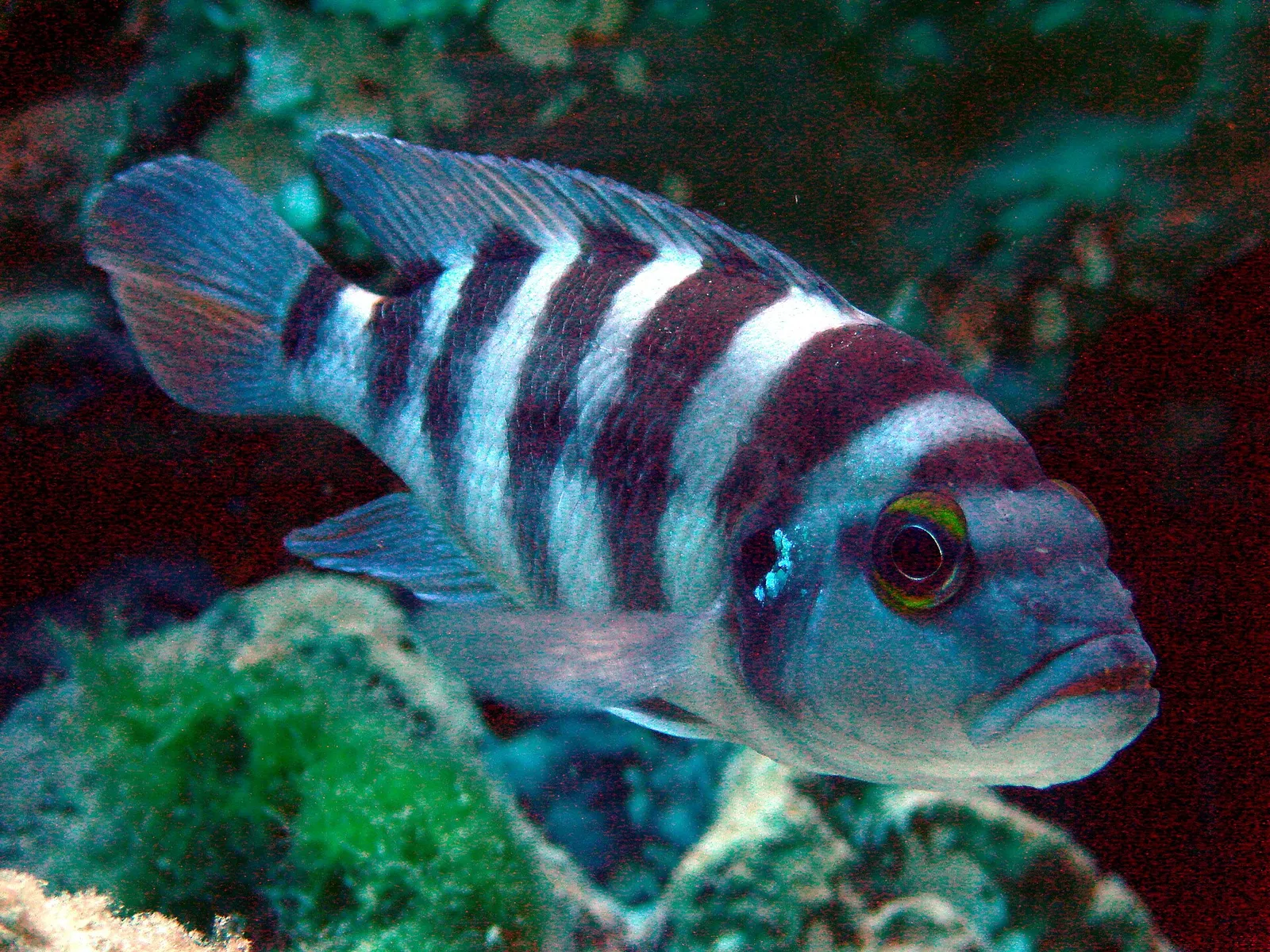
Ethelwynn Trewavas and Max Poll described this species in 1952 as Lamprologus sexfasciatus, working from fish collected at the M'Toto rocky islets in the southern part of Lake Tanganyika, at a depth of just two to three metres. The species epithet is simply descriptive: sexfasciatus means "six-banded" in Latin, for the six dark bars that cross the flanks. That count is not incidental trivia, it is the cleanest way to tell the fish from its close look-alike Neolamprologus tretocephalus, which carries five.
Like most of the lake's small predatory cichlids, it began life in the catch-all genus Lamprologus. The genus Neolamprologus was erected by Colombé and Allgayer in 1985 during a broad reshuffling of that old assemblage, and Maréchal and Poll's 1991 checklist of African freshwater fishes placed sexfasciatus in it, where Eschmeyer's Catalog of Fishes and FishBase both keep it today as the valid name Neolamprologus sexfasciatus (Trewavas & Poll, 1952). It sits in the tribe Lamprologini, the substrate-brooding lineage that, with on the order of a hundred described species, accounts for much of Tanganyika's cichlid diversity. In the trade it is sold as the six-bar or "gold sexfasciatus," the latter after its most common color form.
Morphology
This is a robustly built, deep-bodied Neolamprologus with the genus's typical blunt-headed predator's profile. The ground color depends entirely on where in the lake the population comes from, but the six black vertical bars are constant across every form. Konings recognizes three principal geographical races. The Congolese (Zairean) coast holds the form closest to the original holotype, traded as the "Yellow Congo" variant; the entire Zambian shoreline (except the section nearest the Tanzanian border) produces a deep-blue race sold as the "Blue Sexfasciatus"; and the Tanzanian coast is home to a completely yellow race marketed as the "Golden Sexfasciatus." Other geographic morphs blend these extremes, with yellow heads and upper bodies grading into paler flanks, and forms also circulate under locality names such as Kipili, Kala, and "Sambia."
Reports of maximum size vary more than the barring does: FishBase and Seriously Fish both give about 6 in, lake-habitat references put wild adults near 6.3 in, and Konings' own tabulated figures in Enjoying Cichlids list a maximum of 7 in — likely reflecting the largest wild specimens rather than typical aquarium fish. Sexual dimorphism is subtle, which makes the species genuinely hard to sex by eye, but males grow noticeably larger than females and that size gap is the most reliable cue. The single most useful identification point remains the bar count against Neolamprologus tretocephalus: six bars here, five there. The two are so similar in shape and barring that the gold coloration of typical sexfasciatus is often the quickest tell in a dealer's tank.
Habitat
Neolamprologus sexfasciatus is endemic to Lake Tanganyika and, unlike many of its lake-wide relatives, confined to the southern half. Sources draw the boundaries slightly differently: Seriously Fish brackets it between Cape Tembwe and Karema, while more detailed habitat surveys place it south of Cape Tembwe on the western Congolese shore and south of Isonga on the eastern Tanzanian shore. Along parts of that eastern coast its range overlaps with the five-barred Neolamprologus tretocephalus, yet the two are not reported to interbreed, a clean case of two near-identical cichlids holding their species boundary where they meet.
It lives in shallow water, in rocky zones and the "intermediate" habitat where scattered boulders sit on sand. Compared with Neolamprologus tretocephalus, it tends to favor stretches with more rock and less open sand. The type series came from only two to three metres down, and the fish is generally an animal of the well-lit upper rocky shore rather than the deep reef. As with everything in Tanganyika, the water it lives in is hard, highly mineralized, and strongly alkaline, with a pH around 8 to 9 and surface temperatures in the mid-70s to low-80s Fahrenheit (about 24-27 C). Any care reference quoting a near-neutral pH for this fish should be treated as an error against the lake's real chemistry.
Feeding
Exactly what this fish eats in the wild is the one place its sources genuinely disagree, and Konings' race-by-race field notes go a long way toward explaining why. FishBase, drawing on examined intestinal contents, simply calls it carnivorous and places it at a trophic level around 3.7. Hobby references lean harder, with Seriously Fish describing it as piscivorous and forum write-ups emphasizing a fish-eating predator. Field-oriented sources paint a broader picture: habitat references describe a carnivore taking a range of invertebrates, including insects, crustaceans, and mollusks, with small fishes only an occasional item, and note that for many Tanganyikan Neolamprologus the dominant wild food is actually planktonic crustaceans rather than fish, following the lamprologine feeding studies of Gashagaza and colleagues. Konings adds a geographic wrinkle that reconciles much of this: the Zambian "Blue Sexfasciatus" race shows a noticeably more piscivorous appetite than the Tanzanian "Golden" race, to the point that it cannot safely be kept with fish under about 2 in, while the Congolese (Zairean) race behaves more like the milder Golden form. Reports calling the species a dedicated piscivore may therefore be describing the Blue race specifically rather than the species as a whole.
The most defensible summary is that Neolamprologus sexfasciatus is a robust generalist carnivore of the rocky littoral, equipped to take invertebrates from the substrate and to seize small fish when the chance arises, with piscivory more pronounced in some geographical races than others. That ecological role, a mid-sized opportunistic predator working the boulders and rubble of the shallow southern shore, also explains its temperament: a fish that defends a patch of rock and treats most things its own size as either a rival or a meal. It is also worth noting, for the record, that N. sexfasciatus has sometimes been suggested as one of the color models the scale-eating cichlid Perissodus straeleni mimics to approach its prey unnoticed — but Konings argues this is likely mistaken: straeleni's coloration tracks that of Cyphotilapia frontosa specifically (turning bluer where local frontosa are bluer), and it mimics frontosa even in Burundi waters where sexfasciatus and its supposed lookalike Neolamprologus tretocephalus do not occur at all.
Mating
Socially, this is a difficult, intensely territorial fish, and almost everything keepers struggle with traces back to that. It is very aggressive toward its own kind, to the point that even a large aquarium should hold only a single pair. Sources diverge on how durable the pair bond is, and the difference is real rather than careless. Seriously Fish and hobbyist accounts describe a weak, temporary bond that lasts only through spawning and brood care, after which the male often turns on the female, so much so that pairs are said to break up and the female becomes a target once the fry are independent. Lake-habitat references, by contrast, describe a more monogamous arrangement in which the pair stays together through an extended parental period of around four months. Both can be true of a fish whose pair stability varies with space and population.
What every source agrees on is that you cannot simply introduce an adult male and female and expect a pair; the usual outcome there is a harassed, often dead female. The reliable route is to grow out a group of young fish, let a pair form on its own (which can take a year), and then remove every other individual.
Breeding
Neolamprologus sexfasciatus is a bi-parental cave spawner: the pair takes a rock cave, often enlarging it by digging, and the female lays her eggs out of sight on the cave floor, so spawning is frequently only detected once fry appear. During spawning the dark bars fade dramatically, sometimes reduced to a row of spots along the midline.
Lake-habitat references describe a clutch on the order of 500 eggs, with the pair guarding the brood through an extended parental period of around four months. The 1 in mark is not a hard cutoff for independence — Konings notes that juveniles are sometimes still being guarded by their parents even after growing past that size, and defended youngsters are also tolerated within the territory once the pair produces its next spawn. Once a pair spawns the male becomes formidable, guarding the cave with a ferocity that some keepers describe as turning on anything that approaches, including a hand in the tank. Fry are large enough to take newly hatched brine shrimp essentially from the start.
In the aquarium
This is not a community fish and not a beginner's fish, and the honest framing matters more than any single parameter. The recurring advice across hobby sources is a tank of at least 48 in (47 in) for a single pair, aquascaped with piles of rock built into caves over a sandy bottom, leaving open water between the structures. Konings puts a hard ceiling on stocking: only a single pair per tank, though in a genuinely large aquarium — upwards of 200 gal — two or three females can sometimes coexist, though they usually squabble among themselves. Filtration should be generous: a carnivorous diet means a heavy waste load. Keep the water like the lake, hard and alkaline at pH roughly 8 to 9, in the mid-to-upper 70s Fahrenheit (about 24-27 C).
The central mistake keepers make is trying to pair the fish on purpose. Because adults will not be forced together, the reliable route is to grow out a group of young fish, let a pair form on its own (which can take a year), and then remove every other individual, because the pair will not tolerate them. An older, more direct technique from the lake-cichlid literature is to give the female time to settle into and claim the tank on her own first, and only then introduce a male — reducing the odds he simply overwhelms her. Once a pair spawns the male becomes formidable, guarding the cave with a ferocity that some keepers describe as turning on anything that approaches, including a hand in the tank. Tankmate choice is about giving wide berth: medium-sized Tanganyikans that use different parts of the tank, such as open-water Cyprichromis, are the safest, and larger Julidochromis or Altolamprologus can work in a big, well-structured tank. Seriously Fish notes it can even be kept with robust Malawi mbuna, but it is explicitly not recommended for a general peaceful Tanganyikan community. Anything small enough to be eaten eventually will be — and if the resident fish is a Blue Sexfasciatus, that includes anything smaller than roughly 2 in.
Conservation
Neolamprologus sexfasciatus is listed as Least Concern on the IUCN Red List, in an assessment dated 24 February 2025. Its restriction to the southern half of Lake Tanganyika makes it a narrower-range endemic than many of its lake-wide relatives, but within that range it is not considered threatened, and collection for the aquarium trade is modest and has not been flagged as a population-level concern. The honest statement is the simple one: the species itself is currently secure, even as the lake around it is under measurable strain.
That lake-level strain is well documented and bears on every Tanganyikan endemic. O'Reilly and colleagues (2003, Nature, doi:10.1038/nature01833) found that climate warming has strengthened the lake's stratification and reduced the deep mixing that brings nutrients up from below, with sediment records implying primary productivity may have fallen by roughly 20%, and fish yields by something like 30%. Cohen and colleagues (2016, PNAS, doi:10.1073/pnas.1603237113) added that warming has driven a substantial loss of oxygenated benthic habitat, on the order of 38%, squeezing the lake's bottom-associated fauna from below. Closer to this fish's own home, deforestation in the catchment loads the rocky littoral with sediment that smothers the boulders and crevices shallow rock-dwellers like Neolamprologus sexfasciatus depend on (Cohen et al. 1993). Layered on top is the heavy pelagic fishery for clupeids (Stolothrissa and Limnothrissa) and their Lates predators, which feeds four nations and is coordinated, imperfectly, through the four-country Lake Tanganyika Authority. None of this targets the six-bar directly, but as a shallow rocky-shore specialist of the warming, sediment-prone southern littoral, it lives squarely in the habitat guild those basin-scale pressures act on.