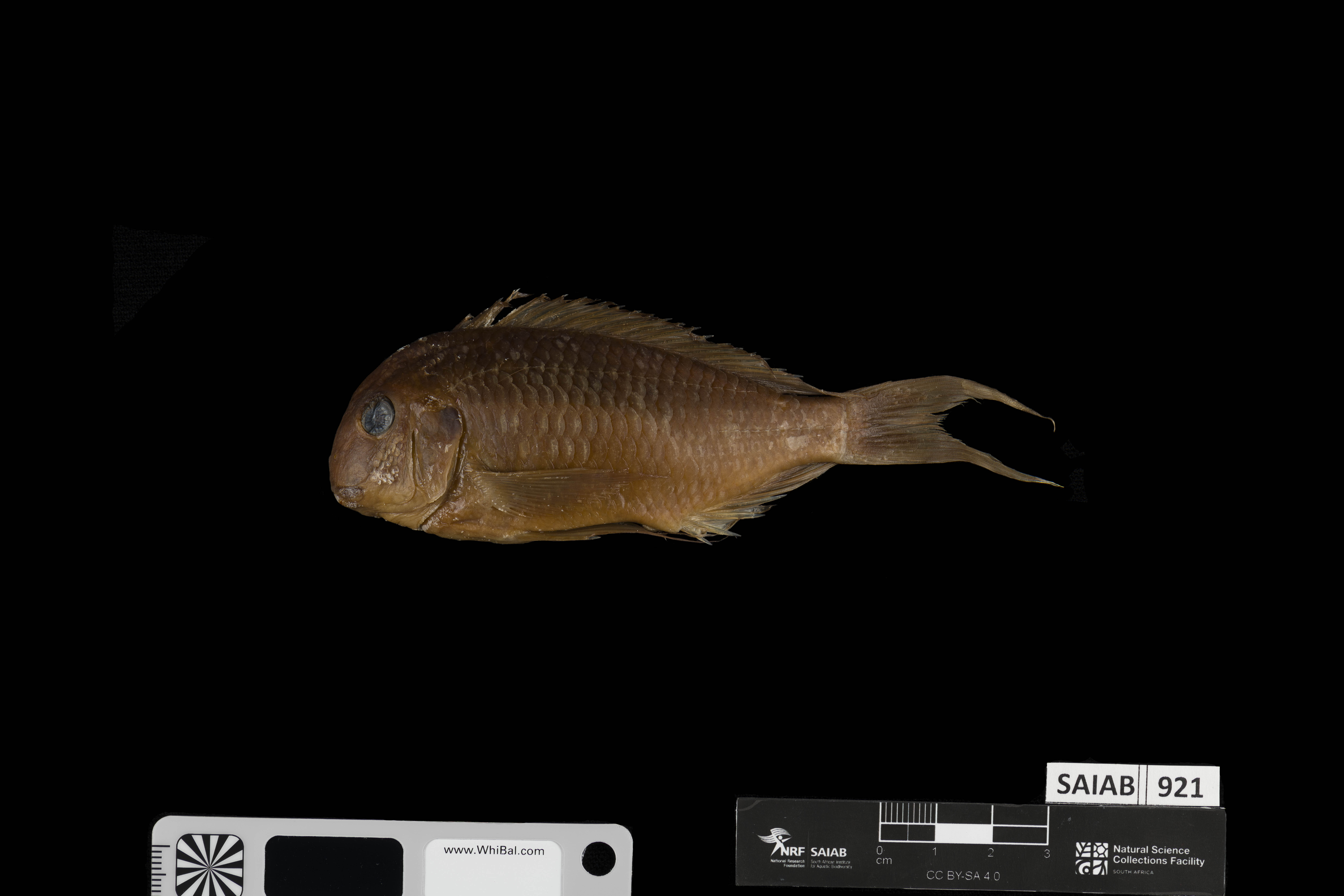
Taxonomy & naming
Tropheus polli was described in 1977 by Glen S. Axelrod, in a short standalone paper, "A new species of Tropheus (Pisces: Cichlidae) from Lake Tanganyika," published as Special Publication No. 17 of the J.L.B. Smith Institute of Ichthyology. The genus name derives from the Greek trophos, meaning nurse or feeder, a reference to the maternal mouthbrooding for which these cichlids are known. The species epithet honors Max Fernand Léon Poll (1908-1991), the Belgian ichthyologist whose surveys did much to map Tanganyika's astonishing fish fauna.
The fish belongs to the tribe Tropheini within the Pseudocrenilabrinae, the rock-dwelling mouthbrooders that anchor the lake's littoral. Its taxonomic status, however, is genuinely unsettled. Konings regards the eastern populations sold and described as Tropheus polli as junior synonyms of Tropheus annectens (Boulenger, 1900) — having observed T. annectens firsthand at M'Toto, Zaïre, he found no meaningful behavioural or morphological difference from T. polli; other workers, including the field collectors at African Diving Ltd, maintain Tropheus polli as distinct. We flag the disagreement rather than resolve it: both treatments appear in current use, and a careful reader should expect to meet this fish under either name.
The dispute has a molecular layer too, and it is a useful illustration of how contested Tropheus taxonomy remains. Konings has directly challenged a mitochondrial DNA study by Sturmbauer & Meyer, which found more sequence divergence between Tropheus polli and Zaïrean T. annectens than between T. polli and the so-called 'Kirschfleck' (double-spot) form of Tropheus moorii — a result the study's authors read as evidence that polli and the Kirschfleck moorii are the more closely related pair. Konings maintains, on the combined evidence of coloration, morphology, distribution and behaviour, that Tropheus polli is simply a population of Tropheus annectens, and argues that a handful of extra base-pair differences in a small sampled fragment of DNA need not track true evolutionary relatedness in a genus whose color races have diverged quickly and recently. Neither side has settled the question; it remains a live disagreement between molecular and morphological approaches to this genus.
Morphology
Tropheus polli is a stocky, deep-bodied cichlid that runs larger than most of its genus. FishBase gives a maximum of about 6.5 in (6.5 in) total length; field accounts have males reaching 6 to 6.7 in (6–6.5 in), with females typically an inch or so (0.5–1 in) shorter. That size, combined with its build, makes it one of the heavyweight Tropheus.
The pattern is muted by Tropheus standards: a dark, charcoal-to-bronze body broken by a paler vertical band or flank blotch, the exact expression varying by collection locality. Two features help separate it from look-alike congeners. First, it is sexually dichromatic, with females colored differently from males, a trait it shares with only a handful of Tropheus (such as Tropheus brichardi) and that is absent in most of the genus, where the sexes look alike. Second, and diagnostically, this lineage carries four anal-fin spines rather than the five or more found in other Tropheus, the same character Konings uses to define Tropheus annectens. (One popular hobby site reports the four spines on the caudal fin; the anal-fin count is the one supported by the systematic literature, and we follow it here.)
Habitat
This is a narrow-range lacustrine endemic. The type material came from south of Bulu Island in the Kigoma District of Tanzania, around 6 degrees South, and the species is confined to the lake's central-eastern, Tanzanian coast. Field collectors place it in two Tanzanian segments, roughly between Katumbi Point and Kalya, and again between Isonga and Kamamba village, the two populations separated by about a 9.9 mi run of sandy shoreline near Kalya and Isonga, the kind of soft-bottomed barrier that rock-bound cichlids rarely cross.
Tropheus polli is a shallow rocky-shore fish. FishBase records it at depths of 20 to 33 ft (20–33 ft), and habitat accounts note it rarely strays below about 23 ft, hugging the upper rocky zone where light and oxygen are highest — consistent with the wider pattern Konings describes for the genus, in which every Tropheus species except the poorly studied T. duboisi keeps to the upper 33 ft of the rocky biotope. It is strikingly sedentary, reportedly seldom moving more than 20 ft (20–23 ft) from its patch of rock even when chased. The in-situ water is hard and alkaline, with a pH around 8.5-9.0, a general hardness near 10-12 dH, and temperatures of roughly 75-79 degrees F (24-26 degrees C) in the surface layer it occupies.
Feeding
Like the rest of its genus, Tropheus polli is an aufwuchs grazer, a trophic specialist that scrapes the thin biological film coating Tanganyika's rocks. Together with T. moorii, T. brichardi and T. sp. 'Black', it shears filamentous algae directly from the rock surface (Yamaoka, 1983) — the feeding habits of T. duboisi, by contrast, remain largely unstudied. FishBase places it at a trophic level around 3.4, reflecting the diatoms, microfauna and detritus tangled in that algal mat and inevitably swallowed along with it.
The genus may lean on another grazer to do some of the groundwork: several species of Petrochromis browse the same rock, combing unicellular diatoms out of the algal turf, and in doing so partially clear the biocover of sediment — housekeeping that Takamura (1984) suggested leaves the rock more suitable for Tropheus to feed on in turn. That feeding mode has shaped the animal in its own right. A long, looping intestine, characteristic of herbivorous cichlids, lets it extract nutrition from a high-fiber, low-protein diet that more carnivorous fish could not process. Ecologically, Tropheus polli is one of many algae-scraping cichlids partitioning the same rocky littoral, a guild whose intense competition for grazing surface is one of the engines behind the lake's explosive cichlid diversity. Its sedentary habits and defended feeding patches are part of how that competition plays out at the scale of a single fish.
Mating
Tropheus polli is a maternal mouthbrooder with conspicuous, year-round territoriality. Notably, females as well as males hold feeding territories, an unusual arrangement among Tanganyikan cichlids; male territories tend to run one to two times larger than those of females. Aggression is sharpest toward conspecifics and softer toward other species, which is exactly why keepers manage the fish in crowds rather than pairs.
That territoriality is unusually constant for the genus. Konings notes that in the wild, Tropheus moorii and Tropheus sp. 'Black' are not always as strictly territorial as their aquarium behaviour suggests — groups of twenty to a hundred fish may graze the same rock face together with little friction — but Tropheus polli, like T. brichardi, holds its territory permanently in nature as well as in captivity. That constancy is exactly why it is difficult to keep in small numbers: there is no lull in the aggression the way there can be in its more sociable congeners.
Spawning follows the classic Tropheus script. A receptive female enters the dominant male's territory, and the two circle on a gently sloping rock; eggs are laid one at a time and taken straight into the female's mouth, where the male fertilizes them. The male contributes nothing to brood care and often drives her off after spawning.
Breeding
The eggs are large for a cichlid, roughly 0.5 in, so broods are small, on the order of 6 to 16 young. The female carries the developing fry for about 24-26 days before releasing them and guarding them briefly. Unusually, brooding females keep feeding while holding eggs, a strategy that helps them survive the long incubation. Fish typically begin breeding around a year old.
In the aquarium
This is not a beginner's fish, and honest keepers say so. The recurring advice across FishBase, specialist habitat references, and hobbyist forums is consistent: keep Tropheus polli in a large group, 15 to 25 fish, skewed to several females per male, in a long tank. FishBase sets a 5 ft minimum length; field-care notes recommend at least 130 gal. Crowding is the tool that defuses the genus's brutal intraspecific aggression by spreading it across many targets; small groups usually end with one dominant fish punishing the rest. Decorate with abundant rock for sightline breaks and use fine sand; plants are absent from the wild habitat and unnecessary, though tough-leaved species like Anubias or Vallisneria are generally ignored.
The single most important warning concerns diet and "bloat." Tropheus have that long herbivore gut and are exquisitely sensitive to excess protein; rich or meaty foods can trigger a fatal digestive collapse. Keepers across cichlid-forum.com, Reddit, and dedicated Tropheus groups converge on the same protocol: a spirulina-heavy, vegetable-based staple, modest daily feeding, and scrupulous water quality. These fish need hard, alkaline, well-oxygenated water (pH comfortably above 7.5), strong biological filtration, and large weekly water changes; they tolerate ammonia and nitrite poorly and degrade under chronic nitrate. One more practical rule from the breeding community: never mix geographic variants of Tropheus, which hybridize readily. Done right, Tropheus polli is a favorite of long-time Tanganyika keepers; done casually, it disappoints fast.
Conservation
Tropheus polli has not been formally evaluated on the IUCN Red List; FishBase records it as Not Evaluated under the current (2025-2) listing, and there is no CITES or CMS listing. That is partly an artifact of the taxonomic dispute, since the fish may be assessed under Tropheus annectens. Where close congeners have been assessed, the news is reassuring: Tropheus brichardi was listed as Least Concern in 2025. The species is harvested for the ornamental trade rather than for food, and its main exposure is targeted collection of a narrow-range, locality-specific population, the sort of fish whose distinct color forms can be thinned by intensive export pressure on a short stretch of coast.
The honest framing is that the fish itself is not known to be threatened, but the lake it depends on is under measurable strain. Lake Tanganyika is warming, and that warming sharpens the lake's vertical stratification and shallows its mixing zone: O'Reilly and colleagues (2003, Nature) inferred from sediment records a roughly 20% drop in primary productivity, implying on the order of a 30% decline in fish yields. Cohen and colleagues (2016, PNAS) used paleoecological records to document warming-driven declines in fish and endemic molluscs alongside an estimated 38% loss of oxygenated benthic habitat. Closer to Tropheus polli's own world, sediment runoff from shoreline deforestation and development smothers the rocky littoral and reduces grazing surface (Cohen et al. 1993), which bears directly on a shallow, rock-bound, sedentary grazer that cannot simply relocate. Governance of these basin-wide pressures, and of the clupeid (Stolothrissa and Limnothrissa) and Lates pelagic fishery that feeds the four riparian nations, is coordinated through the Lake Tanganyika Authority spanning Burundi, the Democratic Republic of the Congo, Tanzania, and Zambia. For Tropheus polli specifically, the takeaway is modest but real: no evidence of a species-level crisis, set against a littoral habitat that sedimentation and a warming lake are slowly degrading.