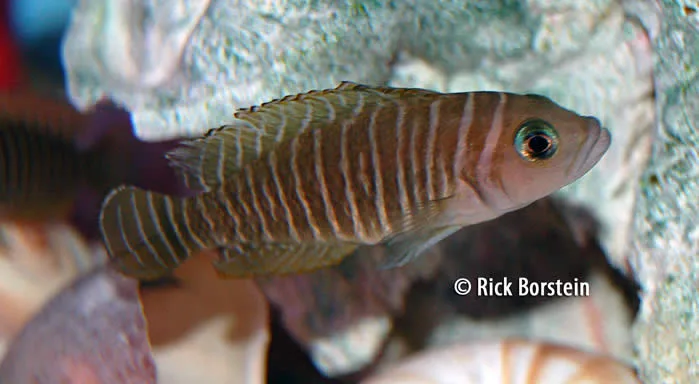
Taxonomy & naming
Heinz H. Büscher described Neolamprologus similis in 1992 in the German aquarium journal Die Aquarien- und Terrarien-Zeitschrift (DATZ), from material collected on the southwestern coast of Lake Tanganyika about five kilometers south of the village of Zongwe, in what is now the Democratic Republic of the Congo. The holotype is held at the Zoologische Staatssammlung München (ZSM 28381). The species sits in the tribe Lamprologini, the substrate-spawning radiation that dominates Tanganyika's cichlid fauna, within subfamily Pseudocrenilabrinae.
The specific epithet says it plainly: similis means "similar," a nod to how closely the fish resembles the already-described shell-dweller Neolamprologus multifasciatus. Eschmeyer's Catalog of Fishes treats Neolamprologus similis (Büscher 1992) as the valid name, while noting that some authorities — notably Ad Konings — place it instead in a broadly defined 'Lamprologus'. That generic shuffling reflects an unsettled, long-running debate about how the Lamprologini should be carved up; for the aquarist and the field observer, the fish is the same animal under either label.
Morphology
This is one of the smallest cichlids kept in the hobby. FishBase gives a maximum of about 2 in (2 in) total length for males, with females smaller at roughly 1.4 in (1.5 in); in practice many specimens mature well under those figures. The body is a warm tan to grayish brown crossed by a series of narrow vertical bars, the fins often edged in pale blue or white, with eyes that catch the light.
The useful diagnostic is the comparison with Neolamprologus multifasciatus, which it shadows so closely that breeders routinely confuse juveniles of the two. The consensus drawn from specialist references and corroborated across hobby forums is that Neolamprologus similis carries a couple of dark bars across the head and face — extending the body striping forward onto the snout — where multifasciatus leaves the head plain, and that similis tends to have a slightly larger eye and a few additional dorsal-fin spines. None of these are dramatic; the name was earned honestly. Sexing is subtle: males run larger, but reliable separation usually waits for behavior, with males holding court over a cluster of female shells.
Habitat
Neolamprologus similis is a Lake Tanganyika endemic, recorded from the lake's southern reaches along the Congolese (DRC) shoreline and the Tanzanian coast. (Boilerplate care-sheet claims of a continuous "entire Zambian shoreline" distribution appear to be recycled text borrowed from other Neolamprologus species and are not supported by the taxonomic sources, which keep the range to the southern Congolese and Tanzanian shores.)
The fish is tied to shell beds — expanses of empty Neothauma snail shells, often mixed with small stones and rubble, lying on or just under the sand. The Cichlid Room Companion describes typical colonies sitting at around 130 ft (131 ft) depth. FishBase notes the species around shell beds as shallow as 33 ft (33 ft), in rocky rubble only at deeper levels (below about 80 ft / 82 ft), and down to a maximum of roughly 150 ft (148 ft). In situ the water is hard and alkaline, with FishBase citing a pH range of 7.4–8.4, dH of 7–30, and temperatures of 73–82°F (73–82 °F) — the stable, mineral-rich chemistry characteristic of this ancient rift lake.
Feeding
Like other small lamprologines of the sediment floor, Neolamprologus similis is a micro-predator that picks its food from the water just above its shells and from the substrate around them. Stomach-content data reported in FishBase list copepods, ostracods and insect larvae alongside strands of algae and ingested sand grains — a diet of tiny invertebrates supplemented by whatever organic material comes with grazing the bottom. FishBase places it at a trophic level of about 3.3, squarely in the small-carnivore range.
Its ecological role is bound up with the shell beds themselves. By occupying, defending and constantly excavating around the empty Neothauma shells — flicking sand to keep entrances clear — colonies of shell-dwellers help keep this distinctive habitat open and structured, supporting a dense community of small fish on substrate that, on the face of it, looks like featureless sand.
Mating
The whole life of Neolamprologus similis revolves around the shell. Each fish claims one as a refuge, a nest and the center of a small territory, and the species lives in colonies — though keepers note it is less of a true communal "colony breeder" than Neolamprologus multifasciatus, with sharper territorial edges between individuals. The mating system is polygynous: a dominant male oversees a harem, spawning with several females that each hold their own shell nearby.
Breeding
Reproduction is substrate spawning inside the female's shell — eggs are laid and fertilized within the shell, and the female tends the clutch in that confined chamber. Parental care is maternal and, by cichlid standards, gentle: this is not a species known to cannibalize its own brood, and fry remain close to the mother's shell until they reach roughly a quarter inch before dispersing. Early broods from young females are often small, sometimes only a handful of fry, before clutch sizes build with experience.
In the aquarium
Neolamprologus similis is an excellent and undemanding nano cichlid, and its compact size lets a group thrive in tanks far smaller than most Tanganyikans require — a footprint of around 24 in (23.5 in) with sand and a generous supply of empty escargot or Neothauma-type shells will house a small colony. Hard, alkaline water (pH in the high 7s to low 8s) and stable warmth suit it, matching the lake conditions above. Provide more shells than fish so every individual can claim one.
The honest caveat is aggression at scale. While not dangerous to larger tankmates, the fish are intensely territorial among themselves, and keepers repeatedly report a dominant "tank boss" bullying weaker individuals once a hierarchy sets in — a problem amplified in undersized tanks with too few shells or too small a group. Give them room and cover and they largely sort it out. They breed readily, and because broods stay in the parents' shells, a species-only tank will slowly fill with fry on its own. Some keepers tuck PVC elbows in among the shells as extra hides; purists object on looks, but the fish use them. They are widely available in the trade, almost all of it captive-bred, which keeps any pressure off wild populations.
Conservation
Neolamprologus similis has been assessed by the IUCN as Least Concern (Fermon, Y. 2025; Red List version 2025-2). As a small, captive-bred aquarium fish of no commercial-fishery interest it faces little direct collection pressure. The most specific threat flagged for it is local: the Cichlid Room Companion notes that erosion-driven sedimentation can bury the shell beds it depends on, observing relatively little such erosion along its Tanzanian range but warning that the Congolese portion of its range is, or may become, more exposed.
That narrow concern sits inside a lake under broad strain. Lake Tanganyika has been warming and mixing less, and O'Reilly et al. (2003, Nature; DOI 10.1038/nature01833) linked that change to roughly a 20% decline in primary productivity with an estimated comparable drop in fish yields. Cohen et al. (2016, PNAS; DOI 10.1073/pnas.1603237113) found that warming has shrunk the oxygenated bottom habitat — on the order of a 38% loss — squeezing the benthic community from below. Shoreline development and deforestation add sediment that smothers the rocky and sandy littoral (Cohen et al. 1993), and a commercial pelagic fishery for clupeids (Stolothrissa and Limnothrissa) and Lates feeds four bordering nations, whose shared stewardship runs through the Lake Tanganyika Authority. Neolamprologus similis is not a pelagic or deep-bottom fish, so the oxygen-loss and open-water-fishery pressures bear on it only indirectly; the threat that lands squarely on a shallow-to-mid-depth shell-bed specialist is sedimentation of the very habitat it cannot live without. The candid summary: the species itself appears secure and is in no way endangered today, but its fate is hitched to the health of Tanganyika's nearshore floor, which is degrading in places even where the fish is doing fine.