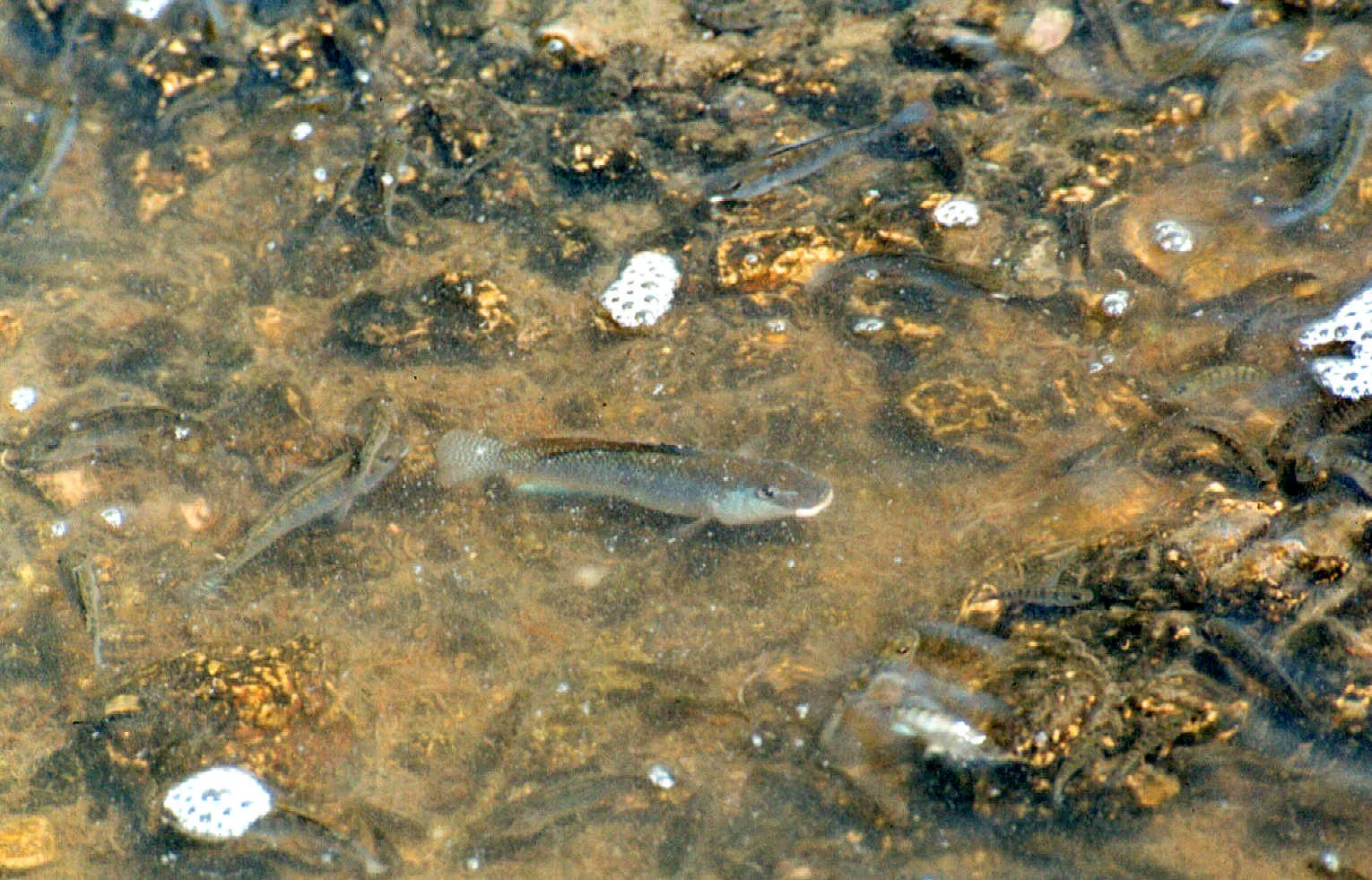
Taxonomy & naming
George Albert Boulenger described the species in 1912 as Tilapia grahami, from material taken in 'Lake Magadi, a hot soda lake in the bottom of the Rift Valley, Kenya' at roughly 1,980 feet elevation. Its name has been unusually unsettled ever since, tracking decades of argument over how the soda-lake tilapias fit into the wider African cichlid radiation. Ethelwynn Trewavas moved it into Oreochromis (as Oreochromis grahami) in 1982, and Trewavas & Teugels (1991) went further, treating it as a mere subspecies — Oreochromis alcalicus grahami — of the Lake Natron form. The modern arrangement comes from Lothar Seegers and Herbert Tichy, whose 1999 revision of the 'Oreochromis alcalicus flock' from Lakes Natron and Magadi recognized the Magadi fish as a full species and revived a separate genus for the soda-lake tilapias, Alcolapia (Seegers et al. 2003). That genus holds just four closely related, exclusively soda-adapted species: Alcolapia grahami, Alcolapia alcalica, Alcolapia latilabris, and Alcolapia ndalalani. Conservation and physiology papers now use the Alcolapia name widely, though Eschmeyer's Catalog of Fishes still files the binomial under Oreochromis grahami and FishBase follows suit — both names point to the same animal. Seegers & Tichy (1999) designated a lectotype, BMNH 1911.1.26.6, with four paralectotypes (BMNH 1911.1.26.7–10) held in the Natural History Museum, London. The species belongs to the subfamily Pseudocrenilabrinae, the vast assemblage of African tilapiine and haplochromine cichlids.
Morphology
The Magadi tilapia is small, short, deep-bodied and flattened side to side. FishBase lists a maximum of 8 in SL, but wild adults run far smaller — Seriously Fish gives a maximum standard length around 4.5 in, and most lagoon fish look slighter still, even emaciated, which is what an energy-limited life produces. The counts are typical for the group: about 11–13 dorsal spines and 12–13 soft rays, three anal spines with 9–11 soft rays, and 28 vertebrae. Colour is where the sexes part ways, and it deepens with breeding condition. A ripe male carries pale blue flanks flecked with iridescent blue on the scales, a conical yellow genital papilla, and — most tellingly — swollen, brilliant-white lobes on the lower lip. A ripe female turns golden overall, with her own swollen genital papilla. Both sexes wear an oblique dark bar through the eye, jet-black in the breeding male and duller in the female. Males also grow larger. Between the blue male, the golden female, and that white lip, a fish in condition is easy to sex in the field.
Habitat
Oreochromis grahami is endemic to Lake Magadi, a hypersaline soda lake in the southern Kenyan Rift Valley whose surface is, for much of the year, a thick crust of solid trona (sodium sesquicarbonate). The fish cannot live out on that crust. It is pinned to the thin band of liquid water at the lake's margins — alkaline hot-spring inlets, spring-fed lagoons, and shallow streams fed by volcanic groundwater — which rank among the most extreme habitats any vertebrate occupies. In-situ measurements (Coe 1966; Wood and colleagues, 2002–2019) put the pH at about 9.5–10.0, alkalinity above 300 mmol/L, salinity near 60 percent of seawater, and temperatures that routinely top 104 °F. One isolated population in the South West Hot Springs sees daytime highs near 109 °F and night-time lows around 90 °F, while the man-made Fish Springs Lagoon stays a steadier 91–97 °F. Oxygen lurches through the day, from anoxia or severe hypoxia at night to hyperoxia under fierce sunlight, alongside high levels of reactive oxygen species and strong ultraviolet exposure. The water is shallow throughout, rarely more than a few metres deep. Introduced populations exist in Lakes Nakuru and Elmenteita in Kenya, and the species has been reported as introduced to Lake Natron in Tanzania — but there is no firm evidence that any introduction has founded a self-sustaining breeding population.
Feeding
In the wild the Magadi tilapia is overwhelmingly a grazer of cyanobacteria. Coe's foundational 1966 study found that the filamentous cyanobacterium Arthrospira (formerly Spirulina) makes up roughly 90 percent of the diet, scraped from rock surfaces and the soft sediment of the springs and lagoons, with the odd copepod or chironomid (midge) larva added. This nitrogen-rich blue-green food underwrites the fish's strange physiology, powering both a high metabolic rate and the ceaseless production of urea. Feeding happens in the morning and again in the evening. That near-total reliance on one patchily distributed food is also a weakness: when flash floods or siltation bury the algae-crusted rocks, a fish trapped in an isolated spring has almost nowhere else to turn. In aquaria the species takes a varied diet of live and frozen foods plus vegetable matter such as spirulina, in keeping with its herbivore-leaning omnivory; FishBase places its trophic level near 2.8.
Mating
Like most tilapiine cichlids, Oreochromis grahami builds its breeding around male-defended sites rather than lasting pair bonds. A ripe male digs a small pit or depression in the substrate — its exact shape set by the bottom he has to work with — and holds it against rivals, slipping away only briefly to feed. Courtship at the pit peaks in the early morning, when both sexes pursue it hardest. Females are not site-faithful: one may drift between the pits of several males in a short span, which raises the possibility that a single brooding female carries eggs fertilized by more than one male. Away from breeding the fish is fairly peaceful, though males stay prickly toward one another, and their small size lets a good number share a modest space. The generations also clash on the spawning grounds — young Magadi tilapia try to snatch the eggs as the female sheds them, so a territorial male spends much of his time driving these juveniles off the pit.
Breeding
Oreochromis grahami is a maternal mouthbrooder, in the classic Oreochromis mould. Once the male fertilizes the eggs in his pit, the female lays only a few at a time — roughly 3 to 10 per bout — and takes each small clutch straight into her mouth; the male trails behind with his genital papilla close to her mouth, apparently releasing sperm so fertilization carries on during pickup. Total fecundity is low, as you would expect from so small a fish. The female then broods the developing eggs and larvae in her buccal cavity for about 12 to 16 days — reported as roughly two weeks — before letting free-swimming fry go, and parental care ends there. The fry are fairly large at release and can manage brine-shrimp nauplii or similar small live foods right away. Captive breeding has happened, but rarely: the fish is seldom available, and recreating its extreme water — high pH, high alkalinity, real warmth — is hard. Keepers who have tried report needing a group of both sexes, a rich conditioning diet, pH held at or above 8.0, and temperatures in the high 20s Celsius.
In the aquarium
Oreochromis grahami is not, in any practical sense, an aquarium fish, and it would be misleading to present it as one. It is essentially absent from the hobby: it does not appear in the ornamental trade, is not listed in commercial availability databases, and falls under Kenya's wildlife and fisheries rules for endemic threatened species. The reason it never entered the hobby is the same reason biologists chase it — its physiology is tuned so tightly to Lake Magadi that even a rough copy of those conditions is out of reach for nearly any home aquarist.
Consider what the wild water actually is. It sits at pH 9.5–10.0, with total alkalinity above 300 mmol/L — around thirty times a typical hard-water cichlid tank — temperatures routinely between 35 and 108 °F, conductivity in the range of dilute seawater, and a daily lurch between near-anoxia and hyperoxia driven by dense cyanobacterial blooms. No commercial buffer is built to hold pH 10 stably in a living system; that alkalinity calls for concentrated sodium carbonate and bicarbonate solutions, not the carbonates sold for Lake Malawi or Lake Tanganyika cichlids. Holding water at 100–108 °F continuously and safely is likewise beyond standard aquarium heaters, which aren't calibrated for that zone and may fail. Extreme heat, extreme alkalinity, high conductivity, and a cyanobacterial food supply together add up to a laboratory problem, not a hobbyist inconvenience.
The few captive studies on record were run by physiologists at research facilities, not by hobbyists. They do confirm that the fish can survive for experimental stretches in water around pH 8.5–9.0, temperatures in the high 20s to low 30s Celsius, and a diet of Arthrospira (spirulina) pellets backed by live and frozen foods — but surviving an experiment and thriving in a home tank are different bars, and long-term health, colour, and reproduction have not been reported outside specialist labs. If you are drawn to alkaliphile cichlids you can genuinely keep, the most accessible East African soda-lake tilapias tolerate pH 8.5–9.5 in lakes such as Natron, and even those are specialist fish. Oreochromis grahami itself stays, for now, with conservation biologists and physiologists rather than the trade.
Conservation
The IUCN Red List assesses Oreochromis grahami as Endangered (criterion B1ab(i,ii,iii)), in an assessment dated 16 June 2022 by W. Nyagweth, E.N. Linus, J. Nguku and G. Kosgei of the National Museums of Kenya. Its whole natural range is a single, tiny, badly fragmented sliver of livable water at the rim of one soda lake — about as exposed as a species gets. The threats all trace back to human pressure on that habitat: industrial soda-ash extraction at Lake Magadi, rising demand for the spring water, and siltation from flash floods that can smother the cyanobacterial mats the fish depend on. Because the populations sit in isolated springs and lagoons separated by hard physical barriers, a single local disturbance can erase a sub-population with little chance of natural recolonization. Researchers have also flagged the Magadi tilapia as a 'bellwether' for a warming climate: already living at the upper thermal edge of vertebrate life, running a metabolic rate in the range of a small mammal with apparently little room to throttle it back during food shortages, the species has scant physiological headroom if its hot springs grow hotter still. It carries no CITES listing.