Taxonomy & naming
The Manyara tilapia was described by the German ichthyologist Franz Martin Hilgendorf in 1905 as Tilapia amphimelas, on material from the saline lakes of what was then German East Africa. Like almost every substrate-spawning or mouthbrooding 'Tilapia' of the period, it was carried for decades in that sprawling catch-all genus. The modern arrangement follows Ethelwynn Trewavas's landmark 1983 monograph 'Tilapiine Fishes of the Genera Sarotherodon, Oreochromis and Danakilia,' which split the old Tilapia into substrate-spawning Tilapia/Coptodon on the one hand and the maternal mouthbrooders Oreochromis and Sarotherodon on the other. Trewavas placed amphimelas in Oreochromis, the maternal mouthbrooders, where it has remained. The epithet amphimelas — Greek amphi, 'on both sides' or 'around,' plus melas, 'black' — refers to the dark coloration that floods a breeding male, fore and aft. Within Oreochromis the species sits among the East African forms and is morphologically conservative; recent genomic work (Sherlock and colleagues, 2025) has shown that the Lake Manyara population is strongly genetically distinct from the other soda-lake populations, hinting that 'amphimelas' as currently drawn may conceal more than one lineage.
Morphology
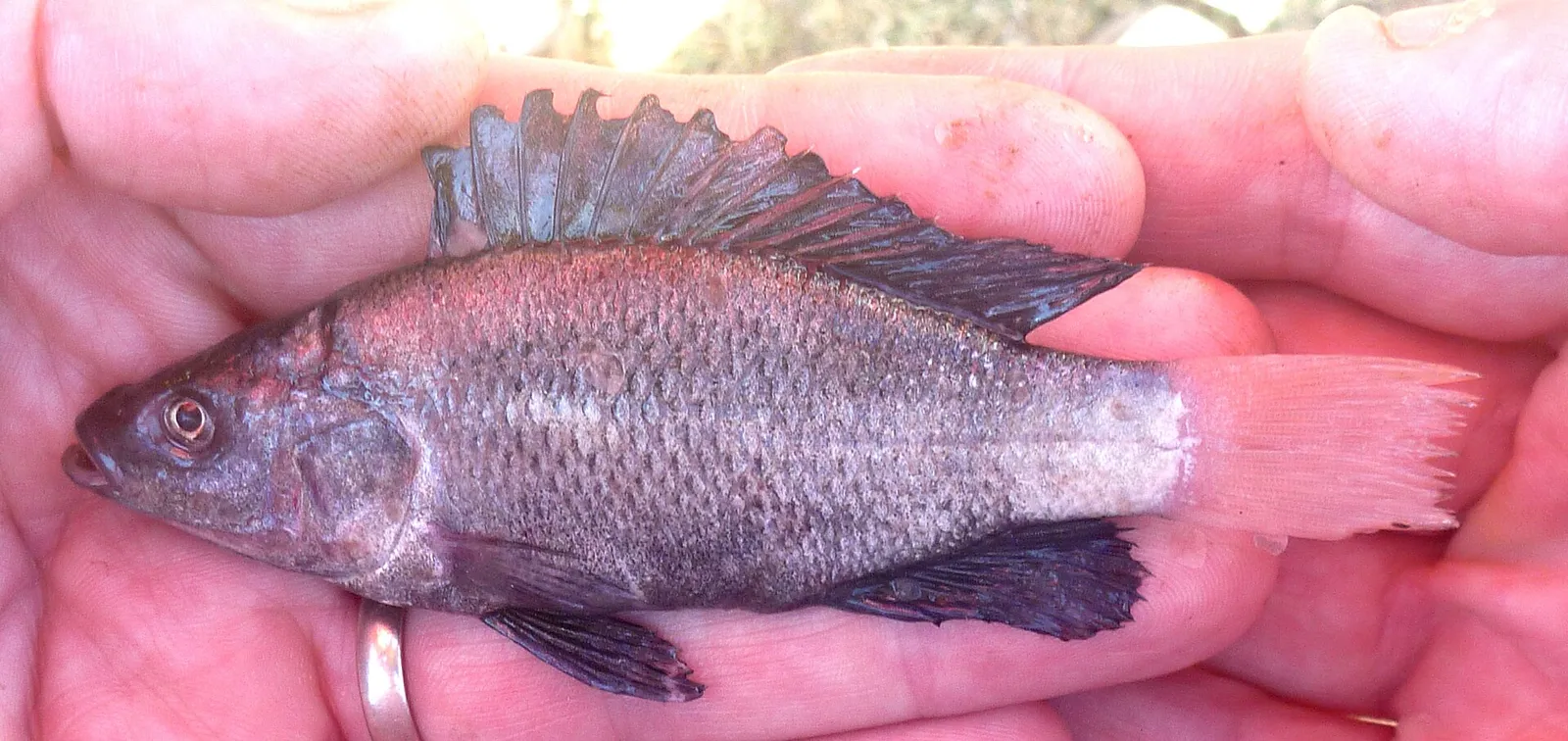
Oreochromis amphimelas is a comparatively slender tilapia, reaching about 11 in in standard length, with a noticeably slim head profile, a small eye and a terminal mouth — proportions that set it apart from the deeper-bodied farmed tilapias. Outside of breeding the sexes look much alike: grey to silvery flanks, often with a faint pattern of vertical bars that come and go with mood, and the unremarkable countershading of an open-water lake fish. Breeding transforms the territorial male. He turns dark — the 'black on both sides' the name records — typically with a jet-black dorsal fin and a flush of pinkish to brick-red along the flanks and lower body, a high-contrast nuptial dress advertised over his spawning pit. Females and non-territorial males stay in their plain grey livery year-round. The fin counts are those of a typical Oreochromis, and the dentition is fine and brush-like, suiting a fish that grazes rather than seizes prey.
Habitat
This is a fish of hard, alkaline, often frankly saline water — among the most extreme habitats any tilapia occupies. Its range is a set of endorheic (closed-basin) lakes in central Tanzania that have no outlet to the sea: Manyara, Eyasi, Kitangiri, Singida and Sulungali, lying roughly between 3°N and 5°S in the eastern Rift. These are shallow, turbid soda and brackish lakes fed by seasonal rivers and ringed by alkaline flats; water level, area and salinity swing dramatically between wet and dry seasons, and several of the lakes can partly dry out in drought years. Lake Manyara, the best-known, is a shallow alkaline lake at the foot of the Rift escarpment. The Manyara tilapia tolerates conductivities and pH values that would kill most freshwater cichlids, and within these lakes it is the dominant — historically the only — native tilapia, a benthopelagic generalist of the open shallows. FishBase places it in tropical freshwater and brackish waters; in practice 'brackish' understates how mineral-rich some of these soda lakes become.
Feeding
The Manyara tilapia is microphagous — a feeder on small particles — in the manner typical of Oreochromis. With its fine teeth and long, fine-meshed gill rakers it grazes and filters the phytoplankton, benthic algae, diatoms and fine organic detritus that the productive soda lakes generate in abundance; these alkaline lakes are often green with cyanobacteria and microalgae, a standing crop that a small-particle feeder can exploit efficiently. It sits low on the food web, the role of a primary consumer converting microscopic plant production into fish flesh — which is exactly why it matters to the people who fish these lakes. There is no evidence of piscivory or of any specialised feeding apparatus beyond the standard tilapiine grazing-and-filtering kit; this is a broad-spectrum herbivore-detritivore making a living in water too salty for most competitors.
Mating
Oreochromis amphimelas is a maternal (female) mouthbrooder, and its breeding follows the lek-and-pit pattern of the genus. Territorial males develop their black-and-red nuptial colours, clear and defend a spawning pit or 'nest' scraped in the substrate of the shallows, and display to passing females. A receptive female enters the territory, the pair circle and spawn over the pit, and she takes the fertilised eggs into her mouth almost at once. Reported observations describe a breeding cycle of roughly seven weeks and note evidence of some biparental involvement around spawning, though the heavy lifting of incubation falls to the female. Because the soda lakes are so seasonal, reproduction is tied to the favourable window after the rains, when water levels rise, salinity eases at the river mouths and food is abundant — a narrow opportunity that the species' fast, cyclical breeding is built to exploit.
Breeding
After spawning, the female carries the eggs and then the larvae in her buccal cavity, where they are aerated and protected through development; she does not feed, or feeds little, while brooding. Once the yolk is absorbed she releases free-swimming fry, which for a time return to the shelter of her mouth when threatened — the classic Oreochromis safe-harbour behaviour — before becoming independent. Clutch sizes are not precisely documented for amphimelas but, as in related Oreochromis, scale with female size and run to a few hundred eggs at most; mouthbrooding trades raw fecundity for the high survival of well-guarded young. The roughly seven-week cycle reported for the species, and its capacity to breed repeatedly through the favourable season, let a population rebuild quickly after the drought-driven crashes its closed lakes impose. In aquaculture trials the species has bred readily, which is part of why it has attracted interest as a salt-tolerant tilapia for marginal waters.
In the aquarium
Oreochromis amphimelas is essentially a research, conservation and aquaculture subject rather than an ornamental-trade fish; it is not a species the average hobbyist will encounter, and there is little tradition of keeping it for display. Where it is held — in fisheries institutes and conservation-minded facilities in Tanzania and occasionally abroad — the keeping requirements follow from its wild ecology rather than from any aquarium pedigree. It needs hard, alkaline, mineral-rich water; this is one of the few tilapias genuinely adapted to brackish and soda conditions, and it should not be kept in soft, acidic water. A large tank or pond is essential for a 11 in fish that grazes constantly and, like all tilapias, is messy and territorial when breeding. Provide open substrate for males to dig spawning pits, robust filtration, warmth in the tropical range, and a diet built around the algae and small particles it eats in the wild — quality vegetable-based and spirulina pellets, supplemented with greens. As with other Oreochromis, mixed groups establish a dominance order and breeding males become aggressively territorial, so space and sight-breaks matter. The honest summary: this is a fish kept on purpose, by people working on its biology or its potential as a hardy food fish, not a community aquarium animal.
Conservation
The IUCN Red List assesses Oreochromis amphimelas as Endangered (assessed 31 January 2006). The threats are a textbook case of small-range, closed-basin vulnerability compounded by human pressure. Its lakes are shallow, evaporative and prone to drying in drought; climate-driven swings in rainfall can crash the lakes and the fish with them. On top of that natural fragility sit overfishing by the artisanal fisheries that target it, habitat degradation and pollution around the lake margins, and — the pressure now reshaping so many African tilapia ranges — the introduction of non-native tilapias, especially Nile tilapia (Oreochromis niloticus), into waters such as Lake Manyara, where they compete with and hybridise the native fish. The recent finding that the Manyara population is genetically distinct sharpens the stakes: losing a single lake may mean losing a unique evolutionary lineage, not merely a local population. Conservation attention in Tanzania, including community-awareness and fisheries-compliance work around Lake Manyara, is beginning to focus on the species, but it remains a genuinely threatened endemic of a shrinking, salty world.