Taxonomy & naming
Paratilapia polleni was described by the prolific Dutch ichthyologist Pieter Bleeker in 1868, who erected the genus Paratilapia for it at the same time; it is the type species by monotypy. The original material came from Ambazoana (rendered 'Ambassuana' in the description) in northern Madagascar — collections made near Nosy-Be by the Dutch naturalist-merchant François Pollen and his companion Douwe Casparus van Dam, after whom the fish and a sister Malagasy cichlid (Paretroplus damii) are named. Eight syntypes survive in the Naturalis collection in Leiden (RMNH 3934, 4483 and 6690), catalogued by Fricke and colleagues in 2018. Bleeker, judging by gross resemblance, placed the genus near Tilapia — hence the name 'para-tilapia,' Greek para meaning 'near' — though he actually thought it closest to Hemichromis; neither relationship reflects its true position. Modern work (Stiassny & Gerstner 1992; Sparks & Stiassny) instead places Paratilapia within the subfamily Ptychochrominae, an endemic Malagasy clade that, together with Etroplinae of Madagascar and India, sits near the base of the cichlid radiation — a relic lineage as distant from African tilapias as from Neotropical cichlids. The species-level taxonomy of the genus remains genuinely unsettled: the names P. bleekeri, P. typus and several undescribed regional forms ('Andapa,' 'East Coast Small Spots,' 'Fianarantsoa Green') have been variously synonymised with or split from Paratilapia polleni, and the binomial has often been applied loosely to spotted Paratilapia across the whole island. Catalog of Fishes treats Paratilapia polleni as valid and gives its core distribution as eastern Madagascar, with the type series from the northwest.
Morphology
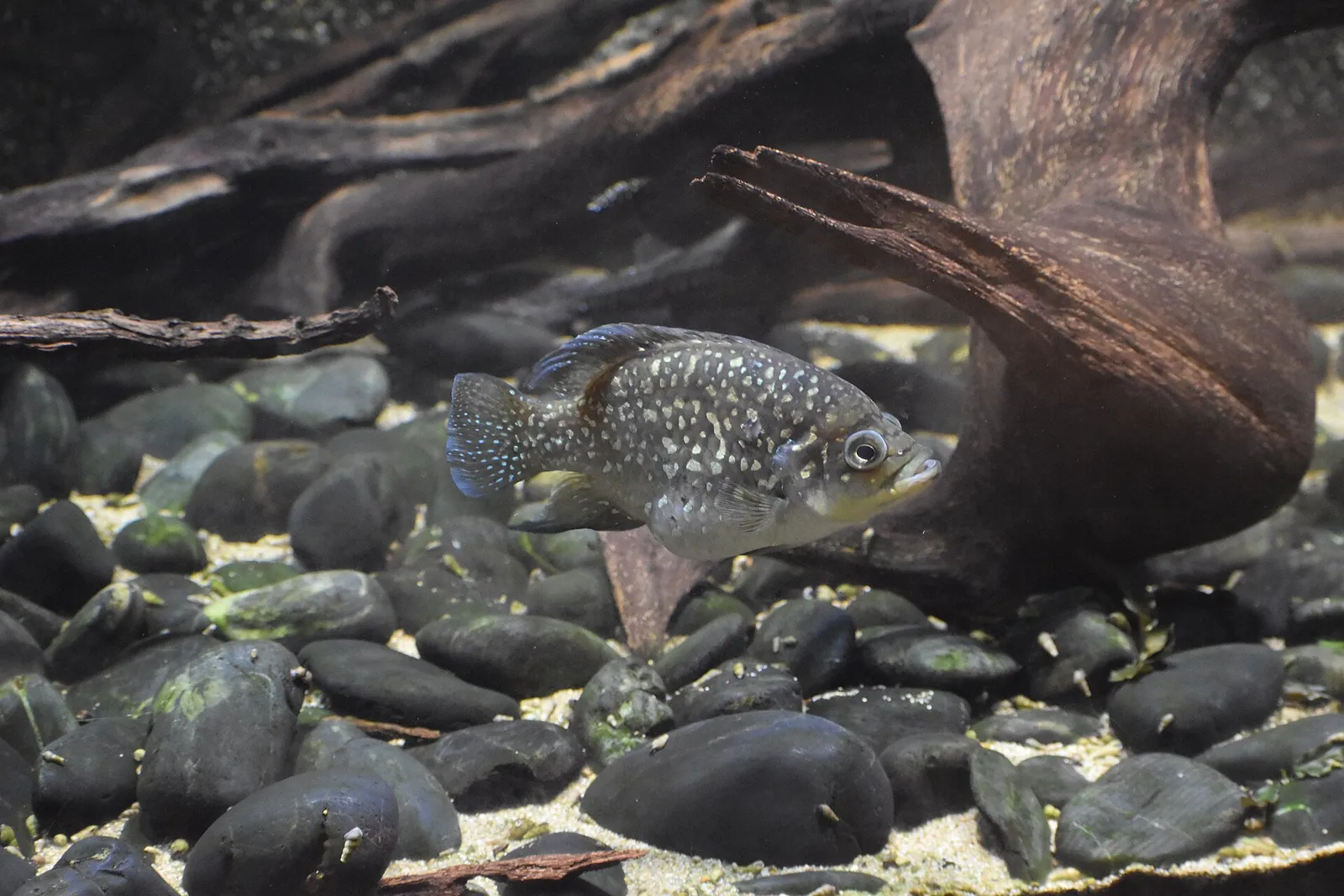
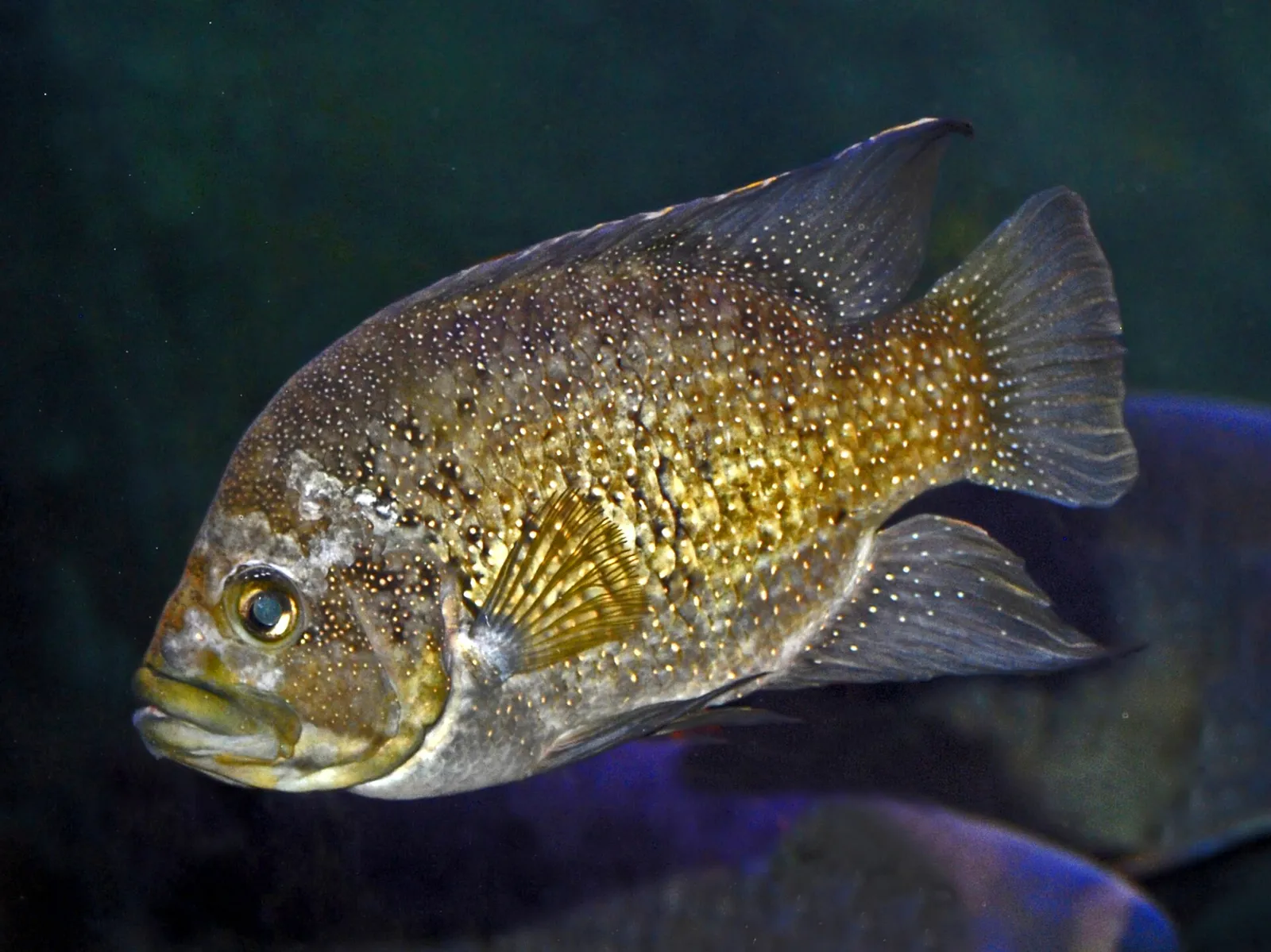
Paratilapia polleni is a robust, deep-bodied and laterally compressed cichlid with a large head, big mouth and conspicuously large eyes — adaptations to its low-light, crepuscular hunting. FishBase gives a maximum of about 11 in total length, though aquarists report the largest regional forms approaching 12–15.5 in; most adults fall in the 10–12 in range. The defining feature is the coloration: a dark brown to velvet-black body overlaid with rows of small, brilliant iridescent spots — white, gold, pale blue or green — that extend onto the median fins, giving the fish its 'starry night' name. The pattern is mood-dependent, fading to a pale beige in a stressed fish and intensifying to glittering black in a confident or breeding one. The unpaired fins are dark and often drawn out into short trailers at their tips, and the caudal fin is short and rounded. Sexing is comparatively straightforward: males grow larger, develop more pointed dorsal and anal fins, frequently build a pronounced nuchal hump with age, and carry a long, pointed genital papilla. Unusually for cichlids, females are often the more vividly spotted of the pair, while some adult males are nearly plain black — a reversal of the usual cichlid pattern that makes the species notable among hobbyists.
Habitat
The species is endemic to Madagascar, where Paratilapia is historically the most widespread cichlid genus on the island — once found from the northwest and northeast down the entire east coast, with relict populations in the Central Highlands and pockets of the southeast. The name Paratilapia polleni in its strict sense is anchored to northwestern Madagascar (the Nosy-Be / Ambazoana type locality), but as broadly applied it spans the eastern lowland drainages as well. Marakely occupy a range of slow, warm, lowland waters: vegetated lake margins, river floodplains, marshes and swamps, and even coastal lagoons where conditions become slightly brackish. They favour structured, well-vegetated habitats with cover and tolerate the warm, moderately mineralised waters typical of the island's lowlands. FishBase records the species as freshwater and demersal, with a reported pH at or above 7.0, hardness up to about 10 dGH, and a preferred temperature band of roughly 75–82 °F; in-situ Malagasy lowland waters are warm year-round, and the fish is reported to be susceptible to ich (white-spot) when kept too cool. It has even been recorded living in rice-field systems, underlining its adaptability within disturbed lowland landscapes.
One well-documented eastern locality is the Nosivolo River drainage near Marolambo, where the species — known locally there by the vernacular name "Sofony" — occurs alongside two other threatened Malagasy cichlid endemics, Oxylapia and Ptychochromoides, plus the endemic catfish Ancharius brevibarbis. It is a reminder of how much of Madagascar's relict freshwater fauna is now packed into a handful of surviving drainages.
Feeding
Paratilapia polleni is a carnivore and a patient, crepuscular ambush predator — most active at dawn and dusk, which accounts for its large, light-gathering eyes. In the wild its principal prey appears to be small fishes, especially the endemic Malagasy rainbowfishes of the genus Bedotia, supplemented by aquatic invertebrates, crustaceans and insect larvae. A hunting marakely hangs motionless in the upper or mid water column, tracking prey with its eyes before lunging and engulfing it in a single gulp of its capacious mouth. FishBase places it at a trophic level of about 3.4, consistent with a mid-level piscivore-invertivore rather than an apex predator. There is little evidence of deliberate plant-eating; any vegetable matter ingested arrives secondhand in the guts of prey. In captivity the species is unfussy, readily taking frozen lancefish, prawns, earthworms, and quality sinking pellets and sticks alongside (or instead of) live food.
Mating
Marakely are monogamous and form strong, lasting pair bonds. Outside breeding they are surprisingly placid for so large and toothy a fish — often likened to Lake Tanganyika's Cyphotilapia frontosa in temperament — but two adult males will not tolerate one another regardless of tank size, and juveniles can be rough on each other as a hierarchy forms. Pairs typically establish themselves out of a group of young fish grown on together. Courtship is a vigorous, ritualised affair: prospective partners engage in jaw-locking, flank-to-flank body slapping, and quivering displays held at a roughly 45-degree angle, the male chasing the female but rarely injuring her. The intensified black-and-spangle coloration peaks during this period. Once a pair has formed they remain closely associated, jointly defending a territory and cooperating through the demanding business of spawning and brood care that follows.
Breeding
Paratilapia polleni is a biparental substrate spawner with one of the more unusual egg-laying styles among cichlids. The pair selects and meticulously cleans a spawning site — a rock face, root, or, ideally, the inside of a cave or hollow. Remarkably, the eggs are non-adhesive and each bears a long filament at one end; the female fans the developing strand with her pectoral fins as she lays, working the filaments together into a compact, mobile mass three or four layers deep that is not fixed to the substrate at all and can be shifted by fin currents alone — which is why a sheltering hollow matters so much. Clutches are modest for a fish of this size — typically not more than about 500 eggs, though a detailed field study of one spawning recorded roughly 1,000, and FishBase cites a fecundity figure near 800 at the higher end.
Both parents guard and tend the eggs, mouthing and occasionally relocating the clutch, but a controlled study of captive brood care (Stiassny & Gerstner, 1992) found the female's role to be clearly the primary one, with the male contributing without ever taking over the bulk of the work. That result mattered for reasons beyond aquarium husbandry: the study was partly designed to test whether Paratilapia's basal position in the cichlid family tree might correspond to stronger paternal involvement, as is typical of many other bony fishes — instead the finding supports female-dominated brood care as an ancestral trait already fixed near the root of the cichlid lineage, predating the group's later diversification.
At warm temperatures the eggs hatch in roughly 60 hours, and the larvae become free-swimming after a few more days, when they begin taking newly hatched brine shrimp. Growth is slow — young may need a couple of months to reach about 1 in — and because the fry can be cannibalistic and the sexes diverge in size early, grading the juveniles by size is advisable. A persistent caveat from breeders is that the parents themselves are notorious egg-eaters, particularly when disturbed or sharing the tank with other fish, so the first few spawns of a young pair are often lost.
In the aquarium
Marakely have a long and devoted following in the cichlid hobby, and because wild stocks are threatened, captive breeding (notably in Indonesia and Eastern Europe, as well as by dedicated hobbyists) now supplies most aquarium fish — a rare case where the trade can be part of the conservation solution rather than the problem. Collectors working eastern drainages such as the Nosivolo have also noted that, unlike the fragile Oxylapia and Ptychochromoides sharing its habitat — both of which reportedly suffer heavy losses in the days after capture — Paratilapia polleni tolerates the stress of collection and transport comparatively well, one practical reason it has remained available to the trade even as more delicate Malagasy endemics have not. Despite their eventual size they do not demand an enormous tank: a footprint of at least about 48 inches in length suits a pair, since these are fairly sedentary fish that, once bonded, are calm and territorial rather than restless. The cardinal stocking rule is one male per tank — a second adult male will be relentlessly harassed no matter the volume — and conspecific aggression among growing juveniles means a divider or grow-out plan is prudent when raising a group to obtain a pair.
Water should be kept warm: at least 79 °F, mirroring the hot lowland waters of Madagascar. The species has a notorious vulnerability to white-spot disease at lower temperatures and is said to recover poorly from it, so a stable, warm tank is the single most important husbandry point. They are otherwise hardy across neutral to moderately hard water (around pH 7 and up, hardness to roughly 10 dGH suits them) provided waste is well controlled — large cichlids produce copious waste, so over-filtration with a strong external filter plus supplemental aeration is recommended. Décor of bogwood, slate and rock arranged to form caves gives the often-shy adults the refuges they value and the hollow they need to spawn; a buried flowerpot serves the same purpose. Live plants are generally ignored as food but may be uprooted during spawning preparations.
Feeding is undemanding: frozen and prepared meaty foods (lancefish, prawn, earthworm) and good pellets are all accepted, and live food is enjoyable to watch but not required. As tankmates, other robust, non-aggressive fish too large to be swallowed work best — marakely will treat anything bite-sized as the rainbowfish they hunt in the wild. The main pitfalls keepers encounter are keeping the tank too cool (inviting fatal ich), housing two males together, and losing early spawns to nervous, egg-eating young parents; all three are manageable with patience.
Conservation
The IUCN Red List assesses Paratilapia polleni as Vulnerable (VU), under criterion B1ab(iii), assessed on 24 June 2016 by T. Ravelomanana of the Université d'Antananarivo, with a decreasing population trend. The listing reflects a restricted and fragmented extent of occurrence combined with ongoing decline in the quality of its habitat. The pressures are the same ones bearing down on Madagascar's freshwater fauna as a whole: rampant deforestation and the resulting siltation and degradation of waterways (logging and wood harvesting are cited explicitly), broader ecosystem modification of lowland wetlands, and — most damagingly for a fish like this — the spread of introduced exotic species, including predatory snakeheads, tilapias and other competitors that prey on or outcompete native cichlids. Local fishing adds further pressure, as marakely are eaten and are recorded from rice-field fisheries. The species carries no CITES or CMS listing. Madagascar's endemic freshwater fishes are among the most threatened on Earth, and several Malagasy cichlids have already slipped toward or into extinction in the wild; against that backdrop, Paratilapia polleni's strong presence in aquaria and in coordinated zoo and hobbyist breeding programmes is widely seen as an important insurance against loss of the wild populations.