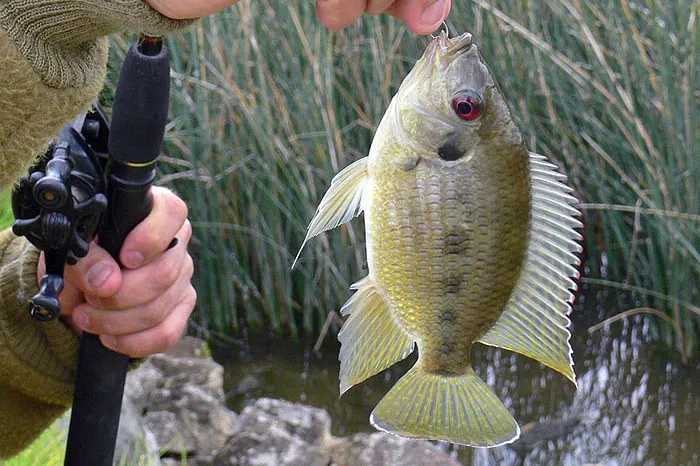
Taxonomy & naming
The spotted tilapia was described by the Belgian-British ichthyologist George Albert Boulenger in 1899 as Tilapia mariae, in the Proceedings of the Zoological Society of London, from material collected in Azuminé Creek on the Opobo River in the Niger Delta of Nigeria. Two syntypes survive in the Natural History Museum, London (BMNH 1896.5.5.49–50). For more than a century the fish sat in the sprawling 'wastebasket' genus Tilapia, which at its peak held dozens of only loosely related African cichlids lumped together by their substrate-spawning habit and generalized body plan. That arrangement collapsed under molecular scrutiny: Dunz & Schliewen, in their 2013 phylogeny of the haplotilapiine cichlids 'formerly referred to as Tilapia' (Molecular Phylogenetics and Evolution 68: 64–80), broke the old genus apart and transferred mariae to the resurrected genus Pelmatolapia. Pelmatolapia had originally been erected by Ethelwynn Trewavas as a subgenus of Tilapia; Dunz & Schliewen elevated it to full genus rank for a small West and Central African clade of biparental substrate spawners. The combination Pelmatolapia mariae (Boulenger 1899) is the name now accepted by the Catalog of Fishes and FishBase, though the older Tilapia mariae remains ubiquitous in the invasion and fisheries literature, and a 2025 study has alternatively placed the species in Coptodon — a reminder that tilapiine generic limits are still being argued. The synonym Tilapia meeki Pellegrin, 1911 has long been regarded as referring to the same fish.
Morphology
Pelmatolapia mariae is a stout, laterally compressed cichlid with a rounded head profile and a notably deep body — body depth runs roughly 47 to 52 percent of standard length. It is among the larger members of its genus: FishBase records a maximum of about 12.5 in standard length, and field workers have measured fish of 14 in total length in Florida and around 13 in in Queensland, with weights to about 1.4 kg. The fin counts are typical of the genus — 15 to 17 dorsal spines, 13 to 15 dorsal soft rays, three anal spines and 10 to 11 anal soft rays. The teeth are diagnostic: the outer jaw teeth are bicuspid, slender and spatulate, while the lower pharyngeal bone carries small, narrow teeth forming an almost felt-like crushing pad, the hallmark of a plant-grinder. The coloration is the easiest field mark. Juveniles and stressed adults show seven to nine bold dark vertical bars on a pale tan-to-olive ground; as the fish matures these bars resolve into a longitudinal series of five or six squarish black blotches along the midflank, and large or dominant fish can darken to nearly uniform blackish. A scattering of pearly and reddish flecks (many ventral scales bear a central red spot) and dark bars across the cheek complete the pattern, and the vertical barring characteristically extends up onto the dorsal fin — a feature that separates it at a glance from the superficially similar redbelly tilapia (Tilapia zillii), which lacks the square lateral blotches and shows red on the belly. Sexual dimorphism is weak: the sexes are very similar in size and finnage, and breeding fish are best told apart by behaviour and by the female's swollen genital papilla rather than by any reliable colour or shape difference.
Habitat
In its native range Pelmatolapia mariae is a fish of warm West African coastal lowlands, occurring in coastal lagoons and the lower courses of rivers from the Tabou River in the Ivory Coast east to the Kribi River in Cameroon, including the Niger Delta; it is conspicuously absent from the stretch of coast between the Pra River in Ghana and Benin, giving it a disjunct, two-part distribution. It lives in both still and flowing water over rocky, mud and sand bottoms, and turns up readily in warm springs and slow, mud- to sand-bottomed canals — habitats it has exploited so well as an invader. The species is markedly euryhaline, tolerating fresh and brackish water and ranging from coastal lagoons into purely freshwater streams. FishBase gives a pH range of about 6.0 to 8.0 and a hardness range of roughly 5 to 19 dH; reported temperatures span a broad warm-water envelope, with the biology review by Bradford and colleagues (2011) citing field temperatures of about 68–91 °F across the range. Depth records are shallow: studies cited in that review place juveniles in water less than 7 ft deep and larger adults somewhat deeper, beyond about 16 ft. These are demersal, bottom-oriented fish that occur in mixed-size, mixed-species aggregations and shelter among logs, leaf litter and submerged structure.
Feeding
Pelmatolapia mariae is fundamentally a herbivore and detritivore, equipped with the felt-like pharyngeal mill of a plant processor. Gut studies across its native and introduced ranges agree that algae, diatoms, aquatic macrophytes and detritus make up the great majority of the diet — on the order of 85 percent by volume in Nigerian and Florida populations — with terrestrial insects, benthic invertebrates, small shrimps and fish eggs taken as a minor animal supplement that tends to increase with body size. FishBase notes a clear preference for plant material, including filamentous algae, higher plants and even pieces of cassava, while still accepting insects and shrimps along with their eggs. The species is an opportunistic grazer rather than a fussy specialist, and this dietary flexibility — the ability to switch between scraping aufwuchs, browsing macrophytes and gleaning small animal prey — is a large part of why it thrives once introduced. In the community it functions as a primary consumer that crops attached algae and rooted vegetation, a role that becomes ecologically loaded when it is dropped into systems that did not evolve with a heavy-grazing cichlid.
Mating
Spotted tilapia form monogamous pairs and are biparental, a social system that sets the whole genus apart from the polygynous, mouthbrooding tilapiines. Outside breeding the fish move in loose mixed aggregations, but a ripe pair withdraws to establish and jointly defend a territory centred on a chosen spawning surface. Pairing is preceded by mutual display and substrate cleaning, and once a bond forms both partners share territory defence, driving off conspecifics and other intruders. The species is conspicuously aggressive and territorial during this phase — a trait quantified in Florida by Brooks & Jordan (2010), who found that introduced spotted tilapia defend territories more vigorously than the native sunfishes they displace, an 'enhanced interspecific territoriality' that they linked directly to the fish's invasion success. Spawning in West Africa is tied to the lunar cycle: the review by Bradford and colleagues reports that most spawnings occur in the few days leading up to the full moon. Maturity comes early and at modest size — around 3.5–4.5 in total length, often within the first year — which combined with paired territoriality and frequent breeding makes for a fast-reproducing, space-contesting fish.
Breeding
Pelmatolapia mariae is a biparental open substrate spawner. The pair cleans a hard surface — a log, a flat stone, a broad leaf or other firm debris — and the female deposits adhesive eggs on it in rows, after which both parents guard and fan the clutch. The classic account of this behaviour is Whitehead & Trewavas's life-history study (Proceedings of the Zoological Society of London, 1962), supplemented by Schwanck's (1989) detailed comparison of parental care in the wild Ethiope River, Nigeria, and in aquaria. Fecundity is high for a substrate spawner and scales with female size: FishBase cites 600 to 3,300 eggs per spawn (up to about 2,000 commonly, and counts approaching 9,000 in the largest females per the Bradford review), markedly more than a mouthbrooder of similar size produces, since the parents are not constrained to carry the brood. Eggs hatch in roughly one to three days, and the larvae need a further six to eight days before they are free-swimming. Parental care is prolonged and shared — both parents guard the wrigglers in pits and then shepherd the free-swimming school, defending it until the young reach about 0.5–1 in; the review notes guarding periods of 40 to 60 days. Spawning recurs frequently under warm, stable conditions, and a pair can produce successive broods through a long season. It is this combination — high fecundity, attentive biparental defence, early maturity and repeat spawning — that underlies the species' reputation as a 'prolific' fish and its formidable colonizing ability.
In the aquarium
The spotted tilapia is a hardy, long-lived and genuinely handsome cichlid, but it is a big, boisterous fish that is poorly suited to community life and is best regarded as a project for keepers who want a robust, behaviourally interesting West African. An adult reaches 12 in or more, so a single fish or a pair needs a large tank — on the order of 120 US gallons and a footprint of at least 59 in, with more space strongly preferred for a pair in breeding condition. The species is undemanding about water chemistry: it thrives anywhere within roughly pH 6.5 to 8.0, moderate hardness, and a temperature of about 72–82 °F, and it tolerates a brackish splash of salt without difficulty. Filtration should be generous and water changes regular, as these are large, messy, plant-shredding fish with a heavy bioload.
Décor must be planned around the fish, not the other way around. Pelmatolapia mariae is an enthusiastic digger and a committed herbivore that will uproot, browse and ultimately demolish most live plants, so aquascapers should use hardy, unpalatable species (anubias, java fern tied to wood) or accept a hardscape of rock, driftwood and a sand or fine-gravel substrate it can rearrange. Provide flat stones or broad surfaces and line-of-sight breaks; a breeding pair will adopt one of these as a spawning site. Temperature tolerance is wide on the warm side but the species is decidedly cold-sensitive — feeding falls off below about 59–64 °F and the lower lethal limit is around 52 °F, so an unheated room is not an option.
Temperament is the real constraint. Spotted tilapia are territorial and become markedly aggressive when spawning, capable of dominating or killing tankmates and of turning on each other. They are not suitable for a peaceful community; appropriate companions are other large, robust fish able to stand their ground — bigger West African cichlids, large characins or catfish — in a tank with enough room to spread out, and even then a breeding pair may need a tank to themselves. Diet is easy: offer a vegetable-based staple (spirulina pellets, blanched greens, vegetable flake) with occasional meaty treats; a diet too rich in protein is unnecessary and unhealthy for a natural herbivore.
One caution stands above the husbandry detail. This species is among the most damaging aquarium-trade invaders on record — every established wild population outside Africa traces to released or escaped aquarium and farm fish. Several jurisdictions, including the state of Florida, ban its possession outright for exactly this reason. It should never be released, and surplus fish must be rehomed responsibly or humanely euthanized, never tipped into a waterway.
Conservation
The IUCN Red List assesses Pelmatolapia mariae as Least Concern, assessed on 16 October 2019 (published 2020) by Diouf, Lalèyè, Moelants and Olaosebikan, with the population trend recorded as unknown. The species is widespread across its West African coastal range, common, tolerant of a broad spread of conditions including brackish water, and faces no range-wide threat; it carries no CITES or CMS listing. The conservation interest in this fish is the inverse of the usual one — not its vulnerability but its impact where it has been introduced. Founded overwhelmingly on aquarium-trade releases and farm escapes, Pelmatolapia mariae has established self-sustaining populations far outside Africa: it is the dominant cichlid through much of the canal network of southeastern Florida, where it has displaced the earlier-introduced black acara and is considered a threat to native sunfishes through enhanced territoriality (Brooks & Jordan 2010); it became the dominant fish in Rogers Spring, Nevada, raising concern for endemic spring fishes; it is established in tropical Queensland and southern Australia, where it is a declared noxious species; and a reproducing population was documented in the warm Gillbach stream in Germany, sustained by power-station thermal effluent (Lukas et al., Royal Society Open Science, 2017). Its spread is checked mainly by cold — northward and temperate expansion is limited by a lower lethal temperature near 52 °F — but within warm waters its early maturity, high fecundity and attentive biparental care make it a persistent and difficult-to-eradicate invader. The honest conservation summary is therefore a split one: secure and unthreatened at home in West Africa, and a serious, trade-driven ecological problem almost everywhere it has been carried.