Taxonomy & naming
The angelfish was first described in 1823 by the collector Christian Friedrich Schultze, writing in a catalogue of museum duplicates compiled by Hinrich Lichtenstein in Berlin. Oddly, he placed it in the marine genus Zeus, as Zeus scalaris. Eschmeyer's Catalog of Fishes fixes the type locality as the lower Amazon River, Brazil, and recognizes a lectotype (ZMB 2833) in the Berlin museum, designated by Paepke and Schindler in 2002; the same authors clarified the authorship now followed today. The genus Pterophyllum itself was erected by the Austrian ichthyologist Johann Jakob Heckel in 1840, as part of his influential work on Brazilian cichlids. The name blends the Greek pteron (fin or wing) and phyllon (leaf) — a nod to the tall, leaf-like vertical fins that define the genus. Pterophyllum's closest relative within the Heroini is a point on which sources disagree: the compiled reference Enjoying Cichlids (Cichlid Press) states that angelfish are thought most closely related to the discus, Symphysodon, on the strength of a shared tall, disc-shaped body plan, while the phylogenetic placement followed elsewhere on this site treats Mesonauta as the nearer relative. Both genera sit in the same tribe alongside Pterophyllum, and the two views likely reflect different eras of evidence — body-shape resemblance versus later molecular work — so the relationship is flagged here rather than resolved.
The species has since accumulated a tangle of synonyms, all now folded back into Pterophyllum scalare: Platax scalaris Cuvier 1831, Plataxoides dumerilii Castelnau 1855, and Pterophyllum eimekei Ahl 1928, the last described from aquarium stock traced to the Rio Negro. Sven Kullander's 1986 revision of Peruvian cichlids consolidated this nomenclature and remains the standard redescription. Pterophyllum sits in the subfamily Cichlinae within the tribe Heroini, alongside Heros, Uaru, Symphysodon (the discus) and its nearest relative Mesonauta. It is one of three angelfish species: the others are the larger, blackwater-restricted Pterophyllum altum and the smaller Pterophyllum leopoldi, which shares parts of the Amazon mainstem with Pterophyllum scalare. As AMAZONAS Magazine (Nov/Dec 2021) notes, scientists currently treat Pterophyllum scalare as a single wide-ranging species with several recognized geographic variants, some of which may eventually prove to be distinct species. Common names include freshwater angelfish, the Brazilian acará-bandeira ("flag cichlid"), and the trade's many fancy strains.
Morphology
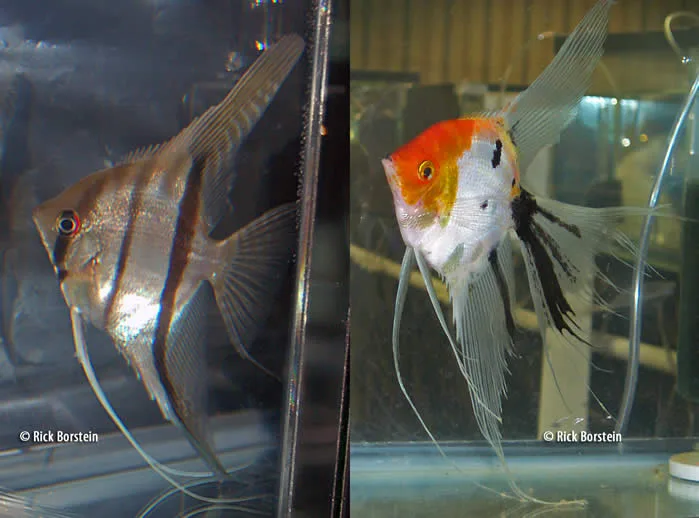
Pterophyllum scalare is built for a life among branches. The body is strongly compressed and nearly circular in profile, with the dorsal and anal fins drawn into long triangular sails whose spines and leading soft rays lengthen toward the rear, completed by a large fan-shaped tail. Stretched fin-tip to fin-tip, a mature fish is taller than it is long. Wild fish are silvery with four to seven dark vertical bars — juveniles carry more, adults fewer — and threadlike pelvic fins that hang below the body like a pair of feelers. The barred pattern and disc shape break up the outline so effectively that, as the Cichlid Room Companion's Juan Miguel Artigas Azas recounts from snorkeling Brazil's Rio Branco drainage, a group of twenty adults can sit among submerged branches almost unseen until they shift.
Reports of maximum size vary. FishBase lists a maximum of about 4 in (4 in) total length, while older accounts and the hobby literature cite around 6 in (6 in) TL; either way, height is the more striking dimension. AMAZONAS (Nov/Dec 2021) puts a typical body diameter at about 3 in (3 in) but notes that, including the sail-like fins and large tail, true dimensions can approach 10 in (10 in) in height and 6 in (6 in) in length. Sexes are difficult to tell apart outside of breeding. Males may develop a slightly steeper forehead or small nuchal hump and tend to run a little larger, but, as experienced breeders caution, plenty of males lack a hump and some females show one — so the only reliable sex difference is the genital papilla (the "breeding tube") visible at spawning, blunt and broad in the egg-laying female. Pterophyllum scalare is separated from look-alikes by lacking the deep notch over the eye and the heavy opercular blotch of Pterophyllum altum, and from Pterophyllum leopoldi by its larger fin-ray and scale counts and the absence of leopoldi's dark saddle at the dorsal-fin base. True altum carries further tells worth knowing before buying a fish sold under that name: a brownish tinge to the body, and dorsal and anal fins that run much longer in proportion to body size than in scalare, on top of the head-profile notch already noted. The distinction matters commercially — a great many angelfish sold in the trade as "altum" are simply large-finned scalare of questionable identity, not the genuinely blackwater-restricted species.
Habitat
The freshwater angelfish ranges across much of the Amazon basin and a few neighboring drainages. FishBase and the Catalog of Fishes record it along the Ucayali, Solimões and Amazon main channels through Peru, Colombia and Brazil; in Amazonian right-bank rivers such as the Purus, Madeira and lower Xingu; north into the Rio Negro and Rio Branco; and beyond the basin into the Rio Oyapock of French Guiana and the Essequibo of Guyana. AMAZONAS (Nov/Dec 2021) gives the native countries as Brazil, Colombia, French Guiana, Guyana and Peru. The IUCN assessment puts its extent of occurrence at roughly 4.2 million km squared, spanning the Brazilian states of Acre, Amapá, Amazonas, Pará, Rondônia and Roraima as well as Colombia and Peru. Within that vast range, Pterophyllum scalare carries the bulk of the genus's distribution, overlapping Pterophyllum leopoldi between Manacapuru and Santarém and meeting Pterophyllum altum's territory only near the upper Rio Negro and Orinoco.
This is fundamentally a fish of slow water. Kullander (1986) recorded it in lake margins and sluggish streams, from bare to densely vegetated, regularly cluttered with fallen branches and leaf litter where the fish shelter; angelfish are also reported under the Amazon's floating meadows and, locally, around rocky cover. A prize-winning Río Nanay (Loreto, Peru) biotope documented in AMAZONAS (June 2024) captures the wild scene precisely: blackwater stained by tannins from fallen branches and leaves, pH about 6.0 and very soft (GH ~5 mg/L), about 79 F (26 C), where angelfish hang among submerged roots and broken branches on a sandy bottom alongside small characins and Corydoras. Because it occupies whitewater, blackwater and clearwater alike, the chemistry it tolerates in the wild is broad — field measurements summarized by Artigas Azas span pH from about 6.0 and very soft water up to around pH 7.6 and 13 dGH, though the softer, more acidic end is more typical. Seasonal flooding is central to its world: when the rivers rise from roughly November to March, inundated forest gives angelfish abundant submerged cover, and at low water they must crowd into whatever vegetation and structure remain.
Feeding
For a fish this familiar, Pterophyllum scalare's wild diet is genuinely under-documented — no dedicated field study of its natural feeding appears to exist, a gap Artigas Azas notes explicitly. What can be said is inferred from anatomy and habitat: a small, horizontally set mouth, fine teeth, and a short gut point to a micropredator that takes small aquatic insects and their larvae (mosquito larvae among them) and zooplankton, very likely supplemented by some algae and detritus. AMAZONAS (Nov/Dec 2021) describes wild angelfish in swamps and flooded, densely vegetated areas seeking out small aquatic crustaceans, insect larvae and tiny fishes. FishBase places the species at a trophic level near 3.6, consistent with a largely carnivorous diet skewed toward small invertebrates rather than fish.
In captivity the feeding mechanics are easy to watch: angelfish hover and pick, taking small prey one at a time with a quick suction strike, and tear at larger items with sideways jerks of the head while gripping with the teeth. That deliberate, ambush-and-pick style fits a fish that earns its living drifting among branches in still water rather than chasing prey in the current. As a mid-water mesopredator in flooded-forest and floodplain-lake communities, the angelfish is itself prey for larger fishes and birds, and its cryptic banding is as much about not being eaten as about not being seen by what it eats.
Mating
Angelfish live in loose colonies and are, by cichlid standards, mild-mannered; their aggression is mostly ritualized posturing and only sharpens around the formation and defense of a breeding pair. A displaying fish tilts upward, swings its pectoral fins forward, and makes short rushes to ram, bite, or flank a rival, occasionally locking mouths and shoving before both fish disengage. This temperament has a sting in the tail in captivity: angelfish rarely kill outright, but a dominant fish can harass a subordinate into isolation, off its food, and eventually to death. That is why keepers stress holding them in groups of six or more, so aggression is diffused and pairs are free to sort themselves out.
They are monogamous and form lasting male/female pairs. Pair formation is mediated partly by chemical cues, and accounts differ on who courts whom — in Artigas Azas's experience and several cited studies, females approach the male's territory and are rammed before being accepted. As AMAZONAS (Nov/Dec 2021) notes, the sexes are notoriously hard to distinguish until a pair has actually begun spawning. Once bonded, a pair separates itself from any group, claims a territory, and selects a vertical or strongly slanted surface — a flooded leaf near the surface in the wild, a broad plant leaf, driftwood, or pane of glass in captivity. Both fish then spend a few days cleaning that surface with their mouths, the ritual that immediately precedes the spawn.
Breeding
Pterophyllum scalare is a biparental substrate spawner that lays adhesive eggs on a cleaned vertical or slanted surface. In the wild, pairs spawn at the onset of the rains on the leaves of flooded terrestrial plants near the surface, where leaf cover is suddenly abundant, and the tannin-stained, low-pH water of the flooded forest favors successful spawning. After the surface is prepared, the female lays rows of roughly ten eggs at a time, the male following closely to fertilize, with a full spawn of a few hundred eggs — early angelfish reproductive studies report about 250 to 650 — deposited over an hour or two.
Care is shared and thorough. Both parents fan and mouth the clutch to keep it oxygenated and clean, pick off eggs that fungus over, and become markedly more aggressive in defending the nest. Eggs hatch in roughly 48 to 60 hours at 79 to 86 F (26 to 30 C); the parents move the wrigglers repeatedly among prepared sites and catch strays in their mouths, and the fry go free-swimming a few days later. Wild breeding success is low — early reproductive studies reported only about one spawn in nine reaching a guarding stage. Hobbyist breeders corroborate the broad picture, reporting hatch on day three or four and free-swimming around day eight or nine, with spawns commonly in the tens rather than hundreds when fish are young; AMAZONAS (Nov/Dec 2021) adds that a healthy pair may spawn as often as twice a month. Domesticated stock, however, are not always reliable parents — many eat their eggs or fry — so breeders often pull the spawning substrate and raise the fry artificially on newly hatched brine shrimp.
In the aquarium
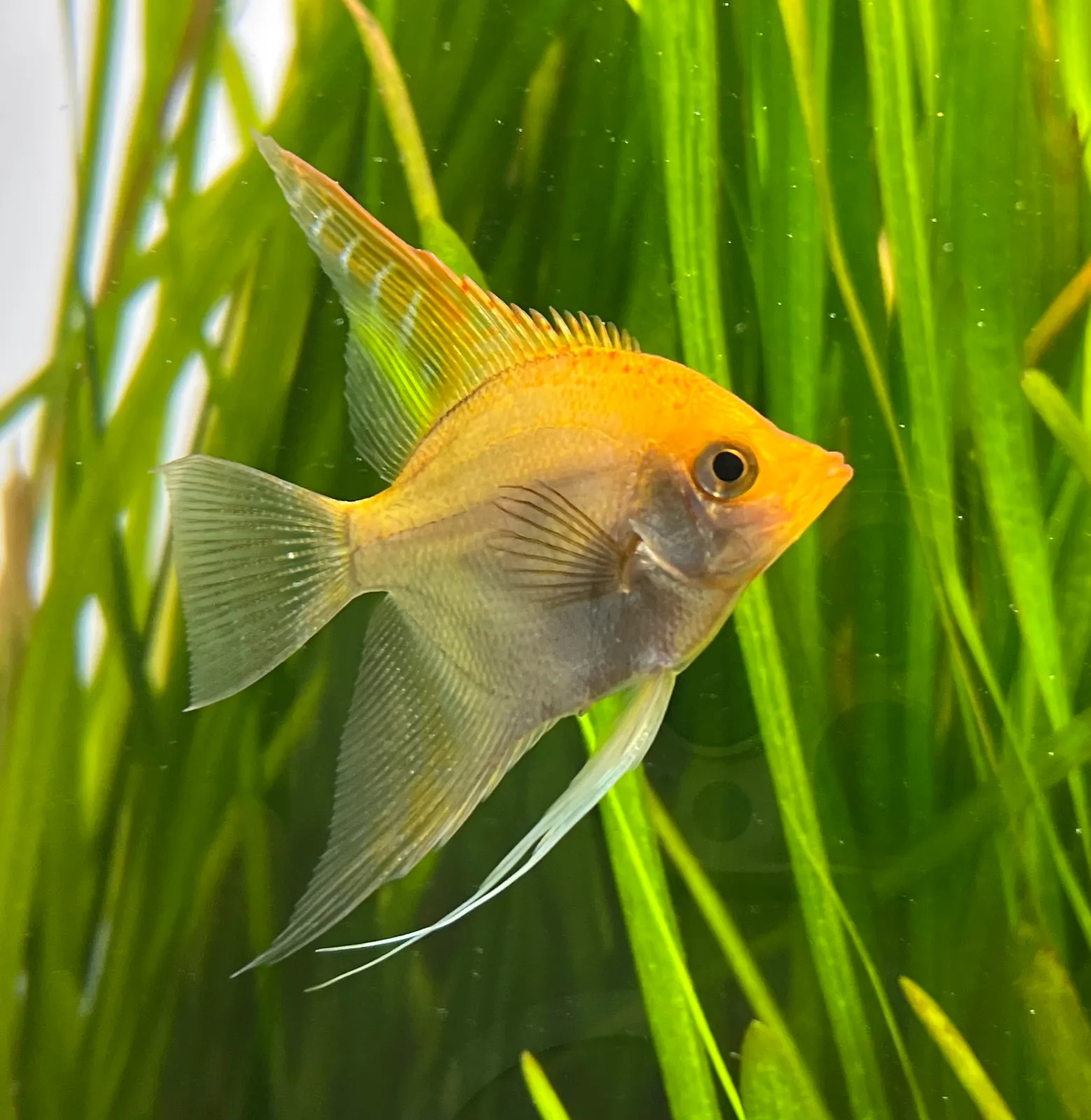
The angelfish has been a hobby fixture since it reached Germany around 1911, and generations of selective breeding have produced veil, koi, marble, gold, pinoy and many other strains far removed in look from wild fish; the December 2024 AMAZONAS even reports the debut of a GloFish (fluorescent) angelfish line. None of that changes the basic requirement set by the body: this is a tall fish that needs a tall tank.
Tank: AMAZONAS (Nov/Dec 2021) recommends a 55- or 75-gallon (60–80 US gal) aquarium — both 48 in long and 21 in high (122 x 21 in) — for a community group of six or more, started as a group precisely to diffuse aggression and encourage shoaling. Breeders commonly isolate a mated pair in a smaller but still tall tank such as a "20 high" (24 x 16 x 12 in / 61 x 41 x 12 in) with little more than a spawning surface. Give them a covered, well-planted setup with tall leafy plants, vertical driftwood and floating cover — they are slow, fin-trailing, sometimes shy fish that jump when startled.
Water: chemistry is forgiving for the common farmed strains, which descend from adaptable lowland stock. FishBase brackets the species at pH 6.0 to 8.0 and 5 to 13 dGH, 75 to 86 F (24 to 30 C), and AMAZONAS recommends an acidic to near-neutral pH of 6.0 to 7.4, soft water, and 76 to 82 F (24 to 28 C), noting angelfish tolerate brief spells above 86 F (30 C) better than most aquarium fish. They benefit from clean, low-waste water and regular partial changes of 20 to 50 percent weekly. The blackwater Pterophyllum altum and some wild Rio Negro angelfish are far fussier, and are not the fish most people are keeping.
Tankmates: angelfish will eat anything small enough to fit, so neon-sized tetras and dwarf shrimp are at risk, while fin-nippers and boisterous tankmates damage their trailing fins or keep them from holding territory. Peaceful tetras in good-sized shoals and Corydoras catfish are the classic companions.
Common mistakes: the honest cautions are about temperament and fragility, not parameters. Keep them warm — much below 73 F (23 C), angelfish become notably more prone to parasitic disease.
Conservation
Pterophyllum scalare is assessed by the IUCN Red List as Least Concern (assessment by Frederico, last assessed 20 November 2020, published 2023). The justification is simple and candid: there is little hard information on the species, but it is common, abundant and very widely distributed, with no evidence of severe threats, and its population trend is recorded as unknown. The Red List notes one clear pressure specific to it — heavy use in the international aquarium trade — but documents no quantified decline and lists no threats or conservation actions. CITES does not regulate the species. In short, this is a fish whose status is reassuring precisely because of its enormous range, not because anyone has studied it closely.
That status sits inside a basin under real but uneven strain. The Amazon's freshwater fishes are framed by the standard Neotropical references — Kullander's Cichlidae chapter in the Check List of the Freshwater Fishes of South and Central America (Reis, Kullander and Ferraris, 2003) and the older floodplain-ecology synthesis of Lowe-McConnell — and most lowland cichlids are Least Concern or simply Not Evaluated, facing collection and habitat change rather than collapse. For Pterophyllum scalare, a fish of white-, black- and clearwater floodplains and flooded forest, the relevant pressures are deforestation, the conversion and degradation of the seasonally flooded forest its breeding depends on, and shifts in the flood pulse — more than the targeted fishing that endangers some range-restricted species. Ornamental collection, often cast as the obvious threat, is in places a conservation positive: along the Rio Negro the wild-caught angelfish and cardinal-tetra fishery documented by Chao and supported by Project Piaba gives riverside communities an economic reason to keep the forest standing rather than clear it. The fair summary is that Pterophyllum scalare itself is secure and abundant across a basin-sized range, even as parts of that basin face genuine habitat pressure, and the fish's main entanglement with people — the aquarium trade — is as much a force for keeping its habitat intact as a drain on it.