Taxonomy & naming
Johann Jakob Heckel, the Austrian ichthyologist, described the saddle cichlid in 1840 as Acara tetramerus from material collected in the Rio Branco of northern Brazil; the surviving syntypes (NMW 33757-58) sit in the Naturhistorisches Museum Wien and were catalogued by Sven Kullander in 1986. When Carl H. Eigenmann and William Bray erected the genus Aequidens in 1894 — at first as a subgenus of Astronotus — they built it around this fish, so tetramerus is the type species; the name nods to its even, equal-sized teeth, set against the enlarged front teeth of Astronotus. Several later names have fallen into synonymy, among them Chromys uniocellata Castelnau 1855, Aequidens stollei Miranda Ribeiro 1918, and Acaronia trimaculata Allen 1942, and the fish has been redescribed repeatedly as workers ground through Amazonian material — by Kullander (1986) for Peru, Kullander & Nijssen (1989) for Surinam, and again in Kullander's 2003 South American checklist. Two layers of trouble sit on top of it. First, the genus once held a much larger assemblage and has been steadily dismembered, with Andinoacara, Bujurquina, Krobia, Cleithracara, and Laetacara all split out (Kullander 1998 and later), and the residue is still awkward: Musilová, Říčan & Novák (2009) recovered the 'tetramerus group' as sister to Cichlasoma and went so far as to recommend sinking Aequidens into Cichlasoma, while López-Fernández, Winemiller & Honeycutt (2010) instead found the diadema and tetramerus groups forming a plausibly monophyletic unit — both camps agree more work is needed. Second, and closer to home, Aequidens tetramerus as recognised today is widely read as a species complex rather than one taxon, which is why field workers already tag it 'gr. tetramerus' in faunal lists.
Morphology
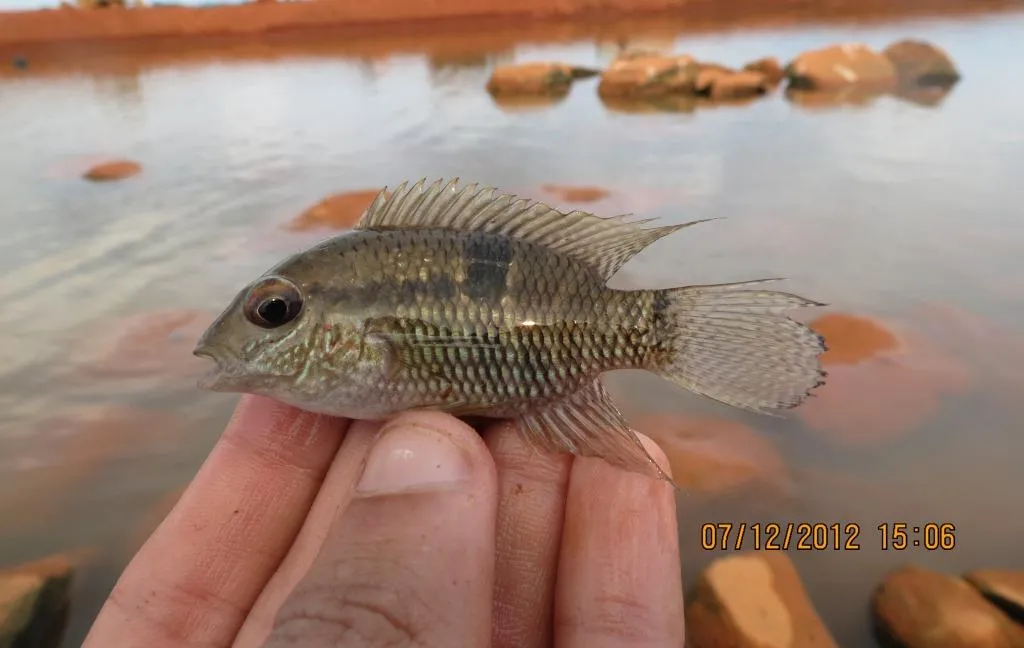
Aequidens tetramerus is a stocky, laterally compressed acara with the deep body and gently sloping head typical of the genus. Reported maximum size shifts with the source and with how length is measured: FishBase lists 7.5 in total length — with an older museum figure of up to about 10 in TL and a recorded weight near 157 g — while Seriously Fish gives the largest reliably documented specimen as 6.5 in standard length. Most aquarium fish settle around 6 in. The name comes from the scales: tetra ('four') and meros ('part') point to the four distinct rows running slantwise across the cheek, one more than the three rows of its relative Aequidens viridis, and a genuinely diagnostic count. The ground colour is grey to olive or brassy, broken by faint vertical bars and iridescent blue-green flecking, with a dark lateral blotch and the dark caudal-peduncle 'saddle' that gives the fish its English name. Colour is also where the species turns vivid and confusing at once, appearing in many locality-based forms: fish from Ecuador develop red and those from Peru orange on the lower jaw, head, and forward belly, while Brazilian populations lean toward overall grey-blue-green — part of the reason the fish is suspected to be a complex. Sexual dimorphism is modest but real. Males grow larger, develop trailing extensions on the dorsal and anal fins as they mature, and colour up strongly in breeding condition; ripe females are rounder-bodied, and the fish is at its brightest while spawning.
Habitat
Few Neotropical cichlids range as widely. Aequidens tetramerus runs through the Amazon basin in Peru, Colombia, Ecuador, Brazil, and Bolivia; through the Tocantins and the coastal Parnaíba of northern Brazil; across French Guiana, Suriname, and Guyana; and into the Orinoco basin of Venezuela and Colombia. It is, in effect, a habitat generalist — much of the reason for that reach. It favours slow-moving or still water over well-structured bottoms of submerged tree roots, fallen branches, and leaf litter, and moves readily into seasonally flooded forest and grassland, floodplain lakes, and oxbows as waters rise. Quieter tributaries and creeks suit it better than the main river channels, and at some sites it lives among dense aquatic plants and the floating rafts of vegetation that gather on floodplain rivers. The water may be blackwater, clearwater, or whitewater, though black and clear water seem to be preferred. Its chemistry tolerance is correspondingly broad: Kullander & Nijssen (1989) report pH from about 4.5 to 7.5, hardness from roughly 1 to 13.5 dGH, and temperatures around 75–79 °F, with blackwater-collected fish apparently needing acidic conditions. In a tributary of the lower Rio Madeira in Rondônia, Brazil, it has been recorded alongside a long roster of other fishes — from Cichla and Crenicichla to characins and large catfishes — a routine member of a species-rich lowland community.
Feeding
The saddle cichlid is an omnivore that leans hard toward animal prey. FishBase places it near trophic level 3.2 and sums up its diet as primarily insects, secondarily fishes and plant material, and stomach analyses of wild fish agree: invertebrates dominate, topped up with small fish and vegetable matter. It works the cluttered, low-current zones it favours as an opportunistic mid-sized predator, going over submerged wood, roots, and leaf litter for aquatic insect larvae and other invertebrates and taking small fishes when it can. Like most acaras it is an adaptable feeder rather than a specialist — a good fit for its generalist habits, and part of how it gets by across so many drainages and water types. In the tank it accepts sinking dry foods, frozen and live bloodworm, brine shrimp, and most prepared diets without fuss. Within the community it fills the marginal and floodplain habitats as a generalist invertivore that also takes small fish, not a sand-sifter or a dedicated piscivore.
Mating
Aequidens tetramerus is a territorial fish that turns markedly more aggressive as it comes into spawning condition, and its social life revolves around holding and defending a breeding territory. The reliable route to a compatible pair, well known to aquarists, mirrors how pairs likely sort themselves in the wild: raise a group of youngsters together and let a pair form by mutual choice, then remove the rest, because the bonded pair will not tolerate them. Males are the more territorial sex, especially when spawning, and small tankmates may simply be eaten. As the pair settles, the male — larger, his fin extensions and breeding colours at their most intense — and the rounder female stake out and guard a territory centred on a chosen spawning surface. Aggression among unpaired or mismatched fish can be severe, so space and broken sightlines matter; in the wild the same drive plays out across the abundant cover of root tangles and flooded margins. Courtship deepens the fish's already strong colour, which is why breeding adults are the best-looking specimens you will see.
Breeding
Aequidens tetramerus is a biparental, open substrate spawner — the classic acara mode, and by aquarium standards a fairly easy one to reproduce. The pair cleans a firm surface, usually a flat or water-worn rock or a piece of submerged wood (in the wild, whichever stone or wood is at hand), and the female lays her eggs on it in the open rather than in a cave or burrow. Clutches are large: FishBase reports a minimum of about 1,000 eggs per spawning, and aquarium accounts likewise describe roughly a thousand eggs on rock or wood. Both parents tend the brood, guarding and fanning the eggs and then shepherding and defending the free-swimming fry — the cooperative habit of the substrate-brooding acaras. Success in captivity is dependable enough that the standard advice is simply to grow on six or more young fish, let a pair form, and give them stable, clean water and a spawning surface; the fish handle the rest. Keep that water quality steady throughout, since the species reacts badly to deteriorating conditions. Wild breeding has not been documented in the detail of some relatives, but everything known fits seasonal, cover-associated open spawning in the quiet floodplain and tributary habitats it prefers.
In the aquarium
Aequidens tetramerus is among the more forgiving cichlids a keeper can pick — adaptable to a wide range of water, undemanding at the food bowl, and willing to breed without fuss — but its size and territorial streak demand respect. Tank: a single adult or settled pair needs at least about 48 in of base length; 59 in or more is better, and becomes essential once a pair is guarding a clutch and defending every centimetre of it. Use sand or fine gravel — the fish roots through the bottom but does not bulldoze constantly the way some Central American cichlids do — and break the tank up with large driftwood, smooth river stones, and robust or artificial plants to make sight-breaks and multiple territories, leaving one open sandy patch near the centre where the pair will spawn. Filtration should be robust, because these are messy feeders and water quality matters more than water chemistry. Water: anywhere in the 75–81 °F band suits all populations; pH can sit in the 6.0-7.5 range for most captive-bred stock, while wild fish from blackwater drainages often settle better toward the acid end (pH 6.0-6.8), and hardness is a non-issue, with fish from across the continent sharing a range of roughly 1-13 °dGH. Food: it takes virtually any meaty food — sinking cichlid pellets, frozen and live bloodworm, chopped earthworm, white mosquito larvae, and the occasional feeder fish — and live or frozen invertebrates a couple of times a week bring it into best condition and colour. Tankmates: do not house it with anything small enough to swallow, since it is an opportunistic piscivore that will take small tetras or rasboras without hesitation; robust, similarly sized cichlids (other medium acaras, severums, Geophagus) can work given space and broken sightlines, but a pair in full breeding mode will try to kill anything in the tank, whatever its size. The simplest setup usually works best: a dedicated pair, perhaps with dithers such as large barbs or silver dollars up at the surface, in a spacious single-species tank. Common mistakes: the fish is hardy and shrugs off minor lapses, which earns it a beginner-friendly rating — with one caveat, that the owner has to be ready for a large, aggressive cichlid rather than treat it as a community fish.
Conservation
The IUCN Red List assesses Aequidens tetramerus as Least Concern, assessed on 28 October 2020 by Renata Guimarães Frederico, on the strength of its enormous range across the Amazon and Orinoco basins and the rivers of the Guianas and its standing as a common, adaptable habitat generalist. It carries no CITES or CMS listing and is considered harmless. Human use is modest: it supports minor commercial fishing in parts of its range and a commercial ornamental trade, with popular regional colour forms — notably the red Ecuadorian and orange Peruvian fish — entering the hobby, and at least some trade stock is now captive-bred. None of that registers as a population-level threat for so widespread a fish. The real caution is taxonomic rather than ecological: because the name almost certainly covers a complex of populations, a single 'Least Concern' verdict may mask narrower-range lineages that would warrant their own assessments if they were formally described. Set against that is the broad, accelerating pressure on Amazonian freshwaters — damming, deforestation, mining and its mercury load, altered flood pulses — which threatens the basin's many narrow endemics far more than it does this resilient, near-ubiquitous acara.