Taxonomy & naming
The fissi was first described in 1930 by the Austrian zoologist Maximilian Holly, in his 'Synopsis der Süsswasserfische Kameruns,' as Tilapia caroli. Holly worked from preserved Cameroonian material rather than from life, and as was common for the period his account gave no etymology for the epithet. The species was later moved to the genus Sarotherodon, the lineage of African mouthbrooding tilapias in which the male — or both parents — carries the eggs and young in the mouth, separating it from the maternal-only Oreochromis and the substrate-spawning Tilapia in the strict sense. Within the modern classification it sits in the tribe Oreochromini of the subfamily Pseudocrenilabrinae. Four species of Sarotherodon are endemic to Lake Barombi Mbo — caroli, linnellii, lohbergeri and steinbachi — and together with the endemic genera Konia, Myaka, Pungu and Stomatepia they form the lake's celebrated cichlid flock. The landmark study of that flock, by Ethelwynn Trewavas, J. Green and S.A. Corbet (1972), confirmed that the Barombi Mbo cichlids evolved in situ from two or three ancestral colonisations and partitioned the lake's resources among themselves — work that made the crater the textbook case of sympatric speciation. Sarotherodon caroli is the species the Barombi people call 'fissi'; the name 'kippe' and other vernacular labels recorded in the early literature attach to the lake's other Sarotherodon.
Morphology
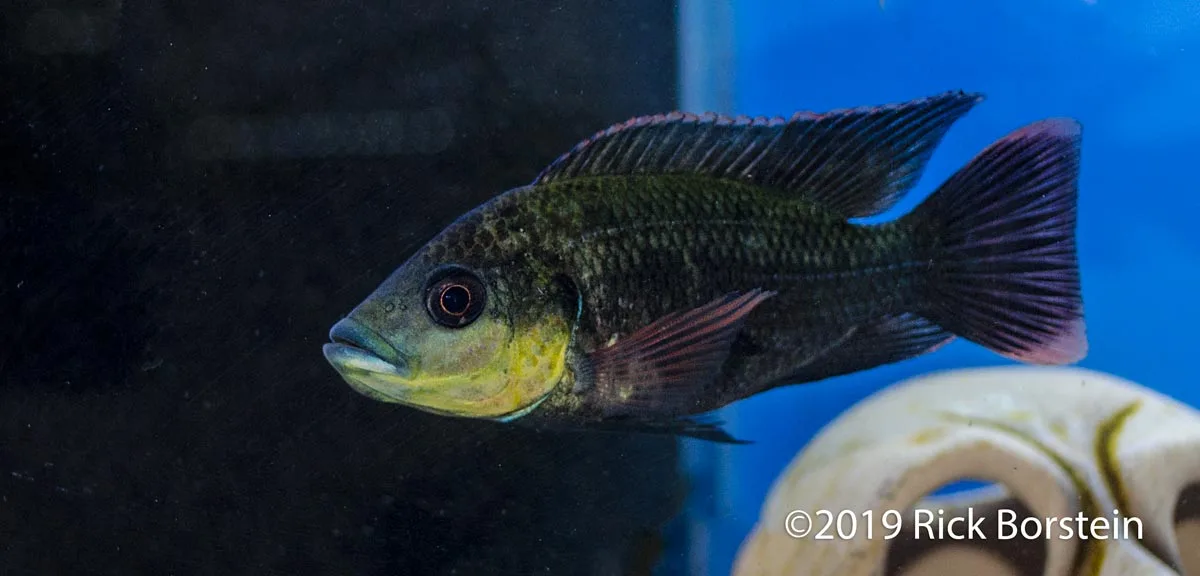
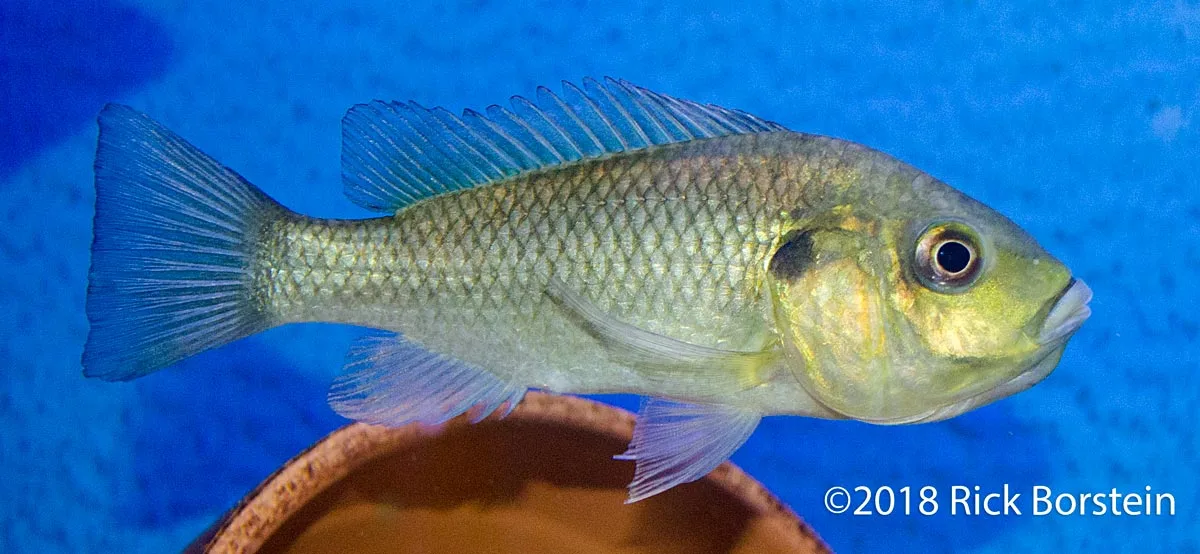
Sarotherodon caroli is a short, deep-bodied cichlid reaching about 7.5 in in standard length, the largest size on record, though most fish are smaller. The fin counts are typical of the genus: 15 to 16 dorsal spines followed by 10 to 12 soft rays, three anal spines and 9 to 11 soft anal rays, and 29 to 30 vertebrae. Diagnostically it carries 17 to 20 gill rakers on the lower limb of the first arch, 30 to 32 scales along the lateral line, and a head that is long relative to the body (39 to 48 percent of standard length). The lower pharyngeal jaw — the fused throat bone whose tooth pad does the real food processing in cichlids — is comparatively small, its toothed area contained two to three times in the length of the ventral keel, a feature that helps separate it from its larger-jawed lakemates. Colour is unremarkable and the chief field difficulty in telling the Barombi Sarotherodon apart: the body is a plain dull grey, and breeding or spent males take on diffuse black or grey smudges rather than any bright nuptial dress. Crucially, fish of about 2.5 in and larger lack the dark 'tilapia mark' (the blotch in the rear of the dorsal fin that many young tilapias show), which aids identification. The species shows little sexual dichromatism even when reproductively active, so the sexes are not reliably told apart by colour.
Habitat
Sarotherodon caroli is endemic to Lake Barombi Mbo and occurs nowhere else. The lake is a roughly circular volcanic crater (maar) lake near Kumba in southwestern Cameroon, sitting at about 988 ft altitude with a surface area near 415 hectares — only about four square kilometres — and a maximum depth of around 361 ft, drained by a single small outlet, the Kumba (Mungo) River. Two features of the lake dominate the ecology of every fish in it. First, it is permanently stratified: the deep water is anoxic, with essentially no dissolved oxygen below about 66 ft, so the entire fish community is restricted to the thin, sunlit, oxygenated upper layer over a lake bed that is otherwise uninhabitable. Second, the cichlids partition that habitable shell among themselves. Nine of the eleven endemic cichlids, Sarotherodon caroli among them, are commonly found together in the shallow littoral zone, while only two lakemates (Konia dikume and Myaka myaka) have pushed down toward the deeper, oxygen-poor water. Within the littoral, Sarotherodon caroli is the flock's open-water grazer, feeding in midwater rather than off the bottom. The water is warm and near-neutral to mildly alkaline tropical crater-lake water; captive maintenance of the species succeeds at roughly 86–91 °F and pH 7.0 to 8.0, consistent with the warm, soft-to-moderately-mineralised conditions of the lake.
Feeding
Sarotherodon caroli is the planktivore of the Barombi Mbo flock. Adults feed predominantly on phytoplankton — the suspended algae of the open water — which they filter and graze from midwater, a niche that sets them apart from lakemates specialised on bottom detritus, sponges, insects or the blood-red deep-water chironomid larvae that Konia dikume exploits. The young are more carnivorous than the adults, taking small animal prey before shifting to the plant-plankton diet as they grow, a common ontogenetic change in tilapias. This low, herbivorous trophic position (FishBase places the species near the base of the food web at a trophic level of about 2.0) is exactly what Trewavas, Green and Corbet documented as the basis of resource partitioning in the lake: by dividing the available foods — plankton, detritus, benthos, insects — among the endemic species, the flock minimised competition and allowed many cichlids to coexist in a single tiny lake. In that community Sarotherodon caroli is the link that converts open-water algal production into fish.
Mating
Sarotherodon caroli forms temporary, monogamous pair bonds for breeding rather than the leks or harems of many other African cichlids. A pair establishes and jointly defends a shared territory in the period leading up to spawning — observations in captivity put this at roughly a week of paired territory defence before eggs are laid. Because the species lacks marked sexual dichromatism even when sexually active, courtship and pair formation do not turn on the kind of bright nuptial colour signalling seen in many rift-lake mouthbrooders; mate choice and pairing instead appear to run on behaviour, body size and territory quality. Experimental work on female mate choice in the species has treated it explicitly as a test case for defining monogamy in cichlids, since larger brooding females can carry more eggs and pair stability is sensitive to the loss of a clutch or the arrival of a rival. The pre-spawning system is therefore best described as a short-term defended pair bond, a relatively unusual arrangement among the otherwise polygamous mouthbrooding tilapias.
Breeding
Like all Sarotherodon, Sarotherodon caroli is a mouthbrooder: after the eggs are laid and fertilised they are taken up into the buccal cavity of a parent and incubated there, sheltered from predators, until the young are free-swimming. The eggs are notably large — a hallmark of the genus, where heavy parental investment in a few big, well-provisioned eggs replaces the many small eggs of substrate-spawning tilapias. A genuine and honest gap remains in the record: it is not known with certainty which parent broods in this species. The genus Sarotherodon includes paternal and biparental mouthbrooders (in contrast to the maternal-only Oreochromis), and given the temporary monogamous pair bond the species forms, paternal or shared incubation is plausible, but the field observations to settle it have not been made. Specific wild clutch sizes for Sarotherodon caroli have likewise not been published; the dependable, sourceable statement is the genus-typical one — a small number of large eggs relative to body size, incubated orally to an advanced stage. After release the young of mouthbrooding tilapias are typically able to dart back into the parent's mouth when threatened during an early guarding phase.
In the aquarium
Sarotherodon caroli is essentially never seen in the general aquarium hobby. It is a single-lake endemic of no commercial ornamental value, and what captive populations exist are research colonies (such as those used in mate-choice studies) and the holdings of a few specialist keepers of West African crater-lake cichlids; the species is not a trade fish, and it would be irresponsible to present it as a casual aquarium subject when wild stocks are Critically Endangered.
Where it has been kept, the husbandry mirrors the lake. The recorded laboratory conditions are warm — about 86–91 °F — at pH 7.0 to 8.0, which fits a warm, near-neutral to mildly alkaline crater lake; a heater capable of holding the upper twenties to low thirties Celsius is therefore essential, as this is not a fish for an unheated or cool tank. Diet is the other defining constraint: this is a phytoplankton grazer, so a vegetable-forward menu (spirulina-based foods, quality herbivore flake and pellet, with only modest animal supplements such as enriched brine shrimp) suits it far better than a meat-heavy regime, and over-feeding protein invites the digestive problems that plague herbivorous tilapias. Like other tilapias it is hardy and adaptable in captivity, and as a deep-bodied fish approaching 7 in it needs a long, roomy tank with open swimming water rather than a heavily decorated one.
Socially it forms temporary monogamous pairs and defends a spawning territory, so a breeding setup needs space for a pair to hold ground without the whole tank becoming a battleground; mixing it with the other Barombi Sarotherodon risks hybridisation and is best avoided. In short: a hardy, undemanding fish to maintain, but a conservation-sensitive endemic rather than a hobby staple, and one whose value lies in dedicated, record-keeping captive husbandry rather than in the trade.
Conservation
The IUCN Red List assesses Sarotherodon caroli as Critically Endangered (criteria B1ab(iii)+2ab(iii)), assessed by T. Moelants on 16 February 2009 and published in the 2010 assessment, with population trend unknown. The rationale is geographic: the species exists in one location, a crater lake of only about seven square kilometres of catchment-bounded habitat, so any single basin-wide event can threaten the whole population. The dominant pressures are land-use changes on the crater rim — oil-palm and cocoa plantations and slash-and-burn agriculture — which drive sedimentation, pesticide runoff and pollution into the lake, compounded by deforestation of the surrounding slopes and by water abstraction to supply the growing town of Kumba. Two further, distinctively crater-lake threats hang over Barombi Mbo. Because the lake is permanently stratified with an anoxic, organic-rich, gas-charged deep layer, there is a real risk of a limnic overturn: a 'burp' of carbon dioxide of the kind that killed thousands at nearby Lake Nyos, and the related danger that rim deforestation lets stronger winds mix the deadly bottom water up into the living surface layer, crashing oxygen and killing the fish. Proposals to develop the area for tourism add to the concern. Lake Barombi Mbo is a recognised conservation priority (it falls within the Western Equatorial Crater Lakes freshwater ecoregion and is a designated wetland of importance), but protection on the ground remains the limiting factor for this and the rest of its irreplaceable endemic flock.