Taxonomy & naming
The blackfin tilapia was named by the Swedish zoologist Einar Lönnberg in 1903 as Tilapia (Gephyrochromis) linnellii, from specimens collected at "Elephant Lake" — an early European name for Lake Barombi Mbo — northeast of Mount Cameroon. Lönnberg worked from a small series of syntypes now split between the Natural History Museum in London, the Swedish Museum of Natural History in Stockholm, and the Uppsala zoological museum. The species was later transferred to Sarotherodon, the genus of African paternal and biparental mouthbrooding tilapias, a placement formalized by Ethelwynn Trewavas, whose 1962 and 1972 studies of the northwestern Cameroon crater lakes and her 1983 monograph on the tilapiine cichlids remain the foundation for everything known about the Barombi Mbo fishes. Within the lake, molecular and AFLP work by Schliewen and colleagues recovered linnellii as part of a pelagic, open-water pair with its close relative Sarotherodon caroli — so similar that the two are most reliably separated by breeding-male colour and habitat, golden inshore males being linnellii and black deepwater males caroli. Their analyses confirmed the celebrated conclusion that the entire Barombi Mbo cichlid assemblage — the several Sarotherodon plus the endemic genera Konia, Stomatepia, Pungu and Myaka — is essentially monophyletic, having radiated within the lake itself rather than colonizing it repeatedly. Sarotherodon linnellii is therefore one of the textbook examples of sympatric or near-sympatric speciation in a closed crater basin.
Morphology
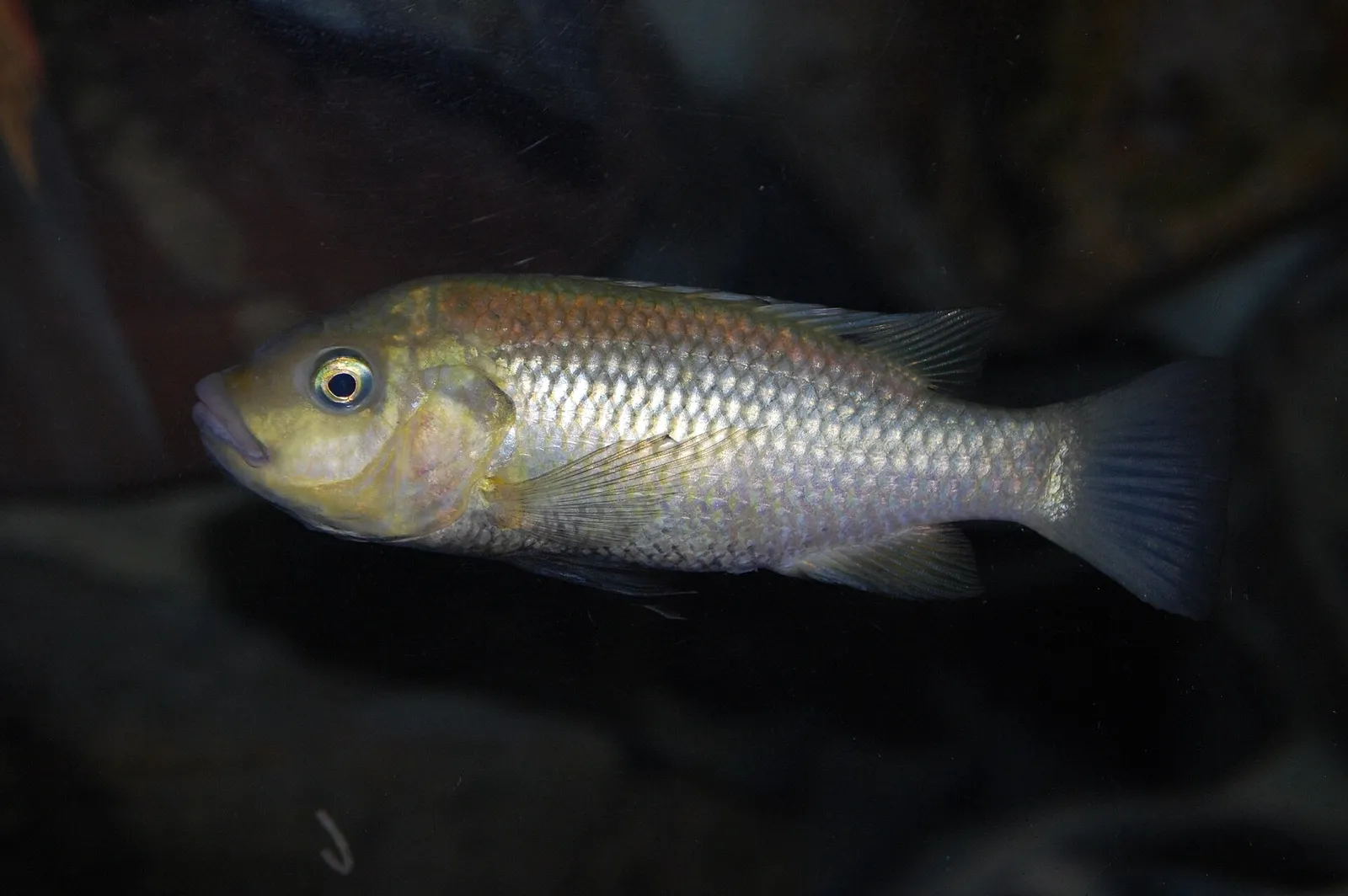
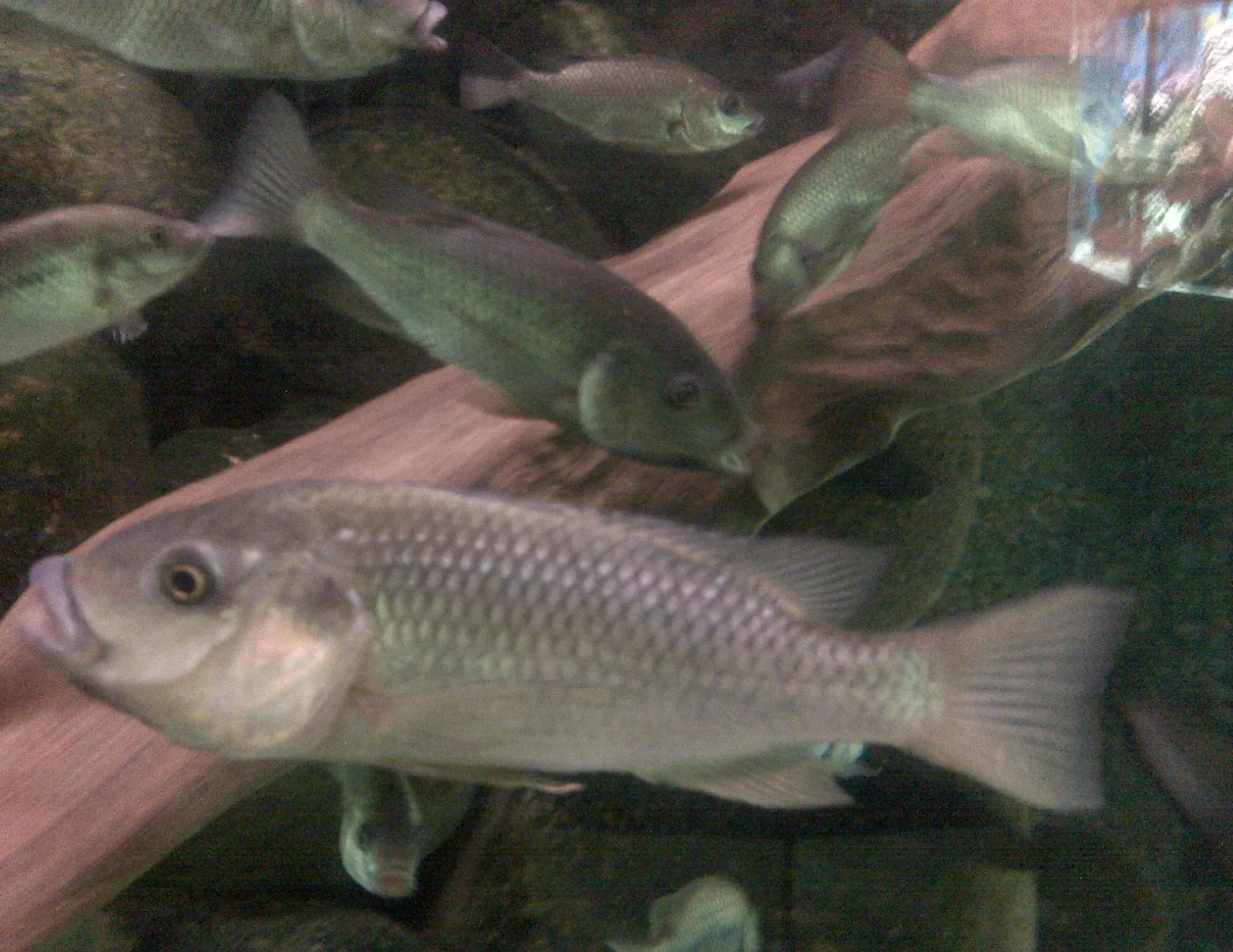
Sarotherodon linnellii is a short, deep-bodied tilapia that reaches about 7.5 in in standard length, making it the largest cichlid in Lake Barombi Mbo. The most distinctive feature is the head, which is large and grows proportionally heavier with age — its length runs roughly 37 to 45 percent of the standard length, giving big adults a blunt, bull-headed profile. The jaws carry very small teeth, fitting a fish that grazes fine suspended food rather than biting or scraping. Fin counts are typical of the genus: 14 to 16 dorsal spines and 10 to 12 soft rays, three anal spines and 8 to 11 soft rays, with 30 to 32 scales along the lateral line and 15 to 20 gill rakers on the lower limb of the first arch. Colour is muted and shifts with maturity. Juveniles and young fish carry the dark vertical "tilapia mark" on the rear flank, conspicuous up to about 4 in and gone above roughly 6 in. As the gonads ripen the lower head and flanks take on a metallic green sheen; breeding males turn green, while brooding females are generally a plain silvery grey with neutral-coloured fins that may show some yellow in the pelvics. The overall impression is of a dark grey to greenish fish — hence the trade name blackfin tilapia. Sexual dichromatism is weak even at the height of the breeding season, so the sexes are not reliably told apart on colour alone.
Habitat
The entire world range of Sarotherodon linnellii is one lake. Barombi Mbo is a roughly circular maar — an explosion crater — about 1.6 mi in diameter with an open-water area near 1.5–1.9 mi², set at around 984 ft above sea level in southwestern Cameroon and drained only by a small, steep outlet that bars colonization from surrounding rivers. It is a deep lake for its size, with a mean depth near 226 ft and a maximum around 361 ft, and like many tropical crater lakes it is permanently stratified, its deep water anoxic, so fish life is confined to the oxygenated upper layer. Within that layer linnellii is an open-water species: it forms small, loose groups of fewer than ten fish over the pelagic zone, typically to a maximum depth of about 16 ft, and occasionally gathers into larger schools. It is mainly diurnal. Recorded surface-water temperatures in the lake sit in a warm, narrow band around 75–79 °F, with the chemistry of these volcanic Cameroonian crater lakes running from mildly acidic to mildly alkaline (roughly pH 6.5 to 8). The lake's small size, single-basin isolation and great depth-for-area are exactly the conditions that allowed an in-situ cichlid radiation — and exactly what makes every species in it, including this one, vulnerable to anything that perturbs the basin.
Feeding
Sarotherodon linnellii is the open-water grazer of the Barombi Mbo community, and its diet shifts with age. Trewavas and co-workers, who dissected guts during their ecological survey of the lake, found that juveniles take a high proportion of animal food — mayfly larvae and assorted terrestrial insects that fall onto the water — while adults feed predominantly on phytoplankton suspended in the upper water column. The small jaw teeth and the moderately numerous gill rakers suit a fish that gathers fine algal material rather than one that rasps surfaces or seizes prey. In the trophic economy of the lake, where the main foods are phytoplankton and organic debris, linnellii occupies the pelagic phytoplankton-feeding niche — a low trophic position, estimated near 2.6 — distinct from the inshore detritus-feeders, the deepwater specialists and the sponge-eating Pungu. This partitioning of a small, simple lake among a dozen closely related cichlids is the heart of why the Barombi Mbo flock is so studied: linnellii is the species that took the open water and the algae.
Mating
Like other Sarotherodon, Sarotherodon linnellii forms only a brief, temporary pair bond around spawning and holds no lasting territory through the rest of the year. When ready to breed, fish move from the open water toward the lake margins, and males construct shallow craters or pits in the sandy bottom that serve as spawning arenas. There the male courts a ripe female and the pair spawns over the pit. The bond does not outlast the act: there is no durable pairing afterward, and the parents separate once the eggs are taken up for brooding. This loose, lek-like crater-spawning at the shore — followed by mouthbrooding away from the nest — is the standard reproductive pattern for the inshore-spawning Sarotherodon of the lake, and it stands in contrast to the substrate-guarding, pair-bonding habits of the more distantly related Coptodon tilapias of the neighbouring crater lakes.
Breeding
Sarotherodon linnellii is a mouthbrooder, and its breeding biology is the trait that defines the whole genus: Sarotherodon are the African tilapias that incubate eggs and young in the mouth rather than guarding them on the substrate as Coptodon and Oreochromis-relatives do in different ways. After spawning in the male's sand crater the eggs are taken into the mouth and brooded through hatching and early larval development. Brooding in this species is carried out by both sexes but predominantly by the female — males are reported to incubate only infrequently — placing it between the strictly paternal mouthbrooders and the strictly maternal Oreochromis. Clutch size has not been precisely published for linnellii; Sarotherodon are relatively low-fecundity mouthbrooders, typically producing a few dozen to a few hundred comparatively large, yolky eggs per spawning, the small clutch being the trade-off for the protection that oral incubation gives each egg. Once the brood is released the young are independent and the temporary pair bond is over. There is no record of extended biparental fry-guarding beyond the mouthbrooding phase.
In the aquarium
Sarotherodon linnellii is not an ordinary aquarium-trade fish; it reaches keepers almost entirely through conservation-minded breeding programmes rather than commercial import. A small number of North American and European hobbyists and public aquaria — notably members of regional cichlid clubs running Barombi Mbo "ark" projects — have maintained it alongside the other endemics of the lake (Konia, Stomatepia, Pungu, Myaka), and it appears in hobbyist accounts of multi-species Barombi Mbo tanks. Anyone considering it should treat it as a species held in trust for a critically endangered fish, not a casual purchase.
The practical husbandry follows from the wild biology. This is a large, active, open-water tilapia that reaches nearly 7.5 in and needs a correspondingly big, long tank with open swimming room — on the order of 100 US gallons or more for a group, with a wide footprint rather than tall, decorated aquascaping. Water should be warm and near neutral, mirroring the lake: roughly 75–82 °F and pH about 6.5 to 8, kept clean and well oxygenated, since these crater-lake fish are adapted to a stable, well-buffered upper layer. A sand bottom lets males excavate the spawning craters they make in nature. As a phytoplankton grazer in the wild it does well on a vegetable-forward diet — spirulina and other algae-based prepared foods — supplemented with smaller live and frozen items, especially for growing juveniles, which are more insectivorous.
Socially it is a typical mouthbrooding tilapia: best kept in a group, with the usual seasonal flare-ups of male aggression around spawning, which a large tank and broken sightlines help diffuse. The honest difficulty is not day-to-day care but the conservation context — keeping a viable, genetically managed line of a fish that exists in a single threatened lake. Hobbyists working with the Barombi Mbo species consistently report that the hard part is moving offspring on to other dedicated keepers and avoiding inbreeding within tiny captive populations, rather than getting the adults to live and spawn.
Conservation
Sarotherodon linnellii is assessed by the IUCN Red List as Critically Endangered (criteria B1ab(iii)+2ab(iii)), assessed on 16 February 2009 by T. Moelants and published in the 2010 update; the population trend is recorded as unknown. The listing is driven entirely by the species' single-site endemism: a Lower Guinea endemic known only from Lake Barombi Mbo, its whole range is one small crater lake, so any deterioration of that one basin threatens the species globally. The assessment flags a familiar suite of pressures on the lake — residential and agricultural development and pollution in the catchment, aquaculture and biological resource use, natural system modification, and, ominously for a deep volcanic crater lake, geological events. Barombi Mbo's stratified structure stores vast amounts of dissolved gas at depth, and the catastrophic 1986 limnic eruption at nearby Lake Nyos is a stark reminder that Cameroon's crater lakes can overturn lethally. Local fishing, sedimentation and nutrient input from the surrounding farmland and lakeside settlement add chronic pressure. Because the entire Barombi Mbo cichlid flock — this fish, the other Sarotherodon, and the endemic genera Konia, Stomatepia, Pungu and Myaka — is confined to the same few square kilometres, it is collectively one of the most concentrated and irreplaceable assemblages of cichlid diversity anywhere, and the captive "ark" populations held by hobbyists and aquaria are a deliberate hedge against losing it.