Taxonomy & naming
The banded tilapia was described by the Scottish-born explorer and naturalist Sir Andrew Smith in 1840, in the fourth volume of his Illustrations of the Zoology of South Africa, from material collected in Namaqualand in streams north of the Orange River. Smith's account introduced both the species name and the genus Tilapia itself, making Tilapia sparrmanii the type species of one of the most consequential — and most contentious — genera in African ichthyology. A lectotype (BMNH 1859.5.7.85, a skin preserved in alcohol, now in the Natural History Museum, London) was later fixed by Seegers in 1996. Several names erected on regional populations have since fallen into synonymy, among them Tilapia fouloni Boulenger, 1905 from Lake Bangweulu, Tilapia deschauenseei Fowler, 1931 from the Botletle River in Botswana, Chromys moffatii Castelnau, 1861 from the Kuruman River, and Chromis ovalis Steindachner, 1866 from Angola — testimony to how variable and widely distributed the fish is.
For most of the twentieth century "Tilapia" was a sprawling catch-all genus holding well over a hundred species of African and Levantine cichlids. The molecular revision by Dunz and Schliewen in 2013 dismantled that assemblage, restricting Tilapia in the strict sense (sensu stricto) to a compact group of true substrate-spawning species built around its type, Tilapia sparrmanii, and parcelling the rest out to genera such as Coptodon, Coelotilapia, Heterotilapia, Pelmatolapia and the long-recognised mouthbrooders Oreochromis and Sarotherodon. The upshot is taxonomically pointed: the genus Tilapia now contains none of the familiar farmed "tilapia" of commerce (those are Oreochromis), and the banded tilapia is its defining member — a biparental substrate spawner, not a mouthbrooder. It sits within the cichlid subfamily Pseudocrenilabrinae, the great African radiation.
Morphology
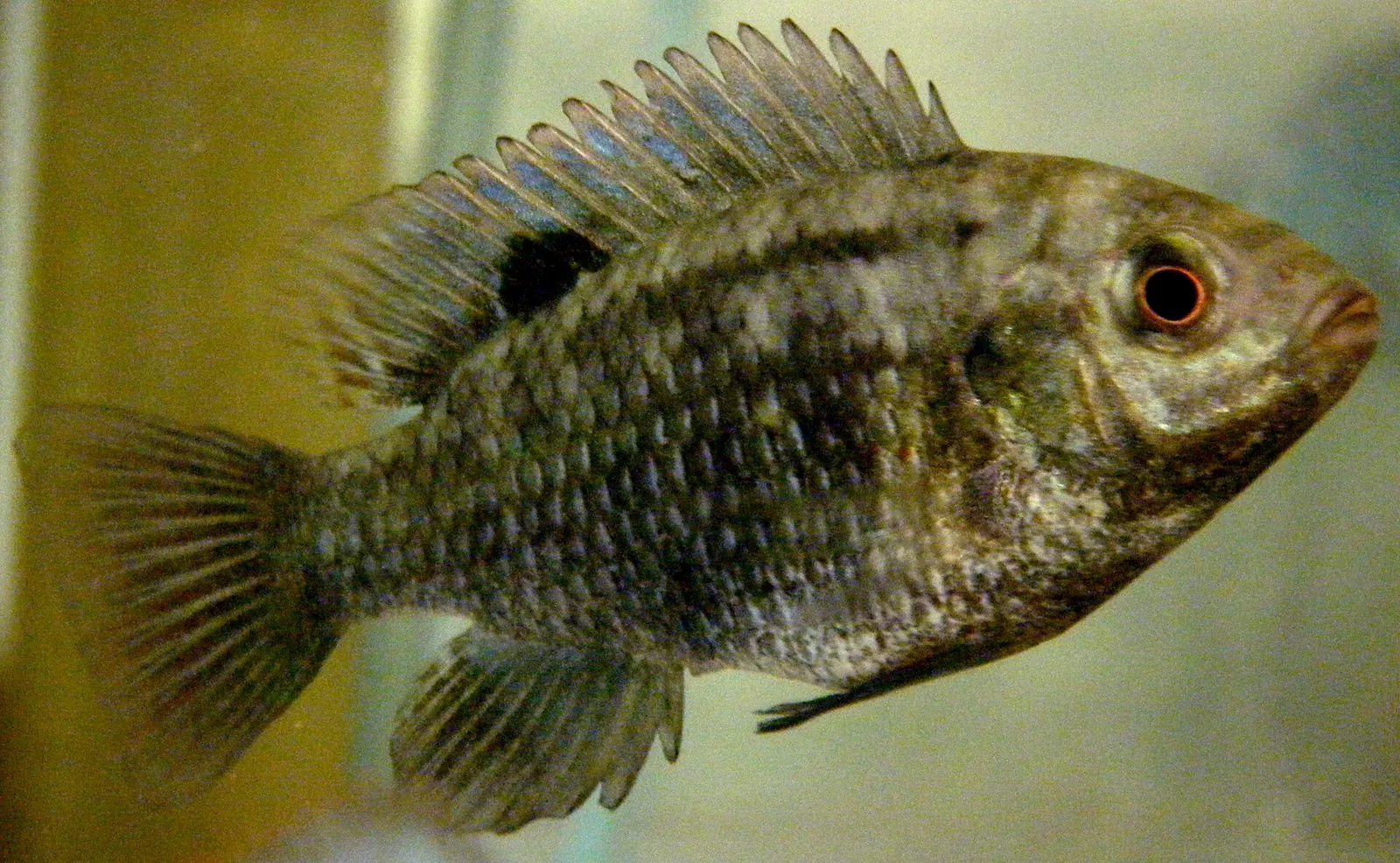
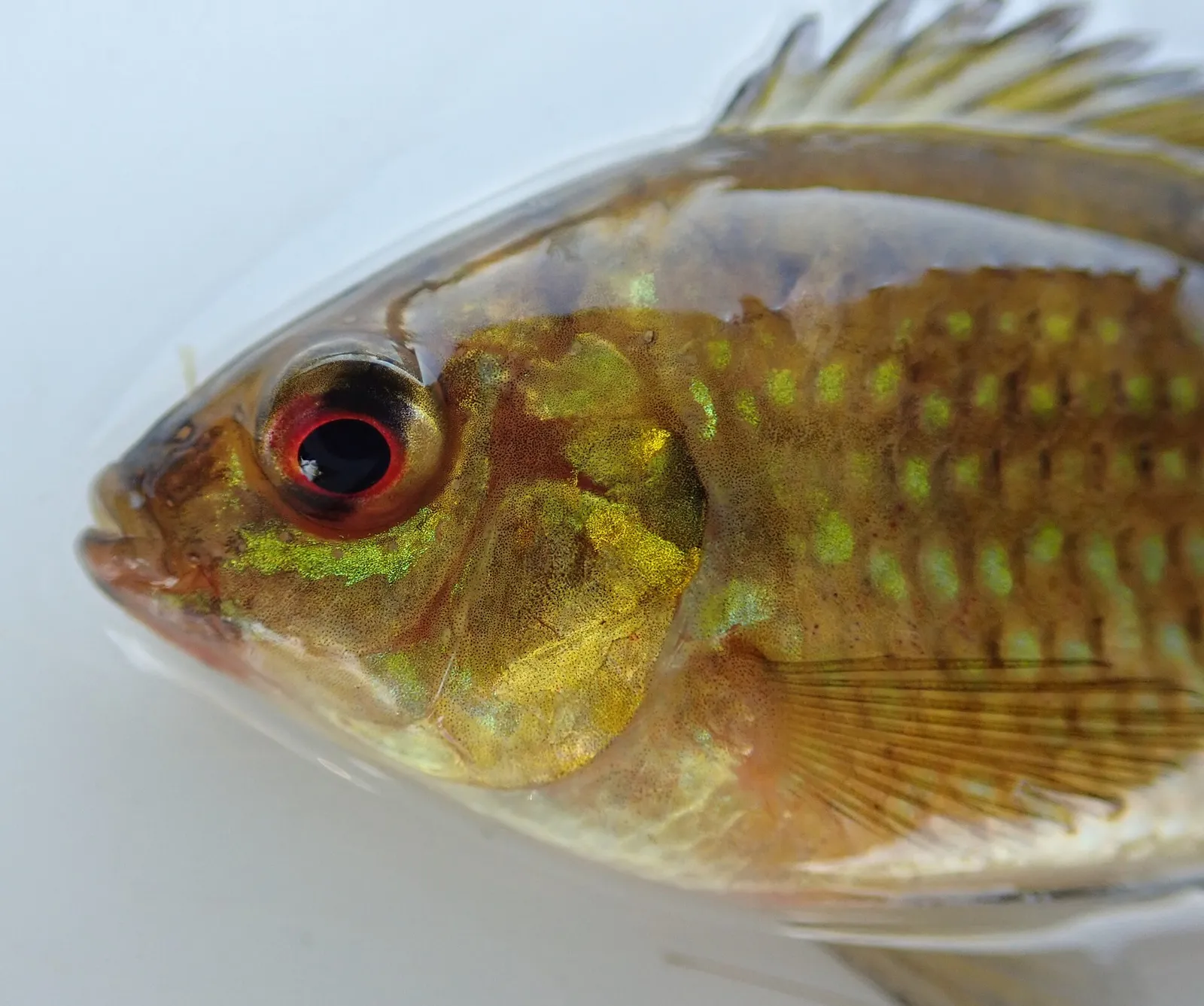
Tilapia sparrmanii is a small, deep-bodied, laterally compressed cichlid with a notably small, narrow head, a rounded to steeply rising forehead, small strong jaws and a rounded caudal fin. It is one of the smaller tilapias: FishBase records a maximum of about 9.5 in total length and a maximum published weight of roughly 445 g, though most fish encountered are considerably smaller, and aquarium and field specimens around 4.5–6.5 in are typical. The dorsal fin carries 13 to 15 spines. Coloration shifts strongly with mood, maturity and condition. The ground colour ranges from a grey-brown or bronze to, in well-coloured fish, a rich deep yellow, overlaid by the seven to nine dark vertical bars that give the species its English name; these bands are usually sharpest on the upper body. The dorsal fin is often reddish-brown with an iridescent bluish flush in its upper part and a red margin, and breeding adults darken dramatically, developing prominent black bars and — a useful field mark — a patch of scarlet scales just behind the head. Sexual dimorphism is modest and not reliable for casual sexing: the sexes are similar in pattern, mature males tend to grow somewhat larger and may show elongated pelvic-fin rays and slightly more extended, spotted unpaired fins, while ripe females are deeper-bodied; both sexes intensify in colour when breeding.
Habitat
Few African cichlids are as widespread. The banded tilapia occupies the middle and upper Congo basin — the Kwilu, Kwango, Kasai and Lomami drainages, and the Lualaba, Lufira, Upemba, Luvua, Lake Mweru, Luapula and Bangweulu systems — as well as the Cunene, Okavango and Lake Ngami, the Zambezi, Limpopo and the northern tributaries of the Orange River, the Cuvelai, the upper Cuanza, the Sabi and Lundi, and the Lake Malawi/Nyasa basin. Within this enormous range it is a generalist of quiet, vegetated water: it favours the weedy margins of rivers, lakes, swamps, floodplains and backwaters, where plant cover is dense, and is largely confined to these shallow weedy zones, so it does not build large populations in open deep lakes. FishBase gives a typical depth range to about 16 ft, though physiological work by Caulton (1975) showed adults can compensate their swim-bladder pressure down to about 49 ft at 72 °F, taking days to descend and return. Its most distinctive ecological trait is thermal: it is the most cold-tolerant of the tilapias, surviving temperatures down to about 45 °F, and is described as "cold-confined" — its southern distribution appears limited more by high temperatures (it struggles above roughly 90 °F) than by cold, the reverse of most of its relatives. FishBase lists a preferred water chemistry from about pH 7 and a hardness from around 10 dH, but in practice the species ranges across soft, slightly acidic floodplain water through to harder, alkaline conditions.
Feeding
The banded tilapia is an omnivore with a strong plant bias, sitting at a low trophic level (FishBase estimates about 2.7). Adults feed preferentially on filamentous algae, aquatic macrophytes and vegetable matter of terrestrial origin — fallen leaves, plant fragments and the like — but readily take animal food as well, and the species is best described as predominantly macrophagous and herbivorous while remaining opportunistic. Juveniles are more carnivorous, feeding on small crustaceans and midge (chironomid) larvae before shifting toward the adult diet. Across its range it functions as a grazer and detritivore of the weedy littoral, processing algae and soft plant matter that many co-occurring fishes cannot exploit; this generalist, vegetation-linked niche is part of why it establishes so readily where it is introduced. Where larger, more valuable cichlids have declined under fishing pressure in the Zambezi floodplains, Tilapia sparrmanii has itself become a primary target of small-mesh net fisheries, and it is also widely used as a forage (prey) fish stocked for largemouth and smallmouth bass.
Mating
Tilapia sparrmanii forms monogamous pairs that cooperate through spawning and the rearing of young, the classic substrate-spawning pattern of the true Tilapia and a sharp contrast to the polygynous, female-only mouthbrooding of Oreochromis and the haplochromines. As the breeding season approaches both partners darken and colour up, the male's scarlet nape patch and the pair's black banding becoming vivid. The species undertakes seasonal upstream migrations and spawns before and during these movements, timing reproduction to the rising water of the wet season when floodplains and weedy margins are inundated. A pair selects and defends a territory in shallow, plant-rich water, where the substrate or the branches of aquatic weeds will serve as the spawning site. Pair-bonded territoriality, mutual courtship and shared defence — rather than the lek-style display of mouthbrooders — define the run-up to spawning in this fish.
Breeding
The banded tilapia is a biparental substrate (open or sheltered nest) spawner. The female deposits a cluster of adhesive eggs on the cleaned bottom of a depression or even attached to the branches and stems of aquatic plants, and the male spreads his milt over them; both parents then guard the eggs and, after hatching, the fry. Notably, although the parents may pick up eggs and larvae in the mouth to shuttle them to alternative sites during hatching, there is no true mouthbrooding — the eggs and young develop on the substrate, not in the buccal cavity, which firmly distinguishes this fish and its genus from the mouthbrooding tilapias. Spawning is tied to warming water and the seasonal flood. Reported clutches are moderate by tilapia standards — the species is small, and a single spawn typically runs on the order of a few hundred eggs rather than the thousands a large Oreochromis can produce, with repeat spawnings through a warm season. Both parents continue to shepherd the free-swimming school, a level of biparental care that makes the species relatively straightforward to raise once it commits to spawning.
In the aquarium
Tilapia sparrmanii is one of the more aquarium-friendly tilapias and has a long history in the hobby, but it is a robust, digging, vegetation-eating cichlid that needs to be kept with that in mind rather than as a community fish. A single pair wants a tank of at least about 47 in (roughly 70–80 US gallons); more is better if a group is kept, because territorial adults will claim and defend space vigorously at spawning time. The species is forgiving of water chemistry — neutral to moderately alkaline water (around pH 7.0–8.0) of moderate hardness suits it, but it tolerates a wide range. Its defining husbandry quirk is temperature tolerance: this is the cold-hardy tilapia, comfortable across roughly 46–86 °F and able to ride out cool spells that would kill most cichlids, which makes it a candidate for unheated rooms and outdoor ponds in temperate summers; an everyday range of about 68–79 °F is fine, with a warm-up to the high 20s to trigger spawning.
A sand or fine-gravel substrate, hardy or potted plants (the fish will graze and uproot soft species), driftwood and rock to break up sightlines, and efficient filtration with regular water changes cover its needs. Feeding is easy and the diet should lean vegetable: a quality plant- or spirulina-based pellet or flake as the staple, supplemented with blanched greens, peas and algae, plus occasional live or frozen foods. Beware over-reliance on protein, which suits a herbivore-leaning omnivore poorly.
The main cautions are behavioural and legal. Outside spawning the banded tilapia is reasonably peaceful for a cichlid, but a breeding pair becomes territorial and will harass tankmates and smaller fish, so companions should be robust and the tank roomy. It digs and grazes, so delicate aquascapes will not last. Most importantly, this is a hardy, cold-tolerant, fast-breeding species with a documented record as an invasive once released: it is a prohibited or regulated species in many U.Sarotherodon states and elsewhere, and it should never be released or allowed to escape into wild waters. Keepers in temperate regions in particular should treat escape-proofing and responsible disposal as part of owning the fish.
Conservation
The IUCN Red List assesses Tilapia sparrmanii as Least Concern (assessed 19 June 2018 by Konings, Tweddle, Coetzer, Bills, Weyl and Chakona; population trend unknown). The rationale is straightforward: it is one of the most widely distributed and adaptable freshwater fishes in central and southern Africa, abundant across many drainages, ecologically flexible and tolerant of a broad range of conditions, with no range-wide threat severe enough to warrant a higher category. It carries no CITES listing. The assessors do flag a localised, emerging pressure: as larger cichlids have been fished out of the Middle and Upper Zambezi, Tilapia sparrmanii has become a main target of small-mesh monofilament gill- and seine-net fisheries, and the widespread use of dragnets could degrade the weedy habitats the species depends on if that trend escalates. The flip side of its hardiness is its record as an invader. Translocated within and beyond Africa as a forage fish for bass, for pond culture and for aquatic-weed control, it has established outside its native range — in South Africa's Cape river systems, Madagascar and Japan among others — where it is implicated in competition with, and the displacement of, native fishes such as the Cape kurper (Sandelia capensis). It is consequently listed as a prohibited or regulated species across numerous jurisdictions, a reminder that a fish of Least Concern in its homeland can be an ecological problem where it does not belong.