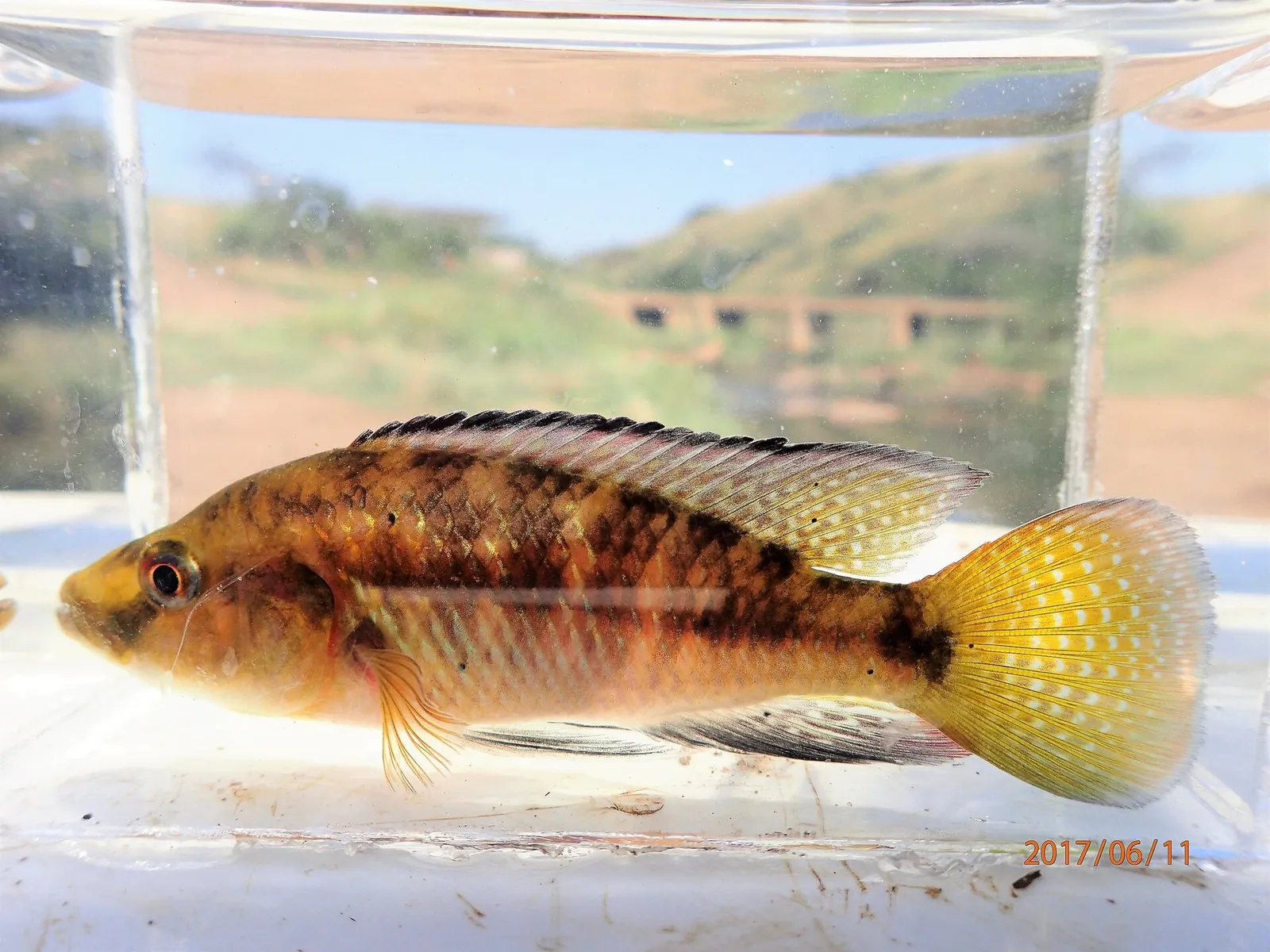
Taxonomy & naming
The southern mouthbrooder was described by the Dutch-German zoologist Max Weber in 1897, originally as Chromis (Ctenochromis) philander, from specimens taken in the Umhlasine River near Verulam in Natal (now KwaZulu-Natal), South Africa — the type locality that anchors the name. The name-bearing lectotype, selected by Matthes in 1964, is held in the Zoological Museum Amsterdam (ZMA 100175), with paralectotypes distributed among the museums of London, Vienna and Amsterdam. The species was later moved into Pseudocrenilabrus, a genus Fowler erected in 1934 for these small African dwarf mouthbrooders; Greenwood's 1984 revision fixed the modern usage, and Skelton's CLOFFA treatment (1991) and his Complete Guide to the Freshwater Fishes of Southern Africa (1993, 2001) remain the standard regional references. Pseudocrenilabrus is a compact genus of maternal mouthbrooders that also contains Pseudocrenilabrus multicolor (the Egyptian or Nile mouthbrooder), Pseudocrenilabrus nicholsi and a handful of others, all small, all agamous (non-pair-bonding) brooders. Pseudocrenilabrus philander is its type species and, on the molecular evidence, the ancestral member: phylogeographic work by Katongo and colleagues (2005, Hydrobiologia) traced the species complex back to the Congo system, from which it expanded its range both north and south. Historically three subspecies have been recognised — P. p. philander, P. p. dispersus and P. p. luebberti — but genetic and morphological surveys have since uncovered as many as eleven distinct, geographically separated populations differing in colour, pattern, behaviour and egg size, so the fish is best regarded as a species complex still being untangled rather than a single tidy taxon.
Morphology
Pseudocrenilabrus philander is a small, deep-bodied cichlid of fusiform, oval cross-section. Maximum reported size is about 5 in total length, but this is at the upper end; most fish run smaller, on the order of 3–3.5 in, with size varying noticeably between populations and localities. The fin counts are typical haplochromine: 13–16 dorsal spines, 9–11 dorsal soft rays, three anal spines and 7–9 anal soft rays. The sexes are strongly dimorphic. A ripe, dominant male is the reason the fish is kept at all — he turns a metallic copper to brassy-gold over the flanks, suffused with iridescent blue-green, with red or orange margins to the dorsal and caudal fins and bright blue lips that give the popular trade form (P. p. dispersus) its "blue-lip cichlid" name. The clinching feature is a vivid orange or red blotch on the tip of the male's anal fin, a classic haplochromine egg-spot. Females and non-territorial males are far plainer — silvery to olive-grey, sometimes with faint barring — which makes the brilliant breeding male unmistakable. Brooding females adopt an even more subdued, cryptic pattern that renders them inconspicuous away from male territories.
Habitat
Few African cichlids range as widely. The southern mouthbrooder occurs from the Orange River system and southern KwaZulu-Natal northwards throughout southern Africa, reaching the southern tributaries of the Congo basin and the lagoons and rivers around Lake Malawi (though not the lake proper), with an outlying record in Lake Rukwa. In national terms that spans South Africa, Eswatini, Mozambique, Zimbabwe, Botswana, Namibia, Angola, Zambia, Malawi, Tanzania and the Democratic Republic of the Congo — taking in the great Zambezi, Okavango, Limpopo and upper Congo drainages. Within this enormous range it is an ecological generalist, recorded from flowing rivers and streams, floodplains, lakes, ponds, marshes and even isolated, spring-fed sinkholes such as Lake Otjikoto in Namibia; some populations tolerate slightly brackish water. It strongly favours quiet, well-vegetated margins rather than open water, and is essentially a shallow-water fish of the littoral zone, typically found within the top metre or two. FishBase characterises its preferred chemistry as hard, near-neutral to alkaline (pH from about 7 upward, hardness 12 °dH and above) at tropical temperatures, though field populations clearly span a wider envelope given the soft, acidic to neutral and the harder waters across its range. Reported habitat temperatures cluster around 72–77 °F, but as a fish of shallow, sun-warmed margins across a continent's worth of latitude it experiences considerably broader extremes, roughly 64–82 °F through the seasons.
Feeding
The southern mouthbrooder is a small, opportunistic predator and generalist carnivore. FishBase places it at a trophic level near 3.7, and field accounts describe a diet of aquatic insects and their larvae, small crustaceans such as shrimps, and even small fish — a micropredator that hunts the vegetated shallows and works the substrate and plant cover for whatever invertebrate prey it can overpower. This combination of small size and a willingness to eat almost anything live is a large part of why the species is so successful across such varied waters, and why it establishes so readily where it is introduced beyond its native range. In the community it occupies the role of an abundant small predator of the weedy littoral, itself prey for larger fish, herons and kingfishers.
Mating
Reproduction in Pseudocrenilabrus philander follows the classic haplochromine, agamous (non-pair-bonding) template, and the sexes lead completely separate lives once spawning begins. A ripe male claims and vigorously defends a territory — reported as up to roughly a metre or so across — at the centre of which he excavates a shallow cleared pit or nest in the substrate. From this arena he displays in full breeding colour to passing females, the orange egg-spot on his anal fin flared, trying to entice a receptive female down to spawn. He is intensely intolerant of rival males and pugnacious even toward unreceptive females, so in any one area a single dominant male typically monopolises spawning. There is no pair bond and no shared territory: the male's investment ends at fertilisation, and a receptive female visits only to spawn before withdrawing entirely. This is the same lek-like, male-arena system that underpins the explosive haplochromine radiations of the Rift lakes, played out here in a single widespread riverine species.
Breeding
Pseudocrenilabrus philander is an ovophilic maternal mouthbrooder — the female alone incubates. Spawning, which in the wild runs from early spring through late summer, follows a tight, well-described choreography: the pair circle in the male's pit, and as the female lays a small batch of eggs she turns and takes them into her mouth almost immediately, then mouths the male's vent (and the dummy egg-spot on his anal fin) so that he releases milt directly, fertilising the clutch inside her buccal cavity. The sequence repeats until she holds the full brood — reported clutches are modest, on the order of 5–100 eggs, in keeping with the fish's small size. She then leaves the territory entirely and withdraws to quiet, sheltered nursery water, where she incubates the eggs, larvae and early juveniles for roughly 12–14 days at about 79 °F, taking no food the whole time. After release the free-swimming fry are guarded for a further five to seven days or so, the female snapping them back into her mouth at the approach of a predator (or a diver) before finally abandoning them to fend for themselves. In nature, brooding and recently released females in their cryptic colours gather in shallow water well away from the male arenas — a spatial separation that shelters the vulnerable broods from the aggression of the territorial males.
In the aquarium
The southern mouthbrooder is an undemanding, hardy and genuinely rewarding aquarium fish that is nonetheless seldom seen in the trade — a pity, because a breeding-coloured male is a spectacular little cichlid. It is a good choice for a keeper ready to manage a single combative male, but a poor one for a placid community. A tank of around 47 in (about 30 US gallons) is a sensible minimum, set up with a sand or fine-gravel substrate that the male can dig, plenty of cover from rockwork, roots, driftwood and clay-pot caves, and ideally some planting to break up sightlines. The water chemistry is forgiving: a temperature of roughly 72–77 °F and a pH near neutral (about 6.5–7.5) suit it well, and it adapts to a broad range of hardness, reflecting the chemical variety of its wild range. It is not a fussy feeder — a good-quality cichlid pellet as a staple, varied with regular live and frozen foods, keeps it in colour and condition.
The critical husbandry issue is temperament. Males are very aggressive toward one another and toward lower-dwelling tankmates, so the standard recommendation is to keep a single male in a harem with three or four females, or to grow on a group of six to eight youngsters and let a hierarchy settle. In anything but a large tank a second male will simply be suppressed or killed. Suitable tankmates are robust, upper-water dither fish that stay out of the male's territory — larger African tetras, rainbowfish and surface-dwellers like hatchetfish — rather than other bottom-dwelling cichlids, loaches or catfish, which need much more room to coexist. Adding such target fish is in fact a recommended breeding tactic: it divides the male's attention and spares the females his relentless courtship.
Breeding is straightforward once a male is in condition — this is one of the easier mouthbrooders to spawn. Condition the fish on rich live and frozen foods, aim for a pH around 7.0 and a temperature near 77 °F, and a dominant male will excavate his pit and begin displaying. A holding female is best moved to her own tank to brood undisturbed, as carrying females draw rough attention from the male; the fry take brine-shrimp nauplii, microworm and powdered dry foods from release. Two cautions are worth flagging: freshly imported fish are reported to travel badly and suffer heavy losses, so give new stock the best possible water from the outset; and because the species is really a complex of distinct populations that hybridise readily, fish of different geographic forms (and the named subspecies) should never be mixed if line purity matters.
Conservation
The IUCN Red List assesses Pseudocrenilabrus philander as Least Concern (assessed 28 February 2018 by Roger Bills and Denis Tweddle of SAIAB), reflecting its enormous range, broad ecological tolerance and large, stable populations — it is one of the most widespread and adaptable cichlids in southern Africa and faces no species-level threat. It carries no CITES or CMS listing and is of only minor commercial fisheries interest, harvested locally as a small food fish and occasionally collected for the ornamental trade. The same adaptability that makes it secure has a flip side: the species is a capable colonist outside its native range, and an introduced population has established and spread in the Baakens River of South Africa's Eastern Cape, an extralimital invasion documented as a potential concern for native fish communities. The broader pressures on the region's freshwaters — habitat loss, the destruction of weedy littoral zones by intensive net fishing, pollution and the damming and modification of rivers across the Zambezi and Limpopo systems — bear on the wider fish fauna more than on this resilient generalist, but they are the backdrop against which its continued abundance should be read.