Taxonomy & naming
Tropheus moorii was described by the British Museum ichthyologist George Albert Boulenger in 1898, and it is the type species of the genus Tropheus. The specimens he worked from were collected at Kinyamkolo, near present-day Mpulungu on the Zambian shore of Lake Tanganyika, by the zoologist John Edmund Sharrock Moore during expeditions in 1895 and 1896; Boulenger named the fish moorii in his honor. The original spelling moorii is the valid one: Boulenger latinized Moore's name to "Moorius" before adding the genitive ending, and under the rules of zoological nomenclature a validly published name can be revised only if it resulted from a printer's error or is grammatically incorrect — neither applies here, so the once-common variant "moorei" has no standing.
The genus is small in name but vast in practice. Modern molecular work assigns roughly 120 distinct color morphs to only about six nominal species, and those species do not form clean genetic groups: studies of mitochondrial and nuclear DNA show the named species to be polyphyletic, with similar color patterns having evolved more than once in separate lineages and with at least one "Tropheus moorii" form (the southern 'yellow') turning out to be a natural hybrid. The species name has also had a genuine taxonomic yo-yo: Marcel Nelissen described a Kasaba Bay population as the subspecies Tropheus moorii kasabae in 1977, at a time when the dark-colored northern form now called T. sp. "Black" (from Rutunga) was widely, and mistakenly, assumed by aquarists to be the true T. moorii — so Nelissen's original comparison material may itself have been muddled with that or other Tropheus populations. Max Poll raised kasabae to full species rank in 1986, and Pierre Brichard (1989) instead treated the northern Black Moorii as a variant of T. moorii; kasabae is now regarded once more as a synonym of Tropheus moorii (Konings, 2019). In the trade the fish is usually sold not by species but by collection point, under names like the locality itself.
Morphology
This is a deep-bodied, blunt-snouted cichlid built for scraping rather than chasing. Adults are commonly cited at roughly 5.5 in (5.5 in); FishBase lists a maximum of about 5.7 in (5.5 in total length), while hobby sources variously report mature fish anywhere from about 4.7 to 6 in (4.5–6 in), so the honest answer is a fish in the 5-6 in range with some variation by population and source.
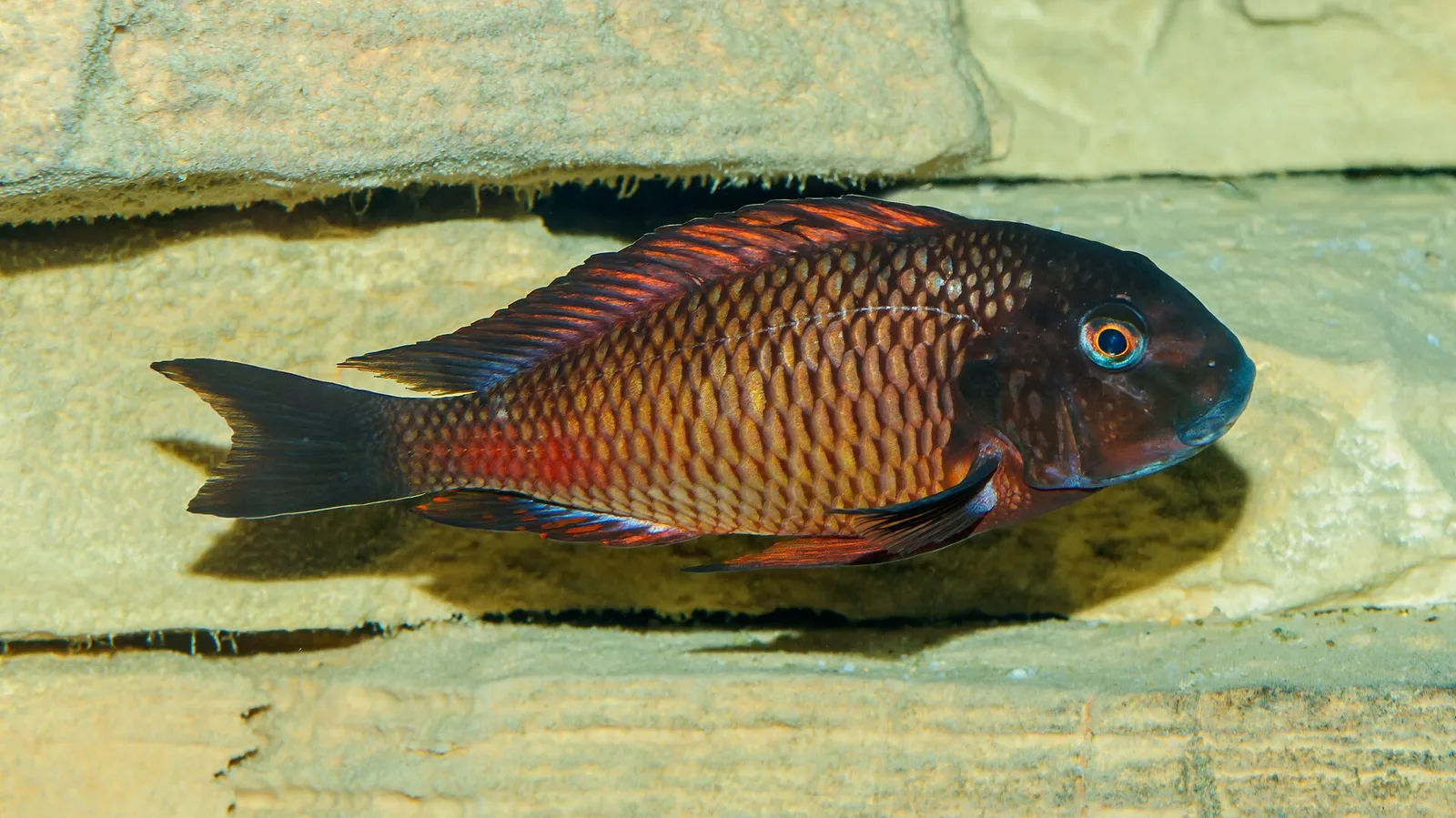
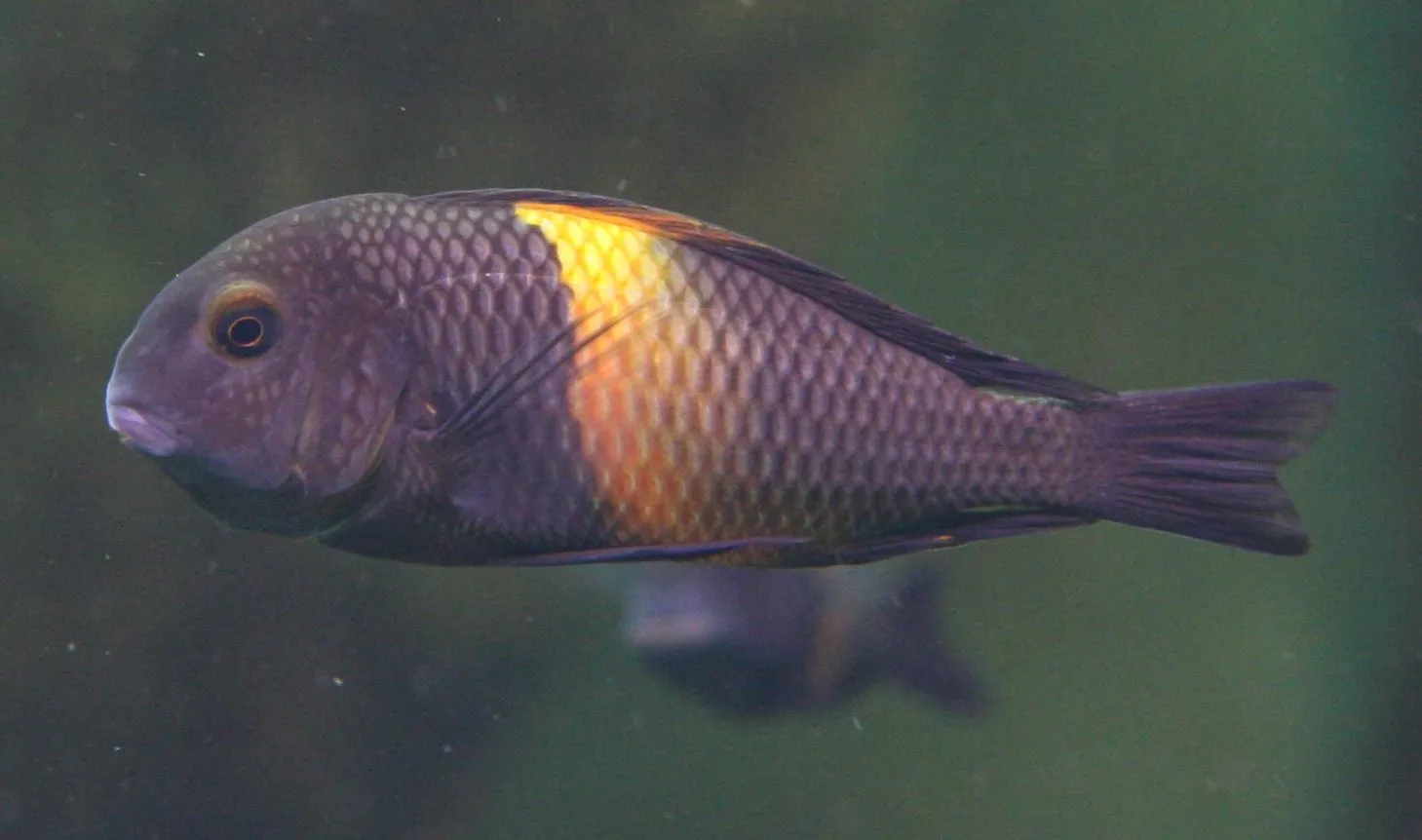
Color is where Tropheus moorii defies a simple description. Depending on the population it can be near-black, dark olive, brown, brick red, or carry a broad yellow, orange, or red flank blotch or band; dorsal-fin tones shift from grayish-blue in many Zambian fish to purplish or reddish in some Tanzanian localities. At the broadest scale, populations along the Zambian and lower Congolese coast fall into two geographic color groups: a lighter-colored group, including the Mpulungu holotype population, marked by a colored patch on the center of the body, and a darker-colored group found in and north of Cameron Bay, marked instead by a colored patch on the cheek. No locality is known where both groups occur together, consistent with the two being broad geographic variants of one species rather than two separate ones. Juveniles often show around nine narrow vertical bars that fade with maturity. The morphs are not tied to water conditions but to genetics, so they hold their color in captivity. Sexual dimorphism is subtle and easiest to read in the head: because females incubate eggs and fry in the mouth, they carry a relatively larger buccal region and broader ventral head than males. Sexing by eye alone is unreliable, and venting is the dependable method.
Habitat
Tropheus moorii is a lacustrine endemic, found only in Lake Tanganyika and nowhere else on Earth, with a disjunct distribution restricted to the southern half of the lake — from the Zambian shore near Mpulungu north along the Congolese coast to around Moba and Kapampa. An outlying population at Kibwesa, well north of that core range on the Tanzanian shore, is thought to be a remnant of a once more extensive distribution; it is also the one confirmed locality where T. moorii lives sympatrically with T. sp. "Black," the dark northern form long assumed by aquarists to be conspecific with T. moorii but now recognized as a separate population. It is a fish of the rocky littoral, hugging the shoreline where boulder and cobble give it grazing surface and crevices for refuge. It is most abundant in very shallow, well-lit water, roughly the upper 3-10 ft (3–10 ft), and — with the exception of T. duboisi, which ranges deeper — the genus as a whole is generally confined to about the top 33 ft (33 ft) of the rocky coast. It avoids sand flats, mud, and open water, which become hard barriers to a fish this tied to rock.
That habitat dependence drives the species' signature pattern: its color morphs are distributed allopatrically, each occupying its own stretch of coast, with little gene flow between them. A striking example is the wide, sandy estuary of the Lufubu River in the south, which forms a barrier separating bluish-morph from yellow-morph Tropheus. Researchers attribute the persistence of these forms to a mix of vicariance, strong site fidelity (philopatry), and mate choice, all reinforced by Tanganyika's long history of rising and falling lake levels that repeatedly split, stranded, and remixed shoreline populations. In situ the water is hard and alkaline, broadly pH 8-9 and warm, around 75-79 F (24-26 C).
Feeding
In the wild Tropheus moorii is a trophic specialist: a dedicated grazer of the "aufwuchs," the dense biofilm of algae and the tiny organisms living within it that coats Tanganyika's rocks. It spends most of its day scraping this mat from hard surfaces, and its low trophic level (about 2.0) reflects an essentially herbivorous diet. Small crustaceans and other micro-invertebrates are taken incidentally, swept up with the algae rather than hunted. Subtle differences in mouth position and head shape between populations point to locally tuned foraging on the same broad food source. Its grazing niche also overlaps with that of the browsing genus Petrochromis: by combing unicellular diatoms out of the algae strands, Petrochromis is thought to partially clear the biocover of sediment, leaving it more accessible for Tropheus to graze in turn (Takamura, 1984).
This specialization matters far beyond ecology, because it dictates the fish's gut. Tropheus carry a long digestive tract adapted to fibrous plant material, and that anatomy is the root of their reputation for fragility in captivity.
Mating
Tropheus moorii is highly social and, at the same time, fiercely territorial toward its own kind, ranking among the more aggressive Tanganyikan cichlids alongside Petrochromis. The intensity of that territoriality looks different in the wild than it does in a tank. In situ, field observers have recorded aggregations of up to roughly 100 individuals grazing side by side on a single rock, with overt territorial defense concentrated mainly around spawning activity rather than everyday feeding space. In an aquarium the same fish behave far more possessively: the largest males divide the available floor among themselves and hold territories that can exceed 2 ft across, pushing females and subordinate males out to the margins. Courtship takes place on the rock surface, where the male displays to the female before spawning commences.
Breeding
It is a maternal mouthbrooder: after a rock-top courtship the female collects her eggs and they are fertilized near the male's vent, after which she carries the developing eggs and larvae in her buccal cavity. Clutches are small for a cichlid, generally on the order of 2 to 15-17 eggs, and incubation is long, roughly four weeks (about 31-33 days), so the female releases a handful of large, well-developed fry rather than a cloud of tiny ones.
In the wild, a female about to release her brood is reported to move into extreme shallows rather than staying with the main group — ground that is harder for predators to reach and rich in food — and she may stay near her fry there for a week or more before rejoining the colony, while the young themselves remain in that shallow refuge until they reach roughly 1 in.
That reproductive load is exactly what shapes the females' larger heads, a neat example of how breeding biology leaves a mark on body form.
In the aquarium
This is not a beginner's fish, and any source that says otherwise should be read with suspicion. The single most important rule is dietary: Tropheus are prone to "bloat," a frequently fatal inflammation of the gut linked to inappropriate, protein- or fat-rich food. Their long herbivore digestive tract is built for roughage, so keepers feed spirulina- and vegetable-based foods and avoid mammalian proteins, bloodworms, tubifex, and beef heart entirely; many deliberately skip a feeding once a week. Experienced keepers note that overfeeding even the right food, and the water-quality crash that follows, is itself a bloat trigger.
The second rule is social. Tropheus cannot be kept as pairs; aggression in a small group concentrates on a few fish and kills the rest. The standard approach is a colony, commonly 12-15 or more individuals, in a large tank (a 5 ft, roughly 110-gallon footprint is a sensible floor, and FishBase suggests around 59 in of length) so that aggression is spread thinly across many targets. Stocking is counterintuitive: density is the tool, and keepers report that moving a settled colony into a much larger tank can actually increase fighting. Hard, alkaline water matching the lake is essential. Most keepers run them as a species-only colony, often a single locality form to avoid hybridizing the morphs; mixing them with American cichlids or other diets is a common and avoidable path to a sick tank.
Some breeders strip eggs from the female's mouth early to raise clutch survival rates. Anecdotally, several long-time Tropheus keepers report that females reared from prematurely stripped fry go on to be poor mouthbrooders themselves — neglecting or swallowing their first few spawns — while females that were allowed to release naturally tend to brood their first spawn successfully; this remains an unconfirmed but widely repeated observation among specialists rather than a settled finding. Breeders who let females release fry naturally sometimes replicate the shallow refuge seen in the wild by building a raised, thinly stocked shelf of small stones near the surface of the tank, which gives a spent female somewhere to recover with her brood away from the rest of the colony.
Conservation
On the IUCN Red List, Tropheus moorii is assessed as Least Concern, reflecting its wide distribution around Lake Tanganyika and the absence of a single lake-wide threat. The caveat lies in its biology: because so many distinct color forms are confined to short, isolated stretches of shoreline, individual local populations can be vulnerable to over-collection for the aquarium trade in a way the species as a whole is not. The same philopatry and habitat fragmentation that generated this diversity also make particular morphs easy to deplete in place.