Taxonomy & naming
The bluemouth cichlid was described by the French aquarist and cichlid specialist Robert Allgayer in 1989, originally as Theraps nourissati, in a revision and redescription of the genus Theraps. The epithet honours Jean-Claude Nourissat (1942–2003), the noted French cichlid specialist who collected the type material. For its first decades the species was lodged in Theraps as that genus was broadly circumscribed. The molecular revision of the herichthyine cichlids by McMahan, Matamoros, Piller & Chakrabarty (2015, Zootaxa 3999), and the comprehensive phylogeny of Říčan, Piálek, Dragová & Novák (2016), showed that nourissati was not a close relative of the Theraps type species and erected the new monotypic genus Wajpamheros for it. The genus name is unusually evocative: it combines the Maya Chol word wajpam — 'to have mud on one's face' — with Heros, the old generic name for many neotropical cichlids, an allusion to the species' substrate-sifting feeding, in which the mouth and lips are pushed into soft sediment. Wajpamheros is morphologically intermediate, with a shallow, elongated body and a shortened caudal peduncle, sitting between the deep-bodied 'lentic' and slim 'lotic' ecomorphs of the Theraps-group radiation. It remains monotypic.
Morphology
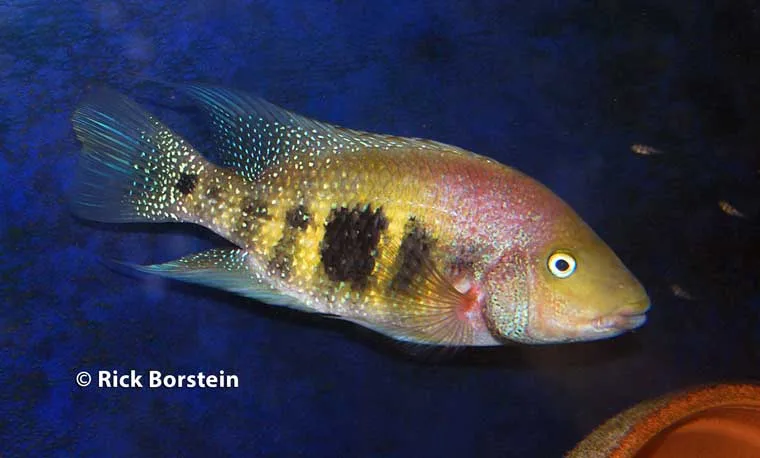
Wajpamheros nourissati is a medium-sized, laterally compressed cichlid with a distinctive intermediate body form — shallower and more elongate than the deep-bodied 'mojarra' cichlids but with a markedly shortened caudal peduncle, a shape unlike either the slim current-dwellers or the tall still-water grazers of its clade. FishBase gives a maximum of about 8.5 in total length. The ground colour is silvery to olive-grey with a greenish iridescent cast and a variable pattern of broken bars and dark blotches; the feature that names the fish is the bluish wash around the mouth and lower head, most vivid in conditioned adults. The lips are somewhat fleshy and protrusible, an adaptation to its sediment-sifting feeding. Sexual dimorphism follows the heroine pattern: males grow larger, develop a steeper forehead and slightly more produced fin tips, while ripe females are deeper-bellied and drop a visible ovipositor when spawning. As with most narrow-range cichlids of the region the detailed morphological record rests largely on the original description and preserved material.
Habitat
The species occurs on the Atlantic (Gulf of Mexico) slope in the Usumacinta river basin spanning Chiapas (Mexico) and Guatemala, with documented populations in tributaries such as the Chancalá. It is a demersal, bottom-oriented fish that needs areas of soft substrate to feed, occupying the sandy and silty reaches of clear-to-turbid lowland and foothill rivers rather than bare rocky riffles. FishBase classes it as freshwater and demersal and gives a preferred temperature band tending toward the warm tropical range (up to about 86 °F) with pH around 7.5 and below. The Usumacinta is recognised as its own Freshwater Ecoregion of the World, noted for an exceptionally rich and partly endemic cichlid fauna, of which the bluemouth cichlid is one of the characteristic members. Quantitative in-situ chemistry beyond the FishBase envelope and a published depth range specific to this species are sparse; the figures here lean on FishBase and the demersal, soft-substrate habit of the fish rather than a dedicated field-limnology study.
Feeding
Wajpamheros nourissati is, as its genus name records, a substrate sifter — the feeding habit that sets it apart from its relatives. It pushes its mouth and lips into soft sediment, takes in mouthfuls of sand and silt, and filters out the food, expelling the inert material; the name wajpam ('mud on the face') captures the result. FishBase assigns it a trophic level near 3.3, consistent with an invertebrate-leaning omnivore that mines the soft bottom for small benthic animals, larvae, micro-crustaceans and the organic matter held in the sediment. This places it in the same functional guild as the dedicated sand-sifting eartheaters of South America, though it is a heroine rather than a geophagine, and it explains its need for fine, sandy substrate in captivity. Much of its foraging is therefore done head-down over open soft bottom rather than scraping rock as its grazing relatives do.
Mating
As with most heroine cichlids, reproduction in Wajpamheros nourissati is organised around a monogamous pair that bonds and then jointly holds and defends a territory. Detailed field observations of courtship in this species are limited, so the account is built from the genus's biology and from aquarium experience. Pairs form within a group as fish mature; courtship runs through the familiar cichlid sequence of lateral displays, fin-spreading, jaw-locking and substrate cleaning, the female deepening in colour and dropping her ovipositor as she ripens. A defensible flat surface near open feeding sand typically anchors the pair's territory. Intraspecific aggression rises as a pair claims and defends its patch, and the reliable route to a compatible pair in captivity is to grow a cohort together and let a bond form rather than to force two adults into proximity.
Breeding
Wajpamheros nourissati is a biparental substrate (open) spawner, the standard mode for its clade. The pair selects and meticulously cleans a hard surface — a flat rock, a slab of wood, or the firm tank bottom — and the female lays an adhesive sheet of eggs over it while the male follows to fertilise. A precise wild clutch count has not been published for the species; cichlids of this body size typically lay on the order of several hundred adhesive eggs, and a productive pair can be expected to fall in that range. Both parents share the brood: the female fans and tends the eggs while the male patrols and defends the perimeter, and after the eggs hatch the wrigglers are moved to pre-dug pits in the sand before the free-swimming fry are shepherded as a tight school by both adults — the soft substrate the adults sift doubling as a nursery. The young feed initially on infusoria and fine prepared foods and learn the sediment-sifting habit early. The species is occasionally bred by specialist keepers, but systematic spawning accounts remain scarce.
In the aquarium
Wajpamheros nourissati is a fish for the experienced keeper rather than a beginner, and its single non-negotiable requirement is substrate: a deep bed of fine, soft sand that lets it express its natural sifting behaviour. Gravel or coarse substrate is unkind to a fish that feeds by mouthing sediment and can damage the gills if drawn in. A pair is best in a tank of at least 75 US gallons (roughly 75 US gal) with a long, open footprint of sand for foraging; intricate rockscapes matter less than clear sifting room. Temperature should sit in the warm tropical range (about 77–86 °F).
Water should be near-neutral to mildly alkaline (about pH 7.0–7.8) and moderately hard, matching its native rivers; like all cichlids of its size it is intolerant of accumulated dissolved waste, and because it constantly disturbs the substrate it benefits from strong mechanical filtration and large regular water changes to keep the water clear. Décor can be sparse — scattered smooth rock, driftwood and a few robust or potted plants to break sightlines — but the open sand bed is the priority; it will rework loose décor and uproot rooted plants. Because the fish is a substrate-sifting invertebrate-leaning omnivore, its diet should centre on sinking foods it can work along the bottom — quality sinking pellets, frozen bloodworm, brine shrimp and similar small items — with a vegetable component; foods that only float are poorly suited to its feeding style.
Tankmates should be robust, similarly sized cichlids and large, fast dither fish that occupy the upper water column, leaving the sand to the bluemouth; small or slow bottom fish will be outcompeted at the feeding sand and, during spawning, harassed. The species is territorial and becomes markedly more aggressive in breeding condition, so the proven approach is to grow a group of juveniles together to allow a natural pair to form and to spread aggression. Given a deep sand bed, warm clean water and sinking foods, it is absorbing to watch work the bottom, sifting mouthful after mouthful of sand, though it remains uncommon outside specialist circles.
Conservation
The IUCN Red List assesses Wajpamheros nourissati as Least Concern, in an assessment dated 26 November 2018. The Least Concern listing reflects a species reasonably distributed across the Usumacinta basin of Mexico and Guatemala, with no documented basin-wide threat severe enough to qualify it for a threatened category; it is also not listed in the Mexican Official Norm NOM-059. It carries no CITES listing. As a substrate-sifting fish dependent on soft sandy and silty bottoms, however, it is exposed to anything that smothers, scours or pollutes its feeding substrate — siltation from catchment deforestation, damming and altered flow regimes, sand and gravel extraction, pollution and introduced species are the familiar pressures on the Usumacinta system. None of these is documented as a present population-level threat to this particular cichlid, but its fortunes track the health of the soft-bottomed river reaches it depends on to feed.