Taxonomy & naming
Polypterus delhezi was described by the Belgian-British ichthyologist George Albert Boulenger in 1899 and is placed by the Catalog of Fishes in the genus Polypterus, family Polypteridae, order Polypteriformes. The Polypteridae — the bichirs and the reedfish — are the most basal living lineage of the ray-finned fishes (Actinopterygii), a branch that split away from all the others deep in the fossil record; they are genuine living fossils, retaining a suite of primitive features long since lost by every other bony fish.
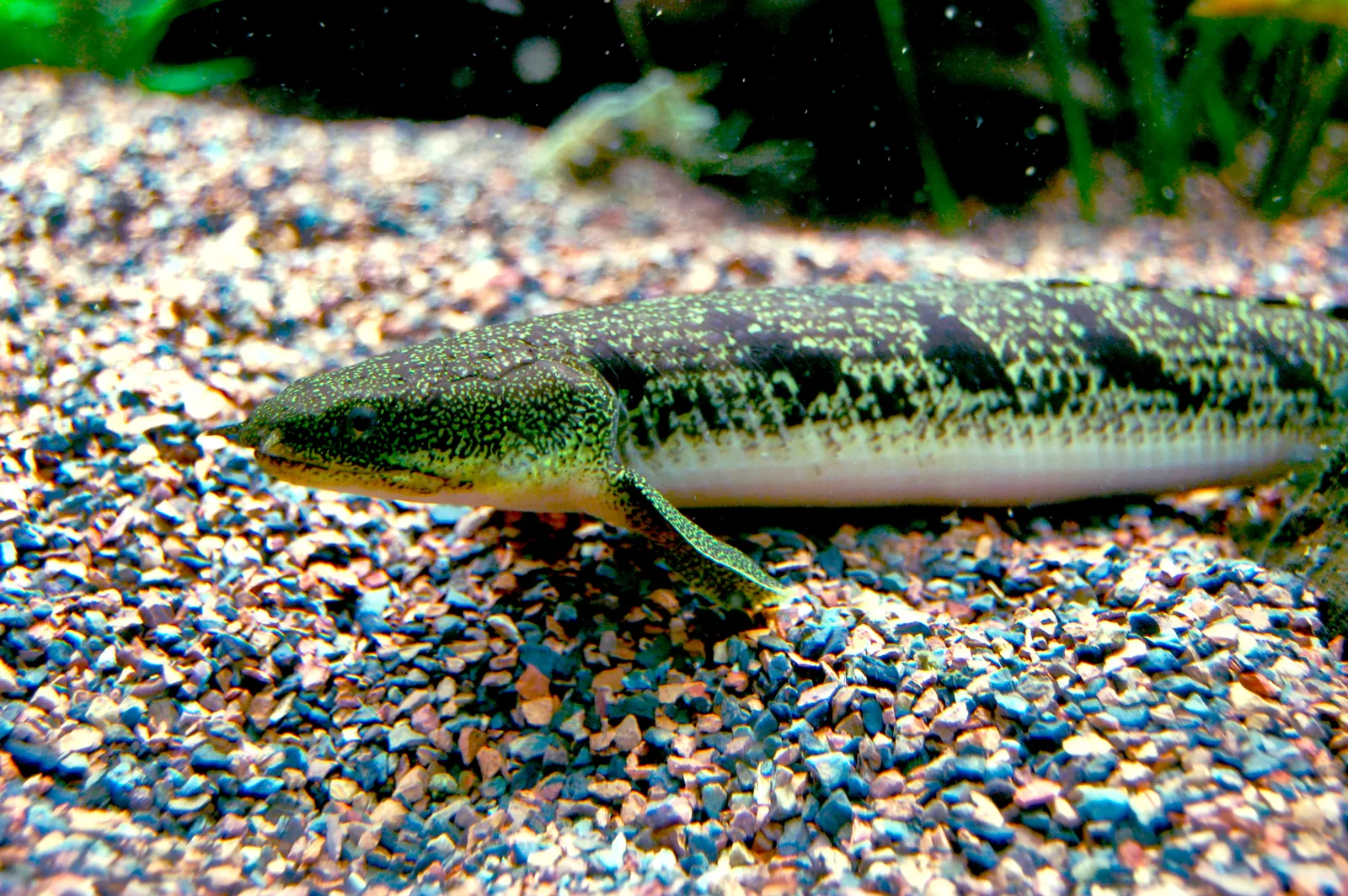
The species epithet honours Henri Paul Delhez (1870–1900), a Belgian naturalist and collector who gathered fish specimens from the Congo that Boulenger drew on for the description. In the hobby it is best known as the barred bichir, for the bold dark bands crossing its body, and sometimes as the armoured bichir, for the plating of scales that covers it — both descriptive trade names rather than anything in the original description.
Morphology
The barred bichir has the classic bichir silhouette — long, cylindrical and only slightly flattened beneath — but is stockier and more heavily built than slender species like the Senegal bichir, and carries a striking pattern of broad, dark, irregular bars or blotches across an olive to grey-brown body, the feature that gives it its common name. The head is broad and flattened, with a distinctly protruding upper jaw and a cleaver-shaped maxilla. Along the back runs the family's signature dorsal fin: not a single sail but a row of separate finlets, each a small spine trailing a flag of membrane, running from mid-back toward the tail (the exact finlet count for this species is not well documented in available sources). The paired pectoral fins sit on fleshy, muscular lobes that the fish uses to prop itself up and crawl along the bottom. The whole body is sheathed in thick, glossy, interlocking ganoid scales — rhombic, non-overlapping plates of bone capped with a hard, enamel-like ganoin layer — forming a flexible suit of armour. Sources give a maximum length of around 14 in, cited as either standard or total length depending on the source, which is the figure aquarists should plan around.
Internally, the barred bichir carries the family's other defining trait: a pair of primitive lungs, effectively a divided and vascularised swim bladder, with which it breathes air gulped at the surface — a bichir denied access to the surface can drown. Its eyesight is poor, and it hunts almost entirely by smell. Juveniles, like those of other bichirs, hatch bearing feathery external gills behind the head, which are absorbed as the fish matures.
Habitat
Polypterus delhezi is native to the Democratic Republic of the Congo, recorded from lakes, streams and seasonally flooded areas in the upper and middle stretches of the Congo River system in Central Africa. It occupies warm, slow-moving lowland waters typical of the Congo basin — vegetated margins, backwaters and flooded ground rather than fast open channels.
Water conditions across its range run warm, roughly 75–86 °F, with a pH from mildly acidic to mildly alkaline (about 6.0 to 8.0) and hardness from soft to moderately hard (around 5 to 25 dH). As with other bichirs, its air-breathing lungs are a real advantage in these still, often oxygen-poor waters, letting it exploit backwaters and flooded areas that pure gill-breathers cannot.
Feeding
The barred bichir is a carnivore and a nocturnal ambush predator. With weak eyesight but an acute sense of smell, it cruises slowly over the substrate after dark, locating prey by scent before engulfing it in a quick sideways snap of the jaws. In the wild it is an opportunist, taking aquatic invertebrates, worms and small fish it can overpower.
In the aquarium it feeds readily on meaty live and frozen foods — prawns, earthworms and bloodworm are all reported as reliable staples — and most individuals will accept large sinking pellets once settled. Because it hunts by smell rather than sight and moves deliberately, it can be outcompeted by faster, more visually driven tankmates at feeding time, so many keepers feed it after the lights go out or place food directly within reach.
Mating
Bichirs reproduce by external fertilisation, and P. delhezi follows the family pattern. A male trails and nudges a ready female, and the pair swim together among plants; the male then cups his thickened, muscular anal and pelvic fins into a shallow pouch, into which the female releases a few eggs at a time. The male fertilises the eggs within this cradle, and the small, adhesive eggs are scattered onto plants and the substrate as the sequence repeats over hours.
As in other Polypterus, the sexes are distinguished chiefly by this spawning equipment — the male's anal fin is noticeably broader and thicker than the female's, especially in breeding condition — with no lasting pair bond or territory involved.
Breeding
Polypterus delhezi is an egg-scatterer with no parental care: the adhesive eggs are left among plants, and the adults will eat both eggs and fry given the opportunity. Reported hatching times run three to four days, with the larvae free-swimming roughly three days after that; as in other bichirs, the newly hatched young carry feathery external gills behind the head that are absorbed as they grow.
Spawning is rarely triggered deliberately in home aquaria — success generally depends on mimicking the seasonal shift in water parameters that a rainy-season flood would bring, in a densely planted, well-conditioned tank. Unlike the Senegal bichir, which is now farmed at scale, the barred bichir is bred in captivity only to a modest degree, and most individuals reaching the trade are still wild-caught out of the Congo basin.
In the aquarium
The barred bichir is a robust, long-term aquarium fish, but one that outgrows small setups quickly. A tank of at least 55 US gal is a sensible minimum for an adult, with the priority placed on floor space rather than height, furnished with soft sand, driftwood and caves for daytime shelter, and kept dimly lit to suit a nocturnal hunter. It tolerates a broad range of established water chemistry provided temperatures stay warm, and its ganoid armour makes it noticeably tougher and more medication-tolerant than scaleless catfishes.
Two cautions outweigh any water-chemistry detail. First, the lid: bichirs are accomplished escape artists that will push through the smallest gap, so the tank must be tightly and fully covered while still leaving an air gap for the fish to breathe at the surface. Second, tankmates: this is a predator that will swallow anything small enough to fit in its mouth, so companions need to be too large to eat and calm enough not to harass a slow-moving, largely nocturnal fish. Given a spacious tank, a secure lid and a varied meaty diet, the barred bichir is hardy and can live for many years, though prospective keepers should expect a wild-caught animal rather than a farmed one.
Conservation
Polypterus delhezi is assessed as Least Concern on the IUCN Red List. It remains a documented presence across lakes, streams and flooded habitats of the upper and middle Congo, and is not considered to be facing a species-wide threat.
As with other Congo basin fishes, that overall security sits against a backdrop of regional pressure — habitat disturbance, water-quality decline and the general difficulty of monitoring fish populations across a politically unstable and still under-surveyed river system. Collection for the aquarium trade continues, and because captive breeding of this species remains limited compared with more commonly farmed bichirs, wild populations bear more of the trade's demand than is the case for species like the Senegal bichir.