Taxonomy & naming
Polypterus palmas was described by William Orville Ayres in 1850, with a type locality at Cape Palmas, Liberia — the source of its species name. It sits in the genus Polypterus, family Polypteridae, order Polypteriformes, the bichirs and reedfish that form the most basal living branch of the ray-finned fishes (Actinopterygii). Like all its relatives it is a true living fossil: the Polypteridae split from the rest of the ray-finned fish lineage deep in the fossil record and have retained a suite of primitive features — armoured scales, separate dorsal finlets, and a pair of lungs — that the rest of the group lost long ago.
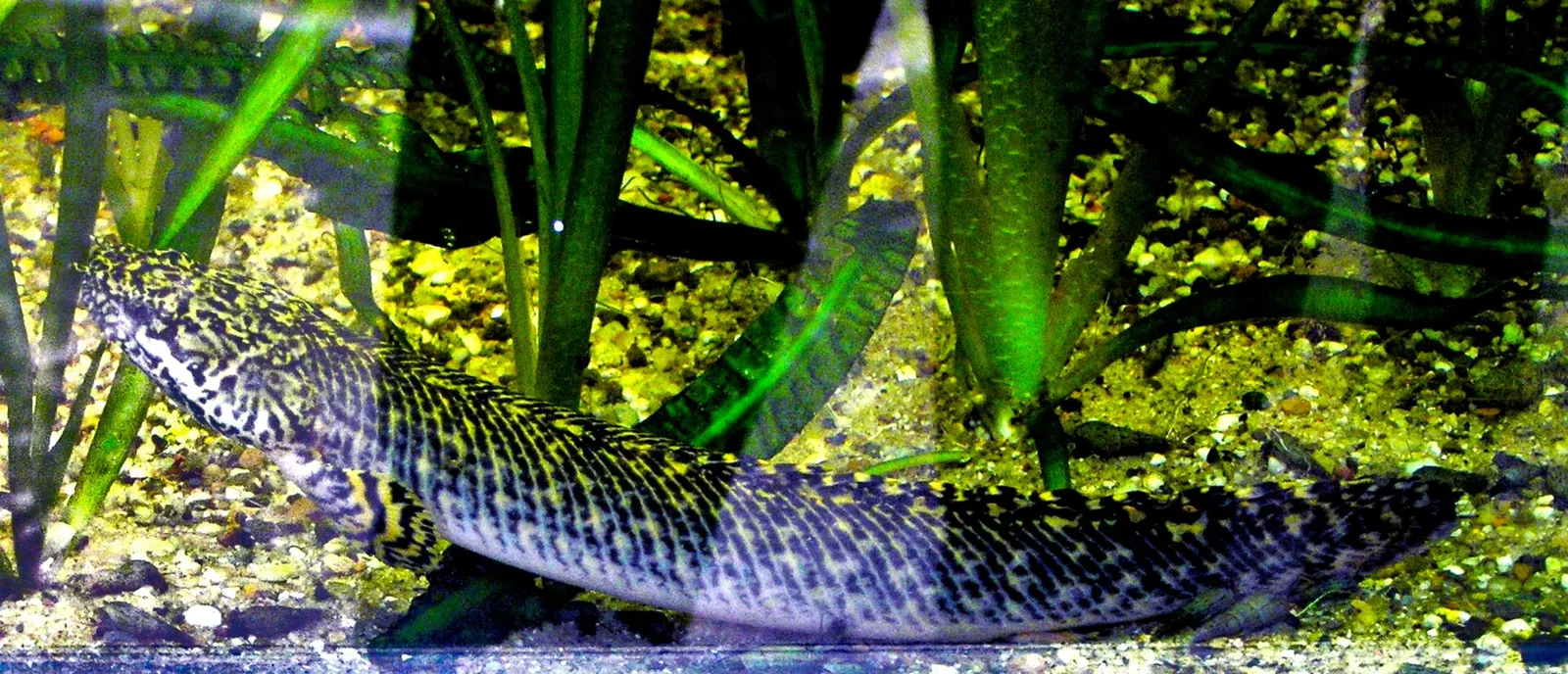
In the hobby it is usually sold as the marbled bichir, for the mottled, blotched pattern that breaks up its body, and sometimes as the shortfin bichir. Trade listings occasionally stretch its range far beyond Upper Guinea into Central Africa, which likely reflects confusion with a closely related Congo basin bichir carrying a similarly marbled pattern; the core, well-documented range of P. palmas is West African, not Congolese, and that West African population is what this account describes.
Morphology
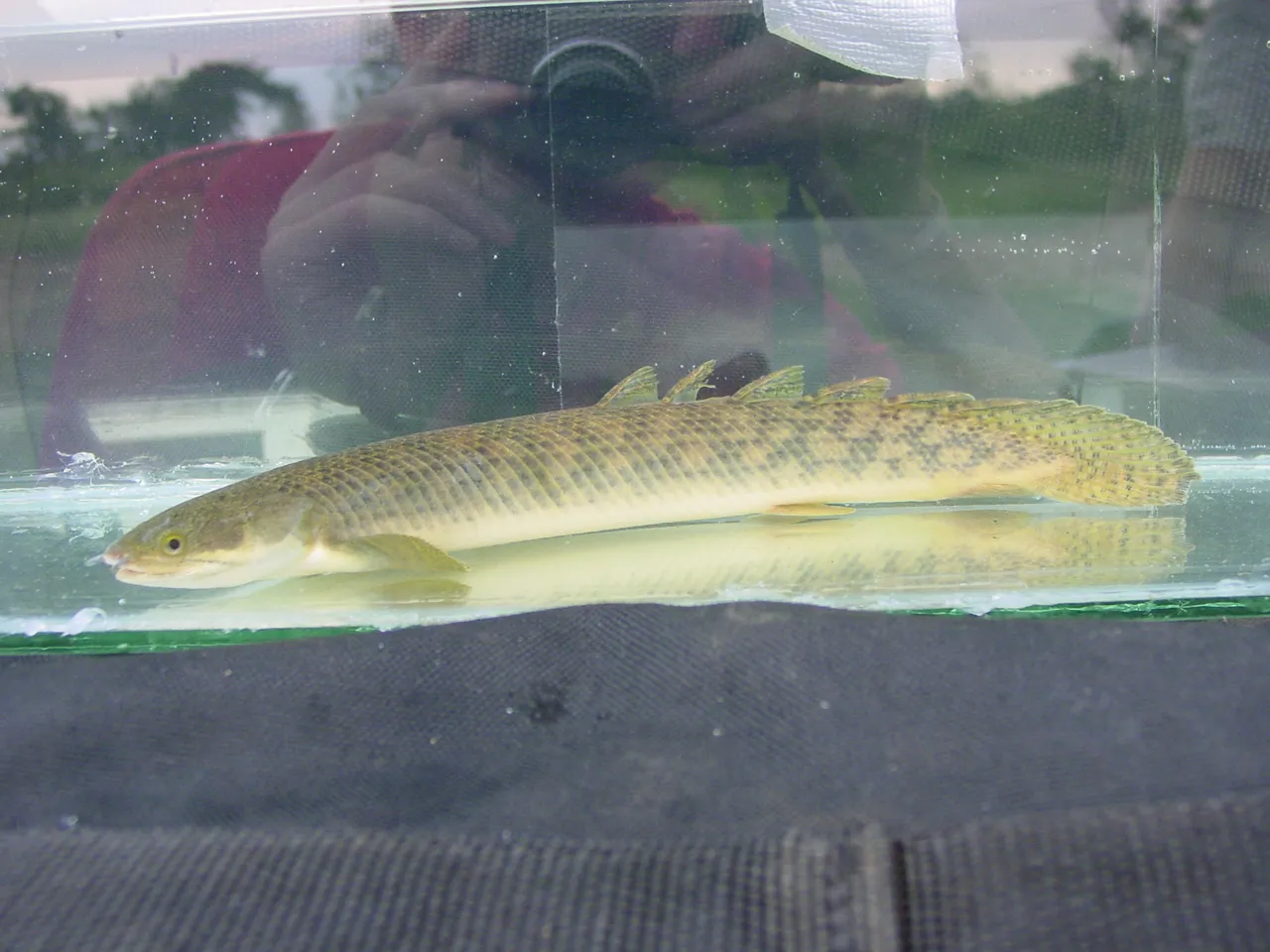
The marbled bichir has the classic bichir silhouette: a long, cylindrical, faintly flattened body, encased in thick, glossy, interlocking ganoid scales — rhombic plates of bone finished in a hard, enamel-like layer that together form a flexible suit of armour. Its base colour is olive to dark brown, broken up by irregular dark blotches and marbling that give the species its common name and help it disappear against leaf litter and root tangles. Along its back runs a row of separate, spine-tipped dorsal finlets rather than a single continuous fin, and its paired pectoral fins sit on short, muscular, limb-like lobes that let it prop itself up and shuffle across the substrate. FishBase records a maximum total length of about 14 in, with most individuals seen in the trade and the aquarium noticeably smaller.
As in the rest of its family, the marbled bichir's real distinction is internal: a pair of primitive, sac-like lungs connected to the gut lets it breathe air gulped at the surface, supplementing its gills in the warm, often oxygen-poor water of its home rivers — a fish cut off from the surface for too long can actually drown. Eyesight is weak, and the species instead relies on a keen sense of smell to find food and navigate after dark.
Habitat
Polypterus palmas is a fish of the Upper Guinea coastal rainforest rivers of West Africa, documented from Guinea-Bissau, Guinea, Liberia — including its type locality at Cape Palmas — the upper Casamance in Senegal, and Côte d'Ivoire. These are warm, soft, often acidic and tannin-stained blackwater systems draining dense coastal rainforest, with water darkened by decaying leaf litter and typically low in dissolved minerals.
Within these rivers the species keeps to slow, sheltered margins thick with driftwood, submerged roots and overhanging vegetation, where it can hide by day and hunt by scent at night. Reported conditions across its range run roughly 75–82 °F with a distinctly acidic pH — as low as 5.5 to 6.0 in some biotope descriptions — a markedly softer, more acidic environment than the hard, alkaline Sudanian rivers some of its wider-ranging relatives, such as the Senegal bichir, also tolerate.
Feeding
The marbled bichir is a strictly carnivorous, nocturnal ambush predator. With poor eyesight but an acute sense of smell, it lies up in cover by day and moves out after dark to hunt over the substrate, locating prey by scent before engulfing it with a quick sideways snap of the jaws. In the wild its diet is opportunistic, built around aquatic invertebrates, worms and any small fish or fry it can catch and swallow whole.
In the aquarium it accepts meaty foods readily once settled: earthworms, prawn, mussel, and frozen or live bloodworm, with many individuals eventually learning to take sinking pellets or wafers. Because it hunts by smell rather than sight and moves deliberately, it is easily outcompeted by fast, bold tankmates at feeding time, so meals are often best offered after the lights go out or dropped close to where the fish is resting.
Mating
As in the rest of the genus, Polypterus palmas reproduces by external fertilisation with an unusual courtship. The male follows and nudges a ripe female, and when spawning begins he cups his thickened, muscular anal and pelvic fins into a shallow pouch beneath her vent; she releases a few small, adhesive eggs at a time into this cradle, which he fertilises before the eggs are shed onto plants and the substrate. The sequence is repeated many times over the course of the spawning bout.
The clearest sign of sex in this species is that same spawning apparatus: mature males carry a visibly broader, thicker anal fin than females, an adaptation for cupping and fertilising the eggs. There is no lasting pair bond and no territory defended beyond the act of spawning itself.
Breeding
Polypterus palmas is an egg-scatterer with no parental care: the small, adhesive eggs are simply left among plants and roots after external fertilisation, and the adults take no further interest in them — indeed both eggs and fry are readily eaten if the parents encounter them again. As in other bichirs, the eggs hatch into larvae bearing feathery external gills behind the head, reminiscent of a salamander tadpole, which are absorbed as the young mature.
Deliberate captive breeding of the marbled bichir is rarely achieved; like most of the genus outside the farm-bred Senegal bichir, it typically needs seasonal or flood-like triggers that are difficult to reproduce reliably in a home aquarium. As a result, the great majority of marbled bichirs in the hobby are still wild-caught rather than tank-bred.
In the aquarium
The marbled bichir asks for the same fundamentals as its relatives, scaled to its more modest adult size. A tight-fitting, gap-free lid is non-negotiable — bichirs are notorious escape artists that will push through the smallest opening, and a fish found dried out on the floor is one of the most common ways keepers lose them — while still leaving a slim air gap at the water's surface for it to breathe. A soft sand substrate, driftwood, and dense planting or other hiding places suit its nocturnal, secretive habits, and dim lighting is appreciated over bright.
Water should lean soft and acidic rather than hard and alkaline, echoing its Upper Guinea blackwater origins, at a stable 75–82 °F. It is a predator first: any tankmate small enough to swallow eventually will be, so companions need to be too large to fit in its mouth and calm enough not to out-compete it for food. Its ganoid armour makes it hardy and more forgiving of medications than scaleless catfish, but keepers should expect a wild-caught animal that benefits from a careful, quarantined start.
Conservation
Polypterus palmas is assessed as Least Concern on the IUCN Red List, reflecting its presence across multiple Upper Guinea river systems in West Africa rather than a single narrow range. No species-specific major threat is documented for it beyond the general pressures facing West African coastal rainforest rivers — deforestation, habitat degradation and water quality changes in the region.
Because the marbled bichir is still predominantly wild-caught for the aquarium trade rather than farmed, as the Senegal bichir now largely is, responsible sourcing and sustainable collection practices remain relevant to its long-term status, even though the species as a whole is not currently considered at risk.