Taxonomy & naming
Polypterus ornatipinnis was described by the Belgian-British ichthyologist George Albert Boulenger in 1902 and is placed in the genus Polypterus, family Polypteridae, order Polypteriformes — the bichirs and the reedfish. This is the most basal living lineage of the ray-finned fishes (Actinopterygii), a branch that split off from all other bony fishes deep in the fossil record; bichirs are genuine "living fossils," retaining ancient features — including functional lungs and heavy enamel-armoured scales — that the rest of the ray-finned fishes lost long ago.
The common name "ornate bichir" describes its elaborate black-and-yellow patterning, among the most decorative of any Polypterus, and it is sometimes described in the hobby as the largest of the so-called "upper-jaw" bichirs. The genus name Polypterus is Greek for "many fins," for its row of separate dorsal finlets; the species epithet ornatipinnis combines Latin ornatus ("adorned, ornate") with pinna ("fin"), literally "ornate-finned" — a fitting name for a fish whose fins and flanks carry such intricate marbling.
Morphology
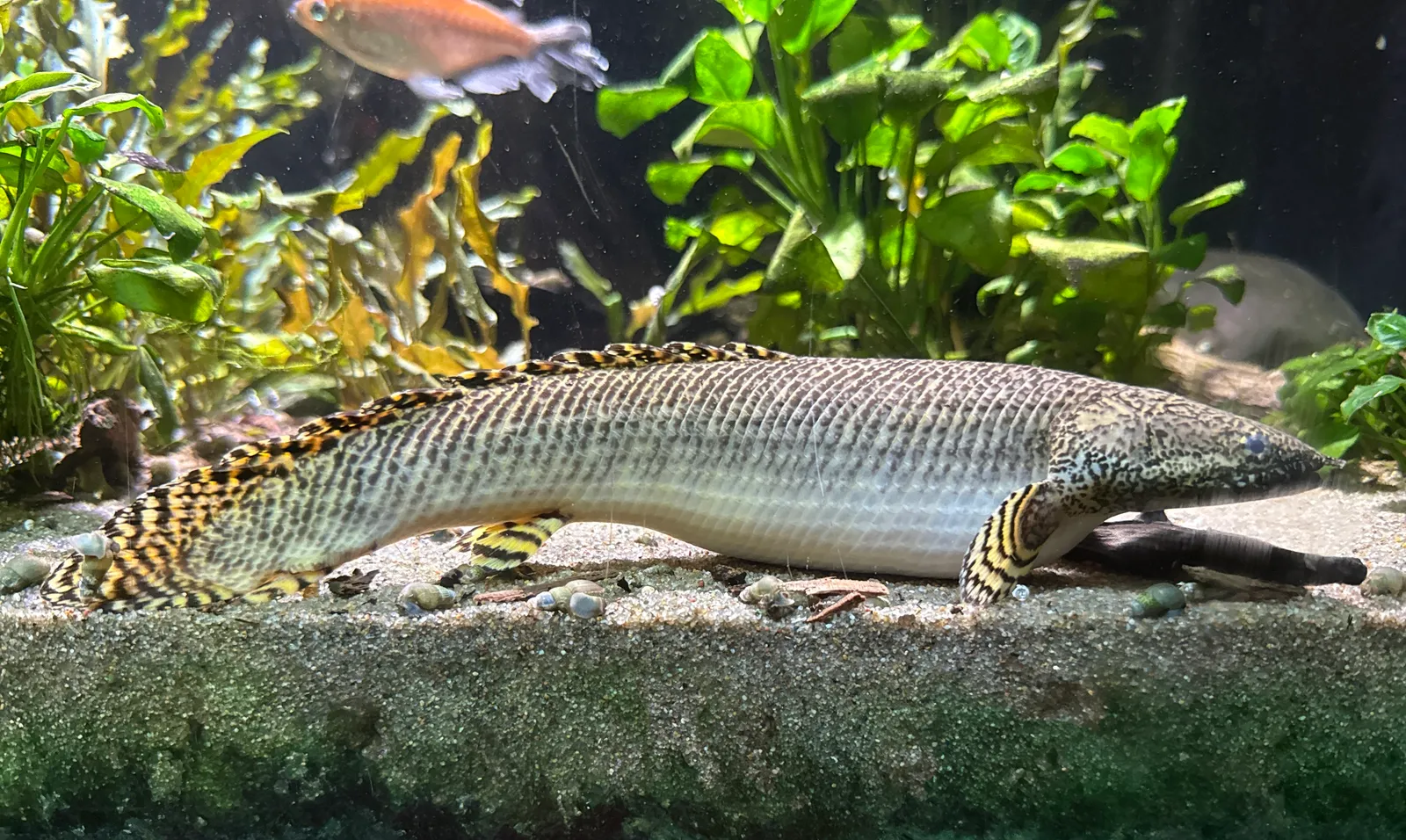
The ornate bichir has the classic bichir body plan: a long, cylindrical, faintly flattened body clad in thick, glossy, interlocking ganoid scales — rhombic plates of bone capped with a hard, enamel-like layer — that form a flexible suit of armour. Rather than a single dorsal fin it carries a row of separate finlets, typically nine to eleven in this species, each a small spine trailing a flag of membrane; the finlet count is one of the most reliable characters for telling Polypterus species apart. The paired pectoral fins sit on fleshy, muscular lobes that work almost like limbs, letting the fish prop itself up and "walk" across the substrate.
Its pattern is the species' signature: a dense, reticulated network of black and cream-to-yellow markings covers the body, head and fins, giving the fish its "ornate" name and making it one of the most attractive bichirs in the trade. It is also one of the larger commonly kept species, reaching up to about 23.5 in total length in the wild, though aquarium specimens usually settle around 17.5 in. As in all bichirs, eyesight is poor and hunting relies chiefly on smell; the dorsal finlets can be folded down into a groove along the back, allowing the fish to reverse through tight gaps and holes. Behind the gills lies a pair of primitive, air-breathing lungs — the fish must periodically rise to the surface to gulp air, and one denied that access can drown.
Habitat
Polypterus ornatipinnis is native to central Africa, with a range centred on the Congo basin and reported from Cameroon, the Central African Republic, the Democratic Republic of the Congo, Angola, Burundi and Tanzania. Unusually for a bichir, it is also recorded from Lake Tanganyika itself, alongside its more typical riverine and floodplain habitat — slow, often tea-stained rivers, marshes and lake margins with abundant cover.
These are warm, structurally complex waters, and the species tolerates a fairly broad range of chemistry, from mildly acidic to slightly alkaline. It favours quiet, vegetated margins over open water, where its camouflage pattern and nocturnal habits let it lie up by day and hunt after dark.
Feeding
The ornate bichir is a strict carnivore and an ambush predator of the bottom and mid-water at night. With weak eyesight but an acute sense of smell, it locates prey — aquatic invertebrates, crustaceans, and any fish or amphibian small enough to fit in its mouth — largely by scent before engulfing it with a sudden sideways strike.
In the aquarium it takes meaty foods readily: earthworms, prawn, mussel, and whole fish or frozen foods, with many individuals eventually accepting sinking pellets. Because it hunts by smell and moves deliberately, it is easily outcompeted by fast, sighted tankmates at feeding time, so meals are best offered after dark or placed close to where the fish is resting.
Mating
As in the rest of the family, ornate bichirs reproduce by external fertilisation with an unusual courtship. A male follows a ripe female and, when she is ready to spawn, cups his thickened, muscular anal and pelvic fins into a shallow pouch; the female releases a few adhesive eggs at a time into this cradle, and the male fertilises them there before they are scattered onto plants and the substrate. The sequence repeats many times, typically triggered by the onset of the rainy season in the wild.
The sexes are distinguished chiefly by this spawning apparatus: mature males carry a visibly broader, thicker anal fin than females, an adaptation for cupping the eggs during release. There is no lasting pair bond and no territory defended beyond the spawning act itself.
Breeding
Polypterus ornatipinnis is an egg-scatterer with no parental care: the small, adhesive eggs are deposited among plants and left to develop unguarded, and adults will consume both eggs and fry if given the chance. Eggs hatch in roughly three to four days into larvae that, like other bichirs, bear feathery external gills behind the head — reminiscent of a newt's — which are absorbed as the fry mature.
Deliberate spawning is difficult to achieve in home aquaria and is usually associated with seasonal, flood-like cues — softened, warmed water and a densely planted tank. Tank-bred specimens do reach the trade, but they remain rarer than wild-caught fish, which still make up most of the ornate bichirs sold.
In the aquarium
The ornate bichir is a large, long-lived fish that needs correspondingly serious accommodation: a minimum tank in the region of 71 in long (roughly 170 US gal) for a single adult, furnished with soft sand, driftwood, and caves or dense planting for daytime cover, under dim lighting suited to a nocturnal hunter. It is tolerant of a range of water chemistry and, thanks to its ganoid armour, more forgiving of medications than scaleless catfish tankmates.
Two points matter more than any water parameter. First, the lid: bichirs are notorious escape artists that exploit any gap, and a fish found dried out on the floor is the most common way keepers lose them, so the tank must be fully and tightly covered while still leaving an air gap for the fish to breathe. Second, tankmates: this is a predator that will swallow anything that fits in its mouth, so companions must be too large to eat and calm enough not to harass a slow-moving, nocturnal fish. Given space, security and a varied meaty diet, the ornate bichir is hardy and can live for many years, but prospective keepers should budget for its adult size and remember that most individuals offered for sale are still wild-caught.
Conservation
Polypterus ornatipinnis is assessed by the IUCN as Least Concern. It has a wide range spanning much of the Congo basin and extending into Lake Tanganyika, and no major species-wide threats have been identified in that assessment.
As with other widespread Congo basin fishes, local pressures such as habitat disturbance and collection for the aquarium trade can affect populations regionally even where the species as a whole remains secure. The continued, if still limited, availability of tank-bred stock is a modest positive for reducing reliance on wild-caught fish.