Taxonomy & naming
Polypterus senegalus was described by Georges Cuvier in 1829 from the Senegal River, and is placed by the Catalog of Fishes in the genus Polypterus, family Polypteridae, order Polypteriformes. The Polypteridae — the bichirs and the reedfish — are the most basal living lineage of the ray-finned fishes (Actinopterygii), a branch that separated from all the others deep in the fossil record; they are true “living fossils,” retaining a suite of ancient features that the rest of the ray-finned fishes have long since lost. They are bony fishes, but very unusual ones.
The species is widely sold under a string of trade names — “dinosaur bichir,” “dinosaur eel” (a misnomer: it is not an eel) and “dragon fish” — and FishBase calls it the gray bichir for its plain colour. Older literature split it into subspecies, a widespread nominate P. senegalus senegalus across the Nilo-Sudan rivers and a Congo form once called P. s. meridionalis, but for the aquarist it is simply the Senegal bichir. The genus name means “many fins,” for the distinctive row of finlets along the back; the epithet marks the Senegal, where the type specimen was caught.
Morphology
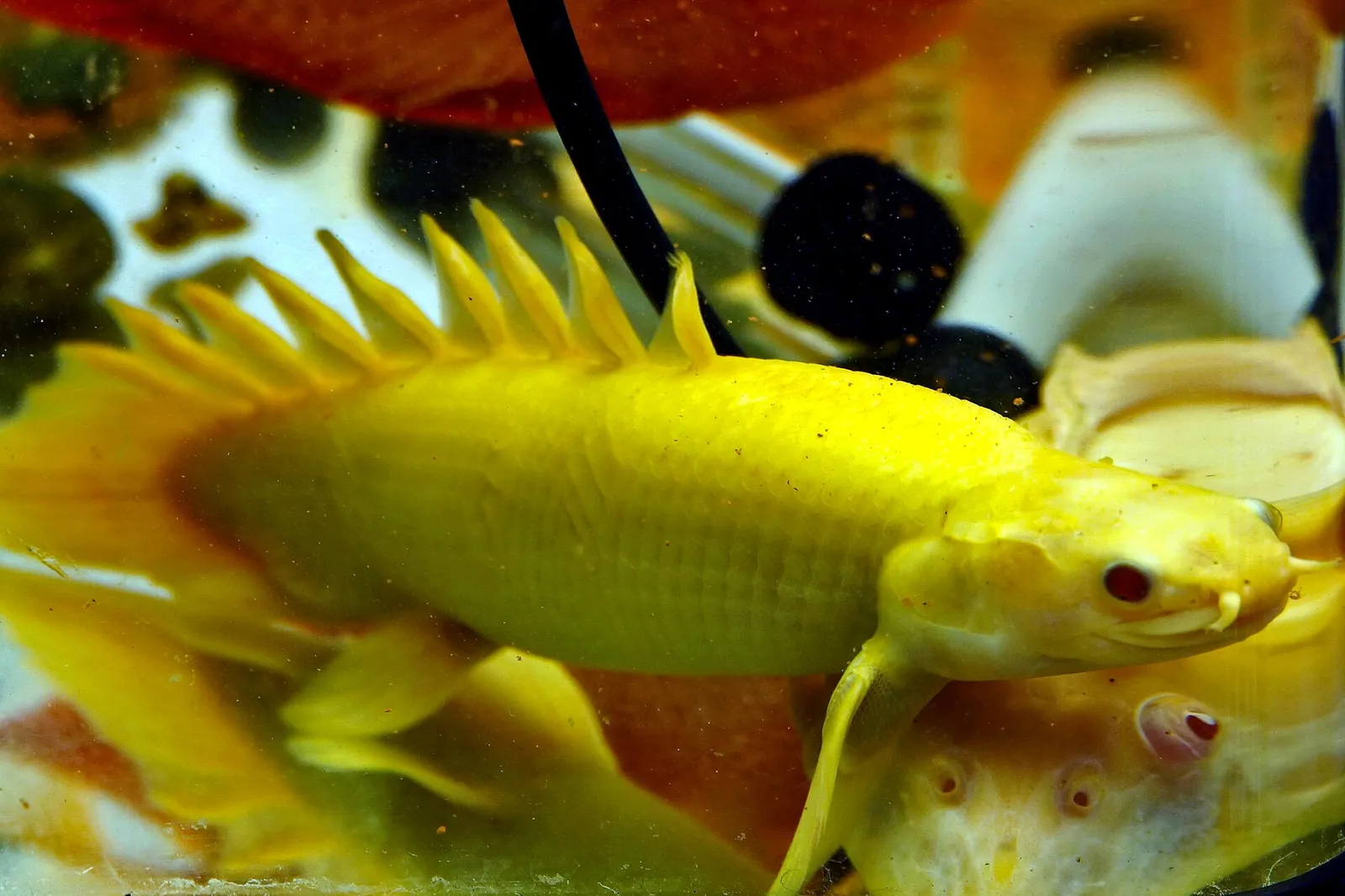
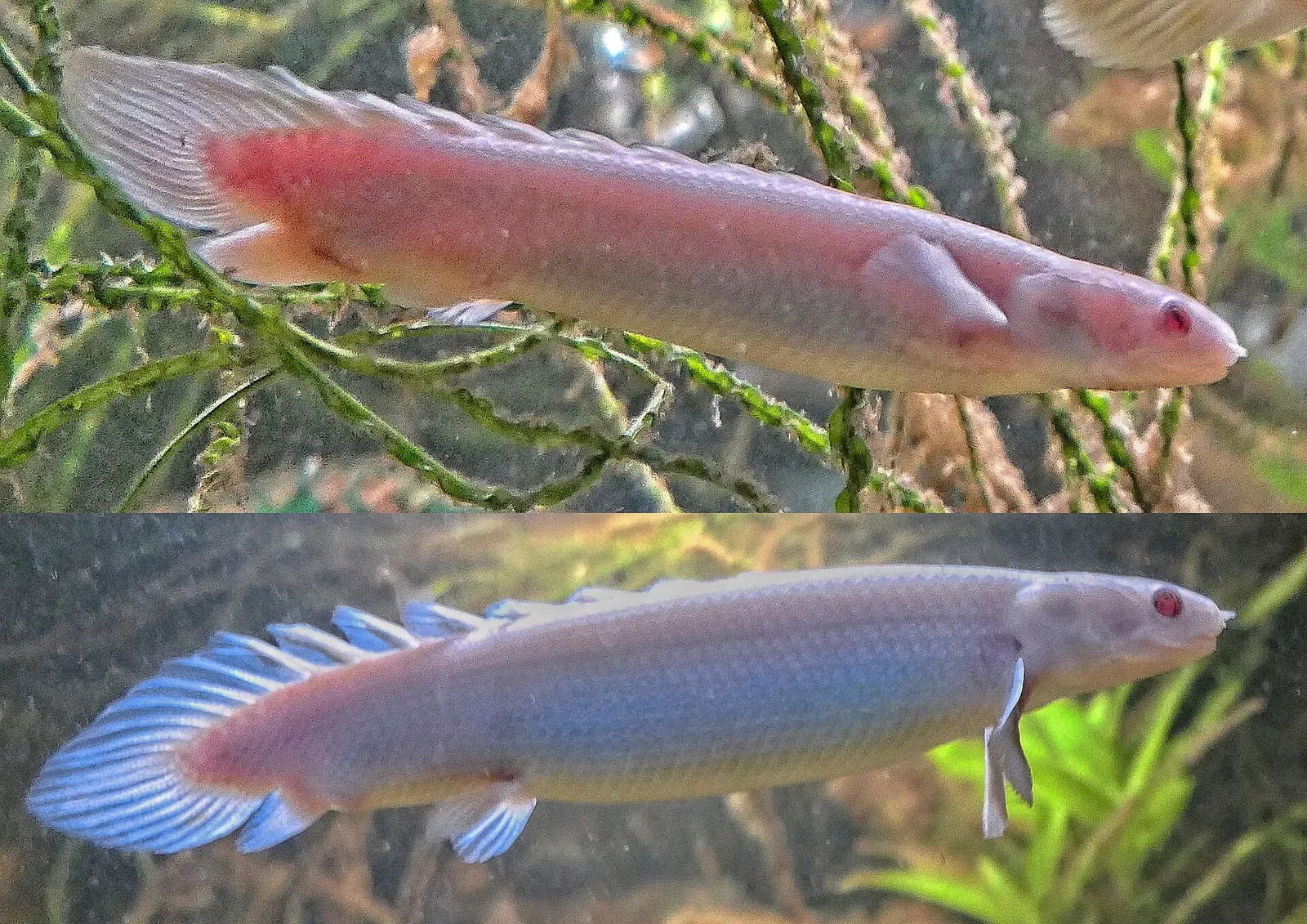
The Senegal bichir has the unmistakable bichir body plan: long, cylindrical and slightly flattened beneath, ash to olive-grey above and pale below, sometimes faintly barred in young fish. The dorsal fin is not a single sail but a row of separate finlets — usually eight or nine in this species — each a small spine trailing a flag of membrane, running from mid-back to the tail. The paired pectoral fins are set on fleshy, muscular lobes that work like little limbs, letting the fish prop, crawl and “walk” across the bottom. The whole body is sheathed in thick, glossy, interlocking ganoid scales — rhombic plates of bone capped in a hard enamel-like layer — that form a flexible suit of armour. Adults commonly reach about 10–14 in in total length in the aquarium; FishBase records exceptional wild fish to around 27.5 in, but such sizes are rarely seen.
Inside, the bichir is even more remarkable. Behind the gills lies a pair of lungs — primitive, sac-like, and connected to the gut — with which the fish breathes air taken at the surface; a bichir denied access to the surface can actually drown. Its eyesight is poor, but it hunts by an acute sense of smell, and its larvae hatch with feathery external gills like those of a newt. The Senegal bichir became briefly famous in a 2014 experiment in which juveniles raised on land walked more efficiently on their pectoral lobes — a living illustration of how the earliest vertebrates may have come ashore.
Habitat
Polypterus senegalus is one of the most widely distributed of all the bichirs, recorded right across the Sudano-Sahelian belt of Africa: the Senegal and Gambia in the west, through the inland Niger and the Lake Chad basin, to the White Nile and the lakes Turkana and Albert in the east, with a separate population in the middle and upper Congo. It is a fish of warm, slow, often turbid lowland waters — the margins of rivers, floodplain swamps, oxbow lakes and seasonally flooded grassland, over mud and sand among dense vegetation.
These are exactly the waters where a lung earns its keep. Sahelian floodplains grow hot, still and starved of oxygen in the dry season, and a fish that can rise and gulp air survives where gill-breathers suffocate; some bichirs will even move overland through wet grass between shrinking pools. The species tolerates a wide range of conditions — warm water, roughly 77–84 °F, and pH from mildly acidic to distinctly alkaline over the hard Sudanian rivers — which is a large part of why it adapts so readily to the aquarium.
Feeding
The Senegal bichir is a carnivore and an ambush predator of the bottom. With poor eyes but an excellent nose, it hunts largely by scent, cruising slowly over the substrate at night and locating prey by smell before engulfing it with a quick sideways snap of the jaws. Wild fish take aquatic insect larvae, worms, crustaceans, molluscs, amphibians and any small fish they can catch; the diet is opportunistic and the rule is simple — if it fits in the mouth, it is food.
In the aquarium it feeds readily on meaty foods: earthworms, prawn and mussel, and whole frozen or live foods such as bloodworm for young fish. Many individuals learn to take sinking pellets. Because it hunts by smell and moves slowly, it can be outcompeted at feeding time by fast, greedy tankmates, so it is often best fed after dark or with food placed near it. It is a slow, deliberate feeder that does well on two or three meals a week as an adult, and is prone to obesity if overfed.
Mating
Bichirs reproduce by external fertilisation, but with a courtship all their own. When a female is ready to spawn, a male follows and nudges her, and the pair swim together among plants; the male then cups his thickened, muscular anal and pelvic fins into a shallow pouch, into which the female releases a few eggs at a time. The male fertilises them in this cradle and the eggs, which are small and adhesive, are scattered onto plants and the substrate. The whole sequence is repeated many times over hours or days.
The sexes are told apart chiefly by this spawning equipment: the male's anal fin is noticeably broader and thicker than the female's, especially in breeding condition, while females tend to grow a little larger and heavier-bodied. There is no pairing beyond the act of spawning and no defence of a territory — the relationship ends when the last eggs are laid.
Breeding
Polypterus senegalus is an egg-scatterer with no parental care whatever: the adhesive eggs are simply left among fine-leaved plants, and the adults take no further interest — and will eat both eggs and fry given the chance. The eggs hatch in three to four days into tiny larvae that cling to plants and, remarkably, breathe through a pair of feathery external gills sprouting behind the head, much like the tadpoles of a salamander; these are absorbed as the young develop. The fry take microscopic live foods and grow steadily.
Spawning is rarely achieved deliberately in home aquaria — it is usually triggered by seasonal cues, softer and warmer water simulating the flood, and a well-planted tank — and most bichirs in the trade are still wild-caught. The Senegal bichir is the notable exception: it is now produced in quantity on commercial fish farms, often with hormone induction and pond rearing, which is why it is the cheapest and most consistently available bichir and, increasingly, a captive-bred rather than wild-caught animal.
In the aquarium
The Senegal bichir is the best beginner's bichir and a genuinely rewarding fish, but it is bought too small far too often. An adult needs a long tank with plenty of floor space — a 47 in, roughly 250-litre aquarium is a sensible minimum for one — furnished with a soft sand bed, driftwood and caves to shelter in by day, and dim lighting to suit a nocturnal hunter. It is undemanding about water chemistry, thriving anywhere from soft and slightly acidic to hard and alkaline at 77–84 °F, and its ganoid armour makes it far tougher and more forgiving of medications than the scaleless catfishes.
Two cautions matter more than any water parameter. First, the lid: bichirs are determined escape artists that will push through the smallest gap, and a fish found dried on the floor is the commonest way keepers lose them — the tank must be fully and tightly covered, while still leaving an air gap at the surface for the fish to breathe. Second, tankmates: this is a predator that will swallow anything it can fit in its mouth, so companions must be too large to eat and too peaceful to bully it. Given a big, calm community of similar-sized fish, a secure lid and a varied meaty diet, a Senegal bichir is hardy, personable and can live for a decade or more.
Conservation
Polypterus senegalus is assessed as Least Concern on the IUCN Red List. It is one of the most widespread fishes of the Sudano-Sahelian rivers, tolerant of a broad range of conditions, and it is not dependent on the aquarium trade — much of the supply is now farm-bred rather than taken from the wild. Across most of its enormous range it remains common, and it faces no species-wide threat.
That security is regional, not universal. The Sahelian and Nile floodplains it depends on are under mounting pressure from water abstraction, damming, drought and the draining of wetlands, and local populations can be reduced where those habitats are lost. As a hardy, air-breathing generalist the Senegal bichir is better placed than most to ride out such change, and the growth of commercial captive breeding is a genuine conservation positive: it takes the pressure off wild stocks for a fish that is easy and cheap to farm.