Taxonomy & naming
Chitala hypselonotus was described by the Dutch ichthyologist Pieter Bleeker in 1851. It belongs to the family Notopteridae, the Old World featherback knifefishes, within the order Osteoglossiformes — the bonytongues, an ancient teleost lineage whose living members are scattered across four continents (South America's arowanas, Africa's butterflyfish and featherbacks, and the Asian and Australasian arowanas and featherbacks). The Catalog of Fishes and GBIF both confirm (Bleeker, 1851) as the standing authority combination and place the species in genus Chitala.
The genus name Chitala derives from a local Bangladeshi name for the related featherback Chitala chitala; the species epithet hypselonotus comes from the Greek hypselos ("high") and notos ("back"), describing the pronounced humped profile behind the head that is typical of the genus. Notopteridae itself is an entirely Old World family, ranging from India across Indochina and the Sundaland islands (this species) to sub-Saharan Africa (Papyrocranus, Xenomystus) — it should never be confused with the New World electric knifefishes of Gymnotiformes, which resemble it only by convergent evolution of a similar blade-bodied, undulating swimming style.
Morphology
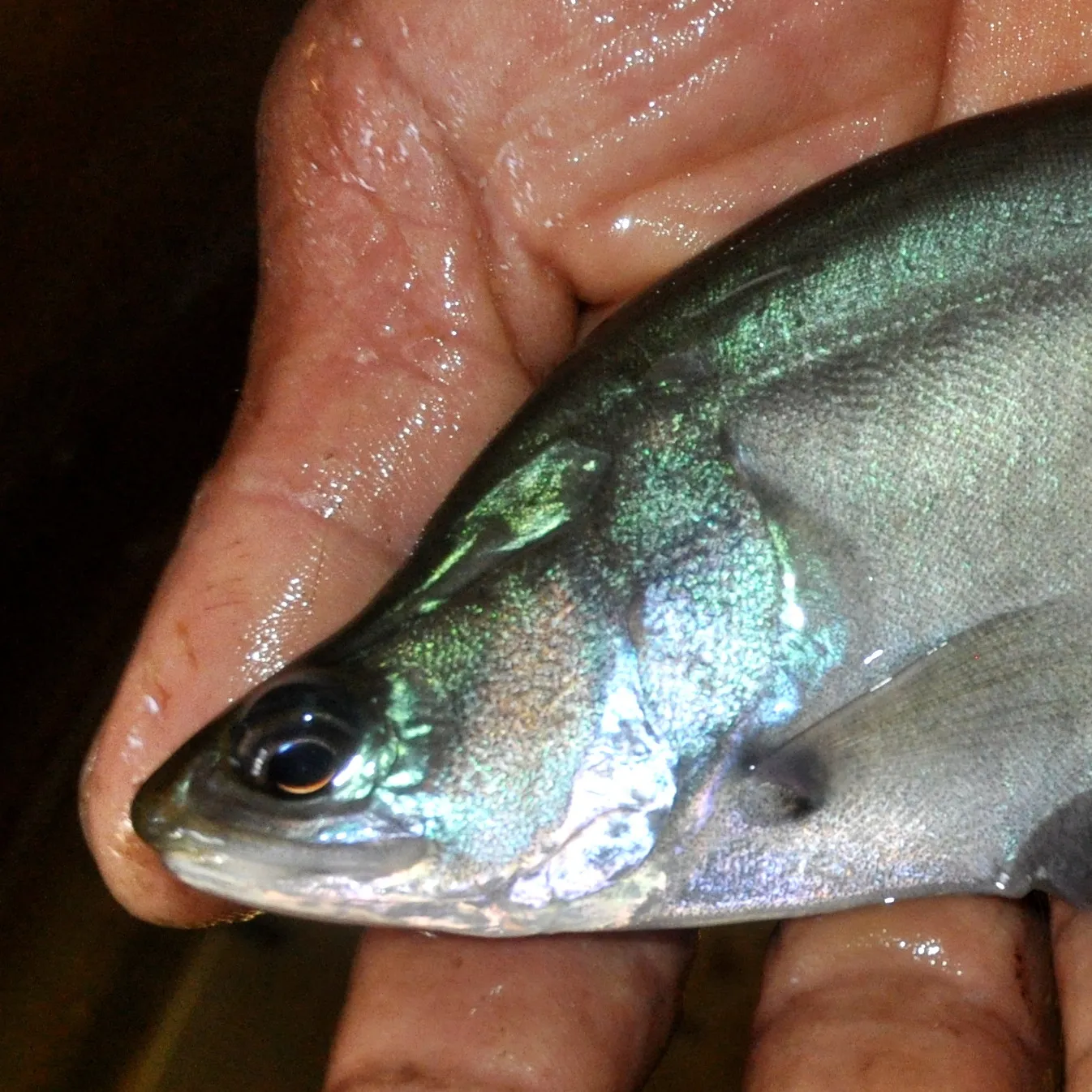
Like every Chitala, the Sumatran featherback has a laterally compressed, blade-shaped body that tapers from a humped, deep-bodied front half to a narrow tail, with a long ribbon-like anal fin that runs almost the length of the underside and fuses into the caudal fin. The dorsal fin is reduced to a small flag set well back on the body. Propulsion comes almost entirely from undulating that long anal-fin ribbon, which lets the fish glide forward, reverse, and hover with an eerie, minimal-effort economy of motion rather than swimming with a conventional beat of the tail.
FishBase documents a maximum size of about 39.5 in total length and 15 kg for this species — figures that put it firmly among the large-bodied Chitala, alongside the better-known clown knife (C. ornata) and giant featherback (C. lopis). It is a facultative air-breather, drawing atmospheric oxygen through a vascularised swim bladder that supplements gill respiration, an adaptation that lets it tolerate the warm, often low-oxygen, turbid waters of tropical floodplains and forest streams. Detailed colour-pattern description for this species is not well documented in the sources consulted; data sparse.
Habitat
Chitala hypselonotus is endemic to the island freshwaters of Sumatra and Borneo, Indonesia (FishBase; GBIF). Within that range, adults occupy tropical freshwater lakes and large lowland rivers, while juveniles are found instead in smaller forest streams — an ontogenetic shift that sees young fish start out in tighter, more sheltered water before moving into open lake and river habitat as they grow toward their eventual large adult size.
As a facultative air-breather it is well suited to the warm, slow-moving, often turbid blackwater and floodplain systems typical of Sundaland, where dissolved oxygen can run low, especially at night when the species is most active. Detailed limnological data (temperature, pH, flow) for the wild habitat is not covered in the sources consulted here; hobby-tank parameters below reflect captive-care guidance rather than a direct field measurement.
Feeding
In the wild, Chitala hypselonotus is a carnivore that takes fish and crustaceans (FishBase), consistent with the family's role as nocturnal ambush predators. It hunts mostly after dark, using its blade shape and undulating anal fin to hold position or drift almost motionlessly close to cover before striking at passing prey — a strategy that favours stealth and a wide gape over pursuit speed.
In the aquarium it is reported as carnivorous and is best offered live or frozen meaty foods; it can be reluctant to accept dry or prepared diets, particularly as a wild-caught or recently imported specimen. Feeding after lights-out, or once tank lighting has dimmed, matches its natural nocturnal foraging pattern and tends to get the best response from a shy new fish.
Mating
Species-specific courtship and spawning behaviour for Chitala hypselonotus is not documented in the sources consulted; data sparse. What is well established for the featherback family (Notopteridae) as a whole — and for the better-studied Chitala species such as the clown knife — is a substrate-spawning strategy: adhesive eggs are laid onto a hard surface such as submerged wood, a root, or a rock, rather than scattered freely into open water or brooded in the mouth.
Given that pattern across the genus, courtship in this species most plausibly follows the same template, with a pair (or a male defending a site against rivals) selecting and clearing a hard surface ahead of spawning. This remains an inference from family-level biology rather than a confirmed observation for C. hypselonotus specifically.
Breeding
Featherbacks in genus Chitala are substrate egg-layers: eggs are deposited in a single layer, adhesive side down, onto a hard surface — submerged wood, a root mass, a rock face, or in captivity a length of pipe or an upturned pot — rather than scattered or mouth-brooded. Parental care in the genus is provided by the male, who guards the clutch and fans it with his fins to keep it aerated and free of silt and fungus until the eggs hatch.
No aquarium spawning account for Chitala hypselonotus specifically was found in the sources consulted; the species is described as rare in the aquarium trade, and its large adult size (up to 39.5 in, 15 kg) makes captive breeding a practical rarity outside large public or research facilities. The breeding mode given here (substrate egg-layer, male-guarded) reflects documented Notopteridae biology rather than a species-specific captive record; data sparse for hypselonotus itself.
In the aquarium
Chitala hypselonotus is described as challenging to keep and rare in the aquarium trade. Hobby guidance gives a temperature range of about 72–77 °F, pH 6.2–7.2 (soft to neutral), and water hardness of 6–16 °dH, with a minimum tank size cited around 350 US gallons — a figure that reflects the fish's eventual adult size rather than what a juvenile needs on day one. That gap is the core risk with this species: it is sold small, but a documented maximum of 39.5 in total length and 15 kg means any keeper taking one on is committing to a genuinely enormous, permanent aquarium, not a starter tank that can be upgraded casually later.
As a carnivorous nocturnal ambush predator it should be kept only with tankmates too large to be swallowed; anything that fits in its mouth is at risk over time, and it is unsuited to a general community tank. It prefers dim lighting, open swimming space, and solid cover (driftwood, overhangs) to retreat to by day, doing most of its feeding and activity after dark. Because it is a facultative air-breather, access to the surface matters, and — as with all knifefish-shaped bonytongues — a secure, well-fitted lid is worth having in general, even though jumping is more strongly documented in the arowanas of this order than specifically reported for this species. Given its rarity in the trade and its demands, this is a fish for an experienced keeper with the space to match its true adult size, not an impulse purchase.
Conservation
The IUCN Red List assesses Chitala hypselonotus as Least Concern, an assessment dated 30 August 2019. The available assessment notes the population as still abundant throughout its known distribution in Sumatra and Borneo, and the species has not been evaluated under CITES.
FishBase flags a real, if moderate, pressure: the species is used commercially, with its skin used for leather, and it carries a relatively high vulnerability-to-fishing score (60 out of 100) in FishBase's standard vulnerability index — a measure of how quickly a species' biology (growth rate, size, longevity) could let sustained fishing pressure erode a population, not a current threat classification. Combined with its Least Concern status and reported wild abundance, the honest read is a species not currently at risk range-wide, but one whose large size and commercial use make it worth continued monitoring rather than complacency.