Taxonomy & naming
Corydoras davidsandsi was described in 1987 by B. Black, in a paper on a new Corydoras from the Rio Unini, Amazonas, Brazil; the type locality is given as the Rio Unini in the whitewater-influenced lower reaches of the Rio Negro. It was placed in Corydoras Lacépède, 1803 — the huge genus of South American armoured catfishes (family Callichthyidae) — and the epithet honours the English aquarist, ichthyological writer and publisher David Sands, so the species reads 'Sands' cory'.
The genus Corydoras had grown to well over 170 species and was shown by molecular work not to be a single natural group. In 2024 Dias, Tencatt and colleagues published a phylogenetic revision splitting it into several genera, and under that scheme davidsandsi falls into the resurrected Hoplisoma Swainson, 1838. The Catalog of Fishes now records the species as 'valid as Hoplisoma davidsandsi (Black 1987)', the combination also adopted by Planet Catfish and FishBase. The change is recent and not yet universal — the trade still says 'Corydoras davidsandsi' — so we keep that heading while noting the current valid combination. The fish sits among the so-called aeneus / adolfoi assemblage of black-striped corys, and much of its hobby story is about telling it apart from its near-twins.
Morphology
This is a small cory, reaching about 1.5–2.5 in standard length, females growing larger and fuller-bodied than males. The build is the standard corydoradine one — a stocky, plated body in two overlapping rows of bony scutes, a hard helmet of a head, three pairs of barbels around the downturned mouth, and a stiff leading spine in the dorsal, pectoral and adipose fins.
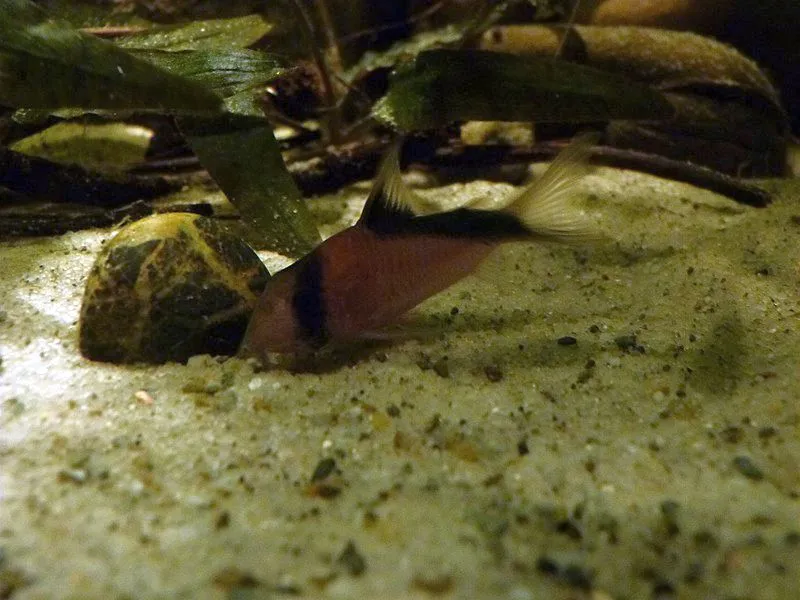
It is the colour pattern that defines davidsandsi. The body ground is a clean, pale tan, essentially unspeckled. A dark bar runs vertically through the eye — the classic 'mask'. A bold black stripe runs along the ridge of the back from the nape, broadening over the dorsal and continuing down the upper caudal peduncle into the lower lobe of the tail; above the caudal peduncle this dorsal band tends to split into two. Between the eye-mask and the dorsal stripe lies a pale, often warm-orange or coppery patch on the shoulder, and the flanks are otherwise free of additional dark blotching. That combination — clean tan body, crisp eye-bar, an uninterrupted black dorsal stripe and an open orange shoulder — is what separates it from its lookalikes: from Hoplisoma metae (shorter snout, stripe stopping at the caudal peduncle) and from H. melini (a two-line pattern behind the dorsal and a dirtier ground colour), as well as from the broadly similar adolfoi and imitator.
Habitat
Corydoras davidsandsi is restricted to the Rio Unini system, a left-bank tributary in the lower Rio Negro basin of Amazonas, Brazil. The original description calls the type area 'whitewater', but the broader Rio Negro region is the archetypal blackwater — tannin-stained, soft, low-conductivity, acidic water draining sandy, podzolised forest. In practice the fish lives in tributary channels and flooded forest over soft sand and leaf litter, in warm tropical lowland water.
The water it wants is soft and warm: temperatures around 68–79 °F, an acidic to near-neutral pH (roughly 6.0–7.2), and soft water with very little hardness. Hobby sources note it as a species that appreciates a little current, consistent with a tributary fish rather than a still-pool one. Like other corys it is a facultative air-breather, surfacing to gulp air and absorb oxygen through a vascularised hindgut, which buffers it against the low-oxygen conditions of warm forest streams.
Feeding
Sands' cory is a benthic foraging omnivore, working the bottom for small invertebrates, worms, insect larvae and detritus, sifting sand through its gills as it tastes out food with its barbels. In the aquarium it readily takes sinking dried foods — tablets, granules and larger flakes — together with frozen and live bloodworm, Tubifex, Daphnia, and grindal or white worm. As with all corys a varied diet matters, and conditioning live or frozen foods are particularly useful for bringing a group into breeding condition; it should never be expected to live on what the other fish leave behind.
Mating
Corydoras davidsandsi is a typical T-position spawner with no pair bond. When a female is ripe the group becomes active; a male presses against her at right angles in the classic 'T', clasping her barbel region with his pectoral fin, and she takes his milt at the mouth. Sperm is thought to pass swiftly through the gut to fertilise the small clutch of eggs she holds in a pouch formed by her pelvic fins, which she then carries to a cleaned surface — plant, glass or stone — and presses into place. Hobby observers report spawning beginning in the morning, the female depositing eggs a few at a time. As in other corys, a group skewed toward more males than females spawns most reliably.
Breeding
Captive spawning has been documented by hobbyists and follows the standard cory pattern, with the species treated as a moderately rewarding breeder rather than a commercial mass-producer. A large (50–70%) cool water change, with extra oxygenation and flow to imitate rains, is the usual trigger; soft, slightly acidic, warm water suits it. Reported clutches are modest — early spawns of only a handful of eggs (around 5–14) building to 20–50 in established groups — laid in batches on plants and glass with no parental care, so the breeder removes the eggs or the adults to prevent predation. Eggs hatch in about three days; once the yolk sac is absorbed the fry take microworm and then Artemia nauplii, and daily water changes are important to carry them through. A 2:1 male-to-female stocking is recommended for a working breeding group.
In the aquarium
Corydoras davidsandsi is a handsome, manageable soft-water cory, a little less ubiquitous than the trade staples but kept on the same principles. It is a shoaling fish and is stressed alone or in twos — keep six or more and the group is confident and active. A tank with a footprint of around 90 × 12 in or larger suits a group, bottom area mattering more than height.
Substrate is close to mandatory: soft sand, or at most smooth rounded fine gravel. Corys feed by sifting, and sharp or chipped gravel erodes and infects their barbels, leaving the blunted faces that mark poor husbandry; keep the bottom clean. Water should be warm (about 68–79 °F), soft and acidic to neutral, well-filtered and oxygenated, with gentle current and shaded cover from wood, rockwork and plants. It is entirely peaceful and ideal alongside small tetras, pencilfish, dwarf cichlids and other calm soft-water community fish. The two universal cory cautions apply: the fin spines snag in nets, so move them in a cup or bag, and a badly stressed cory can release a skin toxin that may kill a whole bagful in transit — so transport them carefully and not crowded.
Conservation
Corydoras davidsandsi has not been assessed by the IUCN Red List, and FishBase carries no threat category for it. As a narrow-range endemic of a single Rio Negro tributary system rather than a continent-wide generalist, its conservation status is genuinely unknown, and that restricted distribution is itself a reason for caution: a fish confined to the Rio Unini and nearby reaches is more exposed to localised pressures — habitat disturbance, deforestation in the catchment, and the collection pressure of the ornamental-fish trade — than a widespread weedy cory. The wider Rio Negro remains comparatively well-preserved and supports a major, partly managed ornamental fishery, but no published assessment exists for this species specifically. Captive breeding, where hobbyists take it up, reduces reliance on wild-caught stock.