Taxonomy & naming
Corydoras imitator was described in 1983 by the Dutch ichthyologists Han Nijssen and Isaäc Isbrücker, from the upper Rio Negro in eastern Amazonas, Brazil — the type material associated with forest brooks near São Gabriel da Cachoeira. The name says exactly what the fish does: imitator, 'the imitator,' for its mimicry of the colour pattern of the already-known Corydoras adolfoi.
For four decades it sat in Corydoras Lacépède, 1803 (family Callichthyidae). But molecular work had long shown that genus to be an artificial grab-bag, and the long-snouted corys — Alexandrou and colleagues' 'Lineage 1,' the Corydoras acutus species-group — sit apart from the short-snouted majority. In 2024 Dias, Tencatt and colleagues published a sweeping revision (Zoological Journal of the Linnean Society, doi:10.1093/zoolinnean/zlae053) that split the old genus into several, and the long-snouted lineage was placed in the resurrected genus Brochis. Under that scheme this fish becomes Brochis imitator, and FishBase, the Catalog of Fishes and Planet Catfish now list it that way (Planet Catfish files it as 'Brochis sub-clade 3'). The aquarium trade still says 'Corydoras imitator,' so we keep that heading while recording the current combination. The crucial taxonomic point is the punchline of the mimicry: its co-mimic adolfoi is a short-snouted fish that the same revision placed in a different genus, Hoplisoma — so the two near-identical fish are not close relatives at all.
Morphology
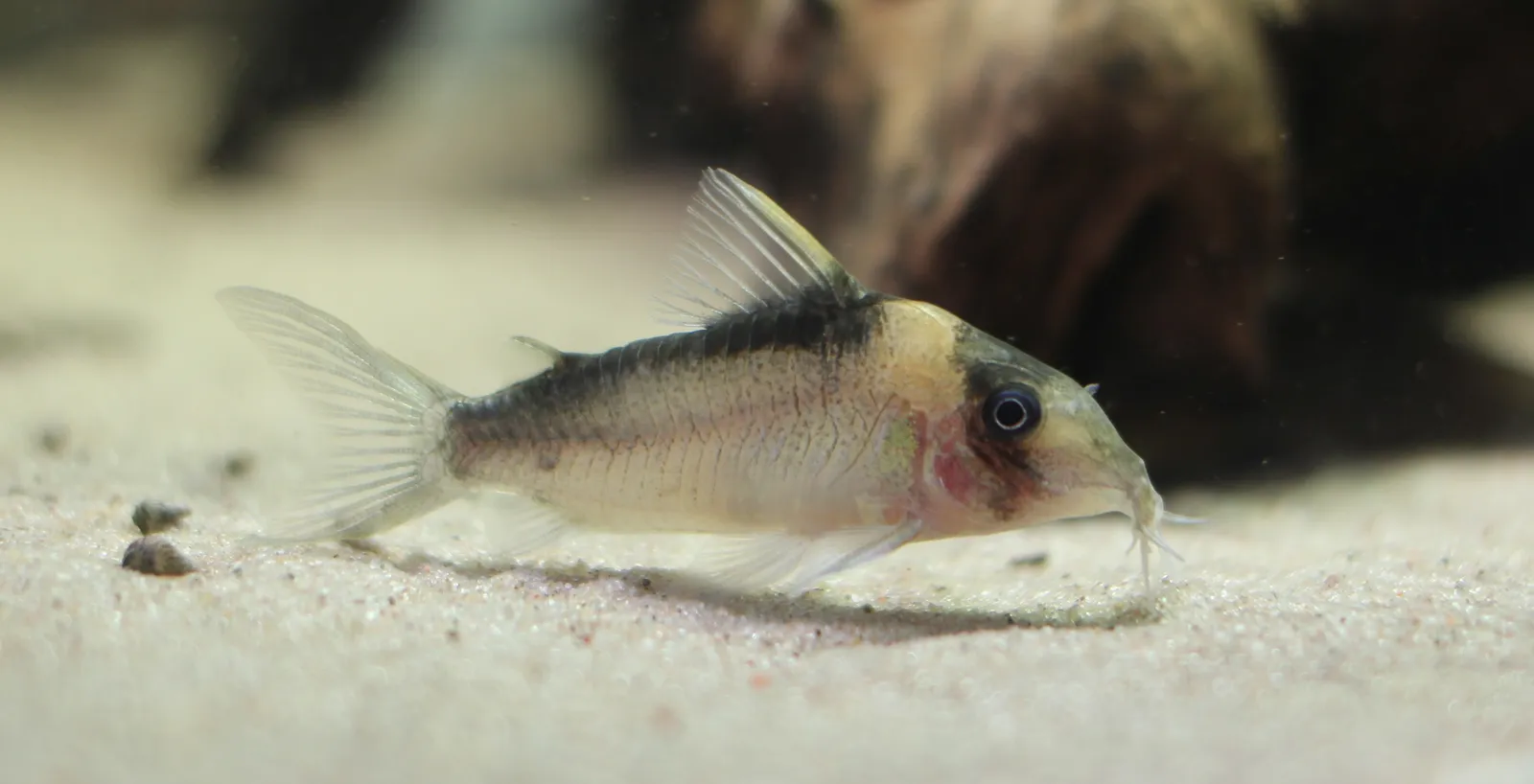
Imitator is a small cory — FishBase gives a maximum of about 2 in standard length, so roughly 2.5 in in total length, with females growing larger and fuller-bodied than males. The body carries the usual cory armour of two rows of overlapping bony plates, and the fins are stiffened by sharp leading spines. What sets it apart from the bulk of the genus is the head: the snout is distinctly elongated and pointed, the long-snouted build of Lineage 1, quite unlike the blunt, rounded face of adolfoi.
The colour pattern, by contrast, is the whole point of the fish, and it is almost a forgery of adolfoi's. The body is a pale pinkish-white; a black band runs through the eye as a mask; a dark stripe runs along the back from the head to the dorsal fin; and a warm orange-to-yellow blotch sits over the nape and shoulder between the two. Put a short-snouted adolfoi (or its close relative C. burgessi) beside a long-snouted imitator and, save for the shape of the snout, the markings line up. That convergence in a fish that is genetically only distantly related is exactly what makes it a classic mimicry example.
Habitat
Corydoras imitator is endemic to the upper Rio Negro basin of north-western Brazil, in the blackwater forest country around São Gabriel da Cachoeira; FishBase summarises the range as the upper Negro River basin, and trade records also note the wider Negro and Solimões region. These are classic blackwater habitats — small, shaded forest streams and igarapés stained tea-brown and tannin-rich by decaying leaf litter, running over sand and submerged wood.
The water is warm, very soft and acidic, the defining blackwater chemistry. FishBase brackets the species at about 72–79 °F with a pH range spanning acidic to neutral and soft water; the wild Rio Negro itself runs markedly more acidic than that. Like other corys it is a facultative air-breather, taking gulps of air at the surface and absorbing oxygen through a vascularised hindgut, which suits the warm, low-oxygen, dimly lit streams it inhabits. Critically, it shares these streams with its model, Corydoras adolfoi: the two occur together, which is the ecological setting any mimicry story requires.
Feeding
Imitator is a benthic omnivore in the standard cory mould. In its blackwater streams it forages over sand and leaf litter, sifting the substrate with its barbels for small invertebrates, insect larvae, micro-crustaceans, worms and detritus. In the aquarium it readily takes sinking pellets and tablets, frozen and live bloodworm, Daphnia, Tubifex and brine shrimp, and grazes what settles to the bottom — but, as with all corys, it should be fed purposefully rather than left to clean up after tankmates, which slowly starves a group.
Mating
Corydoras imitator is an egg-laying shoaler with no pair bond, and there is no reason to think it departs from the family's well-known 'T-position' courtship. When a female is ready the group becomes active; a male positions himself across her head at roughly right angles, forming the T, and she appears to take his milt directly, the sperm passing quickly through her gut to fertilise the small clutch of eggs held in a basket of her pelvic fins. She presses the sticky eggs onto a site she has cleaned and the sequence repeats a few eggs at a time. Documented spawning accounts specific to this species are scarce, so the description rests on the consistent reproductive behaviour of the genus rather than on detailed reports of imitator itself.
Breeding
Imitator is regarded as a difficult and infrequently bred cory, and Planet Catfish records no breeding report for it at all. It reaches the trade as wild-caught fish far more often than as captive stock, and is a more delicate, demanding species than the beginner corys. Where breeding is attempted the approach follows the genus: condition a group hard on live and frozen foods, then trigger spawning with a large change of cooler, very soft, acidic water that mimics rainfall in the blackwater streams. The adhesive eggs would be laid in small batches on cleaned surfaces and given no parental care, so they must be protected from the adults. Reliable clutch sizes, incubation times and fry-rearing notes specific to imitator are not well established — it is a project for an experienced cory breeder, not a first attempt.
In the aquarium
Imitator is a prized but comparatively demanding cory, and a less forgiving fish than the hardy community species. It is strongly shoaling — keep six or more, and ideally more, since it is both more confident and more interesting in a real group. Provide a generous open bottom of soft sand (sharp or coarse gravel abrades and infects the barbels, a common husbandry failure), bordered with driftwood, leaf litter and shade. Because it is a blackwater fish, it does best in soft, acidic, spotlessly clean water on the cooler side of tropical, around 73–79 °F; tannin-stained water from leaf litter or botanicals suits it well. It is entirely peaceful and pairs naturally with the small blackwater community of pencilfish, small tetras, dwarf cichlids and the like. The usual cory cautions apply with extra force for a wild-caught, sensitive species: the fin spines tangle in nets so a cup is safer, and a badly stressed cory can release a skin toxin that can wipe out a whole group in the confined volume of a bag — so acclimatise and transport them carefully. Keeping it alongside its model adolfoi makes a striking, and instructive, display.
Conservation
Corydoras imitator is assessed by the IUCN as Least Concern, in an evaluation dated 2020. Despite its restricted upper-Rio-Negro range it is not currently considered threatened: the remote blackwater forests it inhabits remain relatively intact, and although it is collected for the aquarium trade, that ornamental fishery in the middle and upper Rio Negro is generally regarded as low-impact and, around hubs like Barcelos, an economic alternative to more destructive land uses. None of that makes it invulnerable — deforestation, climate-driven changes to river hydrology and any future intensification of habitat disturbance would bear directly on a species tied to a single blackwater system — but as of the current assessment it is in no danger.