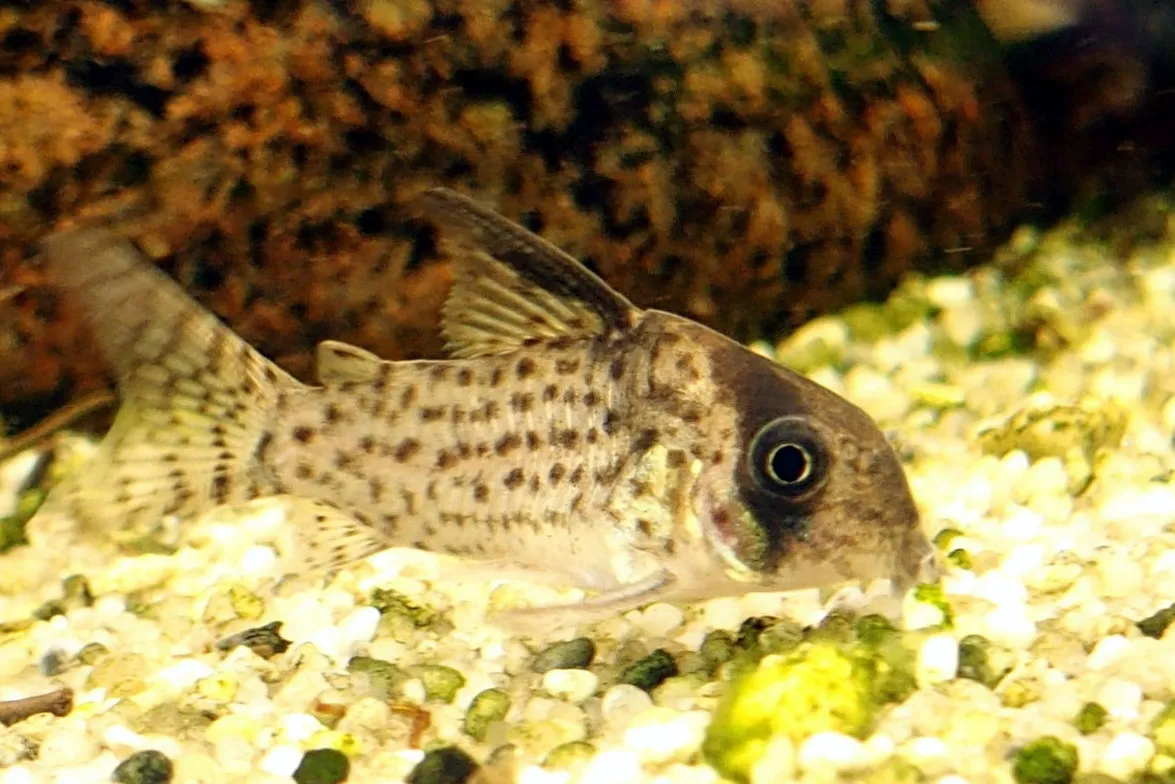
Taxonomy & naming
Corydoras kanei was described by the British cory specialist Steven Grant in 1998. The species name honours Grant's son, Kane. In the hobby it long circulated under two of Hans-Georg Evers's 'C-number' collection codes — C026 and C046 — before and after it received a formal name, a reminder of how many corys reach aquarists as trade codes years before science catches up.
For most of its history the species sat in the catch-all genus Corydoras Lacépède, 1803. The 2024 revision by Dias, Tencatt and colleagues, drawing on molecular phylogenetics, broke that artificial genus into several lineages; kanei falls into the resurrected Hoplisoma Swainson, 1838 — the large lineage built around the spotted, round-snouted corys such as the peppered and panda types — giving the current combination Hoplisoma kanei. Both corydorasworld.com and FishBase now carry it as Hoplisoma. Because the trade and literature overwhelmingly still say 'Corydoras kanei,' we keep that as the heading and note the new combination here.
Morphology
This is a small cory, maturing at roughly 1.5–2 in standard length — toward the dainty end of the group. The build is the familiar Corydoras one: deep-bodied and flat-bellied, armoured with two rows of overlapping bony scutes rather than scales, a hard bony head and three pairs of barbels around the small downturned mouth. Each of the dorsal, pectoral and adipose fins carries a stiff leading spine.
The colour pattern is a pale body covered in dense, fine dark spotting. C. kanei is externally close to C. atropersonatum, but its speckling is denser and — unlike that species — it carries dark markings on the caudal (tail) fin, a useful field distinction. As in most corys, females grow larger than males and become noticeably broader and deeper-bodied when in spawning condition.
Habitat
Corydoras kanei is endemic to the rio Negro basin of northern Brazil, and appears to be restricted to the rio Branco drainage — the Negro's great clearwater-to-whitewater tributary draining the Roraima region around Boa Vista. Trade specimens have been attributed to that area.
The rio Negro system is famous for its soft, acidic, tannin-stained blackwaters, though the rio Branco itself carries more sediment and runs harder and less acidic than the Negro's classic blackwater reaches. Reported aquarium tolerances for the species span a temperature of about 68–79 °F, a pH of roughly 5.5–7.5 and soft to moderately hard water — a fairly broad envelope consistent with a fish of these variable northern drainages. Like all corys it is a facultative air-breather, surfacing to gulp air and absorb oxygen through its hindgut.
Feeding
Corydoras kanei is a foraging benthic omnivore. In the wild it works soft substrates with its barbels, sifting sand and detritus for small invertebrates, insect larvae, worms and organic matter. In the aquarium it readily takes sinking dried foods alongside small live and frozen fare such as bloodworm (chironomid larvae) and Tubifex; a varied diet keeps it in good condition. Like all corys it should be fed as a deliberately catered bottom-dweller, not left to scavenge whatever its tankmates drop.
Mating
Corydoras kanei follows the standard, well-documented courtship of the subfamily. These are egg-laying shoalers with no pair bond. When a female is ready she cleans a spawning site, the group becomes active, and a male takes the classic 'T-position' at right angles to her head; she appears to take his milt into her mouth and fertilises the small batch of eggs she cradles in a basket of her pelvic fins, then presses them onto the cleaned surface. The sequence repeats, a few eggs at a time, until the clutch is complete.
Breeding
C. kanei has been spawned in captivity and is reproduced by dedicated cory keepers. As with its relatives, spawning is best triggered by a large (50–70 percent) water change with cooler, well-oxygenated water, mimicking the rains; groups skewed toward more males than females tend to be most productive. The adhesive eggs are laid on the glass, plants or décor and receive no parental care, so eggs or parents are usually separated. Eggs typically hatch in three to four days, and the fry — after absorbing the yolk sac — take microworm and newly hatched brine shrimp, needing clean water to thrive.
In the aquarium
Corydoras kanei is a peaceful, sociable little catfish well suited to a calm community or a soft-water biotope tank, though it is uncommon and reaches keepers mostly as occasional imports or the output of hobbyist breeders. Keep it in a group of six or more — corys are genuinely stressed when kept alone or in pairs — over a soft sand substrate, which protects the barbels that coarse or dirty gravel erodes and infects. Provide gentle filtration, clean well-oxygenated water and some planting or wood for security. Given its rio Negro / rio Branco origins, soft, slightly acidic, warm water suits it best, though it tolerates a broader range. Pair it only with similarly small, peaceful fish — small tetras and dwarf cichlids are ideal. As with all corys, handle and transport with care: a stressed fish can release skin toxins that may prove fatal in the confined volume of a bag.
Conservation
Corydoras kanei is assessed by the IUCN as Least Concern (2020). It is a fairly localised species of the rio Negro / rio Branco system rather than a continent-spanning one, but it is not currently considered threatened. The broad pressures on Amazonian freshwaters — deforestation, mining and agricultural run-off in the Roraima region, and altered flow regimes — bear on its habitat, and a species with a comparatively restricted range warrants more attention than a widespread one. For now, though, it is not regarded as being at risk.