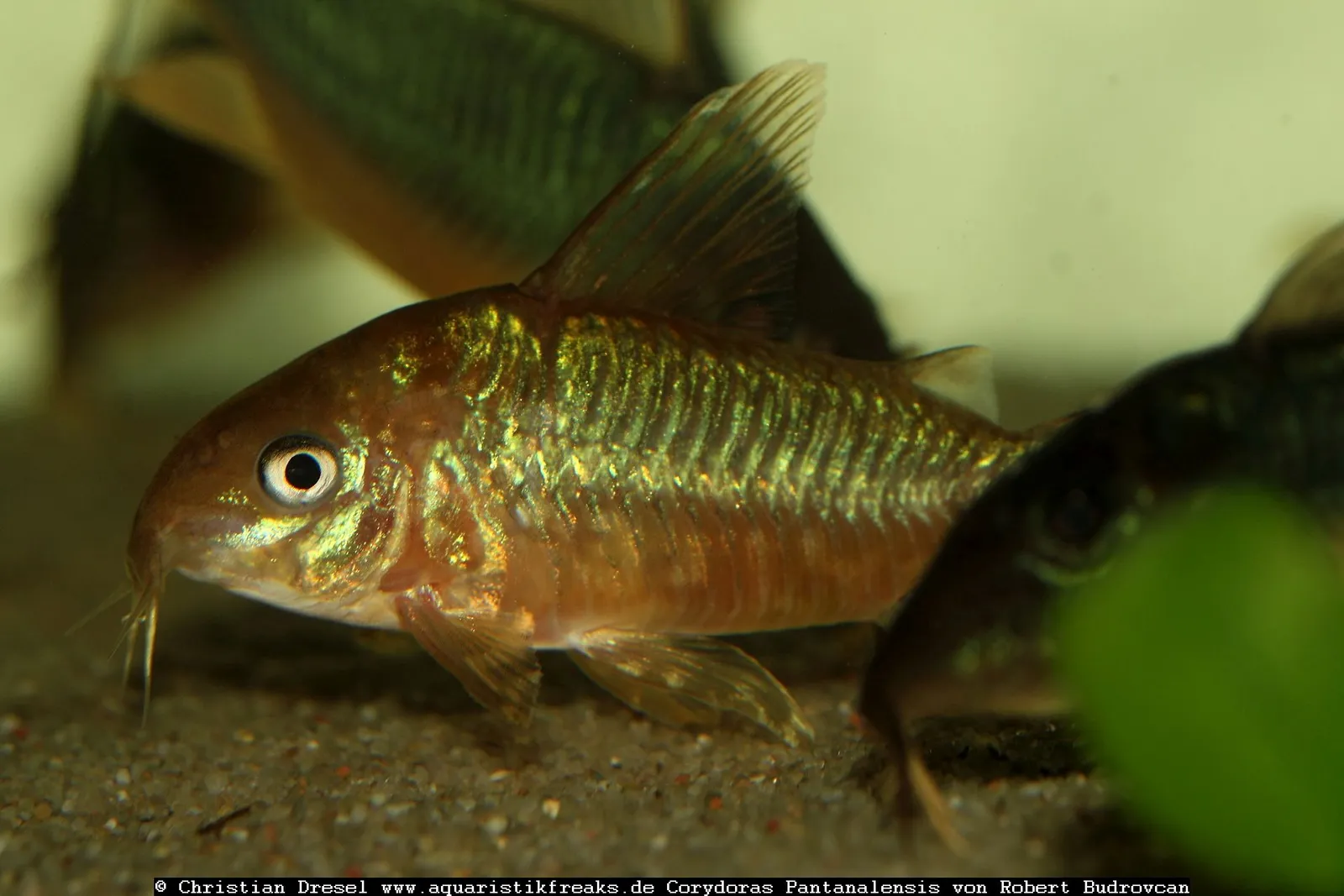
Taxonomy & naming
Corydoras pantanalensis was described by the German aquarist-ichthyologist Joachim Knaack in 2001, in the German hobby-and-science literature (Aquaristik aktuell), from material taken in the Pantanal of Departamento Santa Cruz, Bolivia. In the aquarium trade the fish had already circulated for years under the Planet Catfish collection code C005, and 'Pantanal cory' remains its usual shop name.
For two decades it sat in the giant genus Corydoras (family Callichthyidae, subfamily Corydoradinae). That genus, however, was shown by molecular work to be an artificial assemblage of several distinct lineages, and in 2024 Dias, Tencatt and colleagues published a phylogeny and revised classification that split it into Brochis, Hoplisoma, Osteogaster, Gastrodermus, Aspidoras, Scleromystax and a restricted Corydoras. Under that scheme the Pantanal cory falls within the resurrected genus Brochis — the deep-bodied 'high-finned' lineage — so its current valid combination is Brochis pantanalensis. The change is recent and the hobby still says 'Corydoras pantanalensis,' so we keep that as the heading while recording the new placement. Catalog of Fishes treats pantanalensis Knaack, 2001 as a valid species.
Morphology
This is one of the larger corys, reaching about 2.5 in in standard length — noticeably bigger than most of the small Corydoras of the hobby — and it is built to match: deep-bodied, broad-headed and heavily armoured, with the two interlocking rows of bony scutes that armour every member of the subfamily. The body carries a busy pattern of dark spotting and reticulation on a paler ground, and the head is large and bluntly rounded.
As in all Brochis, the dorsal fin is tall and well developed, and the genus is classically distinguished from true Corydoras by a higher dorsal-fin ray count. Three pairs of barbels fringe the downturned mouth for sifting the substrate, and the leading edges of the dorsal and pectoral fins are stiffened into sharp, locking spines. Females grow larger and noticeably broader than males, a difference best seen from above; mature males tend to have more pointed fin tips.
Habitat
The Pantanal cory is endemic to the Bolivian portion of the Pantanal, the vast seasonally inundated wetland on the upper Paraguay (Río Paraguay) drainage. The type locality lies in Departamento Santa Cruz, and recorded localities include the Cussis and Las Petas areas of eastern Bolivia. This is classic Pantanal country: shallow, slow or still waters — flooded grassland, marsh margins, pools and small tributaries — that swell in the wet season and shrink dramatically in the dry.
Waters of this kind are warm and soft to moderately hard, and often warm and oxygen-poor in the dry-season pools, conditions corys are well equipped for thanks to their ability to gulp atmospheric air at the surface and absorb oxygen through a vascularised hindgut. Because no formal physico-chemical envelope has been published for this species, the water values given here are reasonable husbandry figures for a lowland Pantanal cory rather than measured field data.
Feeding
Like all corydoradine catfishes, the Pantanal cory is a benthic omnivore that forages by driving its barbels and snout into soft sediment and sifting out small invertebrates, insect larvae, worms, microcrustacea and organic detritus, ejecting cleaned substrate through the gill openings. There is no published wild-diet study for the species specifically, but its anatomy and behaviour place it squarely in the substrate-sifting guild of the shallows. In aquaria it readily takes sinking tablets, granules and larger flakes, along with frozen and live bloodworm, Daphnia, Tubifex and similar foods, which are also used to condition groups for spawning.
Mating
No spawning of Corydoras pantanalensis has been formally documented, but corydoradine reproduction is highly stereotyped and there is no reason to expect this species to differ. They are egg-laying shoalers with no pair bond. A ready female cleans a spawning site, the group becomes active, and a male takes up the characteristic 'T-position' at right angles to her head; sperm is thought to pass rapidly through the female's gut to fertilise the few eggs she holds in a pouch formed by her pelvic fins, which she then presses onto the cleaned surface. The sequence repeats, a handful of eggs at a time.
Breeding
There is no published or registered breeding report for the Pantanal cory, so the account here is by analogy with its close relatives rather than from records of this species. In the larger Brochis-type corys, spawning is typically prompted by a large, cooler water change that imitates the onset of the rains, and produces batches of adhesive eggs deposited on plants, wood or aquarium glass. The adults give no parental care and will eat the eggs, so breeders move either the eggs or the parents. Given the fish's adult size, a productive, well-conditioned group and stable, clean water are the obvious prerequisites; until first-hand reports appear, anyone breeding it is in genuinely new territory.
In the aquarium
C005 is an established, if not common, aquarium fish and is kept much like any other large cory. It is a shoaling species that should be kept in groups of six or more; isolated individuals are stressed and inactive. Because it is a sizeable, active catfish, it wants real floor space — a tank with a generous footprint rather than height — and a soft sand substrate is close to mandatory. Corys feed by sifting, and sharp or chipped gravel abrades and infects their barbels, leaving the blunted faces that are a hallmark of poor husbandry.
Warm, clean, well-oxygenated water with gentle flow and regular water changes suits it, and it tolerates a fairly broad pH and hardness range. It is entirely peaceful and makes a good companion for other calm community fish — tetras, rasboras, dwarf cichlids and the like — but not for anything large enough to bully it. The usual cory cautions apply: the fin spines snag in nets (a cup is safer), and a badly stressed cory can release a skin toxin that, in the small volume of a bag or bucket, can kill the whole group, so transport them carefully.
Conservation
Corydoras pantanalensis has not been assessed by the IUCN, so it carries no Red List category and its status is formally unknown. It is a range-restricted species tied to the Bolivian Pantanal, and that narrow distribution is itself a reason for caution: the Pantanal faces mounting pressure from agricultural expansion, altered fire and flood regimes, and upstream changes to the Paraguay drainage. None of that amounts to a documented decline in this fish, but a localised wetland endemic is inherently more vulnerable than the widespread corys of the trade, and it would be a good candidate for formal assessment.