Taxonomy & naming
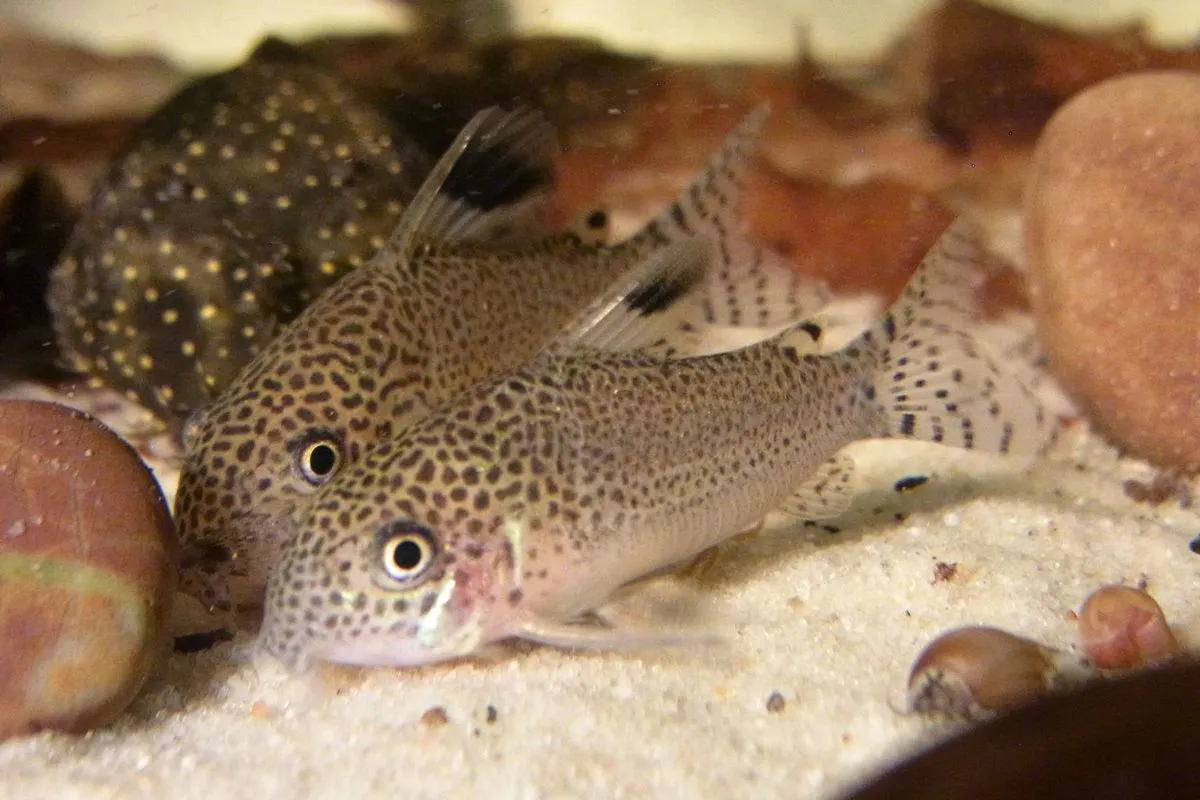
Corydoras punctatus is among the very oldest names in the genus, established by Marcus Elieser Bloch in 1794 (originally in Cataphractus, later in Corydoras Lacépède, 1803) for a small spotted armoured catfish from the Guianas. The epithet punctatus, Latin for 'spotted,' refers to the fine dark speckling that covers the head and body.
Its long history is anything but tidy. Eighteenth- and nineteenth-century type material from the region was poor and partly lost, and for a long stretch 'C. punctatus' was a confused, catch-all name applied to several different spotted Guiana corys, entangled in particular with Corydoras geoffroy Lacépède, 1803 — another antique name from the same waters. The modern fixing of these names rests heavily on Isbrücker's work around 1999, including neotype designation, which separated geoffroy from punctatus and stabilised their application. Today both FishBase and the Catalog of Fishes treat Corydoras punctatus (Bloch, 1794) as a valid species in its own right, restricted to the Suriname and Iracoubo river systems.
The genus Corydoras, with over 170 species, was shown not to be a single natural group, and the 2024 phylogenetic revision by Dias, Tencatt and colleagues split it into several genera — Brochis, Hoplisoma, Osteogaster, Gastrodermus and others. The spotfin cory falls in the lineage now called Hoplisoma, so its current combination is Hoplisoma punctatum; FishBase already lists it that way. We keep 'Corydoras punctatus' as the heading, as the hobby does, while recording the Hoplisoma placement.
Morphology
This is a modest-sized cory, reaching about 2.5 in in standard length. It has the standard build of the genus: a short, deep, flat-bellied body, a blunt armoured head, and a small downturned mouth flanked by three pairs of sensory barbels. Two longitudinal rows of overlapping bony plates (scutes) replace scales along each flank and meet in a ridge over the back.
The defining feature, and the source of both the common and scientific names, is the pattern: a pale body finely peppered with small dark spots over the head and sides, and dark markings extending into the fins — the 'spotfin' effect. As in all Corydoras, the dorsal and pectoral fins are stiffened by hard leading spines that are mildly venomous and can jab a careless hand or catch in a net. Females grow rounder and broader-bodied than the slimmer males, the difference clearest when fish are in spawning condition.
Habitat
Corydoras punctatus, in its modern restricted sense, is a fish of the coastal rivers of the eastern Guianas — the Suriname River basin in Suriname and the Iracoubo River basin in French Guiana. These are warm lowland watercourses, and the species lives in smaller creeks and the shallow margins of larger streams over sandy to sandy-muddy substrates with leaf litter and submerged wood.
The water is warm, soft and acidic to near-neutral — broadly around 72–79 °F with a pH of roughly 6.0–8.0 across the range, tending softer and more acidic in the forest creeks it favours. Like other Callichthyidae, the spotfin cory is a facultative air-breather: it darts to the surface to gulp air and absorbs oxygen through a vascularised, modified hindgut, an adaptation that lets it persist in the warm, shallow, sometimes oxygen-poor pools typical of these coastal drainages.
Feeding
The spotfin cory is a benthic omnivore and detritivore. It forages over the bottom more or less continuously, driving its snout and barbels into sand to taste out small invertebrates, insect larvae, worms, micro-crustaceans and the organic detritus of the substrate, and expelling cleaned sand through its gills. It is an opportunist that takes what the creek bed offers rather than specialising. In the aquarium it accepts sinking pellets and tablets, frozen bloodworm and brine shrimp and similar small foods; like all corys it does best on a varied diet of its own and should not be relied upon merely to mop up scraps.
Mating
Corydoras are egg-laying shoalers with no pair bond and a distinctive, well-studied courtship, and Corydoras punctatus is expected to follow it. When a female is ready she cleans a spawning site — a leaf, a stone, wood or the glass — and the group becomes active. A male takes up the classic 'T-position', aligning at right angles to the female's head; she appears to take milt directly, and the sperm is thought to pass rapidly through her gut to fertilise the few eggs she clasps in a basket formed by her pelvic fins. She carries each small batch to the cleaned surface and presses the sticky eggs into place, repeating the sequence until the clutch is complete.
Breeding
No widely published captive-breeding protocol is specific to Corydoras punctatus; what is expected comes from the genus at large. Spawning is generally triggered by a cool, large water change mimicking the onset of the rains, which drops the temperature several degrees. The adhesive eggs are laid in small batches on firm surfaces and receive no parental care — the adults will eat them, so a breeder removes either the eggs or the parents. Eggs typically hatch in three to five days depending on temperature, and the fry take microworm, baby brine shrimp and powdered foods after absorbing the yolk sac. As a less commonly traded Guiana species, it is bred far less often than the commercial corys.
In the aquarium
Corydoras punctatus is an occasional rather than staple import, but it is a rewarding, peaceful fish kept along standard cory lines. It is a shoaling species and is genuinely stressed when kept alone or in pairs; keep six or more and they reward you with constant, confident foraging.
Provide a tank with ample bottom area — footprint matters more than height — and, crucially, a substrate of soft sand or very smooth, fine, rounded gravel. Corys feed by sifting, and sharp or coarse gravel erodes and infects their barbels, leaving the stubby, blunted faces that are a hallmark of poor husbandry. Keep the bottom clean, add leaf litter and wood, and provide gentle, well-oxygenated flow with regular water changes. Aim for warm but not hot water (about 72–79 °F), soft and slightly acidic to neutral to reflect its Guiana origins. It is utterly peaceful and ideal with small tetras, rasboras, pencilfish and dwarf cichlids — never with anything large enough to bully it. Two standing cautions for all corys apply: the fin spines can catch in nets, so a cup is safer, and a badly stressed fish can release a skin toxin that, in the confined volume of a bag, may kill the whole group — so transport them with care.
Conservation
The IUCN Red List assesses Corydoras punctatus as Least Concern (assessment dated 2020). It occupies coastal river systems of Suriname and French Guiana that remain comparatively well-forested, and it is not a heavily exploited aquarium species, so neither habitat loss nor collection pressure is judged to threaten it at present. The broad pressures on Guiana coastal freshwaters — deforestation, agriculture, gold mining and the mercury and sediment it brings, and pollution near settlements — nonetheless bear on the shallow creek margins it inhabits. A useful footnote is taxonomic: because 'punctatus' was for so long a confused name shared with geoffroy and other spotted Guiana corys, accurate assessment depends on keeping those species cleanly separated, as the modern nomenclature now does.