Taxonomy & naming
The keyhole cichlid was described by the Austrian ichthyologist Franz Steindachner in 1881 as Acara maronii, from specimens taken in the Maroni River of French Guiana; the unique holotype (NMW 33683) resides in the Naturhistorisches Museum in Vienna. For most of the twentieth century the fish was shuffled between the broad catch-all genera Acara and then Aequidens, where it sat alongside dozens of only loosely related South-American acaras. In 1989 Sven O. Kullander and Han Nijssen, in their monograph 'The cichlids of Surinam,' removed it to a new genus of its own, Cleithracara, diagnosing it on a suite of skeletal and squamation characters — among them a preopercle bearing two scales on its horizontal limb, predorsal scales in three rows, extensively scaled soft fins, a single supraneural, a deep notch in the anterior ceratohyal, and the absence of teeth on the fourth ceratobranchial. Cleithracara has remained monotypic ever since: maronii is its only species. Within the Neotropical cichlid radiation it is generally placed near the so-called cichlasomatine acaras, and the morphological and molecular work that has examined it most often recovers Nannacara as its closest relative. The genus name itself is an unusual case of taxonomy borrowing from the aquarium hobby — it fuses the Greek word for a lock or key with the old vernacular acará, formalizing the 'keyhole' nickname the fish had already earned in the trade. The epithet is a toponym for the type locality, the Maroni (Marowijne) River that divides French Guiana from Suriname.
Morphology
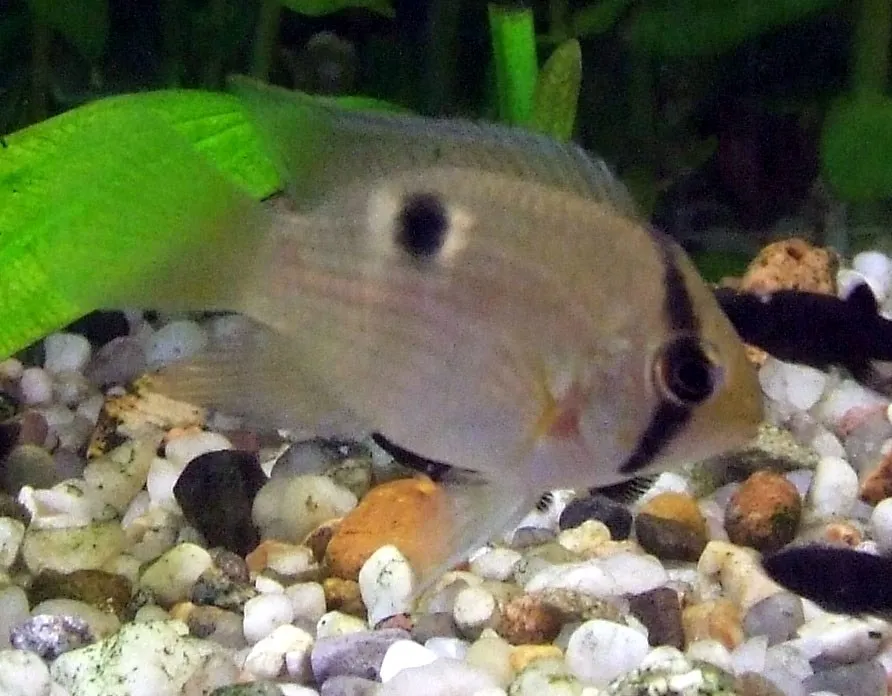
Cleithracara maronii is a small, ovate, laterally compressed acara with a gently rounded forehead and a relatively small mouth. FishBase records a maximum of about 3 in standard length, but that figure understates aquarium fish: well-grown captive males commonly reach 3.5–4.5 in in total length, with females staying smaller at roughly 2–3 in. The ground colour is a soft sandy tan to pale olive, often with a faint pearly sheen and rows of fine iridescent flecks, and the eye is crossed by a dark bar. The diagnostic mark, and the source of every one of the fish's common names, is a single bold black blotch set high on each flank just below the dorsal fin; it is often vertically elongated or has a thin stripe trailing from it, and the resulting outline — a round 'eye' over a narrow 'shaft' — reads to many keepers as a keyhole or an anchor. A second, smaller ocellus sits at the base of the tail. Sexual dimorphism is real but modest: mature males grow distinctly larger and draw the rear rays of the dorsal and anal fins out into trailing points, while ripe females are rounder-bodied and shorter-finned. One of the species' most-loved traits is behavioural rather than structural — it is a dramatic colour-changer. A calm, settled fish is pale and patterned with little contrast, but a frightened or submissive one darkens within seconds, throwing on a blotched, broken pattern of dark bars and saddles that lets it melt into leaf litter and shadow.
Habitat
The keyhole cichlid is a coastal-river fish of the Guiana Shield's Atlantic slope. Its range runs from the Barima River in Guyana east through Suriname and French Guiana to the Ouanary River, takes in most of French Guiana's drainages including the type-locality Maroni, and extends west into the Orinoco delta region of Venezuela; it has also been recorded — apparently only historically, perhaps not since the 1960s — from the island of Trinidad, and the Catalog of Fishes extends its distribution into Amapá in far northeastern Brazil. Across this range it favours small creeks, slow tributaries and standing waters of the coastal lowlands rather than big rivers. The typical biotope is a sluggish or still blackwater stream stained brown by humic acids leached from decaying leaves and wood: clear but tea-coloured water, negligible dissolved-mineral content, and a bottom carpeted with fallen leaves, branches and submerged roots, sometimes with patches of aquatic plants such as Cabomba, Marsilea or floating Pistia. FishBase notes a habit of sheltering among the abundant decaying wood. Recorded water is warm and soft, generally pH 6.0–7.5 in surveyed creeks but as acidic as pH 4.0–5.0 in the most strongly stained blackwaters, with temperatures around 72–82 °F. These are shallow shoreline and creek habitats — on the order of a metre or two deep — and the fish shares them with a long list of small characins, callichthyid and loricariid catfishes, and other acaras such as Krobia guianensis and Acaronia nassa.
Feeding
Cleithracara maronii is a small benthic omnivore that forages over the soft, leaf-littered bottoms of its home creeks. FishBase summarizes its wild diet as worms, crustaceans and insects, and places it at a trophic level around 3.3 — the profile of a generalist invertivore that picks small prey from the substrate and works through detritus rather than hunting in open water or specializing as a dedicated sand-sifter. Unlike the larger eartheaters it is not a heavy digger; it grazes and gleans rather than excavating. In the leaf-litter community of a Guianan blackwater creek it occupies the modest middle of the food web, taking benthic invertebrates and organic matter while itself remaining small and cautious enough to be potential prey for larger predators. In captivity this translates into an easy, unfussy feeder that accepts prepared foods readily but colours up and conditions best on a varied diet that includes live or frozen invertebrates.
Mating
Outside the breeding season keyhole cichlids are gregarious and strikingly peaceful — juveniles in particular shoal loosely, and the species is naturally shy enough that the presence of small dither fish above it is read as an 'all clear' signal that coaxes it into the open. As they mature, fish pair off and a settled pair will hold a territory perhaps a half-metre or so across when breeding. Pair formation is the standard acara pattern: fish choose their own partners from a group, and a bonded pair is monogamous and cooperative rather than combative. Courtship and territorial display lean heavily on the species' colour-changing ability, with posturing, fin-spreading and pattern shifts doing the work that outright aggression does in pushier cichlids. Even in defence of a nest the keyhole is mild by cichlid standards: it will see off intruders from the immediate spawning site but is not the kind of fish that tears a community tank apart. This gentleness, combined with its readiness to pair from a group of youngsters, is exactly why it earned its long-standing reputation as a beginner-friendly cichlid.
Breeding
Cleithracara maronii is a biparental, monogamous, open substrate spawner, and a relatively easy one to breed when the fish are in good condition and the water is clean. There is no dramatic environmental trigger; a sound diet and a stringent maintenance regime are the main requirements, though soft, slightly acidic, warm water and a generous water change are reported to help bring a pair into condition. The pair cleans a solid flat surface — typically a water-worn rock, a broad plant leaf, a piece of driftwood, or even the aquarium glass — and the female lays the eggs in rows while the male follows to fertilize them, the sequence repeated until she is spent. Clutch counts vary with the source and the size of the female: Seriously Fish reports up to around 300 eggs, while FishBase cites figures of roughly 400 and up to 600 deposited on a flat stone. Both parents care for the brood, the female staying close to fan and defend the eggs while the male patrols and guards the surrounding territory. Young or inexperienced pairs frequently eat their first few clutches, especially if disturbed, but settle into reliable parents with practice. The fry are easy to raise, taking powdered dry foods, Artemia nauplii and microworm as soon as they are free-swimming, and biparental care can continue for weeks to several months after spawning.
In the aquarium
The keyhole cichlid is one of the most genuinely beginner-suitable cichlids in the hobby, and for decades it was a staple of the trade — peaceful, undemanding in décor, and forgiving of community life. Most of the wild-type fish on sale today are commercially farmed rather than imported. A pair can be kept in a tank with a footprint of about 90 × 12 in (roughly 20–25 US gal) as a sensible minimum, with more room appreciated for a group or a community. Because the species does not dig in earnest, it adapts well to planted aquaria; a soft sandy substrate with driftwood, branches, leaf litter and one or two flat, water-worn stones recreates its natural creek biotope and supplies ready-made spawning sites. The single most important husbandry point is water quality. Keyhole cichlids are sensitive to deteriorating conditions and should never go into a biologically immature tank; chronic poor maintenance or an inadequate diet shows up as head-and-lateral-line erosion and stunted growth. Over-filter relative to the stocking, keep up substantial regular water changes, but avoid strong flow — these are fish of calm, still creeks — by aiming filter returns to break up the current.
Water chemistry is flexible. The species tolerates pH anywhere from about 4.0 in the softest blackwater to 7.5, with a maintenance sweet spot of roughly pH 6.0–7.5; hardness from very soft up to moderately hard (about 36–268 ppm) is workable, and temperature is best held around 72–82 °F. Farmed stock in particular is adaptable, but soft, warm, slightly acidic water suits the fish best and helps condition pairs for breeding. Diet is simple: keyholes are unfussy omnivores that take quality dried foods alongside live or frozen bloodworm, Artemia, Daphnia and similar, and a varied menu produces the best colour and condition.
Temperament is the species' great selling point and also its one vulnerability. It is not aggressive except when guarding a nest, and it will not harass anything it cannot swallow, so the list of suitable tankmates is long — peaceful, similarly-sized South Americans and groups of open-water characins or other dither fish are ideal, the schooling fish doubling as a confidence cue for a naturally timid cichlid. The mistakes that go wrong with keyholes are almost always about stress and water rather than violence: housing them with boisterous, fin-nipping or hard-water-demanding species, skimping on cover, or letting nitrate creep up. Give them clean soft water, plenty of wood and plants to hide among, and calm companions, and they are among the most rewarding easy cichlids a keeper can own.
Conservation
The IUCN Red List assesses Cleithracara maronii as Least Concern (assessed 28 October 2020 by C. Lasso, published 2023), with the population trend listed as unknown. The assessment reflects a wide distribution across the coastal drainages of the Guianas and the Orinoco delta region, spanning French Guiana, Guyana, Suriname, Venezuela and the historical Trinidad record. The species carries no CITES listing and is of no interest to food fisheries, though it is highly commercial in the aquarium trade — a demand now met largely by captive breeding rather than wild collection, which limits direct collecting pressure on natural populations. No species-specific threat is flagged. The broader backdrop is the freshwater landscape of the Guiana Shield, whose coastal rivers face localized pressures from deforestation, gold-mining and associated mercury contamination, and habitat alteration; the transboundary Maroni basin in particular has drawn conservation attention for exactly these reasons. None of this is documented as a present danger to this widespread, adaptable little cichlid, but it is the context against which its long-term status should be read.