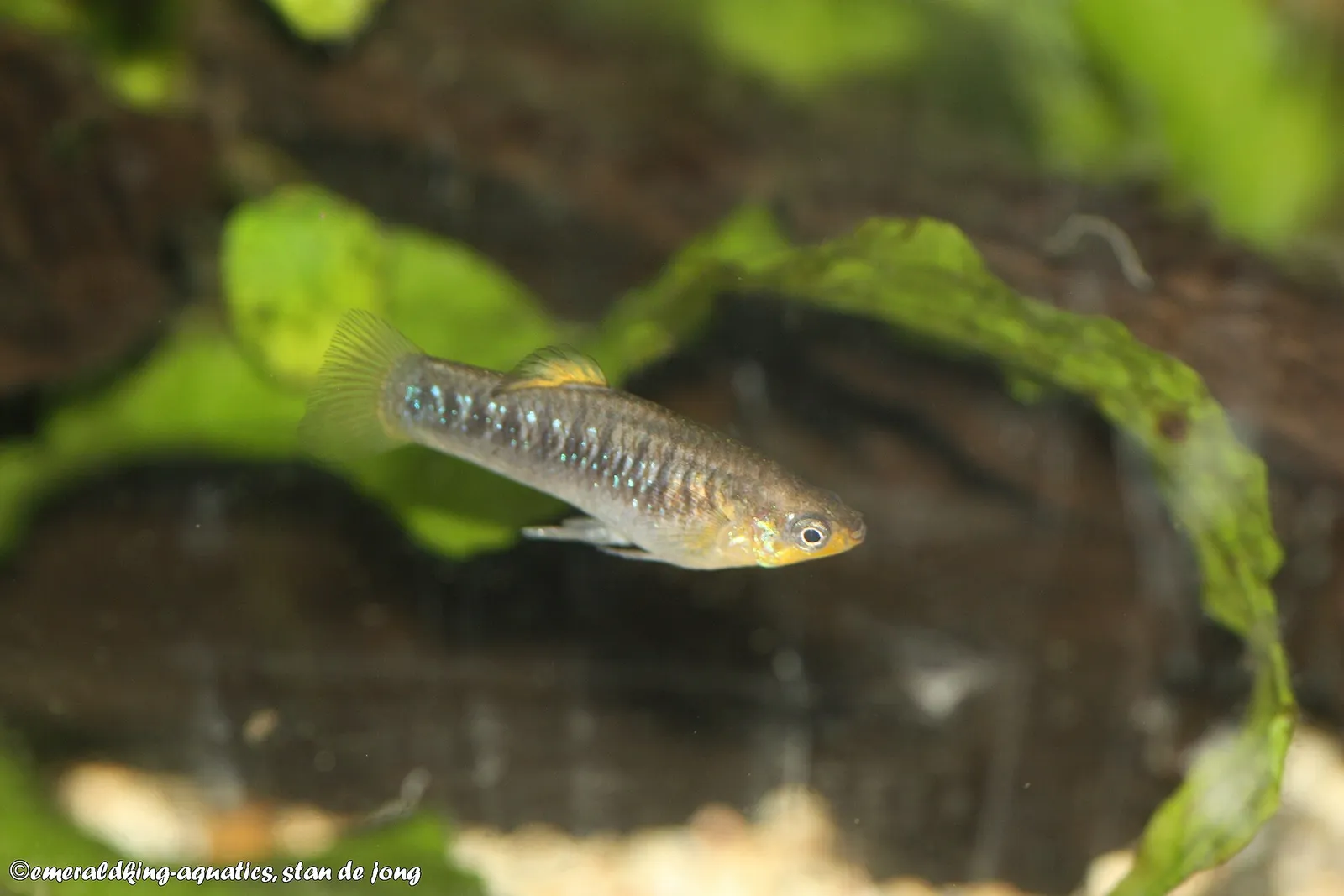
Taxonomy & naming
Poecilia tridens was described by the German zoologist Franz Martin Hilgendorf in 1889 from material collected on Hispaniola. Eschmeyer's Catalog of Fishes treats the combination Poecilia tridens (Hilgendorf, 1889) as the valid name; the parenthetical authority reflects that the species was originally placed in a different genus and later moved to Limia. It sits within the family Poeciliidae, subfamily Poeciliinae, in the order Cyprinodontiformes — the New World livebearing toothcarps that also include the guppies, mollies, platies and swordtails.
The genus Limia was erected by Poey in 1854. Its members are concentrated in the Greater Antilles, with Hispaniola being especially rich in endemic Limia species, several of them restricted to single lakes or drainages. Some authors have at times subsumed Limia within the broader genus Poecilia, but the name Limia remains in wide use for this Antillean radiation, and modern phylogenetic work — notably Rodríguez's 1997 analysis of the tribe Poeciliini (Copeia 1997(4):663–679) — has examined the relationships of these fishes in detail.
The genus name Limia derives from the Latin limus, meaning mud, a reference to the mud-grazing feeding habits of these fishes. The species epithet tridens is Latin for "three-toothed" or "three-pronged" — the same root as trident — alluding to a structural feature noted in the original description.
This fish was long listed as Limia tridens; Eschmeyer's Catalog of Fishes places the species in Poecilia, and the current combination Poecilia tridens is followed here.
Morphology
Poecilia tridens is a small fish showing the marked sexual size dimorphism typical of the poeciliids. Males reach about 1 in in total length, while females are notably larger, growing to roughly 1.5 in — the females being the deeper-bodied, more robust sex. This is a modest-sized livebearer even by the standards of the family.
In overall form it is a typical Limia: an elongate, laterally compressed little fish with a dorsally flattened head, an upturned mouth suited to surface and substrate grazing, and the single dorsal fin set well back on the body. Published length–weight figures for the species (Bayesian estimates a = 0.01047, b = 3.14) describe the near-isometric, slightly robust build expected of a benthopelagic grazer.
The defining male feature, shared across the livebearing poeciliids, is the gonopodium — a slender intromittent organ formed from modified rays of the anal fin and used to deliver sperm to the female internally. Females lack this structure and, when carrying young, typically show a darkened gravid region toward the rear of the abdomen. Detailed colour notes for P. tridens are sparse in the literature; like many Hispaniolan Limia it is comparatively plain compared with the showier hobby livebearers, the females larger and duller and the males smaller.
Habitat
Poecilia tridens is endemic to Hispaniola, occurring in both Haiti and the Dominican Republic. FishBase classes it as a freshwater, benthopelagic, non-migratory tropical species, with a recorded temperature range of roughly 75–84 °F.
As with the genus generally, Hispaniolan Limia inhabit a range of still and slow-moving fresh waters — pools, ditches, spring-fed streams and lake margins — and many tolerate hard, alkaline, mineral-rich conditions, some of the island's Limia faunas being associated with brackish or saline-influenced lakes. Specific micro-habitat data for P. tridens are limited in the available sources, so beyond the island endemism and the tropical, warm-water profile, finer details of its preferred waters are best described as data sparse.
The broader context is an insular freshwater fauna under chronic pressure from habitat alteration and introduced species across Hispaniola. Against that backdrop P. tridens remains one of the more widespread and secure native livebearers of the island.
Feeding
Poecilia tridens is an omnivorous grazer with a trophic level estimated at around 3.0. The genus name itself — from the Latin for mud — points to the characteristic feeding mode of these fishes: browsing over the substrate and surfaces for algae, aufwuchs, detritus and the small invertebrates living among them.
In practice a Limia of this kind takes a mixed diet of plant and animal matter: algal films and biofilm grazed from rocks and plants, organic detritus, and small aquatic invertebrates and insect larvae picked from the water column and surface. The upturned mouth and flattened head suit both surface feeding and substrate grazing.
In the aquarium the species is undemanding and accepts the usual fare — good-quality flake and small pellets, supplemented with small live and frozen foods such as Daphnia and brine shrimp. A meaningful share of vegetable or algal matter reflects the natural diet and keeps the fish in good condition; like other small grazing livebearers it does best with several modest feedings rather than one heavy meal.
Mating
Reproduction in Poecilia tridens is internal, as in all poeciliids. Fertilisation occurs inside the female: the male transfers sperm using the gonopodium, the modified anal fin that serves as an intromittent organ. There is no nest, no egg-laying and no external spawning — courtship and copulation are the whole of the mating act.
Limia males court more or less continuously, pursuing and displaying to females, and a skewed sex ratio in captivity — keeping two or three females per male — is the standard recommendation to spread that attention and prevent any one female from being harassed. Females are able to store viable sperm internally, so a single mating can fertilise several successive broods.
No superfetation has been documented in Limia. The simultaneous carrying of broods at different developmental stages, known in some other poeciliids such as Poeciliopsis and Heterandria, is not a feature of this genus; Limia females carry one developing brood at a time.
Breeding
Poecilia tridens is viviparous — a true livebearer. Like the Poeciliidae generally it is lecithotrophic, meaning the developing young are nourished by yolk rather than through a placental connection to the mother, and the female gives birth to fully formed, free-swimming fry rather than laying eggs.
Gestation runs roughly three to four weeks, with broods produced at intervals of about three to five weeks given good conditions and stored sperm. Brood size is small, as expected for so small a fish — commonly from single digits up to around twenty fry. The newborn fry are relatively large and immediately able to swim and feed.
As with most livebearers, the adults — including the mother — will predate the fry, so survival in a community setting depends on cover. Dense planting, floating plants and fine-leaved thickets give the young places to hide, and breeders who want to raise good numbers provide heavy vegetation or rear the fry separately. The fry grow readily on fine prepared foods and newly hatched brine shrimp, and the species' productivity makes it an easy livebearer to propagate.
In the aquarium
Poecilia tridens is a hardy, peaceful, undemanding livebearer well suited to the keeper interested in the Antillean Limia rather than the mass-market fancy strains. It is small, sociable and best kept in a group, and — as with the genus generally — a ratio favouring females (two or three per male) reduces the pestering that comes with the males' constant courtship.
Warm water in the species' natural range, roughly 75–84 °F, suits it. Hispaniolan Limia generally appreciate hard, alkaline water, and some tolerate a degree of brackishness; most, however, thrive in straight, well-maintained fresh water with no added salt, so stable, clean, moderately hard conditions are a safe target. A modestly sized, well-planted aquarium with cover for fry suits a colony.
It is a peaceful community fish that should not be combined with boisterous or fin-nipping tankmates. Its prolific breeding means population management, rather than coaxing it to reproduce, is usually the real task. As a less commonly traded species it is most often found through specialist livebearer keepers and associations rather than general aquarium shops.
Conservation
Poecilia tridens is assessed as Least Concern on the IUCN Red List, in an assessment dated 16 June 2020. The species is endemic to Hispaniola but is currently regarded as secure across its range, and FishBase rates its resilience as high, with a population doubling time under fifteen months and a low vulnerability to fishing.
This is a comparatively reassuring status for an island endemic. Many freshwater fishes restricted to single islands or lakes face acute threats from habitat loss, water extraction and introduced predators and competitors, and several of Hispaniola's narrowly distributed fishes are of conservation concern. By contrast P. tridens, as a more widespread and adaptable native livebearer, has so far avoided that pressure.
That said, the broader trajectory of Hispaniolan freshwaters — deforestation, agricultural runoff, wetland drainage and the spread of non-native fishes — is the backdrop against which any island endemic's future should be read. The Least Concern listing reflects present abundance rather than a guarantee, and the responsible aquarist treats captive-bred stock and specialist livebearer networks as the right way to keep the species without drawing on wild populations.