Taxonomy & naming
Panaque cochliodon was described by Franz Steindachner in 1879, with a brief diagnosis published in the Anzeiger der Kaiserlichen Akademie der Wissenschaften, Wien (volume 16, number 18, page 194) and a fuller description later in the same year (Steindachner 1879:187). The original genus was correctly Chaetostoma in Steindachner's sense, though the CoF notes that the original genus should be read as Chaetostoma. Syntypes are deposited at the Naturhistorisches Museum Wien (NMW 47297-98). The type locality is the Río Cauca, Magdalena River drainage, Colombia.
The Catalog of Fishes (Eschmeyer, CAS, updated June 2026) confirms the valid combination Panaque cochliodon (Steindachner 1879), consistently placed in Panaque since Isbrücker (1980) and confirmed through multiple subsequent works including Fisch-Muller (2003), Lujan et al. (2010), and Ortega-Lara & Lujan (2020). The species has not been moved to Panaqolus; CoF maintains it in Panaque, the large wood-eating genus defined in part by its uniquely broad, spoon-shaped (spatulate) teeth.
No DATZ L-number or LDA code has been assigned to this species. It circulates in the hobby simply as 'blue-eyed royal pleco' — a name that, unusually, focuses on the startling eye colour rather than pattern or origin.
Morphology
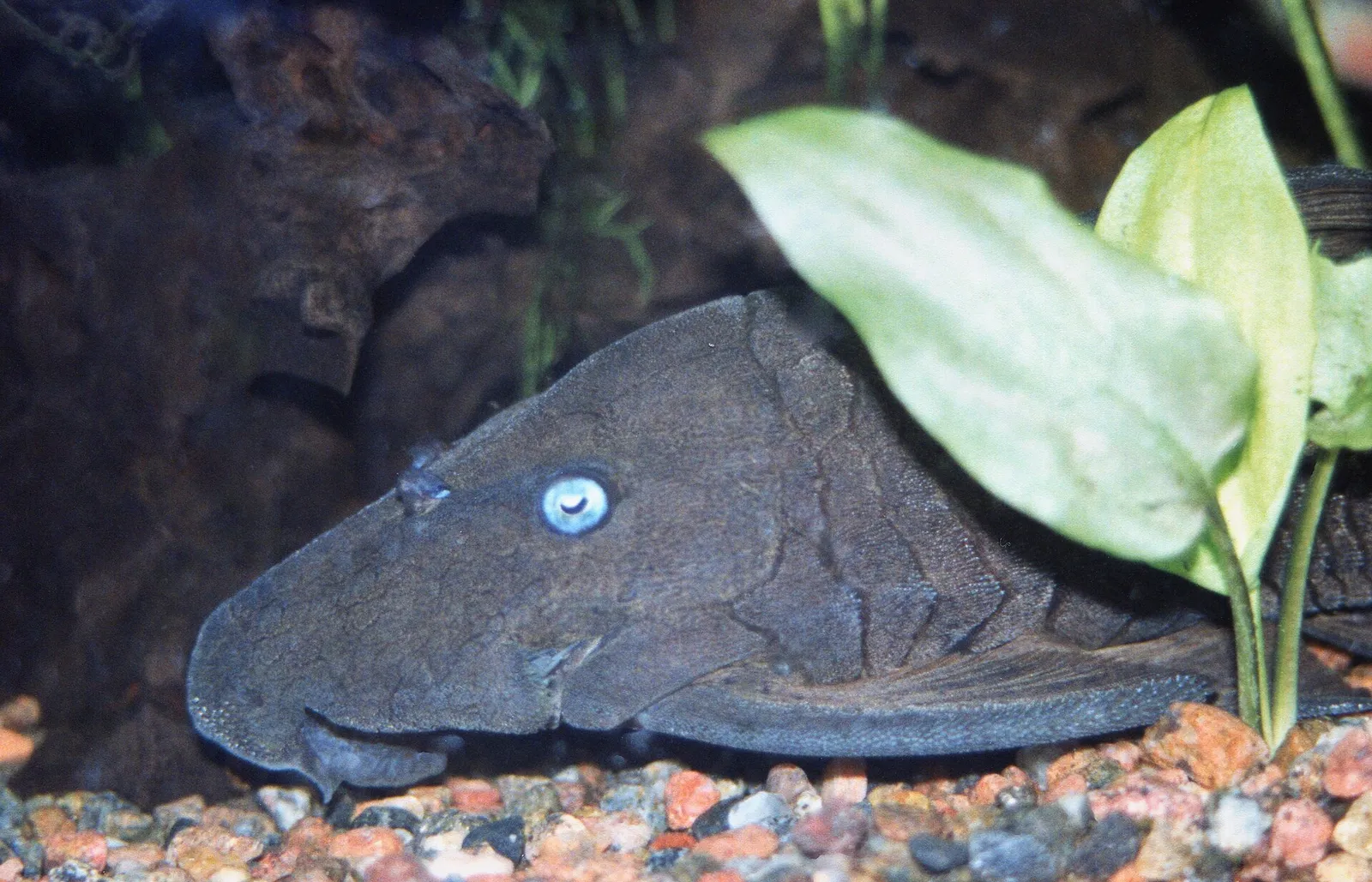
Panaque cochliodon is a large, robust loricariid. FishBase records a maximum of 12 in total length (TL) from collected specimens, with PlanetCatfish listing 12 in SL as the species maximum and an exceptional captive individual from the Magdalena middle course reportedly reaching 17.5 in SL and 1.45 kg (Echeverri pers. comm. in FishBase). The body is covered in broad, dark olive-brown to near-black bony scutes; the overall impression is of a heavily armoured, somewhat compressed catfish with a large, broadly rounded head.
The diagnostic feature of genus Panaque — and the clearest way to distinguish this species from superficially similar large loricariids like Pterygoplichthys — is the tooth morphology. Panaque teeth are distinctively spoon-shaped (spatulate): noticeably wider at the tip than at the base, and arranged in a relatively sparse row. This adaptation permits effective gouging of intact hardwood grain. A second diagnostic feature noted by PlanetCatfish is the absence of a buccal papilla (a fleshy flap inside the mouth) that is present in many other loricariid genera.
The common name 'blue-eyed' refers to the strikingly coloured iris, which flashes iridescent teal-blue or blue-green under aquarium lighting — an unusual feature among plecos. Sexual dimorphism is not well documented for this species specifically; the general Panaque pattern is likely applicable, with males developing odontodes on the pectoral spines and posterior body scutes when in condition.
Habitat
Panaque cochliodon is endemic to the Cauca and Magdalena river basins in Colombia — a pair of major rivers that drain northward to the Caribbean Sea through the inter-Andean valleys of the western and central cordilleras. Both basins originate in the Andes and descend through dramatic altitudinal gradients before reaching the lowland plain; the catfish occurs in the middle and lower reaches where submerged wood habitat is available.
The Magdalena is a large, moderately turbid whitewater system carrying significant Andean sediment load; the Cauca is its main western tributary. Water chemistry in the middle Magdalena is characteristically near-neutral to slightly alkaline, moderately hard, and with relatively stable temperatures in the range of 75–82 °F. This contrasts with the soft, acidic waters favoured by many Amazonian Panaqolus species, and makes P. cochliodon one of the more tolerant xylophages with respect to water hardness.
Microhabitat is among submerged wood accumulations, fallen trees, and root tangles in moderate to strong current — the same structural habitat used by Panaque nigrolineatus further south. The Magdalena and Cauca basins have been heavily modified by agriculture, deforestation, and hydraulic engineering, and much of the natural riparian wood habitat has been reduced.
Feeding
Like all Panaque, P. cochliodon is a committed xylophage: wood forms the foundation of the diet. The broad, spatulate teeth are specifically adapted to excavating intact wood grain, and captive specimens visibly gouge deep channels into driftwood in the manner characteristic of the genus — behaviour not replicated by the smaller, multi-cusped teeth of Panaqolus. The fish ingests wood fibres and the microbial community (bacteria and fungi) colonising the wood; microbially assisted fermentation in the hindgut is the presumed mechanism for deriving nutrition from cellulose and hemicellulose fractions.
In captivity, substantial pieces of hardwood driftwood are an absolute requirement and must be replaced as they are consumed. The PlanetCatfish profile recommends supplementing with algae wafers and fresh vegetables — courgette (zucchini), cucumber, peas, green beans — as well as tubers such as sweet potato and potato. This vegetarian staple diet should be maintained consistently; P. cochliodon is not suited to high-protein feeding regimens appropriate for carnivorous or omnivorous plecos, and an excess of protein can lead to fatty organ degeneration in long-term captives.
Mating
Reproductive behaviour of P. cochliodon in captivity has not been formally documented; PlanetCatfish records no breeding reports for this species, and it remains one of the more rarely spawned loricariids in hobbyist collections. What is known is extrapolated from the broader Panaque biology and the behaviour of P. nigrolineatus, which has been spawned.
Large Panaque require correspondingly large cave structures — a hollow section of substantial driftwood or a ceramic cave with an internal diameter of 3–4.5 in is appropriate. Males will become territorial around prospective spawning sites and display or spar with rival males using interopercular odontodes and pectoral spines. Conditioning on a varied diet, provision of robust wood furnishings, and a large tank volume with good water quality and regular changes are the prerequisites for approaching breeding condition. Given the species' large eventual size, a tank of at least 105 US gal is needed for a breeding pair.
Breeding
No confirmed captive spawning of Panaque cochliodon is recorded on PlanetCatfish or in the published literature accessible as of June 2026. The species' rarity in collections — PlanetCatfish lists only 15 registered keepers — reflects both the difficulty of sourcing Colombian specimens and the tank scale required. General Panaque biology suggests the reproductive mode would be cave spawning with paternal brood care, consistent with the wider tribe Ancistrini.
For hobbyists attempting to condition this species, the approach follows the template established with P. nigrolineatus: mature pairs need a minimum tank of 120–130 US gal, extensive driftwood, moderate to strong filtration producing good flow, and regular large water changes (30–40% weekly). Diet should emphasise multiple wood types, soft vegetables, and limited protein. Seasonal temperature cycling — dropping toward 72–75 °F in a 'winter' period and allowing a gradual rise toward 81–82 °F in 'summer' — is thought to cue reproductive behaviour in Colombian Panaque.
In the aquarium
Panaque cochliodon is an advanced keeper's fish: large, expensive, potentially long-lived, and demanding in terms of tank scale, wood supply, and water quality. PlanetCatfish's size record of 12 in SL (roughly 15 in total length) means a single adult requires a tank of at least 105 US gal to be housed comfortably, and ideally 130–160 US gal. The footprint should be generous — a 150 × 23.5 in base is reasonable for an adult.
Water parameters appropriate for the Magdalena origin: temperature 75–82 °F, pH 6.5–7.8, moderate hardness (5–15 °dH). The species tolerates harder and more alkaline water than most Amazonian loricariids — a useful trait. Filtration must be powerful; a fish this size consuming substantial wood generates considerable waste, and ammonia management via efficient biological filtration and 30% weekly water changes is essential.
Driftwood should be replaced regularly as it is consumed. The blue-eyed royal pleco can share a tank with large, robust tankmates — large cichlids, arowanas, large catfish — but will defend its wood territory from other loricariids. Keeping two individuals together requires a tank of 185 US gal or more with distinct wood territories. The striking eye colour and impressive body size make this a centrepiece fish for specialists, but it should never be impulse-purchased alongside small community fish.
Conservation
The IUCN Red List assessed Panaque cochliodon as Near Threatened (NT) in 2014. This elevated status — above the Least Concern of most related plecos — reflects the species' restricted range in the Magdalena and Cauca basins of Colombia, both of which have been severely altered by human activity over the past century. The Magdalena is the most heavily modified large river in Colombia: hydroelectric dams, flood-control levees, deforestation of riverine zones, agriculture, gold and alluvial mining, and intensive artisanal fishing all affect the basin. The Cauca has been similarly impacted.
The degradation of riparian forest reduces the input of large woody debris — fallen trees and root tangles — that Panaque depend on for both food and shelter. Several hydroelectric projects on the Cauca and upper Magdalena have fragmented the fish's range. The ornamental trade collects this species in small numbers; captive breeding at scale does not appear established. The NT assessment should be seen as a conservative minimum; the species warrants monitoring and ideally re-assessment as baseline data on population trends improves.