Taxonomy & naming
Sturisomatichthys aureus was originally described by the Austrian ichthyologist Franz Steindachner in 1900, in a paper published in the Anzeiger der Kaiserlichen Akademie der Wissenschaften, Wien (volume 37, number 18, pages 206–208), based on specimens collected from the Bodega central, Río Magdalena, Colombia, by Princess Therese of Bavaria during her 1898 South American expedition. Steindachner placed the species in the genus Loricaria under the name Loricaria aurea.
The species subsequently passed through the genus Sturisoma — the broadly defined whiptail genus erected by Swainson (1838) — under the widely used name Sturisoma aureum, which persisted in the scientific and hobbyist literature for most of the twentieth century and remains common in aquarium trade contexts today.
The current valid placement in Sturisomatichthys follows the molecular phylogenetic revision by Covain, Fisch-Muller, Oliveira, Mol, Montoya-Burgos & Dray (2016), 'Molecular phylogeny of the highly diversified catfish subfamily Loricariinae (Siluriformes, Loricariidae) reveals incongruences with morphological classification,' published in Molecular Phylogenetics and Evolution. This study demonstrated that the genus Sturisoma as previously constituted was not monophyletic, with the trans-Andean species (those occurring west of the Andes) forming a distinct clade now recognised as Sturisomatichthys Isbrücker & Nijssen, 1979. S. aureus, endemic to the Magdalena, San Jorge, and Cesar basins on the Pacific and Caribbean slope of the Andes, is accordingly now assigned to Sturisomatichthys.
Because the species was originally described in a different genus (Loricaria), the authority is given with parentheses: (Steindachner, 1900). The Catalog of Fishes (Eschmeyer, CAS) lists Sturisomatichthys aureus (Steindachner, 1900) as the valid name, with Loricaria aurea Steindachner, 1900 and Sturisoma aureum as synonyms.
Morphology
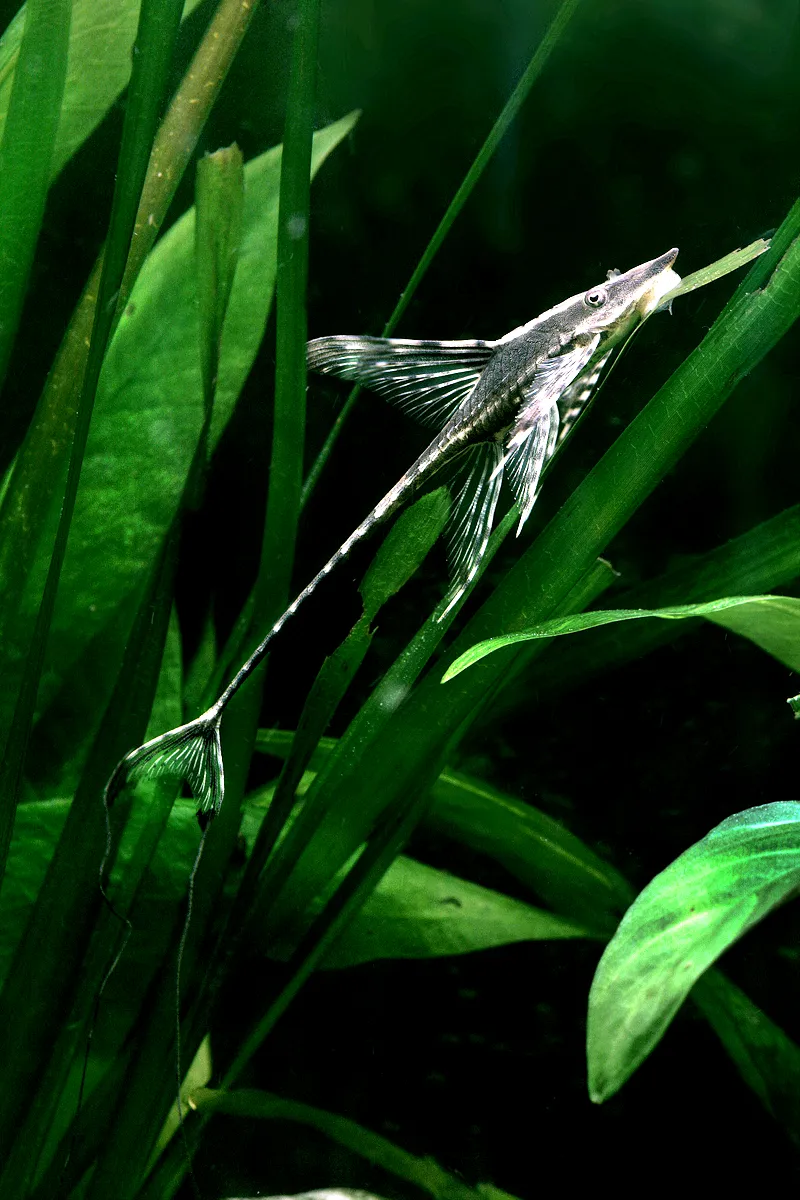
Sturisomatichthys aureus is one of the largest loricariids kept in the aquarium hobby, reaching approximately 8 in SL (FishBase) — often cited in hobby sources as up to 12 in total length including the extended caudal filaments. The body is strikingly elongated and strongly depressed throughout its length, tapering progressively toward the tail and terminating in a whip-like caudal extension, particularly in mature males.
The bony armour consists of longitudinal rows of overlapping scutes covering the body. The head is flattened, with a broad, muscular suction-disc mouth equipped with multicuspid teeth suited for rasping aufwuchs from hard surfaces. The snout is moderately pointed compared with the blunt profile of Chaetostoma.
Colouration is tan to brown dorsally with a distinctive golden or yellowish sheen — the basis of the species epithet and the common name 'golden whiptail'. A pattern of darker irregular spots or a reticulate network may be evident along the flanks, varying with individual and condition. The ventral surface is pale.
Sexual dimorphism is well-marked in adults. Mature males develop a conspicuous 'beard' of elongated odontodes along the sides of the snout, giving a bristled appearance around the head. Males also typically develop longer caudal and dorsal filament extensions than females. Females are fuller through the body and lack the pronounced snout odontodes, making sexing straightforward in adults.
Habitat
Sturisomatichthys aureus is endemic to three river systems in Colombia, all part of the Caribbean and Pacific drainage of the Andes: the Magdalena, San Jorge, and Cesar basins. The Magdalena is Colombia's principal river, draining the Andean interior westward and emptying into the Caribbean. These are not blackwater systems in the Amazonian sense; the Magdalena basin runs through a range of altitudes and geological substrates, and water chemistry varies considerably along the river's length.
The type locality — Bodega central on the Río Magdalena — is a lowland to mid-elevation site. The species is associated with clean, moderately to well-oxygenated stretches with hard substrates and current, where biofilm and aufwuchs accumulate on rock, wood, and other surfaces. Water parameters at collection localities in these basins are typically moderate in hardness and near-neutral in pH; FishBase records a range of 77–84 °F, pH 6.0–8.0, and hardness 5–19 dH for the species.
S. aureus is naturally a facultative air-breather, a trait shared across much of Loricariinae. This adaptation allows the species to supplement gill respiration with atmospheric air in conditions of reduced dissolved oxygen — a physiological hedge useful in seasonally variable river systems. In the aquarium, facultative air-breathing should not be mistaken for a tolerance of poor water quality; the species still requires clean, well-maintained water.
Feeding
Sturisomatichthys aureus is primarily an aufwuchs and algae grazer. Its broad, multicuspid-toothed mouth and powerful suction disc are adapted for rasping the film of algae, diatoms, and associated microinvertebrates from the surfaces of submerged rocks, roots, wood, and other hard substrates. In the wild, this forms the bulk of the diet, supplemented by plant material including roots and organic detritus.
In the aquarium, the species is an enthusiastic consumer of algae growing on tank glass, décor, and plant leaves — one of the reasons it has been popular in the hobby as a 'cleaning' fish. FishBase notes that it feeds on 'plants and roots' in aquarium settings; hobby sources list vegetable matter (lettuce, cucumber, spinach, pre-cooked peas, spirulina-based wafers) as preferred foods.
Animal protein supplements — mosquito larvae, bloodworm, Artemia, daphnia, and similar live or frozen invertebrate foods — are also accepted and beneficial, particularly for conditioning breeding fish. A varied diet combining algae/vegetable and occasional animal protein components is recommended for long-term health. The species should not be kept solely on algae; while it will graze efficiently, supplemental feeding is needed in most aquarium environments where algae growth alone cannot keep pace with the fish's nutritional requirements.
Mating
Sturisomatichthys aureus is an open-surface spawner, unusual among the larger loricariids in not using enclosed caves. Spawning occurs on exposed flat surfaces — most commonly on the aquarium glass, on broad flat rocks, or on the roots or stems of large plants. This is a significant difference from the cave-spawning Hypancistrus and related genera and simplifies observation of the full breeding sequence.
Males court females actively; the elaborate snout odontodes ('beard') of mature males are presumed to play a role in male–male competition and female choice. Once a female is receptive, the pair spawns side by side on the chosen surface, with eggs deposited in a compact cluster and fertilised immediately. The female typically takes no further role after egg deposition.
The male then takes up station beside or on top of the egg cluster and remains to guard and fan it continuously until hatching. This open-surface paternal care is one of the defining characteristics of Sturisomatichthys reproductive biology. In a community aquarium, the exposed position of the egg mass means tankmates may attempt to eat the eggs; a species-specific tank or a setup with minimal egg-predation pressure is advisable for breeding attempts.
Breeding
Sturisomatichthys aureus breeds readily in captivity when conditions are appropriate, and it is one of the more accessible large loricariids to breed in the hobby. Aquarium Glaser and multiple hobbyist sources report clutch sizes of 80–100 eggs per spawning event — substantially larger than the modest clutches of cave-spawning Hypancistrus species.
Egg clusters are typically deposited on aquarium glass, and the male fans them constantly. Incubation lasts approximately 7–9 days at 79–86 °F; sources vary slightly, but 7–9 days is the most frequently cited range. Fry consume their yolk sac over the first 3–4 days after hatching, then begin active feeding. The standard recommendation is to remove the parents once eggs hatch, because in a well-algaed tank the adults may inadvertently consume the algae film that newly independent fry need — or simply outcompete them for it.
Fry can be raised on finely powdered algae-based foods, spirulina powder, baby brine shrimp nauplii, and soft blanched vegetables. They grow relatively quickly and are hardy once free-swimming. Breeding temperature should be maintained at the upper end of the acceptable range, around 82–86 °F, to promote successful incubation.
Conditioning fish for breeding requires a spacious, well-maintained aquarium with strong current, regular large water changes, and a varied, algae-rich diet. A sex ratio of one male to two or three females is often recommended to allow the male to manage multiple clutches and reduce harassment of individual females.
In the aquarium
Sturisomatichthys aureus is among the more demanding large loricariids in terms of space: at up to 8 in SL (or up to ~12 in including caudal extensions), it requires a genuinely large aquarium. Hobby sources broadly agree on a minimum of 59–78.5 in tank length for adult specimens or a pair — significantly more than is typically suggested for the species on budget care-guide sites. The aquarium should include a generous expanse of open sandy substrate, large smooth rocks or driftwood for grazing surfaces, and adequate open swimming area.
Water quality requirements are high: the species is sensitive to organic pollution and low oxygen. Regular water changes (30–50% weekly) and efficient filtration are essential. A moderate current is appreciated. Water temperature of 77–84 °F is appropriate; the species tolerates a range of pH and hardness (6.0–8.0; 5–19 dH) but should not be kept in extreme conditions.
S. aureus is peaceful and can be kept in a community with other large, non-aggressive fish. It is compatible with other species that do not compete for the same grazing territories or that will not harass it. Other large loricariids may compete for territory; care should be taken in mixed-loricariid setups.
One practical note frequently overlooked in hobby literature: because this species grows large and has substantial vegetable-food requirements, it produces a considerable amount of waste. The filtration system must be sized accordingly, and the aquarium owner should be prepared to perform substantial water changes. Smaller specimens sold in shops will often outgrow typical 'community tank' setups within 1–2 years.
Conservation
Sturisomatichthys aureus is assessed as Data Deficient (DD) on the IUCN Red List, assessed in 2016. The Data Deficient designation reflects insufficient information on the species' population status, distribution within Colombia, and the specific nature and severity of threats it faces — not an absence of concern.
The species is endemic to Colombia and restricted to the Magdalena, San Jorge, and Cesar river basins — a geographic range that, while covering a significant area, is subject to some of the most intensive land use and pollution pressures in South America. The Magdalena basin is heavily developed for agriculture, industry, and urban settlement; the river carries high loads of sediment, agrochemicals, industrial effluents, and municipal wastewater. The San Jorge and Cesar tributaries face comparable pressures including deforestation, wetland drainage, and mining.
In this context, a Data Deficient assessment is conservative: the biological plausibility of a population decline given the scale of habitat degradation in the Magdalena basin is high, but the data needed to apply a threatened category under IUCN criteria have not been gathered. A reassessment with targeted field surveys could plausibly result in a threatened designation.
The species has been collected for the ornamental fish trade from Colombian rivers for decades and is available in the hobby internationally, typically under the trade name 'Sturisoma aureum' or 'royal whiptail.' Captive breeding is feasible and documented; captive-bred fish are available from specialist breeders and are to be preferred over wild-caught Colombian specimens.