Taxonomy & naming
Sturisomatichthys festivus was described by George S. Myers in 1942 in the Stanford Ichthyological Bulletin (volume 2, number 4, pages 100–103, figures 8–10), based on specimens collected from the Río Monay, approximately 22 mi north of Trujillo, within the Motatan river system draining into Lake Maracaibo, Venezuela. Myers originally placed the species in the genus Sturisoma, under the name Sturisoma festivum; the epithet is a Latin neuter adjective meaning 'festive' or 'gay with colour,' alluding to the attractive banded and spotted patterning of the living fish.
The Catalog of Fishes (Eschmeyer, CAS) recognises the current valid combination as Sturisomatichthys festivus (Myers, 1942), with Sturisoma festivum Myers, 1942 as the basionym. The parenthetical authority reflects the original description in a different genus. PlanetCatfish and some older literature list the name as Sturisomatichthys festivus, treating the epithet as masculine, but because Sturisomatichthys is a grammatically feminine genus, the correct form of the Latin adjectival epithet is the neuter or feminine-agreement form festivum. FishBase (2025) records the valid name as festivum.
The placement in Sturisomatichthys follows the molecular phylogenetic revision by Covain et al. (2016), which demonstrated that the broadly defined genus Sturisoma was not monophyletic. Trans-Andean species — including those from the Maracaibo and Catatumbo systems — are now placed in Sturisomatichthys Isbrücker & Nijssen, 1979, while cis-Andean lineages remain in Sturisoma. S. festivus belongs to Loricariinae within Loricariidae; its phylogenetic relationships within Sturisomatichthys remain underexplored.
Distinguishing Sturisomatichthys from Sturisoma requires attention to abdominal plate arrangement (less organised in Sturisomatichthys, lacking the three clear longitudinal series of Sturisoma), the presence of dark spots on fins (usually present in Sturisomatichthys, absent in Sturisoma), and a lower lateral plate count of 15–18 in the median series for Sturisomatichthys versus 20–21 for Sturisoma.
This fish was long listed as Sturisomatichthys festivum; Eschmeyer's Catalog of Fishes places the species in Sturisomatichthys, and the current combination Sturisomatichthys festivus is followed here.
Morphology
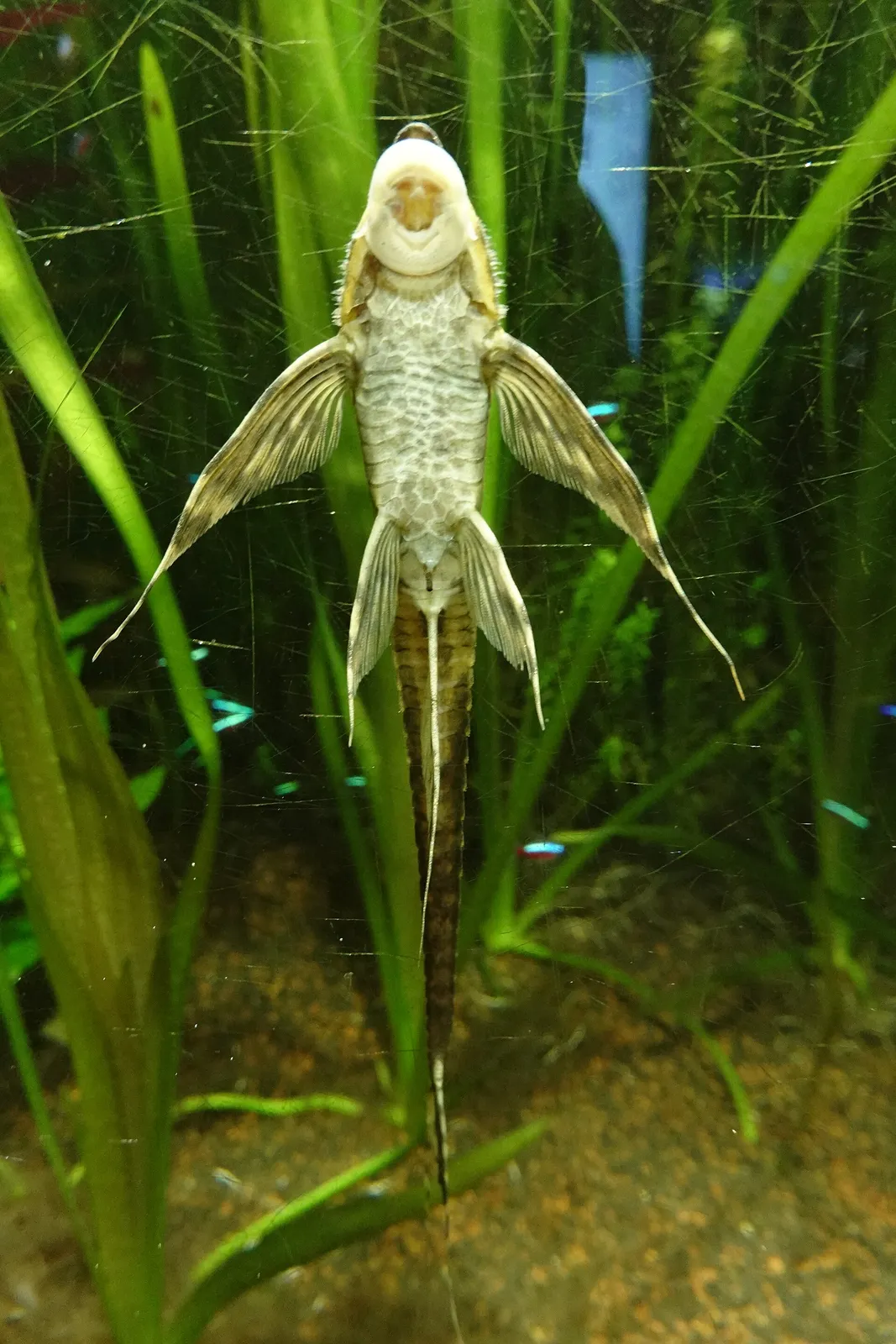
Sturisomatichthys festivus is a moderately large whiptail, reaching 6.5 in SL per the main reference cited in FishBase (Ferraris, 2003), with PlanetCatfish recording 7 in SL for large individuals. The body is strongly elongated and dorso-ventrally depressed throughout, tapering progressively from a broad, flat head to a thin caudal peduncle that terminates in an extended filamentous caudal ray in mature males — a feature that adds several centimetres to overall length beyond the standard length measurement.
The bony armour consists of interlocking scutes covering the dorsal surface and flanks in longitudinal rows. Abdominal plating is less organised than in Sturisoma — a diagnostic character of the genus. The inferior sucker-disc mouth is equipped with multicuspid teeth suited for rasping algal and biofilm growth from hard surfaces. The dorsal fin is elevated and flag-like, a trait common to the genus.
Colouration is the feature most responsible for the common name 'Real Royal Farlowella': a pale cream to tan ground colour overlaid with a series of prominent dark brown to blackish transverse bands or blotches along the body, plus dark spots visible on the dorsal and other fins — a pattern that sets it apart from the cleaner, less-spotted banding of many Sturisoma. The ventral surface is pale. Individual variation exists, and captive fish may shift colour intensity based on substrate and condition.
Sexual dimorphism follows the Sturisomatichthys pattern. Mature males develop conspicuous odontode-bearing bristles ('beard') along the sides of the snout, often more pronounced than in females. Males also typically develop longer caudal and fin extensions. Females are broader-bodied when gravid and lack the pronounced odontode beard.
Habitat
Sturisomatichthys festivus is endemic to the Lake Maracaibo basin, northwestern Venezuela — a distribution restricted to the Motatan river system (the type locality being Río Monay, a Motatan tributary) and the adjacent Catatumbo drainage that also feeds Lake Maracaibo. PlanetCatfish records the species from both the Lake Maracaibo and Catatumbo drainage areas.
Lake Maracaibo is South America's largest lake and one of the oldest on Earth, estimated at 20–36 million years old, predating the final uplift of the Andes. Its drainage is biologically distinctive, sharing more affinities with the trans-Andean Pacific slope ichthyofauna than with Amazonian assemblages. The rivers of the Maracaibo basin range from clear foothill streams to more turbid lowland reaches; the Motatan system where the type series was collected is a highland-fed river descending through the western Venezuelan Andes.
Water conditions across the Maracaibo basin vary, but rivers draining the Andes into the lake tend to be moderately oxygenated, clear to lightly tannin-stained, warm (approximately 75–82 °F per PlanetCatfish), and ranging from neutral to slightly acidic depending on the substrate and season. S. festivus is a facultative air-breather, as confirmed for the genus by FishBase (Ref. 126274), allowing it to supplement gill respiration under conditions of reduced dissolved oxygen.
The species is associated with riverine microhabitats offering hard substrate (smooth rocks, submerged roots, exposed bedrock) on which biofilm and aufwuchs accumulate. It is unlikely to inhabit the lake itself, residing instead in the tributary river system.
Feeding
Sturisomatichthys festivus is primarily an aufwuchs and algae grazer. Its broad, multicuspid-toothed sucker mouth is adapted for rasping the film of algae, diatoms, and associated microorganisms from submerged rock surfaces, roots, wood, and other hard substrates. This feeding mode is typical of the Loricariinae subfamily and is shared with its congeners including the related Sturisomatichthys aureus.
The trophic level for the species is estimated at 2.5 (FishBase), consistent with a predominantly algal-biofilm diet supplemented by small invertebrates and detrital matter encountered during grazing. The fish feeds continuously throughout the day and night, methodically rasping substrate surfaces.
In the aquarium, S. festivus performs well as an algae-grazed fish in a tank with a good growth of green algae on rocks and glass. Supplemental foods should emphasise vegetable matter: spirulina-based wafers, blanched courgette (zucchini), spinach, cucumber, and pre-cooked peas. Occasional live or frozen invertebrate foods — bloodworm, Artemia, daphnia — are accepted and help condition fish for breeding. As with other aufwuchs-oriented loricariids, the species should not be expected to subsist on incidental tank algae alone; active supplemental feeding is necessary for long-term health and reproductive conditioning.
Mating
Sturisomatichthys festivus is an open-surface spawner — a reproductive strategy unusual among the larger loricariids and characteristic of Sturisomatichthys. Unlike cave-spawning genera such as Hypancistrus or Panaqolus, spawning occurs on exposed flat surfaces: aquarium glass, smooth flat rocks, broad driftwood surfaces, or the underside of large horizontal plant leaves.
PlanetCatfish records nine breeding reports for the species, confirming that captive spawning is achievable. The male's distinctive snout odontodes ('beard') are presumed to function in male–male competition and female assessment. Males become territorial around preferred flat surfaces, and a conditioned female will approach and engage with the male on the chosen spawning surface.
Spawning occurs with the pair positioned side by side; the female deposits a cluster of eggs directly onto the surface, and the male fertilises them immediately. The female plays no further role. The male then takes up position adjacent to or partially over the egg mass and begins fanning it continuously with fin movements to maintain oxygenation. PlanetCatfish photos document a male guarding eggs on aquarium glass — a sequence reproduced across multiple breeding reports for the species.
Conditions that support breeding readiness include: a spacious, well-maintained aquarium with regular large water changes (which can substitute for the seasonal hydrological variation the species experiences in the Maracaibo drainage), a varied vegetable-rich diet, clean water, and adequate surface area of suitable spawning substrate.
Breeding
Captive breeding of Sturisomatichthys festivus is documented with at least nine breeding reports on PlanetCatfish, placing it among the more successfully bred Sturisomatichthys species. The reproductive biology follows the pattern common to the genus: open-surface deposition of a compact egg cluster, followed by exclusive paternal guarding and fanning.
Clutch size is not formally published for this species; by analogy with the better-studied congener S. aureus, clutches are likely in the range of 50–100 adhesive eggs, deposited in a tight group on a flat surface. Eggs are pale yellowish to greenish, relatively large, and firmly adherent. The male fans them continuously and remains close to the egg mass, departing only briefly. Incubation takes approximately 7–10 days at 79–82 °F, consistent with Sturisomatichthys aureus data from Aquarium Glaser and hobby reports.
Fry emerge with substantial yolk sacs and become free-swimming within 3–5 days of hatching. They begin grazing biofilm and fine algae almost immediately and accept finely powdered spirulina, baby brine shrimp nauplii, and microworms. Growth is relatively rapid under good conditions. Some breeders recommend removing the male once fry have hatched and dispersed, as the adults may compete for biofilm with the fry in a well-managed aquarium.
Breeding is promoted by: a spacious tank (minimum 59 in in length for an adult pair), high water quality with regular water changes of 30–40%, temperature maintained at 79–82 °F, and a varied diet rich in algae and vegetable foods.
In the aquarium
Sturisomatichthys festivus is an appealing and moderately demanding aquarium species — a rewarding subject for specialists in loricariids or South American biotope aquaria but not ideally suited to the typical community setup. Its relatively large adult size (up to ~6.5 in SL, or ~8.5–9.5 in total length including fin extensions in large males) requires a tank of at least 47–59 in length; a 200-litre aquarium with a 59 in footprint is more appropriate for a pair or trio.
Water conditions should reflect the Maracaibo basin highland-river origin: temperature 75–82 °F, pH 6.5–7.8, moderate hardness. The species is not particularly demanding within these parameters but responds poorly to organic accumulation and low dissolved oxygen. Good circulation and generous oxygenation are important. Weekly water changes of 30–40% are recommended, and the efficiency of filtration must keep pace with the bioload of a large grazing loricariid.
Aquascape should include large flat rocks, smooth driftwood, and areas of open, clean substrate; algae is encouraged on rock and glass surfaces as a constant food supply. Robust, hard-leaved plants (Anubias, Microsorum) attached to wood survive well alongside grazing loricariids; fine-leaved plants will be nibbled or uprooted.
S. festivus is peaceful toward other species and is compatible with mid-water tetras, larger rasboras, or other South American community fish. Conspecific males can be territorial; a ratio of one male to two or more females minimises conflict. Because the species is an open-surface spawner, other benthic fish that might disturb or eat eggs are best excluded from breeding setups. Juveniles and sub-adults are occasionally available from specialist importers; the species is not common in the trade but is periodically imported from Venezuela.
Conservation
Sturisomatichthys festivus is listed as Not Evaluated (NE) by the IUCN Red List as of the 2025-2 assessment version (FishBase, Ref. 130435). The species has not undergone the formal review process required for an IUCN category assignment. PlanetCatfish cites an IUCN assessment of 'Least Concern' last updated in 2021 via the IUCN API link, but this does not currently resolve to a confirmed IUCN Red List assessment page, and FishBase 2025-2 records the status as 'Not Evaluated' — accordingly, the most conservative current designation is NE.
The species' restricted endemic range within the Lake Maracaibo drainage of northwestern Venezuela is a concern from a biogeographic perspective, regardless of formal listing status. The Maracaibo basin is one of South America's most oil-rich and industrialised freshwater systems; the lake and its tributary rivers face chronic pollution from petroleum extraction, urban and agricultural runoff, and sedimentation from deforested Andean hillsides.
The highland rivers of the Motatan system, where the type specimens were collected, are in a zone subject to intensive agriculture (primarily sugar cane and banana cultivation) and urbanisation along the Andean foothills. The extent to which clean, well-oxygenated running-water habitat with algae-covered hard substrate — the microhabitat this species requires — remains available across its range has not been formally assessed. Given the tight endemism and the documented pressures on the Maracaibo basin, a targeted field survey to establish baseline population data and a formal IUCN evaluation would be valuable.