Taxonomy & naming
Jay R. Stauffer Jr. and Kenneth R. McKaye described Amphilophus sagittae in 2002, in the regional journal Cuadernos de Investigación de la Universidad Centroamericana (No. 12:1-18). They named it alongside two other Lake Xiloá endemics, Amphilophus amarillo and Amphilophus xiloaensis. All three had been folded into a broad concept of the Midas cichlid, Amphilophus citrinellus, until researchers noticed that distinct color and body-shape patterns tracked distinct habitats within the lake. The holotype sits at Penn State University (PSU 3386.1), and the type locality is Lake Xiloá at roughly 12°13.8'N, 86°19.4'W, between 3 and 33 ft depth.
The genus name Amphilophus is Greek for "crest on both sides"; the epithet sagittae is the Latin genitive of sagitta, "arrow," so the name reads as "of the arrow" — a nod to the fish's slender, pointed profile beside its higher-bodied lakemates. It belongs to the Cichlinae, within the heroine cichlid radiation, and sits inside the Amphilophus citrinellus (Midas) species complex. That complex now takes in a string of crater-lake endemics: Amphilophus zaliosus, Amphilophus astorquii, Amphilophus chancho and Amphilophus flaveolus in Lake Apoyo, and Amphilophus amarillo and Amphilophus xiloaensis beside Amphilophus sagittae in Xiloá — most of them young offshoots of an ancestral citrinellus-like colonist. The group's taxonomy is still being sorted out, and several populations remain undescribed, so the literature often hedges by calling these fish Amphilophus cf. citrinellus.
Morphology
Amphilophus sagittae is a large Midas cichlid, and keepers routinely grow it to around 12 in — a robust adult that wants a six-foot tank, not the modest resident its published measurements suggest. The 6.5 in figure in FishBase is a standard length taken from the preserved type series, and it sells the living fish short. Of the three Midas cichlids in Lake Xiloá, this is the odd one out in shape: the lake's elongate limnetic form, with a notably small head and eye, a laterally compressed, drawn-out mid-body, and a long, narrow caudal peduncle — the arrow silhouette its name describes. Geometric-morphometric work on the Midas complex by Elmer, Kusche, Lehtonen and Meyer found that across these crater-lake fishes, most body-shape change concentrates in exactly these features (head and mouth shape, head size, body depth and caudal-peduncle length), and that elongate limnetic forms like Amphilophus sagittae sit at one extreme of that axis. Behind the streamlined exterior are delicate, papilliform (finely-cusped) pharyngeal jaws suited to soft prey, rather than the heavy, molariform crushers of its rock-grubbing relatives.
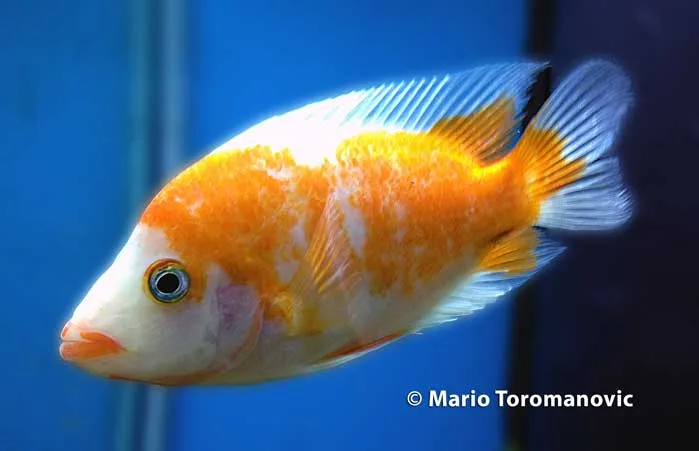
Coloration is famously variable. In the wild, most fish wear a barred, wild-type pattern — dark vertical bars on a grey-brown ground. A minority carry the amelanistic "gold" or xanthic morph, the loss of black pigment that turns the fish orange, white or piebald, which the Elmer et al. study reports at under 7% of Amphilophus sagittae — below the (under 20%) share seen in its lakemate Amphilophus xiloaensis. Aquarists have selected heavily on this variation, and the species circulates in the hobby as black, white/xanthic, and orange-and-white "creamsicle" forms; breeders note that creamsicle fry hatch in dull wild-type brown and only develop their yellow-orange wash at a few months of age. Sexual dimorphism is modest — males grow somewhat larger and adult males often develop the rounded nuchal hump typical of Midas-group cichlids. It is easily confused with its congeners; the IUCN assessment itself notes that similar coloration and morphology make it hard to separate from close relatives, so the safest identifications come from wild-collected stock of known Xiloá origin.
Habitat
Amphilophus sagittae lives in a single body of water: Lake Xiloá, a crater lake of roughly 1.5 mi² on the Chiltepe Peninsula about 12 mi north of Managua, in the Pacific-slope volcanic belt of western Nicaragua. The lake is geologically very young — on the order of 6,100 years old — which makes the fish's degree of specialization all the more striking. Xiloá sits just above the great Lake Managua (Lake Xolotlán), and the two are not fully isolated: when Managua's level has risen historically, water has exchanged between them. That connection ties the species to the broader Managua-basin fauna even as it stays restricted to the crater itself.
Within Xiloá, Amphilophus sagittae holds the depth band of about 9-30 ft, usually cruising the open water just above sandy bottoms rather than hugging rock. This is what makes it unusual: a genuinely limnetic cichlid, one of the few known from the Neotropics, paralleled most closely by Amphilophus zaliosus of Lake Apoyo. In-situ conditions are warm and hard — surface temperatures around 75-79°F, near-neutral pH around 7, and high mineral hardness — the same general chemistry seen across Nicaragua's crater lakes. It breeds slightly deeper than its higher-bodied lakemate Amphilophus amarillo, and field accounts place spawning over sand within mixed structure of aquatic plants and rocks.
Feeding
Amphilophus sagittae is the open-water predator of the Xiloá Midas trio. Vivas and McKaye characterized it as limnetic, and its elongate body, small mouth and fine pharyngeal jaws all point to prey taken in the water column rather than ground off the substrate. FishBase places its trophic level at about 3.3 — squarely carnivorous. Hobby and natural-history accounts converge on a menu of small fishes, aquatic insects, crustaceans and zooplankton: the mobile, soft-bodied prey a streamlined cruiser is built to chase. No published gut-content study isolates its exact diet, so this picture is inferred from its morphology, its limnetic habit, and accounts of the Midas complex rather than measured directly.
That feeding role is the engine of the species' evolutionary interest. Across Nicaragua's crater lakes, Midas cichlids have repeatedly split into high-bodied, hard-jawed "benthic" forms that work the rocks and slender, fine-jawed "limnetic" forms that hunt open water — and they have done it independently in different lakes. Amphilophus sagittae in Xiloá and Amphilophus zaliosus in Apoyo are the parallel limnetic endpoints of that process: separate populations that converged on nearly the same arrow-shaped body to exploit the same niche. Work by Kusche and colleagues on young crater-lake cichlids shows that even within a single such species, individuals can specialize along the benthic-limnetic axis — the kind of variation thought to seed the earliest stages of ecological divergence. In Xiloá, Amphilophus sagittae represents that divergence largely completed.
Mating
Like other Midas-group cichlids, Amphilophus sagittae is monogamous, forming lasting pair bonds rather than holding a harem or mouthbrooding. A pair claims and defends a spawning site with both partners sharing the work: the female stays close over the eggs and brood while the male patrols the perimeter against intruders. In captivity, keepers report that pairs form around a year of age, often at a cave or sheltered site, with the female occupying the cavity and the male standing guard nearby.
Field accounts from Lake Xiloá note that Amphilophus sagittae breeds in deeper water than the syntopic Amphilophus amarillo. That depth partitioning helps keep the lake's closely related cichlids reproductively separate — a soft barrier to hybridization between forms that are otherwise easy to cross. As with most large heroine cichlids, pair aggression can spike sharply in the run-up to spawning, and unpaired adults can be rough on one another, though some keepers report surprisingly peaceable groups. These temperament notes come from aquarist forums and club profiles rather than published ethology, but they hold up consistently across independent keepers, which lends them weight.
Breeding
Amphilophus sagittae is a biparental substrate spawner, not a mouthbrooder. The pair cleans a spawning surface, the female lays an adhesive clutch, and both parents then tend it — fanning and guarding the eggs before escorting the free-swimming fry as a defended school. Field accounts from Lake Xiloá describe pairs leading young over open sand, with spawning placed over sand within mixed structure of aquatic plants and rocks, and slightly deeper than the lake's higher-bodied Amphilophus amarillo. No clutch-size count has been published for Amphilophus sagittae specifically; Midas-complex cichlids typically lay clutches numbering in the hundreds — FishBase records roughly 300-1,000 eggs for the parent species Amphilophus citrinellus — but the precise figure for this species is undocumented.
In captivity the fish breeds readily and behaves much as it does in the wild. Aquarists describe it as a confident, constantly-visible open swimmer rather than a hider — "one of the highest-personality cichlids," in the words of one keeper — that greets people at the glass. Cave or sheltered spawning is common in tanks, with the female in the cavity and the male on guard, and keepers consistently praise both parents as attentive, durable guardians of the fry. Those fry hatch in dull wild-type brown even in the selectively-bred "creamsicle" line, developing adult coloration only at a few months of age. As with most large Central American cichlids, the real breeding challenge is managing pair aggression and giving the parents room, not coaxing them to spawn.
In the aquarium
Amphilophus sagittae is a genuine rarity in the hobby, circulating mostly among Central American cichlid specialists. The odd breeding group surfaces on cichlid-forum trade threads or at club auctions, but there is no established commercial supply chain. Because it hybridizes readily with other Midas-group cichlids and misidentified fish are common, anyone acquiring it should verify the provenance of their stock.
Tank: this is a big, restless, open-water cruiser, and even a single pair needs a sizable footprint — a realistic minimum is 180 × 23.5 in (roughly 170 US gallons), and larger is better. The extra volume is the single most effective buffer against pair aggression during spawning, and it lets the male hold a proper patrol perimeter without turning every corner into contested territory. Standard large-cichlid filtration applies: heavy mechanical and biological load, strong circulation, and 30–50 % weekly water changes.
Water: track the crater-lake baseline — temperature 75–79 °F, pH 7.0–7.5, and moderately hard water (GH roughly 10–20 °dH). Soft or acidic water is not appropriate; like all Midas-group fish, it comes from warm, mineral-rich volcanic lakes. Buffering with coral sand or crushed limestone holds the chemistry stable without constant tinkering.
Aquascape: build for open sand, not a planted or rock-cluttered scape. Use a sand substrate, a few larger flat or cave-forming rocks to anchor pair territories and serve as a spawning surface, and open swimming lanes in front. Plants work as accents but not as the main structure — the fish will rearrange or uproot them at spawning time. Terracotta caves or smooth slate slabs make good spawning sites.
Tankmates: the Midas temperament comes standard. Amphilophus sagittae is assertive, territorial when breeding, and quite capable of inflicting real damage on smaller or more passive fish, so community keeping is not realistic. The safest setups are a proven pair on their own, or — to display several cichlids — a very large tank stocked with similarly sized, robust Central American species (Vieja melanurus, Paraneetroplus species, or other heroine cichlids of comparable body weight) and enough broken line-of-sight to diffuse aggression. Do not house conspecific males together once they are sexually mature unless the tank is very large and the pairs are already formed.
Feeding: keep it simple. Medium–large sinking cichlid pellets make a good staple, supplemented with meaty foods — krill, mussel, earthworm, and the occasional frozen bloodworm or white mosquito larva. Feeder fish are unnecessary and carry disease risk, so skip them. Feed once or twice daily, only what is eaten within two to three minutes.
Breeding: it happens readily once a compatible pair is established, and the fry are hardy on crushed pellet and baby brine shrimp. The main practical hurdle is pair compatibility — the fish choose their own partners, and a rejected pairing can end with a dead or badly injured individual. Introduce prospective pairs as juveniles and let them sort themselves out, or use a divider so they can court through a barrier before you commit them to the same space.
Bottom line: difficulty is moderate to high. The husbandry itself is forgiving — the water parameters are undemanding and the fish feeds and breeds readily — but the aggression management, the rarity of captive-bred stock, and the space requirement put it beyond the casual fishkeeper. It suits someone already experienced with large Central American cichlids who wants to work with a biologically interesting, seldom-kept species.
Conservation
The IUCN Red List assesses Amphilophus sagittae as Vulnerable (VU) under criterion D2, in an assessment dated 17 June 2019 (published 2020; Lyons & Contreras MacBeath). That status rests on geography, not on any documented decline: the fish is confined to a single small lake, with estimated extent of occurrence and area of occupancy of only about 3.1 mi², all of it effectively one location and one population. The population trend is judged stable, the species is not fished or traded, and at the time of assessment there were no major active threats to the lake. The D2 listing exists precisely because so narrow a range can be tipped into danger by a single bad event. The assessment names the most plausible one: the introduction and establishment of non-native tilapia (Oreochromis spp.), which have damaged native fish communities elsewhere in Nicaragua. Encouragingly, Lake Xiloá had so far escaped tilapia establishment (McCrary et al. 2007), and it lies within the Chiltepe Peninsula Nature Reserve, which gives it some indirect protection.
That reassuring species-level picture has to be read against the strain on the wider basin. Lake Xiloá drains into the Managua basin, and the great Lake Managua (Xolotlán) below it is one of the most polluted large lakes in Central America — burdened for decades by untreated urban sewage, industrial and agricultural runoff, and elevated contaminant loads including mercury in its commercial fishes — before it spills onward to Lake Nicaragua via the Río Tipitapa. The broader Central-American cichlid literature documents how introduced species and habitat change have reshaped these waters. Xiloá's crater walls have so far buffered it from the worst of what afflicts Managua, but the periodic hydrological connection between the two lakes is a reminder that the buffer is not absolute. The honest summary is the one the Red List implies: Amphilophus sagittae is not declining today, but its whole existence rides on the continued health of one tiny, encircled lake in a basin under real and growing pressure.