Taxonomy & naming
Apistogramma allpahuayo was described in 2012 by Uwe Römer and a large international team — Beninde, Duponchelle, Vela Díaz, Ortega, Hahn, Soares, Díaz Cachay, García Dávila, Sirvas Cornejo and Renno — in Vertebrate Zoology (62(2): 189–212), working from 51 specimens collected in and around the Reserva Nacional Allpahuayo Mishana in the Departamento de Loreto, Peru. The species name is a noun in apposition taken from the type locality, the Quebrada Allpahuayo inside that reserve. FishBase files the English name "featherfin dwarf cichlid," but that is an aggregator label; in the hobby the fish has long been the "black chin" apisto, and earlier the trade names Apistogramma sp. "Diamante" and — mistakenly — Apistogramma juruensis.
The holotype is an adult male of 1.5 in standard length, catalogued as MUSM 40593 in the fish collection of the Museo de Historia Natural at the Universidad Nacional Mayor de San Marcos in Lima; paratypes are divided among MUSM, the California Academy of Sciences (CAS) and the Museum für Tierkunde Dresden (MTD F). The type material came from a small nameless forest cocha (oxbow) about 18 mi south of Iquitos, netted in August 2011.
The authors place the species in the Apistogramma-cacatuoides complex within the broader Apistogramma cacatuoides lineage, on combined morphological and genetic grounds. That kinship is why it circulated for years as "Apistogramma cf. juruensis" or "sp. Black Chin": Römer and Soares had themselves misidentified it as Apistogramma juruensis Kullander, 1986 in the mid-1990s, and it had been imported from Peru for the hobby since at least 1995 before the 2012 description settled matters. One caveat comes from the specialist literature. Mike Wise, the long-standing authority on the genus at apistogramma.com, notes that the type-locality cocha held no Apistogramma allpahuayo before about 2000 — historically the fish was known only from the middle Rio Nanay near the village of Diamante Azul (hence the early name Apistogramma sp. "Diamante"), and local collectors appear to have moved it to ponds and streams nearer Iquitos to make collecting easier. The genus Apistogramma itself was erected by Regan in 1913 and now holds roughly ninety described species, one of the most diverse cichlid radiations in the Neotropics.
Morphology
This is a true dwarf cichlid. The type series gives a maximum standard length of about 1.6 in in males and 1.2 in in females; the "3 in" male (2.8 in) quoted by some exporters and aquarium sources is a total-length figure that counts the extended finnage and inflates things considerably. Either way, you measure this fish in fractions of an inch.
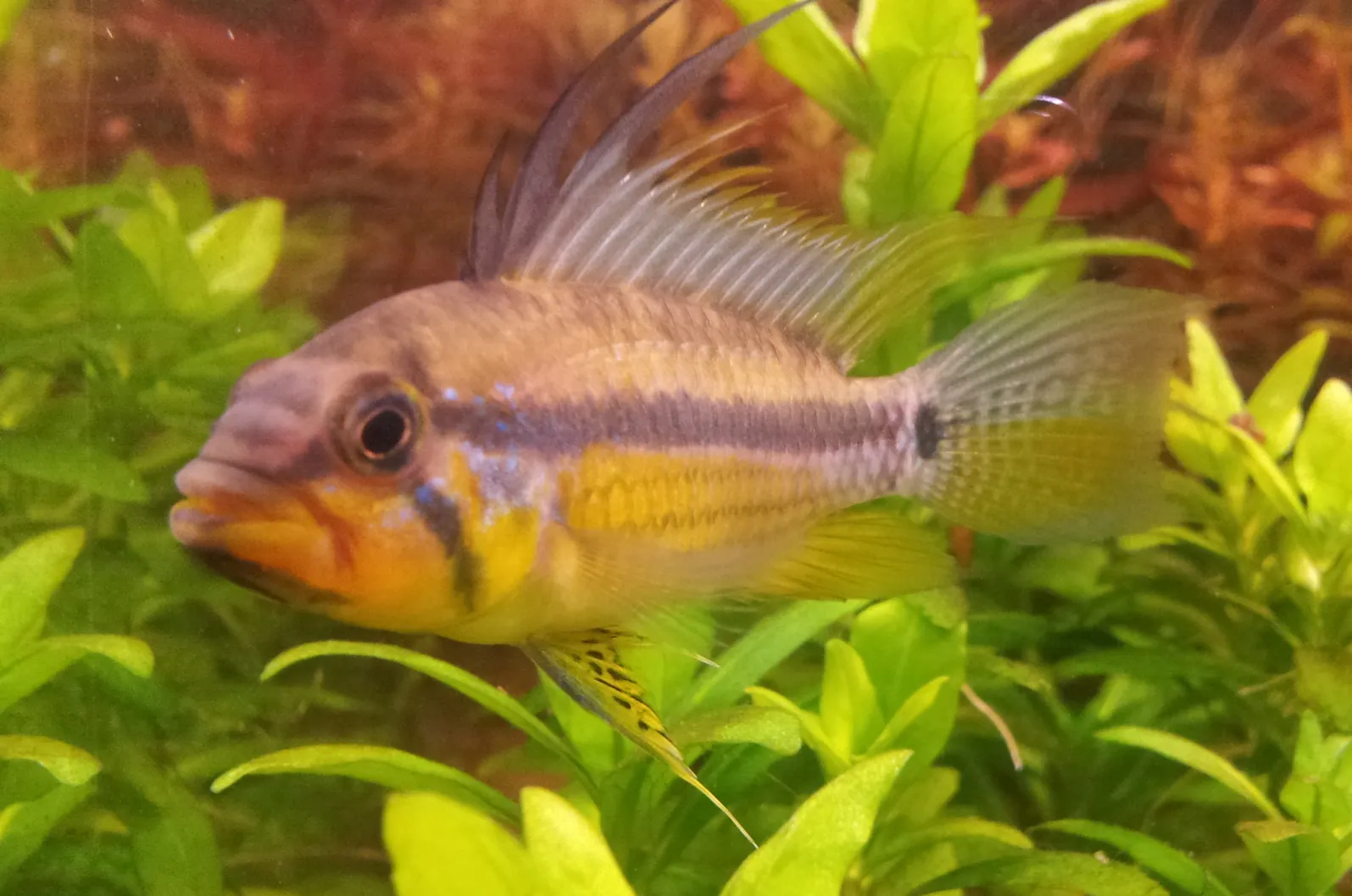
Its signature is the black, W-shaped mark across the lower jaw — the "black chin" — carried by both sexes, though it brightens and fades with mood. To that the authors add the combination that separates it from every relative: a lyrate (twin-pointed) caudal fin in adult males, unusually massive jaws with hypertrophied orange lips, a roundish spot on the caudal peduncle that stays clearly separate from a lateral band ending at the seventh vertical bar, a serrated dorsal fin whose first membranes draw out into conspicuous extensions, and dorsal-spine proportions that break the genus's usual rule — here one of the third-to-fifth spines is longest, not the last. A subtler touch, shared with Apistogramma huascar, is the red-to-orange fleshy tissue holding the jaw teeth, set against the whitish teeth themselves.
Males are highly polychromatic, and their colour forms are sometimes sold as if they were localities. Early breeding notes recorded several morphs; the 2012 study kept to two well-marked types — informally a "blue" and a "yellow" form — and judged the rest to be intermediates, and the standard hobby references (Römer's Cichlid Atlas, the DATZ articles and Koslowski) likewise figure just these two. Females are far plainer: yellowish to light brown with faint vertical bars that intensify toward the back, darkening to a bold black brood-care pattern when they guard eggs and fry.
Habitat
Apistogramma allpahuayo looks to be a narrow endemic of the Rio Nanay drainage, a black-water tributary system on the north bank of the Amazon near Iquitos in Loreto, northeastern Peru. On current evidence its range concentrates west of the Iquitos–Nauta road inside the Reserva Nacional Allpahuayo Mishana, with only two or three confirmed populations from a single stream outside the reserve and scattered single specimens elsewhere; the authors suspect it is somewhat more widespread than recorded but note it has never turned up beyond Loreto. Human transplantation muddies the map — some populations near Iquitos, the type locality among them, are probably introduced rather than natural — so the species' true native footprint may be smaller and more centred on the middle Rio Nanay than the collection points suggest.
Geologically the fish sits at the northeastern edge of the Iquitos palaeoarch, a hilly zone where terrain walls small streams off from one another. There are no broad seasonal inundation zones (várzea) here to reconnect them, so even neighbouring brooks stay biologically isolated — a setting that rewards localized endemism and drives the high small-stream diversity of this part of Amazonia.
It lives in shallow forest quebradas, most of them black water, a few touched by white or clear water. The in-situ readings are telling: water temperatures of about 76–83 °F, strongly acidic pH (mostly 4.6–5.7, with one white-water-influenced brook anomalously at 7.4), low conductivity of roughly 23–142 µS/cm, and strikingly low dissolved oxygen, from 2.26 mg/L down to a near-anoxic 0.37 mg/L. Oxygen-starved, tannin-stained, leaf-littered soft water like this is classic apisto habitat, and the species is plainly built for conditions that would stress most other fishes.
Feeding
No detailed field study of what Apistogramma allpahuayo eats in the wild has been published; the describing authors said plainly that its distribution and ecology still need filling in. The rest is inference from the genus and from its gut and trophic biology. FishBase puts its trophic level near 3.3, in keeping with a small omnivore that takes invertebrates.
Like other Apistogramma, it forages over and through soft substrate and leaf litter. A detail the importers stress, and one broadly true of the genus, is that much of the natural "diet" is really the microfauna and microorganisms living in decaying plant matter rather than the plant matter itself; the digestive system is built for fine, high-fibre forage, not rich protein. That cuts both ways, in the wild and in the tank: keepers who lean too hard on rich, wormy foods reliably make these fish sick, while a varied menu of small live and frozen fare (daphnia, cyclops, baby brine, bloodworm in moderation) plus a good dry food keeps them healthy.
In its low-oxygen streams the species shares the water with armoured catfishes (Hoplosternum), knifefishes (Gymnotus) and the swamp eel Synbranchus marmoratus, among others. The authors float an intriguing ecological idea: by tolerating oxygen sometimes under 1 mg/L, brooding Apistogramma females may reach refuge habitat where large predators are scarce and competition eases — turning a physiologically hostile microhabitat into safer ground for raising fry.
Mating
Apistogramma allpahuayo runs on a polygynous, harem-style social system — the standard Apistogramma template. A dominant male holds a large territory overlapping the smaller territories of several females, each of whom defends her own patch against rival females, though not against the alpha male. The species is also known for highly ritualized frontal threat displays during territorial disputes, a behaviour it shares with the related Apistogramma huascar; the gaping, lip-flaring posture that shows off those orange lips is part of the signalling.
Male colour polymorphism is more than decoration. Apistogramma females are choosy, and breeding experiments on this species found reproductive success tied to male morph, with a male's offspring keeping true to his colour type. The authors suggest that female preference for particular morphs could be stabilizing those colour forms genetically — a small window onto how mate choice might nudge such fishes toward speciation. In the aquarium the practical face of all this is simple: several females and enough cover — caves, driftwood, leaf litter — to break up sight lines are what let a peaceful harem form.
Breeding
Apistogramma allpahuayo is a substrate-brooding cave spawner with female-led parental care, the genus norm. The female spawns on a hidden surface — usually the ceiling of a cave or crevice — then takes over, tending the eggs and guarding the larvae and fry while the male patrols the wider harem territory. Clutches are modest, on the order of dozens of eggs. A guarding female switches to her conspicuous black brood pattern, and in close quarters females may even mix broods, adopting another female's young.
In the hobby it is bred much as its cacatuoides-group relatives are. Soft, acidic, low-conductivity water is what carries sensitive eggs through development: breeders stress that total dissolved solids matter more than a dark tint, and that genuinely soft water — very low TDS from RO or rainwater — is the real trigger, with temperatures in the upper 70s to low 80s °F (about 75–82 °F) matching the wild streams. As in many Apistogramma, the water chemistry around spawning also skews the brood sex ratio, so the same soft, warm, acidic conditions that suit the eggs are the ones keepers adjust to balance the fry. Beyond that the fish asks only for cover — sand, botanicals and a choice of caves (coconut shells or inverted pots) — and a few mid-water dither fish such as small tetras to settle the cichlids and signal that it is safe to spawn.
In the aquarium
Apistogramma allpahuayo is genuinely rare in the hobby — seldom in stock and almost never at a chain store. Most fish that surface come from specialist importers or from hobbyists breeding their own, since the Reserva Nacional Allpahuayo Mishana designation rules out commercial collection at the type locality and the wild populations outside the reserve are small. This is not a beginner fish, and not one to buy on impulse.
Water is the non-negotiable: soft and acidic. Field readings from the type locality put pH at 4.6–5.7 and conductivity at 23–142 µS/cm — water so soft it barely conducts electricity. Aim for pH 5.0–6.0 and very low TDS, which in most homes means reconstituted reverse-osmosis or rainwater rather than aged tap unless the tap is unusually soft. Indian almond (Terminalia catappa) or dried oak leaves earn their place less for any pH they deliver than for the humic acids and the dim, leaf-littered feel; the fish are visibly calmer in tinted water. Hold temperature in the natural range, 77–82 °F, with the upper end for breeding conditioning.
Tank size is set by floor area, not volume. A pair fits a 60-litre (15-gallon) footprint aquarium; a trio (one male, two females) or a full harem is better served by the extra floor of an 80–100-litre tank. Length beats height — these fish work the bottom and need horizontal territory. Use sand or fine gravel, which they sift constantly, and give them broken sight lines: driftwood, clumps of dried leaves, and two or three caves (coconut-shell halves, unglazed ceramic pots, or narrow-mouthed PVC tubes). Perimeter planting is optional but settles them.
Tankmates: a shoal of small, mid-water dither fish completes the setup — 8–12 pencilfish (Nannostomus spp.) or a fine-barred tetra suit blackwater. They signal to the cichlids that the open water is safe, coaxing the Apistogramma out to display and hold territory rather than hide. The failure mode with polygynous Apistogramma in a small, open tank is a male that can watch every female at once: he polices the whole floor, females are constantly displaced, and breeding stalls — which is exactly why the wood and leaf clumps matter.
Feeding follows the rule from the Feeding section: variety and restraint. Small frozen cyclops, baby brine shrimp, daphnia and the occasional bloodworm work well, with a quality micro-pellet rounding things out; live or gut-loaded foods build condition before spawning. Overfeeding rich fare — waxworms, beefheart, big bloodworm portions — is a documented way to shorten these fish's lives.
The most common mistakes are untreated hard tap water (eggs fail to develop and adults are visibly stressed); a single pair crammed into a tank that is too small and too bare (the male batters the female); and buying underfed wild fish with no quarantine. Apistogramma allpahuayo is prone to Hexamita/hole-in-the-head under stress, and internal parasites are common in fresh imports, so a four-to-six-week quarantine — bare or lightly furnished, with metronidazole on hand — is standard for any wild-caught Apistogramma. Overall the fish is moderate-to-high difficulty for the genus: harder than Apistogramma cacatuoides or Apistogramma agassizii in a typical local water supply, but on par with other blackwater endemics like Apistogramma bitaeniata or Apistogramma panduro once the chemistry is dialled in.
Conservation
The IUCN Red List assesses Apistogramma allpahuayo as Least Concern (Ortega Torres, Correa & Chuctaya; assessed 24 April 2014, published 2016; e.T58385437A58385440), with an unknown population trend and the blunt note that "no current threats" are recognized — and the assessment itself carries a "Needs updating" flag. That comfortable status rests on an unusual fact: essentially the whole known population falls inside the Reserva Nacional Allpahuayo Mishana, where the assessment estimates 91–100% of the species sits within a protected area. Collection there is tightly regulated and barred for commercial purposes, so while the fish does appear in the international ornamental trade, shop stock is largely produced elsewhere or drawn from the limited populations beyond the reserve boundary.
The honest caveat is range size. This is a narrow Rio Nanay endemic whose isolated black-water streams are walled off from one another by terrain — exactly the fragmented distribution that can leave a species vulnerable to localized habitat change even when no broad threat is named. Around Iquitos, deforestation, road-linked development and watershed disturbance are real pressures on small forest brooks, and the reserve buffers them without erasing them. The collectors' transplantation adds its own uncertainty, since some of the populations padding the range map may be human-made rather than wild.
In the wider Amazon picture the fish is unremarkable in its risk profile: most Neotropical cichlids are Least Concern or Not Evaluated and face ornamental-trade collection and gradual habitat change rather than the outright collapse seen in some over-fished or impounded systems. The standard references for placing it — Kullander's 1986 treatment of the Amazonian cichlids of Peru, his contributions to the Check List of the Freshwater Fishes of South and Central America (Reis, Kullander & Ferraris, 2003), and the broader Neotropical fish-ecology literature such as Lowe-McConnell — frame it as one narrow-range thread in an enormous, still-incompletely-catalogued regional fauna. The bottom line is plain: Least Concern and largely protected on paper, but with a long-term security that tracks the fate of a handful of small Peruvian streams.