Taxonomy & naming
The chanchita was described by the Austrian ichthyologist Johann Jakob Heckel in 1840 as Acara dimerus, in the second volume of the Annalen des Wiener Museums der Naturgeschichte, from a specimen taken in the Rio Cuiabá of Mato Grosso, Brazil. The holotype survives in the Naturhistorisches Museum Wien under register NMW 33620. For most of the twentieth century the name was treated as a junior synonym of the port cichlid (then Acara, later Aequidens, portalegrensis), and the two — together with the black acara, the species long called Acara marginatus and Heros centralis — were hopelessly muddled in both the literature and the aquarium trade. The fish was eventually shuffled into the genus Aequidens before Sven O. Kullander's landmark 1983 revision of the South American genus Cichlasoma reorganised the whole group. Kullander restricted Cichlasoma in the strict sense to a tight cluster of medium-sized acaras built around the type species Cichlasoma bimaculatum, moved portalegrensis into it, and resurrected dimerus as a valid species distinct from both, splitting his three three-anal-spined forms — Cichlasoma portalegrense, Cichlasoma dimerus and the newly described Cichlasoma pusillum — largely on geography and meristics. The three are clearly close relatives; a more conservative worker, as the American Cichlid Association's Buntbarsche Bulletin noted at the time, might have left them as geographic races of a single dimerus. Within Cichlasoma the species is diagnosed in part by its three hard anal-fin spines, which separate it from the otherwise similar black acara (Cichlasoma bimaculatum), which usually has four, and by the web-like reticulated banding of its caudal fin. It belongs to the subfamily Cichlinae, the radiation of New-World cichlids.
Morphology
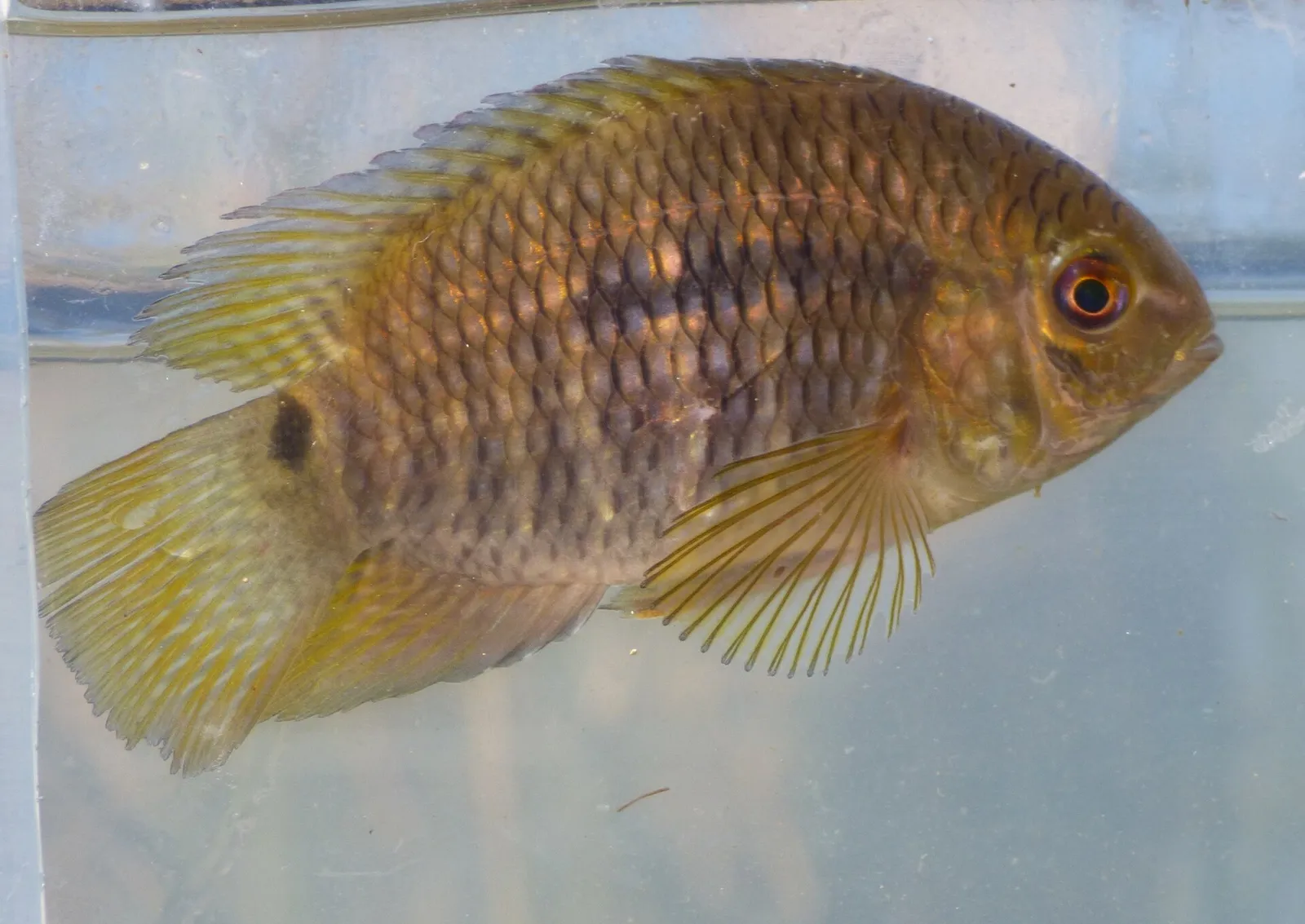
Cichlasoma dimerus is a small, fairly deep-bodied and laterally compressed acara, reaching about 4.5 in in standard length — roughly 5.5–6 in total length in well-grown aquarium fish — with males growing distinctly larger than females. Older males develop a modest nuchal hump on the forehead, nothing like the exaggerated headgear of the big Central American 'cichlasomines'. The base colour is variable and strongly mood-dependent: greenish to grey, washed with yellow and blue-green iridescence, the centre of each scale often a gleaming mint-green and the lips and gill covers similarly tinted. The fixed markings are a dark blotch in the middle of the flank, a second on the caudal peduncle (sometimes ringed in pale grey), a sub-orbital cheek spot, and a dark antero-lateral band running back from the eye to the mid-lateral blotch; several faint vertical bars come and go with the fish's state. The pectoral fins are lemon-yellow, and the dorsal, anal and especially the caudal fin carry a handsome reticulated pattern of dark bands that, near the tail base, fuse into alternating black-and-white concentric arcs. Reproductive adults intensify dramatically — territory-holders flush with bright iridescent colour, breeders take on a black ventral wash, and the soft rays of the dorsal and anal fins draw out into short filaments, sometimes with a red rim around the eye. Non-territorial fish, by contrast, fade to a drab opaque grey. This behaviourally switched colour signalling — pale and gregarious when subordinate, brilliant when dominant — is one reason the species is so useful to behavioural physiologists. FishBase's frank verdict that the fish 'is not very colorful and interesting for the aquarium trade' is fair for a stressed shop specimen but undersells a settled breeding male.
Habitat
The chanchita is a fish of the subtropical La Plata system, distributed through the Paraná and Paraguay river basins across northern Argentina, Bolivia, Paraguay, southern and central Brazil and Uruguay, spanning roughly 15°S to 34°S — a wide latitudinal band that exposes it to a genuinely seasonal, temperate-edged climate rather than the steady warmth of the Amazon. It is a lowland generalist that turns up in slow rivers, streams, backwaters, marshes and floodplain lagoons. Habitat studies in Brazilian savanna (Cerrado) streams give a mixed picture that fits a flexible opportunist: some workers find it most abundant among macrophytes and fine root tangles, others over harder open substrates, the difference probably reflecting season, competition and predator avoidance rather than a strict preference. Water chemistry is correspondingly tolerant. FishBase lists it from neutral-to-hard water (pH from about 7.0, hardness around 20 dH and up) at 73–81 °F, but the species' real envelope is far broader: it withstands temperatures from roughly 43 °F to 86 °F and is famously tolerant of low dissolved oxygen that would kill most companions, and it has been seen dispersing across extremely shallow sheets of water at the start of the rainy season. This combination of subtropical hardiness, broad chemistry tolerance and air-gulping endurance is exactly what later allowed it to establish far outside its range.
Feeding
Cichlasoma dimerus is an opportunistic generalist rather than a trophic specialist; FishBase places it near a trophic level of 3.0. A detailed gut-content and ecomorphology study of cichlids in the Cuiabá River basin — the species' own type drainage — found its diet dominated by plant matter, terrestrial insects and aquatic insects, with detritus, fish scales, small fish and algae also present. Tellingly, microcrustacean zooplankton were entirely absent from its stomachs, a gap the authors tied to its relatively short, widely spaced gill rakers: this is a fish built to pick and graze at the bottom and among vegetation, not to filter open water. In practice it browses, grubs through soft sediment, and takes whatever invertebrate or plant material is going, a catholic appetite that underpins both its success across varied habitats and its trouble-free feeding in captivity. In its native communities it functions as a small benthic omnivore of the margins, leaf-litter and weed beds.
Mating
The chanchita's social system is the reason laboratories keep it, and it has been documented in unusual detail. Outside breeding the fish are gregarious and pale-coloured, schooling loosely. As reproduction approaches, a dominance hierarchy is hammered out through aggressive interactions, and that hierarchy gates access to breeding: among males it determines who holds a territory, and among females it determines access to the territory-holding males. Dominant fish are invariably the largest — size is the main currency of rank — and they flush into bright territorial colours while subordinates stay a dull grey. Courtship displays in Cichlasoma dimerus are closely related to threat displays, both working by maximising the visible area of the fish, and reproductive individuals of both sexes take on a characteristic black ventral coloration. The physiology behind this has been mapped: reproductive, territory-holding males carry higher pituitary levels of the gonadotropin β-FSH and of somatolactin than non-reproductive males, while subordinate, non-reproductive fish of both sexes run higher plasma cortisol — evidence that social suppression of breeding is mediated through the stress axis. Females are notably aggressive in their own right, especially toward conspecific intruders once a pair has formed and a spawning site is being defended.
Breeding
Cichlasoma dimerus is a biparental, open-substrate brooder with one of the more thoroughly described life histories of any Neotropical cichlid, thanks to its laboratory career. A pair clears and defends a territory and the female lays her eggs on a cleaned hard surface; reported clutches run from about 400 to 800 eggs, scaling with the size and condition of the pair and the area of available spawning surface, with exceptional spawns approaching 1,500 eggs. Both parents tend the brood — fanning and guarding the eggs, then moving the hatched larvae by mouth into pits dug in the substrate. In the first days after hatching the larvae anchor themselves to the substrate with sticky secretions from six cephalic adhesive glands, a wriggler stage typical of substrate-spawning cichlids, before becoming free-swimming under continued parental escort. Embryonic and larval development through this whole sequence was described in detail by Meijide and Guerrero (2000) from laboratory-reared fish. The species breeds readily and often: under good conditions pairs may spawn every 15–20 days, the mating season running from roughly September to April in the warmer, lower latitudes of its range and compressing to November–March further south. Optimal breeding temperature is around 77–81 °F, and fry can reach about 2 in within four months of hatching. This high breeding frequency, biparental care and tolerance of laboratory crowding are precisely why Cichlasoma dimerus has become a standard model for cichlid reproductive physiology.
In the aquarium
The chanchita is an undemanding, durable cichlid that has been in the hobby for the better part of a century — much of that time under the wrong name, lumped with the port and black acaras. It is a fish for the keeper interested in behaviour rather than colour: a settled, breeding male is attractive in an understated, iridescent way, but a stressed shop specimen is genuinely plain, which is why it has never been a trade staple. A pair is comfortable in a tank of around 30 US gallons or more; like most acaras they appreciate a sand or fine-gravel bottom, some driftwood and rockwork to break sight-lines, and a few flat stones or a slate to serve as spawning surfaces. Robust plants can be used but may be uprooted when the fish are in breeding mode.
Water chemistry is the easy part. Unlike the soft-water specialists of the Amazon, Cichlasoma dimerus comes from subtropical, often harder and near-neutral-to-alkaline waters, and it thrives across a wide range — anything from soft and slightly acidic up to moderately hard and alkaline is tolerated, with a pH around neutral and temperatures of 75–82 °F ideal for general keeping and 77–81 °F for spawning. Its tolerance of cool water (down toward single digits Celsius for short periods) and of low dissolved oxygen makes it forgiving of beginner mistakes, though chronic neglect is no kinder to it than to any cichlid. A varied omnivore diet — quality flake or pellet rounded out with frozen bloodworm, brine shrimp and the occasional vegetable matter — keeps it in condition; it is a willing, unfussy feeder.
The real management challenge is temperament, not husbandry. These fish establish size-based dominance hierarchies and become territorial and pugnacious when breeding, with females especially aggressive toward intruders near the nest. In a small tank a forming pair can harass tankmates or each other; give them space, keep companions to robust, similarly sized fish that can stay out of the way, and be ready to separate a mismatched pair. Get those social dynamics right and the chanchita rewards the keeper with the same reliable, attentive biparental spawning that has made it a laboratory favourite — it is, in fact, one of the easier cichlids to breed. Prospective keepers in the warmer United States should also note its proven capacity to establish in the wild and never release unwanted fish.
Conservation
The IUCN Red List assesses Cichlasoma dimerus as Least Concern (assessed 10 November 2020 by R.G. Frederico and T.J. Lyons; published 2023), reflecting a wide distribution across the Paraná and Paraguay basins, no evidence of significant decline, and a hardy, adaptable biology. It carries no CITES or CMS listing and is harmless to people. The species is not a meaningful target of either food or ornamental fisheries — its small size and muted colour see to that — and the broad chemistry, temperature and oxygen tolerance documented across its range buffers it against the kind of habitat change that threatens narrow-range endemics. The wider La Plata system is nonetheless under the usual suite of pressures on large South American rivers: hydroelectric damming and flow regulation on the Paraná and Paraguay, agricultural expansion and pollution, and the spread of non-native species. Indeed, Cichlasoma dimerus illustrates the last point from the other side: hardy, fast-breeding and aquarium-traded, it has itself become an established exotic outside its range, with reproducing populations confirmed across several counties of central Florida, where it most likely escaped from ornamental-fish farms or was released by aquarists. Its impact in the invaded range is as yet unstudied, but its very success there is a reminder of how robust this unassuming little acara really is.