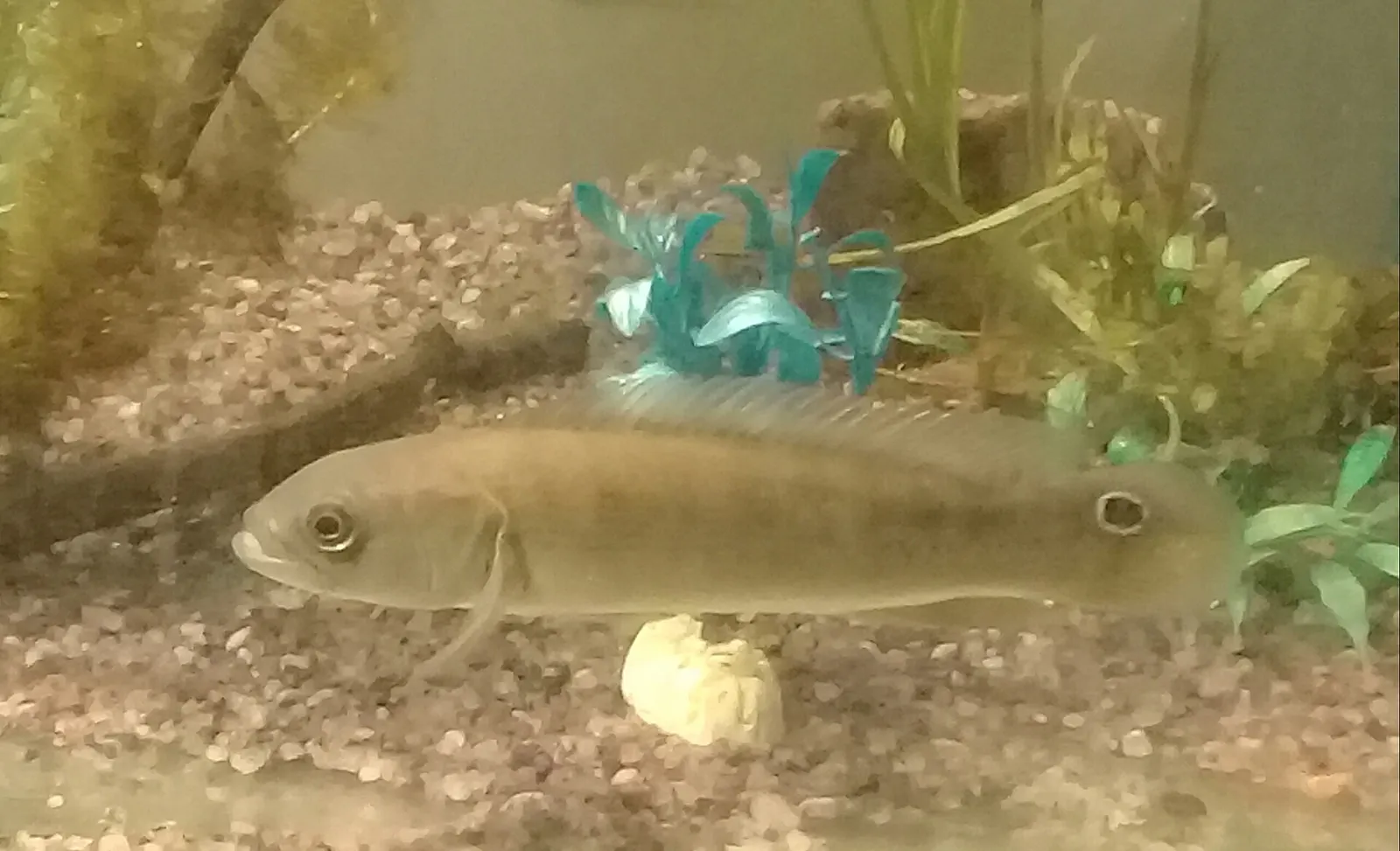
Taxonomy & naming
The half-banded pike cichlid was described in 1840 by the Austrian ichthyologist Johann Jakob Heckel, in the same monograph (Annalen des Wiener Museums der Naturgeschichte, volume 2) in which he erected the genus Crenicichla itself. He did not place it in Crenicichla, however: he made it the type species of a second, separate genus, Batrachops, as Batrachops semifasciatus, distinguished by stouter teeth and a noticeably thicker, blunter head. The type material came from the Rio Paraguay near Caiçara, opposite Cáceres in Mato Grosso, Brazil — the same drainage that feeds the inland delta of the Pantanal — and was deposited in the Naturhistorisches Museum Wien (NMW), where it can no longer be located. Later workers — Günther, Pellegrin, Haseman and, most influentially, Sven Kullander in his 1986 revision — synonymized Batrachops with Crenicichla, recognizing that the dental and cranial differences graded continuously into the rest of the genus. The path was not straight: Haseman's 1911 case for synonymy rested partly on dental forms he read as intermediate between the two genera, a reading later shown to be mistaken, and C. Tate Regan revived Batrachops as valid again only two years afterward. It took Kullander's 1986 revision, independently corroborated the same year by Alex Ploeg, to close the question for good; both concluded that although the group's dental and cranial characters grade into the rest of Crenicichla, its roughly dozen members — including semifasciata, C. reticulata, C. stocki and C. cyanonotus — still form a coherent natural lineage within the genus, whether labelled 'Batrachops' in the broad sense or the Crenicichla reticulata species group. The fish has been treated as Crenicichla semifasciata ever since. The most recent rearrangement, Varella, Kullander, Menezes, Oliveira & López-Fernández's 2023 integrative phylogeny of the pike cichlids (placing the whole assemblage in the subtribe Crenicichlina), kept semifasciata inside Crenicichla but resurrected Batrachops as a subgenus for it and its close relatives — a treatment Eschmeyer's Catalog of Fishes still lists as the valid combination Crenicichla semifasciata (Heckel, 1840). Phylogenetically it falls in the Crenicichla reticulata species group of robust, southern, short-snouted pikes, and mitochondrial work by Piálek and colleagues recovered it near the base of the southern South American Crenicichla radiation. No synonyms beyond the original Batrachops combination are recognized.
Morphology
Crenicichla semifasciata is a medium-sized pike cichlid, reaching about 7–7.5 in standard length; the largest catalogued specimens (for example a 7 in SL fish from Argentine Formosa) sit at the top of that range, and total length runs a little higher — a wild-caught Paraguay male photographed for the Cichlids Yearbook measured roughly 10 in total length, larger than the museum-catalogued series suggests and a reminder that field maxima can outrun preserved specimens. It is among the most distinctive of all pikes in build. Where the typical Crenicichla is a slender, cylindrical ambush predator, semifasciata is comparatively deep-bodied and laterally compressed, with the shortest snout of any Crenicichla form — short and bluntly pointed — and a small mouth: the 'frog-face' profile that earned Heckel's genus name Batrachops. The diagnostic and namesake feature is the colour pattern: seven or eight dark vertical bars cross only the upper half of the body, fading out toward the belly so that the fish appears 'half-banded' (semi-, half; fasciatus, banded). Ground colour is a brassy to olive-grey, often with fine dark reticulation or speckling over the flank and onto the head and fins, and a dark blotch is usually present on the gill cover; a further identifying mark, present in both sexes but individually variable, is a run of black lines near the anterior lateral spots, formed by a line of same-coloured scales along the central flank. Like other pike cichlids it carries the serrated rear edge of the preopercle that helps define the group. Sexual dimorphism follows the genus pattern and is modest: as in all Crenicichla, males become somewhat more elongate with age, and they carry small, regularly arranged spots on the posterior part of the soft dorsal fin that females lack — the most reliable field cue for sexing this species, since the two are otherwise not strongly divergent and can be hard to tell apart at a glance. Ripening females instead signal their condition through body shape and colour rather than fin marking (see Mating).
Habitat
The species is endemic to the La Plata (Río de la Plata) drainage of central South America, specifically the Paraná–Paraguay system. Eschmeyer's Catalog of Fishes gives its range as the Paraná River basin across Argentina, Brazil, Bolivia and Paraguay; it occurs in the Río Paraguay (including the Brazilian Pantanal, where it is collected for the trade as the 'Pantanal' pike) and down the Paraná drainage through Paraguay and into the Argentine provinces of Formosa, Entre Ríos and Misiones, with records also reported from Uruguay and a first record from the upper Río Paraná documented by Roa-Fuentes, Zeni, Varella and colleagues. FishBase notes it is 'found in ponds,' and that captures its ecology well: unlike the many rheophilic pikes of fast Amazonian rapids, semifasciata is a fish of slow, warm, lowland floodplain waters — marshes, oxbow lagoons, vegetated backwaters and the seasonally inundated grasslands (esteros) of the Pantanal and Paraná floodplain. These are shallow, structure-rich habitats, generally no more than a couple of metres deep, with dense aquatic and marginal vegetation in which the fish lurks. FishBase records the species as benthopelagic in fresh water with a preferred temperature of about 73–81 °F, a pH at or above 7.0, and hardness up to roughly 12 dH — neutral to slightly alkaline, moderately mineralized water typical of the subtropical La Plata basin rather than the soft blackwater of Amazonia. Being a subtropical floodplain fish, it experiences a pronounced seasonal temperature and flood cycle.
Feeding
Crenicichla semifasciata is a predator, as the body plan and the pike-cichlid lineage both imply, but a comparatively short-snouted, small-mouthed one rather than a slender fish-swallowing specialist. FishBase places it at a trophic level near 3.3. In the floodplain it functions as a robust generalist carnivore, taking aquatic insects and their larvae, crustaceans, molluscs, other invertebrates and small fish from among submerged vegetation and leaf litter. The reticulata-group pikes to which it belongs are built for this kind of opportunistic invertebrate-and-fish predation; comparative work on co-occurring Crenicichla in South American floodplain rivers by Montaña and Winemiller has shown how pike cichlids partition such prey by habitat and gape, with the stouter, blunt-headed forms leaning toward hard-shelled and benthic prey. Like all pikes it is an ambush hunter, holding position in cover and seizing prey with a rapid lunge and suction strike rather than pursuing it in open water.
Mating
Courtship in Crenicichla semifasciata has actually been described in some detail, unusually well for a pike cichlid, and follows a distinct sequence. As a female approaches spawning condition her abdomen visibly swells, and her belly undergoes a dramatic paling to cream — a colour change that appears only once a male is present, marking it as a courtship signal rather than a simple physiological shift. She then solicits the male by curving her body into an S-shape display. The pair selects their breeding cave several days ahead of spawning and works to enlarge it in preparation, well before eggs are laid. Pairing itself is the critical and sometimes hazardous phase typical of the genus: unpaired adults can be aggressive toward one another, and a mismatched or unready pair may fight, so keepers typically raise a group of young fish together and let a compatible pair form on its own. Once a bond is established the partners cooperate closely, and — as Wayne Leibel emphasized in his broader account of maintaining and spawning pike cichlids — bonded consorts often become surprisingly peaceful and devoted to each other and, later, to their brood. In this species, with its still-water floodplain biology, territory is centred on cover within the marginal vegetation; sexual maturity is reached at roughly 4–4.5 in total length.
Breeding
Contrary to the reputation of pike cichlids generally, Crenicichla semifasciata has been bred repeatedly in captivity and is reported as one of the more problem-free members of the genus to spawn. It is a biparental cave spawner: following the courtship described above, the female attaches her clutch of adhesive eggs — each suspended on a tiny individual stalk — to the ceiling or wall of the cave the pair prepared in advance. The eggs hatch after about three days, the exact timing depending on water temperature, into larvae still incapable of swimming; the female immediately moves them to a pit she excavates in the floor of the cave. The fry stay hidden there for up to another eight days before they are first seen outside the cave, searching independently for food. As in all Crenicichla, the female takes the visibly more active role in brood care — tending eggs and larvae at close range — while the male leans more toward defending the wider territory. No reliable wild egg count has been published for semifasciata; congeneric pikes of comparable size lay clutches on the order of a few hundred eggs, which remains the best available estimate for this fish.
In the aquarium
Crenicichla semifasciata reaches the aquarium trade only sporadically, usually as wild-caught fish labelled 'Crenicichla semifasciata Pantanal,' and it is a specialist's fish rather than a community subject. It is best thought of in the same terms as other medium-sized pike cichlids: a predatory, territorial cichlid that needs space, cover and good water. A single fish or a bonded pair wants a tank of at least 47–59 in in length (around 80–120 US gal), longer if a group is grown out to obtain a pair, because floor area and the ability to retreat are what keep aggression manageable.
Water should match the subtropical La Plata floodplain rather than soft Amazonian blackwater: neutral to slightly alkaline (pH about 7.0–7.8), moderately hard (up to roughly 12 dH), and warm but not hot — 73–81 °F is the documented preferred range, and as a subtropical fish it tolerates and arguably benefits from a cooler winter rest at the lower end. Strong biological filtration and regular water changes are important, as predatory cichlids on a meaty diet load the water heavily. Unlike the rapids-dwelling pikes, this is a still-water species, so brisk current is unnecessary; a calm tank with gentle flow suits it.
Décor should provide the cover it relies on in the wild: a soft sand bed, generous driftwood and root tangles, rockwork arranged into caves and crevices, and — as Leibel found with other pikes — lengths of wide PVC pipe make excellent, readily accepted retreats. Sightline-breaking structure and some shade lower stress and make the fish bolder. Robust plants can be used but may be disturbed.
Feeding is straightforward for a carnivore: a varied diet of frozen and live foods — earthworms, prawn and mussel pieces, larger insect larvae, the occasional feeder where appropriate — with many specimens eventually weaning onto good-quality sinking carnivore pellets. As an ambush predator it will eat any tankmate small enough to swallow, so companions must be of similar size and robust temperament; suitable options are larger, fast, peaceful South Americans such as big characins, robust catfish and similarly sized cichlids, while small fish, very long-finned fish and other strongly territorial pikes are poor choices. The main pitfalls keepers encounter are intraspecific aggression during pairing and underestimating the fish's adult size and predatory appetite. It is an uncommon, rewarding subject for an aquarist specifically interested in South American pike cichlids, not a fish to be bought on impulse.
Conservation
The IUCN Red List assesses Crenicichla semifasciata as Least Concern (assessed 30 November 2020 by R.G. Frederico, published 2023), on the strength of its wide distribution across the Paraná–Paraguay basin, its presence in floodplain habitats throughout that range, and the absence of evidence for population decline. It carries no CITES listing and is not a fisheries target, drawing only minor, localized harvest for the ornamental trade. As a widespread habitat generalist of the La Plata lowlands it is far less vulnerable than the many narrow-range, rapids-endemic pike cichlids of the genus. The broader concern for the species is the cumulative pressure on the Paraná–Paraguay system itself — extensive damming and hydrological alteration of the Paraná, agricultural expansion and wetland conversion across the Pantanal and the floodplain grasslands, and pollution — all of which degrade the slow, vegetated backwaters this fish depends on. None of these is documented as a present threat to semifasciata specifically, but they are the backdrop against which its long-term status in a heavily developed basin should be read.