Taxonomy & naming
The species was described by the Austrian ichthyologist Johann Jakob Heckel in 1840 as Acara vittatus, in the Annalen des Wiener Museums der Naturgeschichte, from a specimen collected at Cuiabá in Mato Grosso, Brazil — the headwaters of the Paraguay system in the Pantanal. The holotype (NMW 33879) remains in the Naturhistorisches Museum in Vienna. For more than a century the fish was shuffled through the catch-all genera of its day: it was long treated as Aequidens vittatus, the genus into which most non-eartheater 'acaras' were swept. The modern placement dates to Sven O. Kullander's 1986 monograph on the cichlids of Peru's Amazon drainage, in which he erected the genus Bujurquina to gather an assemblage of primitive (delayed) biparental mouthbrooders formerly lumped in Aequidens, and described thirteen new species alongside the handful of older names. Bujurquina vittata is one of those older names, and the genus's southernmost member; the bulk of Bujurquina diversity is Amazonian and Andean-foothill. Aquarists and ichthyologists alike historically confused several of the western-Amazon forms with vittata, and Iquitos, Leticia and Manaus shippers exported them under whatever name was convenient — so old hobby references to 'Bujurquina vittata' from Peru or Colombia are almost always something else. The confusion reached Surinam too: a widely cited textbook reference to 'Aequidens vittatus' occurring there is an error Kullander and Nijssen traced, in their survey of Surinam's cichlids, to a misidentified Krobia guianensis — true vittata has never been recorded from Surinam. The genuine vittata is a Paraguay–Paraná animal. Recent molecular work (Říčan and colleagues) keeps Bujurquina within the cichlasomatine radiation of the Neotropical cichlids, with the mouthbrooding 'saki' acaras forming a coherent group.
Morphology
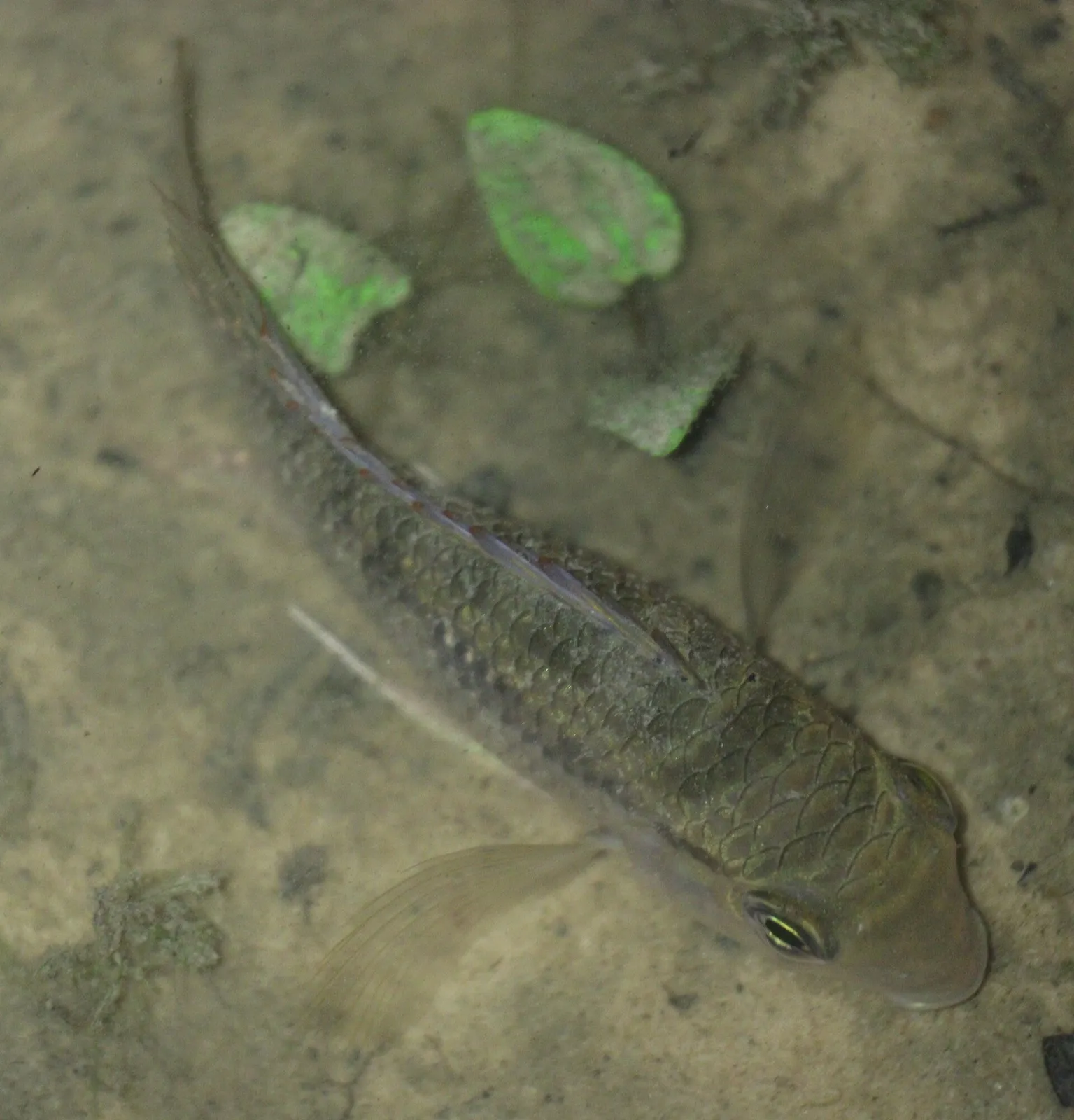
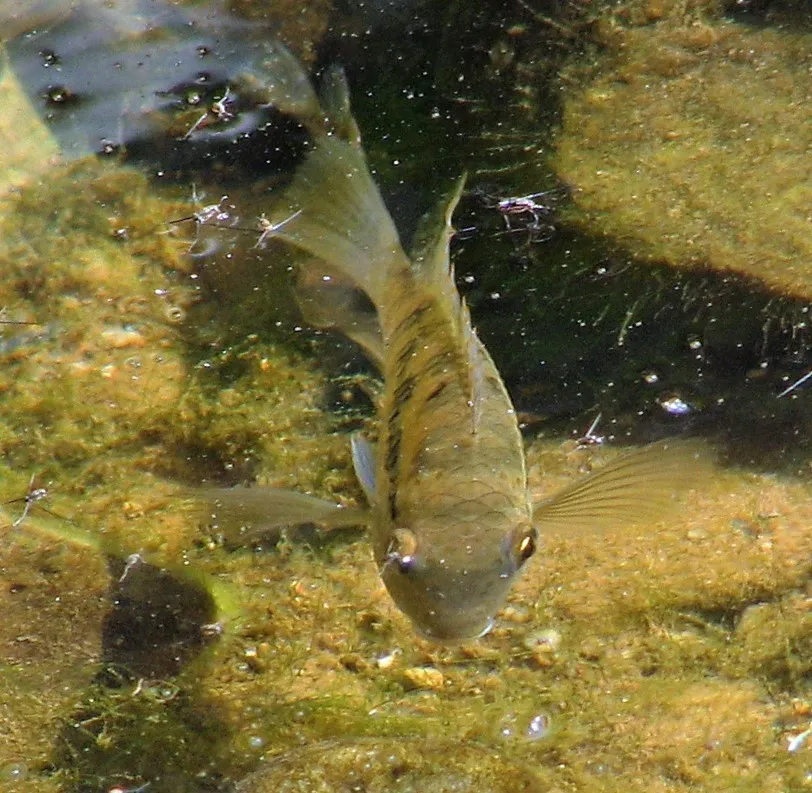
Bujurquina vittata is a modestly sized, fairly slender acara. FishBase records a maximum of about 3.5 in standard length, while well-grown aquarium fish are commonly reported around 4.5 in in total length, the long fin filaments of dominant males adding to the apparent size. The body is the typical compressed acara oval with a moderately pointed snout. Ground colour is an unshowy grey-tan to olive, but the defining mark — and the source of the epithet vittata, 'banded' — is the pattern of dark markings: a horizontal lateral stripe running from behind the eye to the tail, crossed above by a series of roughly six to eight interrupted vertical bars, plus an oblique dark band running down through the eye (the suborbital stripe that helps separate the many Bujurquina species). A dark blotch sits at the midflank where stripe and bars intersect, and another marks the caudal-fin base. Sexual dimorphism is real but subtle. Males grow somewhat larger, develop a slight nuchal hump with age, and carry the showiest finnage — extended, thread-like trailing rays on the dorsal, anal and caudal fins, blue lips and cheeks flushed with yellow and gold, a red margin to the dorsal, and turquoise streaking through the unpaired fins and pectorals. Females are smaller, plainer and grey overall, retaining only a wash of aqua at the rear of the dorsal and in the anal fin, and lack the trailing filaments. Outside breeding the two sexes are easy to confuse, and the fish is best sexed in a group as it matures.
Habitat
The Paraguay mouthbrooder is native to the Paraguay River drainage and the middle Paraná basin of south-central South America, an area spanning northern Argentina, Paraguay, the Bolivian lowlands and the Brazilian states of Mato Grosso and Mato Grosso do Sul — the great seasonally flooded plain of the Pantanal and the rivers draining south from it. This is well south of the Amazon proper, and it makes vittata a fish of a strongly seasonal, subtropical-to-tropical climate rather than the equatorial constancy most of the genus knows. FishBase records it from the shallow zones of rivers; in practice it occupies slow and still marginal waters — backwaters, lagoons, floodplain channels and vegetated shallows over sand and mud, among submerged wood and leaf litter. The flood pulse of the Paraguay system, which spreads water across the Pantanal for months each year and then withdraws, governs much of its life, and the fish's habit of dragging its egg-bearing leaf around may be partly an adaptation to shifting water levels. Recorded water chemistry is soft to moderately mineralised and near-neutral: FishBase gives a pH range of roughly 6.0–8.0 and a hardness of about 5–12 dH, with temperatures around 75–82 °F. As a southern floodplain species it tolerates cooler winter temperatures than equatorial Amazonian cichlids, but it is still fundamentally a warm-water fish.
Feeding
Bujurquina vittata is an opportunistic benthic omnivore, working the bottom and the lower water column of quiet floodplain habitats for small invertebrates, insect larvae, crustaceans and organic detritus, with some plant and algal material taken incidentally. FishBase places it around trophic level 3.5, consistent with a generalist that leans toward small animal prey rather than a dedicated herbivore or a piscivore. It is not a specialised sand-sifting eartheater like Satanoperca or Geophagus; it forages over and among the substrate and structure rather than processing mouthfuls of sand. In the community it occupies the role of a mid-sized, mid-to-lower-level invertebrate feeder of vegetated margins and leaf-litter beds. This dietary flexibility is one reason the species adapts so readily to aquarium foods, accepting prepared pellets and flake as freely as live and frozen fare.
Mating
Socially, vittata is among the gentler cichlids. Outside reproduction it is tolerant of its own kind and will move in loose groups, a sociability unusual in the family and one that lets keepers grow on a batch of juveniles to let pairs form naturally. Pairing is by mutual selection within such a group: a male and a female sort themselves out, take up a territory — often in the open centre of their space rather than tucked into cover — and begin to drive surplus fish away. Once a pair has formed the bond is comparatively stable and the two cooperate closely. Pre-spawning behaviour is the usual cichlid repertoire of lateral displays, lip-locking and joint site defence, but it is comparatively restrained; this is not a fish that routinely kills its partner. Breeding pairs become territorial and will see off tankmates that approach the nest, but their aggression is moderate, and they are notably nervous rather than belligerent — disturbed parents bolt across the tank rather than standing and fighting.
Breeding
Reproduction is the genus's signature: a delayed (larvophile) biparental mouthbrooder. The pair spawns a clutch of up to about 400 eggs not on a fixed rock or cave wall but on a movable surface — classically a fallen leaf, and in aquaria just as readily a loose slate, a leaf-shaped object, or as one hobbyist breeder found, the inner ridge of a coconut-shell half. Crucially the parents will pick the spawning substrate up and shift the whole clutch elsewhere, apparently in response to predators or to changing water levels, a behaviour FishBase notes explicitly — Ad Konings recorded exactly this while photographing a pair in an aquarium, watching them seize the wood chip carrying their eggs and haul it out of camera range. The eggs are guarded and fanned in place for the first days; then, once they hatch into yolk-sac larvae, the parents take the wrigglers into their mouths. Observers report that the male typically does the initial mouthbrooding for roughly the first five days, after which both parents share the duty — carrying the larvae, releasing them to forage in a tight cloud between the adults, and snapping them back into the mouth at any alarm. After the fry are free-swimming the pair continues to shepherd them for a week or two; hobbyist accounts describe parents trying, with limited success, to corral an increasingly independent brood. The young begin grazing biofilm and small foods almost at once and take newly hatched brine shrimp and crushed flake readily, growing without difficulty. The combination of substrate-spawning, leaf-portability and shared oral brooding makes this one of the most interesting reproductive strategies a small home aquarium can showcase.
In the aquarium
The Paraguay mouthbrooder is a rewarding and genuinely beginner-tolerant cichlid, valued precisely because it breaks the South-American mould: it is small, peaceful for a cichlid, social enough to keep in a group, and it performs a mouthbrooding ritual otherwise associated with African Rift fish. It is uncommon in the trade and tends to pass between hobbyists and specialist breeders rather than fill chain-store tanks, but it is not difficult to maintain.
A single pair can be bred in a tank as small as a standard 30 gallons (about 30 US gal, 35.5 in long), and that is a realistic minimum for a dedicated breeding setup. To raise a group and let pairs form, more room is better — a 55-gallon (200-litre) or larger tank with open swimming space down the middle and structure around the edges suits the species well, and the extra space lets unpaired fish keep clear of an established pair. Décor should follow the biotope: a sand or fine-gravel bed, driftwood and roots, leaf litter, and some planting or other visual barriers to break sightlines. Because the fish spawns on movable objects, providing a few flat leaves, slates or a coconut shell gives a pair somewhere to lay.
Water should be warm and unremarkable in chemistry: 75–82 °F, pH anywhere from about 6.0 to 7.5, and soft to moderately hard water (roughly 3–12 dGH). The species is adaptable and has been bred in neutral, moderately soft municipal water without fuss; stability and cleanliness matter more than hitting precise numbers. Standard filtration and regular partial water changes keep it in good health, though during spawning many keepers deliberately ease off on water changes and disturbance, since the parents are nervous and a startled pair may abandon or eat a first brood. Screening the front glass or siting the tank in a low-traffic spot pays off with skittish breeders.
Feeding is easy: a varied diet of quality sinking pellets and flake supplemented with live or frozen foods — bloodworm, blackworm, daphnia and brine shrimp — keeps colour and condition high and conditions fish for spawning. The species is not fussy and feeds across the lower and middle water.
For tankmates, choose peaceable medium South Americans and dither fish that share its water: larger tetras and other characins, corydoras and other calm bottom-dwellers, and similarly mild cichlids. Avoid boisterous or fin-nipping companions, which both stress this nervous fish and target the males' long fin filaments. Conspecific aggression is mild by cichlid standards, so a group is workable, but a settled breeding pair will still claim and defend a central territory and is best given the room to do so.
Conservation
The IUCN Red List assesses Bujurquina vittata as Least Concern (assessed 5 November 2020 by R.G. Frederico, published in the 2020 assessment cycle), with the population trend listed as unknown. The rating reflects a wide distribution across the Paraguay and middle Paraná basins and no evidence of a population-level decline; the species carries no CITES or CMS listing and is harmless to humans. It is taken in small numbers for the ornamental trade but not at a level flagged as a threat. As with all fishes of the La Plata and Pantanal systems, the broader pressures on its habitat are the ones to watch rather than any species-specific danger: hydroelectric damming and the resulting fragmentation and altered flow regimes of the Paraná, agricultural expansion and the conversion of wetland in the Pantanal and Chaco, water abstraction and pollution. None of these is documented as imperilling this particular cichlid, which remains a widespread and adaptable inhabitant of the region's floodplain waters, but they form the backdrop against which its long-term outlook should be read.