Taxonomy & naming
Geophagus brachybranchus was described in 1989 by the Swedish ichthyologist Sven O. Kullander and the Dutch ichthyologist Han Nijssen in their monograph The Cichlids of Surinam (E.J. Brill, Leiden). The holotype (RMNH 30974) and an extensive paratype series were collected above the Blanche Marie waterfalls (Blanche Marie Valen) in the Nickerie District of Suriname, in the upper Nickerie River drainage. The name has stood unchanged since: Eschmeyer's Catalog of Fishes lists it as valid as Geophagus brachybranchus Kullander & Nijssen 1989, in the subfamily Cichlinae. It belongs to the genus Geophagus in the restricted sense defined by Kullander's 1986 revision, which limited the genus to the 'surinamensis-type' eartheaters bearing paired caudal extensions of the swim-bladder; older, broader uses of the name (which once swept in the brasiliensis and steindachneri assemblages and species now placed in Satanoperca) do not apply here. Within Geophagus, brachybranchus sits in the surinamensis species-group, a cluster of deep-headed, single-flank-spotted eartheaters that resemble one another closely and have proven notoriously hard to tell apart. It is most readily separated from its relatives by a combination of characters Kullander and Nijssen emphasized: dark preopercular markings, the absence of vertical flank bars even in stressed or preserved fish, gill filaments on the first arch largely covered by a skin flap, a blackish exposed branchiostegal membrane, and a reddish adult caudal fin patterned with large pale spots. Because almost every surinamensis-group fish is sold in the trade as 'Geophagus surinamensis' regardless of origin, the species has a long history of misidentification — true Geophagus surinamensis is now considered endemic to the Suriname and Maroni (Marowijne) drainages of eastern Suriname and is almost never traded.
Morphology
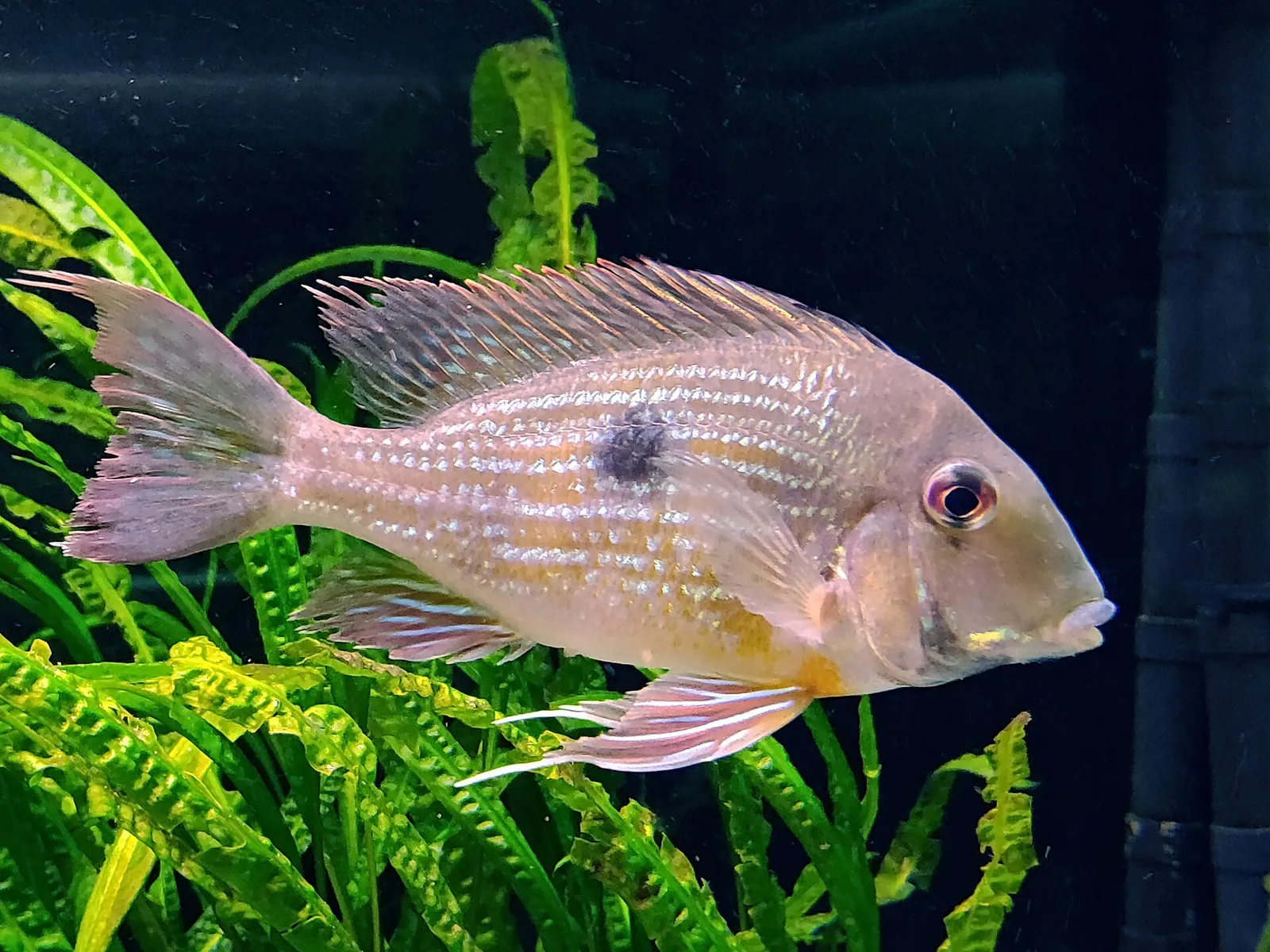
This is a moderately deep-bodied, laterally compressed eartheater with the steeply rising forehead and underslung, protrusible mouth typical of the genus, showing no strong difference in body proportions from the more familiar Geophagus altifrons and Geophagus surinamensis. The largest officially recorded wild specimen measured 5.5 in (5.5 in) standard length, the figure carried by FishBase from the original description; Weidner, however, rates it a genuinely large species, citing males of about 10 in total length in the wild (with females running 1–1.5 in smaller) — well beyond the museum maximum — and captive fish on a steady diet and in roomy tanks are likewise reported to reach roughly 7–8 in TL, so aquarium and field fish both noticeably outgrow the original type series. Coloration is a brassy to greenish-gold over the flanks, broken by iridescent blue-green spangling on the head, body and fins; a single dark blotch sits on each flank, the shared signature of the surinamensis group. Weidner's description resolves that pattern into an unusually detailed sequence of flank stripes, present from about 3 in total length upward: a first stripe above the eye; a second running from the dorsal-fin origin down to an often-faint, incomplete band that starts behind the eye and ends at the level of the lateral spot; a third beginning under the spinous dorsal and ending at the same band, sometimes closing in a small, easily missed secondary spot; a fourth, not always fully visible, ending in the large rounded lateral spot itself (which pales when the fish is aggressive); a smaller, rounder spot further back under the spinous dorsal at the fin base; a sixth stripe below the first soft dorsal rays running down to just beneath the lower lateral line; a seventh at the end of the dorsal doing the same; and an eighth and last stripe on the caudal peduncle — with the upper lateral line kinking slightly upward between the second and third stripes. The adult caudal fin is reddish and dappled with large, opaque-to-clear spots, and the always-present dark preopercular bar Weidner uses as a key field mark in fish over 3 in sits along the lower part of the front gill cover. The species' defining detail is concealed at the throat: the gill filaments on the first arch are mostly hidden beneath a flap of skin, which makes the exposed portions look unusually short (hence brachybranchus, 'short gills'), while the visible branchiostegal membrane is stained blackish — the origin of the Australian trade name 'black-throated eartheater.' Sexual dimorphism is minimal. Beyond the male's larger adult size, Weidner notes that once fish exceed about 6 in, females develop more rounded unpaired fins and a somewhat more rotund belly; no reliable external difference separates the sexes below that size, and accurate sexing of resting fish is very difficult, which is why hobbyists raise groups and let pairs sort themselves out.
Habitat
Geophagus brachybranchus is a fish of the Guiana Shield rivers. Its confirmed core range is the Corantijn (Courantyne) system — which forms much of the border between western Suriname and Guyana — and the Nickerie River drainage of northwestern Suriname, where the type specimens were taken from a rocky pool above the Blanche Marie falls. Kullander and Nijssen suspected, and Kullander (2003) reaffirmed, that the species ranges farther west into Guyana: specimens from the Demerara and Essequibo collected by Eigenmann in 1912 and originally filed as Geophagus surinamensis appear in fact to be this fish. López-Fernández and Taphorn (2004) extended the documented range across Guyana and into eastern Venezuela by way of the Río Cuyuní system. Suriname's climate is tropical and strongly seasonal, with two wet periods (a minor one December-February and a stronger one April-June) during which river level, flow and turbidity can swing dramatically. The fish favors gently sloping marginal zones along shorelines and around islands, over bottoms of sand, fine gravel and mud, with scattered rocks, submerged roots and branches; at some localities it lives in or near rapids. No habitat data was published in the 1989 original description, but a detailed picture comes from Weidner's account of Geophagus cf. brachybranchus in the Guri reservoir and Río Caroní of Venezuela — material he treats as probably, though not certainly, this species. There the fish holds over sandy substrates studded with rocky outcrops, in remarkably clear water (visibility to about 16 ft) that moves slowly, and it favours deeper water by day, moving into shallower zones with rocky caves and accumulated wood only at night. The water there is markedly soft and acidic: pH below 6.0, hardness too low to register on standard aquarium test kits, and conductivity around 15 µS/cm — among the softest, most demineralised water documented for any Geophagus in this genus. Water across the wider Corantijn-Nickerie region is likewise warm and soft, typically near-neutral to acidic and low in dissolved minerals, with year-round air temperatures averaging about 81 °F. As a shoreline and shallow-margin fish by day it occupies the upper few metres of the water column, descending into deeper water outside feeding hours if the Caroní pattern holds generally.
Feeding
Like all true Geophagus, brachybranchus is a benthophagous 'eartheater': it takes mouthfuls of sand and fine sediment, sifts them through the gill rakers for edible particles, and expels the cleaned substrate through the gill openings and mouth. A soft, sandy bottom is therefore not a decorative preference but a functional necessity. Stomach contents of wild fish are dominated by small aquatic and terrestrial invertebrates, plant material such as seeds, organic detritus and ingested sediment — the diet of a low-trophic-level generalist forager (FishBase estimates a trophic level near 2.4). Once settled the fish will rise readily into the water column to intercept drifting food, but it returns to browsing the bottom between meals. Notably, even adults seem poorly equipped to handle large food items, so in the wild and in captivity alike the species works through a steady supply of small prey rather than big mouthfuls. In its riverine community it functions as a sediment-processing invertivore-detritivore of the calm marginal zones, recycling organic material from the sand.
Mating
Outside of breeding, Geophagus brachybranchus is gregarious and surprisingly peaceful, living in loose aggregations within which a dominance hierarchy forms; juveniles in particular shoal strongly. Because the sexes are so hard to tell apart, pairs form from within a group rather than being deliberately paired by a keeper, and the fish are slow to mature — Weidner puts sexual maturity at around two years old, later than many surinamensis-group relatives. Courtship is comparatively understated: a forming pair exchanges fin-flaring, circling, gaping and head-jerking displays before selecting and cleaning a spawning site. Once a pair commits, it defends a territory around the chosen site, with the male taking the larger share of perimeter defense. The species is not a heavy-handed aggressor toward other fish; the main social friction is intraspecific, and in small groups a dominant individual may harass weaker conspecifics, while too-small a group can simply fail to settle. This combination — a peaceful, shoaling temperament that flips to territorial pairing at spawning time — is characteristic of the surinamensis-group eartheaters.
Breeding
Geophagus brachybranchus is a larvophilous, biparental mouthbrooder — one of the minority of Geophagus that brood, placing it among the genus's 'delayed' (larvophilous) reproducers as distinguished from the substrate-brooding and ovophilous (immediate mouthbrooding) members. Weidner reports the species is slow to mature, not reaching breeding condition until about two years old. Courtship and rival disputes follow the pattern typical of this closely related group: fish display laterally with spread fins and tail-beating to impress a partner or intimidate a rival, the opercula flare slightly, and the body may quiver; circling is uncommon, and if a rival is not sufficiently cowed the two may resort to mouth-fighting, pushing each other around the tank without causing injury. Once paired, both fish jointly select the spawning site, testing nearly every piece of decor and hardware with brief exploratory cleaning; Weidner's own pairs consistently chose a flat piece of slate lying on the substrate and shielded from above by bogwood. The chosen surface is then partially excavated and cleaned intensively, mainly by the female, for three to four days before the genital papillae appear, with spawning itself following one to three days after that. The female lays the eggs — of the elongate, substrate-adherent 'L-type' shared with several congeners — in a straight line on the surface, and the male follows over them in the same line to fertilise; if he is occupied defending the territory, fertilisation may happen somewhat later. Clutch size runs to about 250 eggs. Both parents free the larvae from their egg cases roughly 48 hours after spawning and take them up into the mouth; brood care after this point is variable and pair-dependent, with the parents repeatedly digging fresh pits in the substrate to hold the fry for short periods. The fry become free-swimming at about 8-11 days, at which point the parents begin releasing them to forage more widely, shepherding them back into the mouth at any threat with a flick of the ventral fins as the signal; as the young grow they return only at night, and the defended territory expands with them. Fry are easily raised on powdered dry foods, Artemia nauplii and microworm. In a community tank, brooding females are best moved, since released fry are quickly eaten by tankmates and even conspecifics.
In the aquarium
Geophagus brachybranchus is a rewarding but demanding eartheater, generally uncommon in the hobby — though, oddly, it is one of the more established Geophagus in Australia, where it goes by 'black-throated eartheater.' Because it is gregarious and naturally shoaling, it should be kept in a group: five to eight individuals is a sensible minimum, which lets a dominance hierarchy form without any one fish being singled out, and allows pairs to develop. That argues for a large footprint — an aquarium with a base of about 180 x 23.5 in (roughly 170 US gal) or more is appropriate for a long-term group.
The single most important furnishing is a soft, sandy substrate, deep enough for the fish to sift naturally. Gravel and pebbles are actively harmful here: they inhibit the sifting feeding mechanism, can abrade or damage the gill filaments, and may be swallowed and cause blockages. Décor beyond the sand is largely a matter of taste — driftwood, scattered roots and branches, a few flat water-worn stones as potential spawning sites, and subdued lighting all suit the fish. Leaf litter, though natural, tends to be a nuisance in the tank because the constant sifting puts a haze of decomposing material into suspension that clogs filters.
Water quality is the make-or-break factor, though less so for everyday maintenance than for breeding specifically. Weidner rates the species as unfussy day to day — it will do well even in genuinely hard water up to about 20 °dGH, and unlike several relatives it is not especially prone to skin lesions — but that same hard water suppresses spawning entirely; breeding requires hardness under 10 °dGH with a pH noticeably below neutral. Beyond that distinction, these cichlids are highly sensitive to deteriorating water and to swings in chemistry, and should never go into a biologically immature tank; chronic poor maintenance shows up as head-and-lateral-line erosion or stunted growth. The standard regime is heavy over-filtration (canister filters and/or a sump) combined with large weekly water changes of 50-70 percent, with mechanical filtration tuned to catch the fine sand and detritus the fish stir up. High flow should be avoided — position returns to keep current gentle. Target warm water in the 79–86 °F range for general keeping; for breeding, drop the pH and hardness as above. Because the species can reach a genuinely large size (Weidner's field data put wild males near 10 in) and does best in a sizeable group, Weidner recommends nothing smaller than a 500-litre aquarium for a settled group — larger than the 650-litre figure some keepers use as a rule of thumb, but a useful floor rather than a ceiling. Feed several small portions a day of fine-grade prepared foods plus small live or frozen bloodworm, Tubifex, Artemia and mosquito larvae, with a vegetable component such as spirulina; remember adults cannot handle large items well. Tankmates are easy to find — almost any peaceful species sharing the same warm-water preferences works, while aggressive fish and competing substrate-dwellers are best avoided. Some keepers house Geophagus with Potamotrygon stingrays with mixed results — occasionally the eartheaters simply vanish overnight.
Conservation
The IUCN Red List assesses Geophagus brachybranchus as Least Concern (assessed 1 March 2007 by R. Reis and F. Lima; published 2009). It carries no CITES listing and is not flagged under CMS. As a fish of the relatively sparsely populated and comparatively well-preserved Guiana Shield rivers — the Corantijn, Nickerie, Essequibo and Cuyuní systems — it faces less acute pressure than many narrowly endemic Neotropical cichlids, and FishBase rates its fishing vulnerability as low. The species is taken in small numbers for the ornamental trade but is genuinely uncommon in the hobby, so collection is not a documented population-level threat. The broader risks to its habitat are the ones general to the Guianas: gold mining (and the mercury contamination and sedimentation that come with it), forest clearance, and the damming and altered flow regimes that reshape Shield rivers — none currently identified as a specific danger to this cichlid, but the backdrop against which its long-term status should be read.