Taxonomy & naming
Cichla ocellaris was described by Marcus Elieser Bloch and Johann Gottlob Schneider in 1801 — not from a preserved fish but from a color drawing of a specimen of uncertain provenance, logged misleadingly as coming from "India Orientali." Because it was the first peacock bass formally named, it became the type species of the genus Cichla, and for generations afterward essentially every peacock bass that reached a museum or an aquarium was filed under this one name. The genus name comes from the Greek kichle, a wrasse; the epithet ocellaris is Latin for "little eye," a nod to the bold ocellus — a dark spot ringed in pale gold — at the base of the tail.
How many species hide inside that old catch-all name, and where ocellaris itself actually lives, is where the experts diverge. Kullander and Ferreira's 2006 monograph (A review of the South American cichlid genus Cichla, Ichthyological Exploration of Freshwaters 17(4): 289–398) split the genus into fifteen species and restricted true Cichla ocellaris to the Guiana Shield rivers plus the upper Rio Branco. In that reading, the familiar Amazonian peacocks belong to separate species they (re)described — Cichla monoculus, Cichla kelberi, Cichla pleiozona. Winemiller and colleagues, in their 2021 book Peacock Bass, take the opposite view: their genetic and morphological work treats those Amazonian forms as regional varieties of a single, wide-ranging Cichla ocellaris rather than distinct species. A 2020 description by Sabaj and coauthors added a further twist, splitting off the Essequibo's rapids-dwelling "falls lukanani" (Cichla cataractae) from the fish it had long been confused with. Trade and common names track that messy history: lukanani in Guyana, tucunaré or pavón across Brazil and the Spanish-speaking Amazon, and simply butterfly or peacock bass in English.
Morphology
This is a large, fusiform predator built like a freshwater bass — deep through the shoulders, with a big terminal mouth. FishBase records a maximum of about 29 in (29 in) total length and a published weight near 15 lb (6.8 kg), though most wild fish run far smaller, on the order of 12–14 in (12–14 in), and introduced populations are often smaller still.
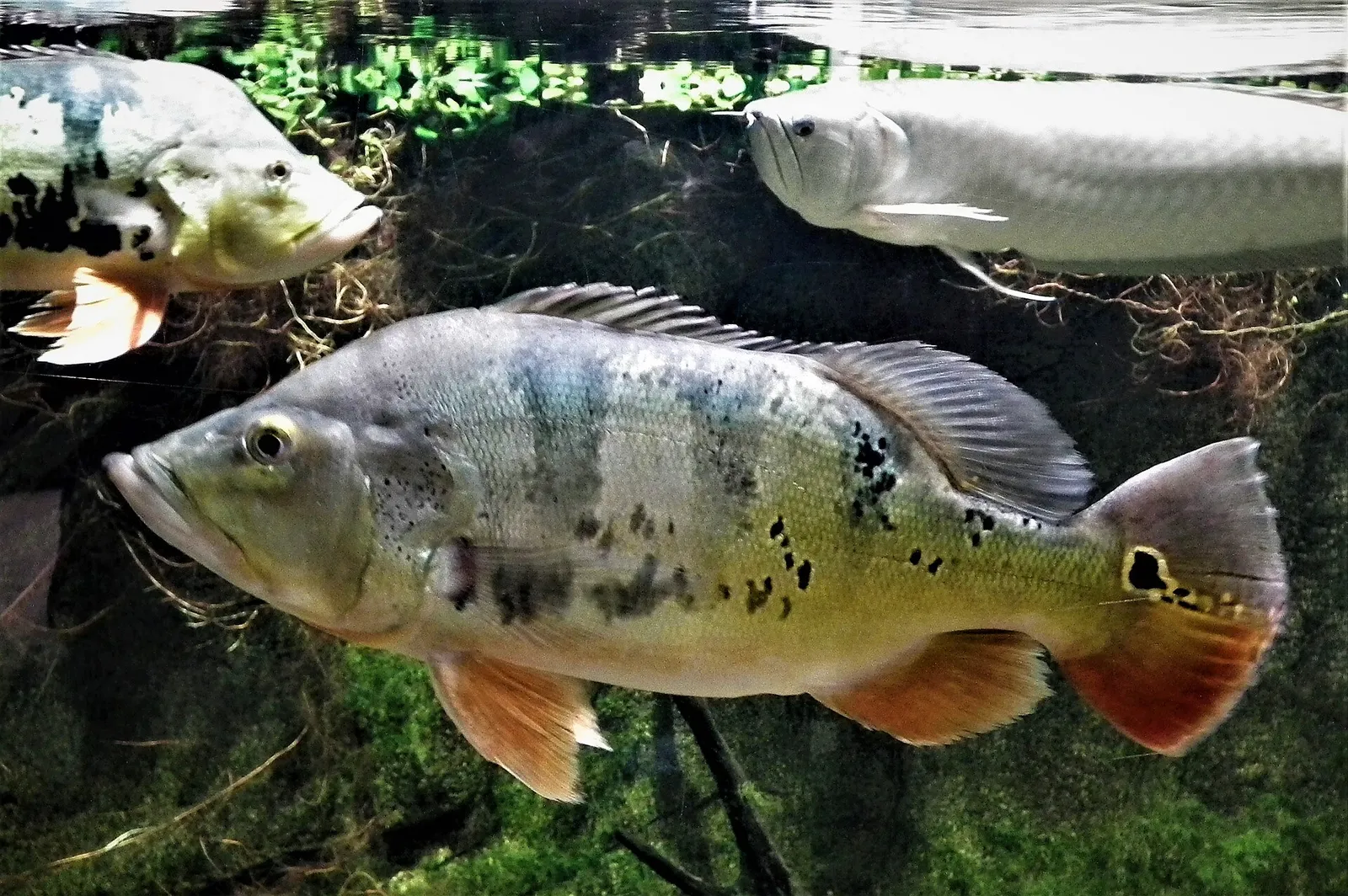
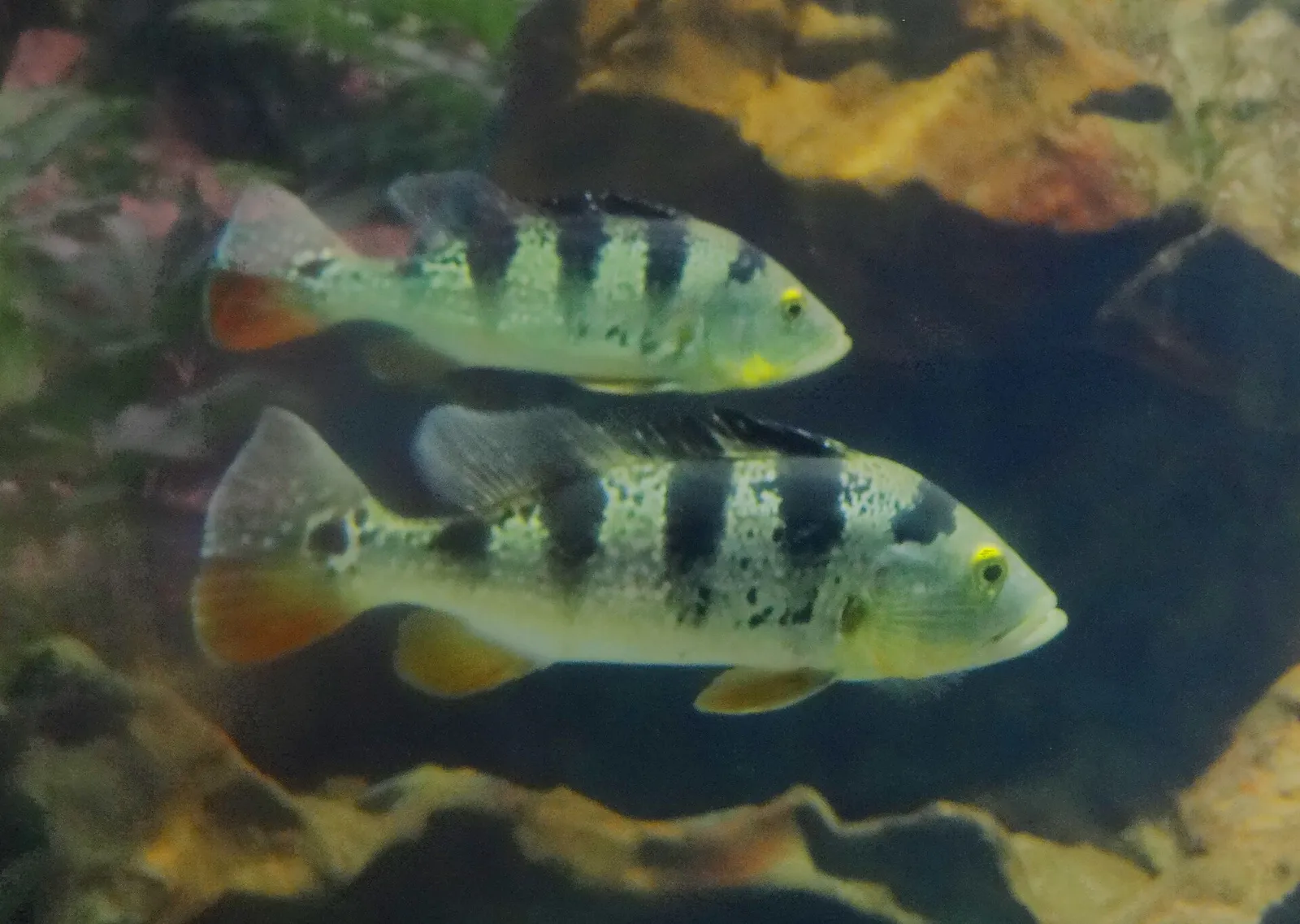
The ground color shifts from grayish or olive green over the back to yellow and golden along the flanks, with a white belly. Three dark vertical bars cross the body, narrowing toward the belly, and the third bar usually carries an ocellated blotch above the midline. The trait that most reliably marks this species, according to Winemiller and colleagues, is a row of irregular black abdominal blotches low on the side — sometimes merging into a horizontal band — that other peacock basses lack. All peacock bass share the eye-like caudal ocellus, widely read as a decoy that may deter fin-nipping piranhas from striking the tail. Color is mood-dependent and changes within minutes of capture; breeding fish of both sexes flush orange-red on the throat, pelvic and anal fins, and lower tail, and their irises turn brilliant red. Kullander and Ferreira's diagnosis leans on subtler counts — a usually continuous lateral line, roughly 70–80 scales in the E1 row, and the abbreviated juvenile lateral band — to separate it from look-alikes such as Cichla orinocensis, Cichla nigromaculata, and Cichla intermedia.
Habitat
Where the natural range ends depends on whose taxonomy you follow, and that nuance matters on a site organized around water bodies. Under the narrow concept of Kullander and Ferreira (2006), followed by the IUCN, native Cichla ocellaris is a Guiana Shield fish — the Marowijne, Corantijn, Demerara, and Essequibo drainages of Suriname, French Guiana, and Guyana — reaching into the Amazon basin only via the upper Rio Branco in Brazil's Roraima. Under the broad concept of Winemiller and colleagues (2021), the same name covers populations throughout the lowland Amazon, the Rio Negro, the upper Orinoco via the Casiquiare, and the Tocantins, making it the most widely distributed peacock bass of all. So calling Cichla ocellaris "an Amazon-basin cichlid" is true under one widely used treatment and an overstatement under another — a distinction worth keeping in view.
Either way, the habitat picture is consistent. It favors shallow, structure-rich water near shore — submerged roots, branches, logs, rocky margins, and floodplain lakes and side channels — rather than open, fast current. It tolerates a wider span of water chemistry than its relatives, from acidic Rio Negro blackwater (pH near 4–5) to clearwater and slightly turbid, near-neutral floodplain habitats, which may explain its broad reach. Like all peacocks it is a sight hunter and needs reasonably clear water; in genuinely muddy rivers it is replaced by catfishes that hunt by smell and electroreception.
Feeding
Cichla ocellaris is an apex diurnal piscivore — FishBase places it at trophic level 4.5, about as carnivorous as freshwater fish get. In the wild it hunts small fishes by sight, ambushing and chasing prey through flooded structure during daylight. Winemiller, Taphorn, and Barbarino-Duque's study of Cichla in two blackwater rivers of southern Venezuela (Copeia, 1997) documented how co-occurring peacocks (Cichla temensis, Cichla orinocensis, and Cichla intermedia) partition habitat and prey to coexist, with the smaller species working shallower nearshore water than the bulkier Cichla temensis. Thomas Zaret's classic work on the same species (Biotropica, 1980) traced its life history and growth as a tropical predator.
Its ecological weight is most starkly visible where it has been moved. When peacock bass were introduced to Lake Gatun in Panama, Zaret and Paine's much-cited 1973 paper (Science) recorded a cascade through the food web — collapses in native fish, shifts in zooplankton and invertebrates, even knock-on effects on local mosquito populations. That episode is the textbook caution about introducing an efficient sight-feeding predator into a naive community, and it is why the fish is treated as a potential pest outside its range.
Mating
Peacock bass are loosely social — wild and aquarium fish often move in groups, and young especially seem more secure in a shoal — but they pair off to breed. Cichla ocellaris is a substrate-spawning, biparental cichlid, not a mouthbrooder. A pair selects and cleans a flat, hard surface — a rock or log, in shallow water — bare to begin with or cleared of algae and other vegetation during the spawning activities themselves. The female then moves forward laying a single tight row of adhesive eggs while the male follows behind, exuding sperm over each row; bouts can run a couple of hours. Males develop a fatty nuchal hump before spawning, a fitness signal and likely an energy reserve for a period when feeding nearly stops. Both sexes flush orange-red on the throat and lower fins and their irises turn brilliant red, the visual signature of a fish in breeding condition. In seasonal rivers, spawning peaks near the end of the annual flood; in reservoirs and lakes it can occur year-round with one or two peaks, with FishBase noting spawning roughly every two months.
Breeding
The adhesive eggs, about 0.5 in across, hatch in roughly 70–90 hours at tropical temperatures (FishBase gives 78 hours at 82 °F). What sets the genus apart is the parental care that follows. Both parents excavate one or more shallow pits in sand or clay, then carry the wriggling larvae in their mouths to these depression nests, where a sticky organ on the head helps hold the young in place; the parents fan them, ferry them between pits, and guard the brood — sometimes for weeks until the young reach a couple of inches. Reported batch fecundity clusters around 6,000–14,000 eggs depending on female size and population, with FishBase citing roughly 9,000–15,000 eggs per kilogram of female released at spawning. A telling field detail from Winemiller and colleagues: nesting fish attack lures and baitfish ferociously out of brood defense rather than hunger, which is exactly why anglers prize them and why a guarding pair in a tank turns dangerous to anything nearby.
In the aquarium
Honestly: this is not a tank fish for almost anyone, and the sport-fishing glamour hides that. Experienced keepers on MonsterFishKeepers and Cichlid-Forum are blunt — the species combines a very large adult size (commonly 15–24 in among the smaller stocks, more for some) with a heavy bioload and, the recurring theme, a low tolerance for poor water quality. Keepers repeatedly report it wants soft, acidic water (pH well below 7, closer to 6) and near-undetectable nitrate, and that fish kept in hard, alkaline, nitrate-loaded tanks simply waste away, often with hole-in-the-head or chronic fungus. That tracks the wild picture of a fish at home in blackwater; Lake Gatun's adapted, hard-water population took decades to acclimate and tops out smaller than Amazonian fish.
The size advice is sobering. Veteran keepers call an 8-ft tank too small and treat a 10-ft tank (around 3 ft wide) or an indoor pond as the realistic minimum for adults; the smallest species, Cichla kelberi, is the only one some will keep in a 6-ft footprint. There is a behavioral irony worth flagging: despite being a fearsome predator, peacock bass are socially timid and can be bullied by smaller, pushier cichlids, so tankmate choice is its own problem. Keepers consistently recommend buying juveniles in groups of three or more, pellet-training them early (a real chore — many resort to stuffing pellets into shrimp), avoiding untreated live feeders, and committing to relentless water changes. The community's honest verdict is that most hobbyists who buy peacock bass eventually lose them — usually to water quality and undersized tanks — and that this is a fish for someone with pond-scale space and a serious filtration habit, not a centerpiece for a standard living-room aquarium.
Conservation
Cichla ocellaris is assessed by the IUCN as Least Concern (assessment by Frederico, last assessed 5 November 2020, published 2023). The justification is straightforward: although little is known about its populations and the trend is recorded as unknown, it occupies a wide range across a largely intact region, so no severe current threat is evident. The only flagged pressure is future habitat change — dams planned within its Brazilian range that could alter water quality, with effects still unquantified. Its main human use is sport fishing rather than the aquarium trade or food netting, so targeted collection pressure on the wild stock is modest.
Placing that in the wider Amazon context calls for honesty rather than alarm. As Kullander's treatment of the Cichlidae in the Check List of the Freshwater Fishes of South and Central America (2003) makes plain, the Neotropical cichlid fauna is enormous and, for most species, simply not assessed — peacock basses generally fall into Least Concern or Not Evaluated. The basin-scale concerns are real but diffuse: hydroelectric dam-building that fragments rivers and converts flowing reaches to reservoirs, deforestation and sedimentation, and an expanding commercial and sport fishery for tucunaré. None of these has been shown to threaten Cichla ocellaris specifically; if anything, the species' adaptability to reservoirs and its value to anglers cut the other way, and it has become an established, sometimes damaging, introduced predator in Panama, Florida, Puerto Rico, and beyond. The accurate framing is therefore the modest one the IUCN gives: a wide-ranging, resilient generalist that is not currently of conservation concern, living in basins that face genuine but species-non-specific strain from dams and land-use change.