Taxonomy & naming
Corydoras septentrionalis was described by William A. Gosline in 1940, in his revision of the neotropical Callichthyidae (Stanford Ichthyological Bulletin), from the Río Piña in the Río Guarapiche system near Maturín, Monagas, Venezuela — part of the wider Orinoco-region drainages of the country's northeast, which remains the type locality. The epithet septentrionalis means 'northern,' a reference to its position at the northern edge of the corys' continental range. It belongs to the family Callichthyidae and subfamily Corydoradinae, in the long-snouted morphological group.
The species has always sat in Corydoras Lacépède, 1803. That genus was shown not to be a single natural lineage, and the 2024 revision by Dias, Tencatt and colleagues (Zoological Journal of the Linnean Society) split it into several genera. C. septentrionalis falls in Lineage 1, the group that keeps the name Corydoras in the strict sense (built on the type species C. geoffroy), so its combination is unchanged. It is sometimes confused with the long-snout C. simulatus of Colombia — from which it differs in retaining the third (rictal) pair of upper barbels — and with C. amapaensis, which has a clear rather than barred caudal fin.
Morphology
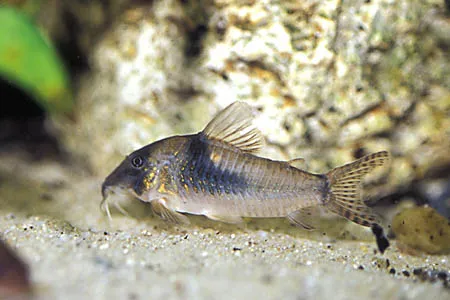
This is a true longnose cory: the snout is elongate and slightly down-curved, greyish, and gives the head a markedly different profile from the rounded, blunt-snouted corys. It reaches roughly 2–2.5 in; the body is comparatively slim, plated in the usual two rows of overlapping bony scutes, with three pairs of barbels — including the small rictal pair at the corners of the mouth that helps separate it from C. simulatus.
The ground colour is a plain pinkish- to silvery-grey, generally without the bold blotching of the spotted corys, and the most distinctive marking is the dark barring on the caudal fin. The dorsal, pectoral and adipose fins each carry a stiff defensive spine. As in most corys, females in condition are visibly rounder and broader-bodied than the slimmer males, especially viewed from above.
Habitat
Corydoras septentrionalis is recorded from the Orinoco basin and associated northeastern Venezuelan drainages, ranging into adjacent Colombia. The type locality lies in the Guarapiche system near Maturín. Unlike the small-stream specialists among the corys, this species is found in the main river channels and their larger tributaries, over sand.
It is a warm-water fish of moderate, flowing reaches, reported at roughly 72–81 °F, a pH from acidic to near-neutral (about 6.0–7.5) and soft to moderately hard water (around 2–15 °dGH). The bottom is sand and fine sediment, with submerged wood and marginal vegetation for cover. Like all corys it is a facultative air-breather, rising to the surface to gulp air absorbed across a vascularised hindgut — an adaptation for warm, sometimes low-oxygen water.
Feeding
C. septentrionalis is a benthic omnivore. Its long snout is built for foraging: it drives it into the sand and uses the barbels to taste out insect larvae, small crustaceans, worms and the organic detritus of the bottom, sieving the substrate and passing cleaned sand out through the gills. In the aquarium it readily takes sinking dried foods — pellets, tablets and granules — along with live and frozen bloodworm, brine shrimp and chopped earthworm. A varied diet keeps it in condition; it should not be left to scavenge tankmates' leftovers alone.
Mating
No spawning account specific to C. septentrionalis has been published, but corys share a uniform and well-documented courtship. They are egg-laying shoalers without a pair bond. A ready female cleans a spawning site and the group grows active; a male adopts the 'T-position' at right angles to her head, and she appears to take milt into her mouth, fertilising the small clutch of eggs she clasps in a pelvic-fin basket. She presses each batch onto the cleaned surface — leaf, stone or glass — and the cycle repeats until the eggs are distributed.
Breeding
There are no confirmed records of C. septentrionalis being bred in the aquarium, and no clutch figures specific to it, so its reproduction is expected to follow the genus norm. Conditioning the group well and then performing a cool, generous water change — dropping the temperature several degrees and raising oxygenation to mimic the rainy season — is the usual trigger. The adhesive eggs are laid in small batches on plants, wood and glass and receive no parental care; adults will eat them, so breeders remove the eggs or the parents. Eggs hatch in roughly three to four days, and the fry take microworm and brine shrimp nauplii after absorbing the yolk sac.
In the aquarium
A handsome, slightly larger-channel cory that suits the keeper who can give it space and the right floor. It is a shoaling species and should be kept in a group of six or more; alone or in pairs it is nervous and inactive. Floor area matters more than height, and a sand substrate is essential — long-snout corys feed by burying the snout, and sharp or coarse gravel abrades and infects the barbels, eroding the face. Keep the bottom clean, the water warm (about 72–81 °F), well-filtered, well-oxygenated and gently flowing, with regular water changes. It is peaceful and community-safe with tetras, rasboras, pencilfish and calm dwarf cichlids, given tankmates too small to bully it. Handle with a container rather than a net, since the fin spines snag, and transport with care, as a badly stressed cory can release skin toxins that may kill the group in the confined volume of a bag.
Conservation
Corydoras septentrionalis is assessed by the IUCN as Least Concern (assessed 2020 per FishBase). It is reasonably widespread across the Orinoco and northeastern Venezuelan drainages, and is collected for the ornamental trade in modest numbers rather than under heavy pressure. As with all the region's fishes, habitat degradation — deforestation, agricultural run-off, sedimentation and pollution of the channels and tributaries it favours — is the realistic long-term concern, but the species is not currently considered threatened.