Taxonomy & naming
Cyphotilapia gibberosa was described by Tetsumi Takahashi and Kazuhiro Nakaya in 2003 (Copeia 2003, no. 4: 824–832), splitting the genus that George Albert Boulenger had founded on a single species, Cyphotilapia frontosa, back in 1906. The genus name fuses the Greek kyphos, "hump" or "curved," with tilapia, an Africanized term for fish; the species epithet gibberosa comes from the Latin gibbus, "hump" — a doubly humped name for a doubly humped fish. The genus sits in its own tribe, Cyphotilapiini, within the Tanganyikan cichlid radiation.
The split was geographic as much as anatomical: Takahashi and Nakaya assigned the southern populations to gibberosa and kept the northern ones as frontosa. The two are separated by a handful of consistent characters — most usefully, gibberosa carries three scale rows between the upper and lower lateral lines where frontosa has two, and it tends to be the deeper-bodied of the pair. Not everyone accepted the change: the influential aquarist-author Ad Konings has argued the differences are too slight to warrant two species and treats gibberosa as a junior synonym of frontosa. Catalog of Fishes and FishBase, however, list it as valid, and a 2024 genomic study (Jackson et al., Fishes 9(12):481) found a sharp genetic barrier between the two roughly mid-lake — strong support for two real lineages, whatever one calls them. The hobby, for its part, often ignores the question entirely and still sells southern fish as "frontosa."
Morphology
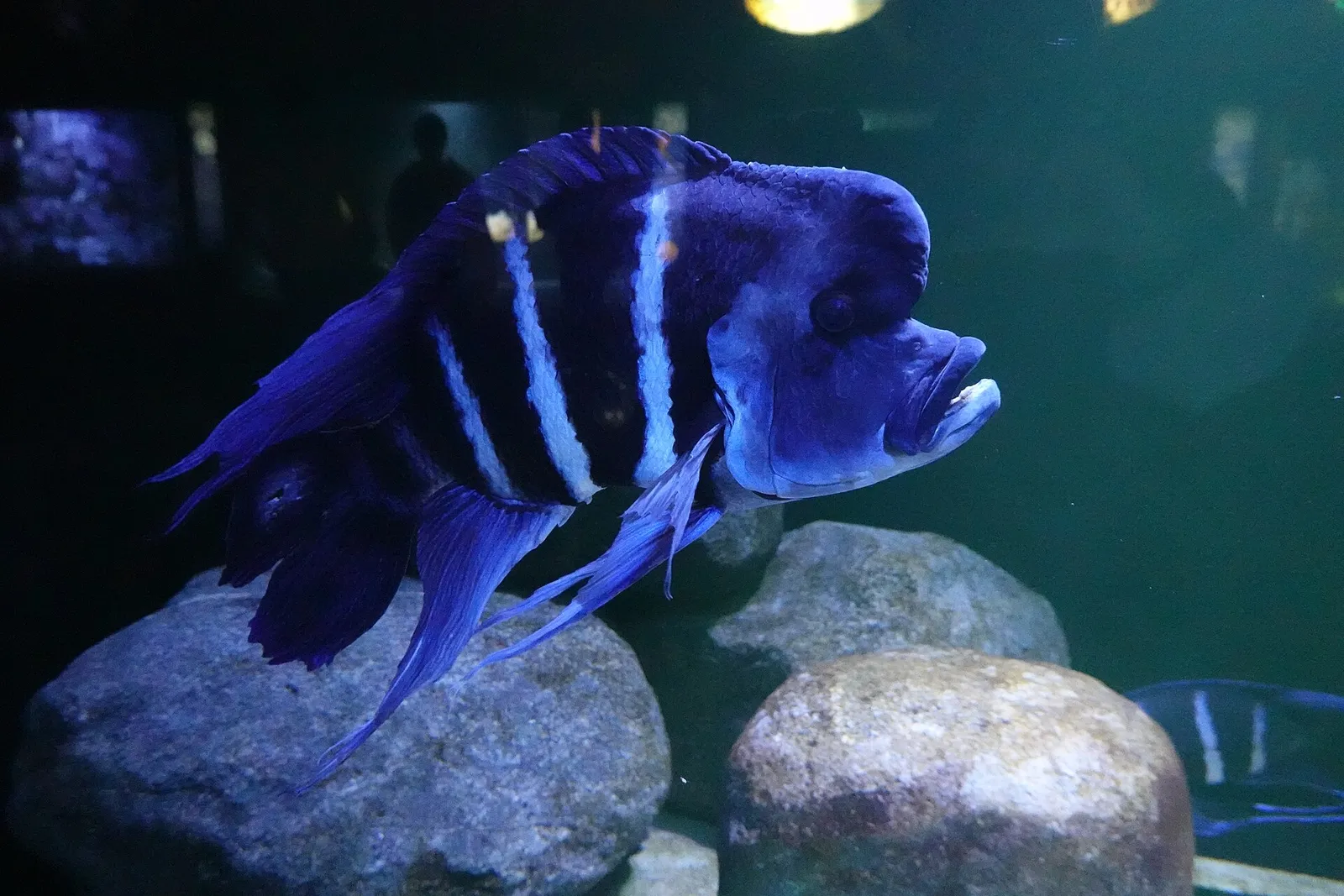
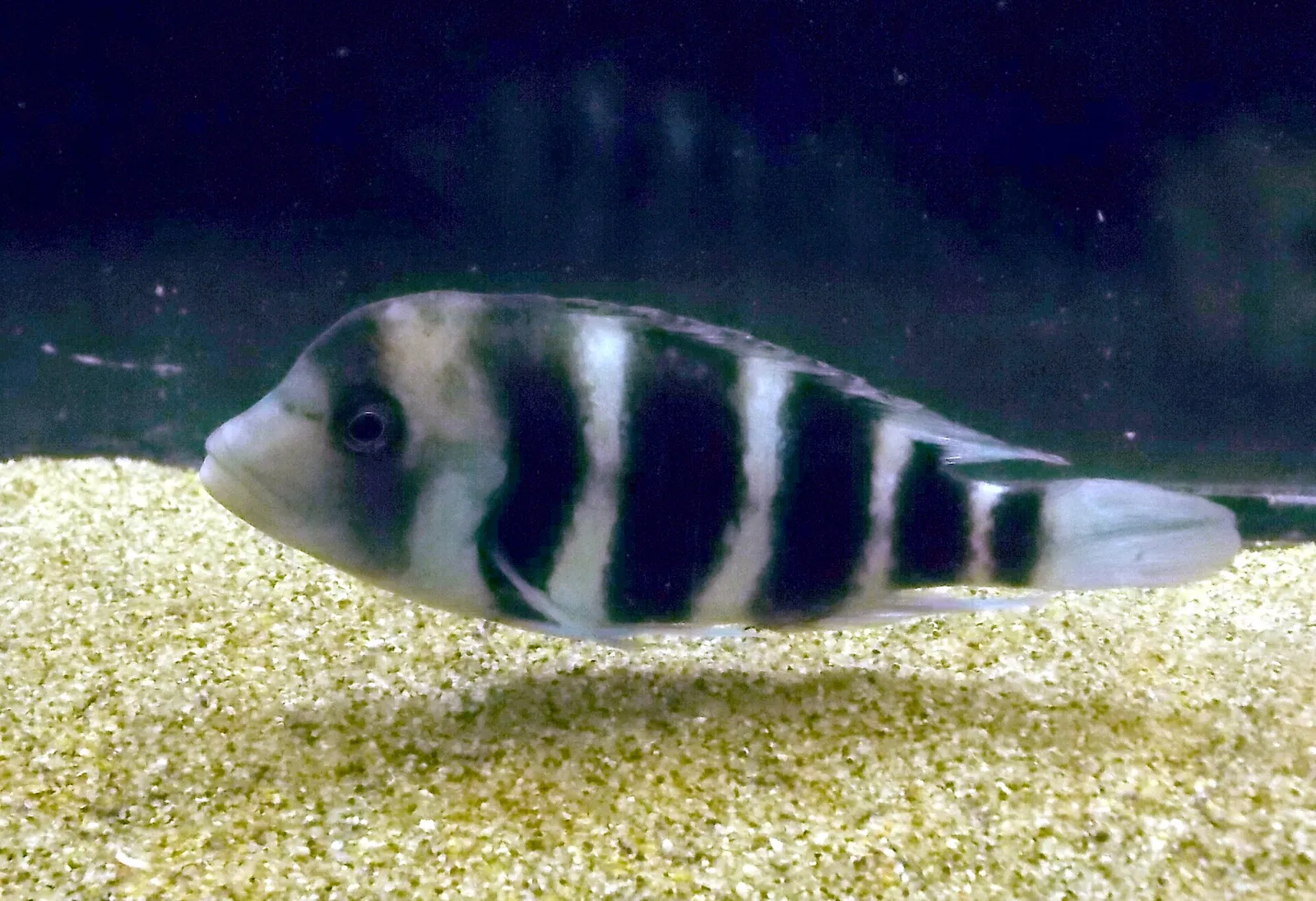
This is a tall, laterally compressed cichlid built like a slab, crossed by five broad dark body bars plus one through the head — a pattern that fades and blurs in big males. The signature feature is the nuchal hump, a fatty-muscular swelling of the forehead that grows for years and reaches its most exaggerated in old, dominant males; females and subordinate males develop smaller versions, which makes the hump a poor sex marker until fish are fully mature.
Ground color is silvery-white to blue, and the blue is where local populations earn their fame: Congolese and Zambian fish — the "Blue Zaire" forms from Mikula, Kapampa and Moba, plus Tanzanian populations near Cape Mpimbwe — can be saturated electric blue, while other locales run paler. Aquarists distinguish gibberosa from northern frontosa by the eye stripe: gibberosa wears a thick, triangular dark bar that covers most of the eye and runs partway down the cheek — the so-called "Zorro mask" — and dominant fish often add a dark upper lip like a mustache. Reported size depends on how you measure: FishBase lists a maximum of about 8 in (8.5 in) standard length from preserved material, while hobby and field sources routinely cite males of 14 in (14 in) total length or more, with females smaller. Males also grow long trailing extensions on the dorsal and anal fins.
In the hobby gibberosa is followed by collection point, loosely grouped into three geographic variants. The south-eastern Tanzanian shore yields Ikola, Kipili, Mpimbwe, Samazi (Bismarck), Kantalamba, Kasanga, Sibwesa, Mabilibili, Fulwe Rocks and the Tanzanite line; the Zambian south end gives Isanga, Chaitika, Nangu and Sumbu; and the Congolese (Zaire) western shore produces the celebrated deep-blue fish — Kapampa, Moba, Kitumba, Tembwe, Moliro and Kalumba — sold collectively as "Blue Zaire". Keepers maintain each point as a separate, un-crossed line, since the variants differ in the shade and extent of blue even though they belong to one species.
Habitat
Cyphotilapia gibberosa is endemic to Lake Tanganyika and occupies the southern half of it — broadly, the DR Congo coast south of Kalemie, the Tanzanian shore south of the Isonga–Ikola area, and effectively the entire Zambian shoreline. Its northern counterpart, Cyphotilapia frontosa, holds the upper lake; the two meet near the middle, where the 2024 genomic survey documented a steep cline and signs of past and present admixture, consistent with lineages that were separated by historical lake-level swings and have since come back into contact.
This is a deep-rock fish. The holotype was taken at 112 ft off Kasenga Point near Mpulungu, Zambia, and adults are typically reported at 130–200 ft, with credible records pushing toward 390 ft. Juveniles live shallower among the rocks before moving down with age. The habitat is steep rubble and boulder slope rather than the sun-lit upper reef, which shapes everything about the fish — its muted lighting tolerance, its unhurried temperament, and the practical headache of collecting it, since wild adults must be decompressed over several days to avoid fatal barotrauma. Like all Tanganyikan endemics it lives in hard, alkaline water: pH around 8.5–9, high carbonate hardness, and the lake's famously stable temperature near 77°F (77 °F).
Feeding
Cyphotilapia gibberosa is a piscivore with a specialist's schedule. Adults shadow the vast mid-water schools of sardine-cichlids (Cyprichromis) that hang above the rocks, but they are slow, deliberate hunters rather than open-water sprinters. The payoff comes at the edges of the day: at dusk, as the Cyprichromis descend to rest among the rocks, and again at dawn before they rise, the frontosa picks them off — the ambush predator that succeeds precisely because its prey is briefly off guard. Stomach-content work on wild fish backs up the broader picture, turning up not just fish but mussels, snails, shrimps and insect larvae, so the diet is better described as predominantly piscivorous with opportunistic benthic feeding. Juveniles lean on soft-bodied crustaceans before graduating to fish.
FishBase places the species around trophic level 3.5 and rates its fishing vulnerability as low. Within the deep rocky community it functions as a mid-sized apex predator of the slope — large enough to be near the top of its microhabitat's food web, but tied to the rock-and-sardine guild rather than the open pelagic zone that the lake's commercial sardine-and-Lates fishery exploits.
Mating
Socially, gibberosa is a colony fish. In the wild it lives in groups built around a dominant male, several females, and a few subordinate males, and — unusually for a cichlid — the males do not dig nests or hold rigidly defended territories. Aggression is real but structured: it runs along the group's dominance hierarchy rather than spilling out as the constant border-warfare of many rock cichlids. Southern gibberosa is also often described as a bit bolder and less skittish than its northern relatives.
Spawning happens within the group at a loosely defended site. The female lays her eggs while backing over the substrate and gathering them up — skipping the circling, egg-spot-chasing routine typical of other mouthbrooders, a behavior the species reportedly shares only with Trematochromis benthicola.
Breeding
After spawning, the female incubates a relatively small clutch of large, near-pea-sized eggs in her mouth for roughly five weeks before releasing well-developed fry. Clutch sizes are modest for a fish this big — commonly a few dozen, with reports ranging widely up to around 50–60. Fish mature slowly and may take several years to begin spawning, which is part of why wild-collected and home-bred lines both command real money.
In the aquarium
This is a spectacular fish and an honest commitment, not a beginner's purchase. Adults are big, long-lived — keepers commonly cite 20-plus years — and social, so they need both volume and a group. A trio of one male and two or three females is the workable minimum; a proper colony is more rewarding and far larger. Realistically that means a tank of at least 6 ft (71 in), and many specialists push toward 98.5 in / 1,000+ liters (roughly 250+ gallons) for a real group, with front-to-back depth mattering more than height because these fish like to rise off the bottom.
Water should mirror the lake: hard and alkaline (pH ~8–9), warm and above all stable — gibberosa tolerates a range but resents sudden swings in temperature or chemistry, and it does not forgive sloppy water quality, so keep nitrate low with regular changes. Aquascape with substantial, stable rockwork and dim lighting against a dark background; abrupt light changes spook them. They are predators, so anything small enough to swallow — shell-dwellers, small Cyprichromis, juveniles — is a meal, while suitable companions are larger, robust Tanganyikans (bigger Neolamprologus and Lepidiolamprologus, Gnathochromis, large Synodontis catfish) that won't out-compete a slow eater. Feed quality carnivore pellets plus frozen mysis and krill; skip live feeder fish, which carry disease and which these unhurried hunters often fail to catch anyway. The most common mistakes are buying cute juveniles for a tank that will never be big enough, mixing locality variants (which muddies the prized blue lines), and underestimating how slowly they grow and mature.
Conservation
Cyphotilapia gibberosa has not been assessed by the IUCN Red List — it stands as Not Evaluated (per FishBase, version 2025-2), as do its CITES and CMS listings. Its northern sibling Cyphotilapia frontosa was assessed Near Threatened in March 2025, flagged in part for collection pressure, which is a fair proxy for the kind of attention gibberosa also receives: it is a high-value aquarium export, hand-collected by divers from depth, and the blue southern locales in particular are targeted. That said, there is no evidence the species is threatened at the lake-wide scale, and its FishBase resilience is rated high — so the honest summary is that gibberosa is not currently flagged as at risk, even though it lives in a lake under mounting strain.
That strain is well documented. Tanganyika is warming, and the warming stabilizes the water column and shoals the mixing zone, cutting the upwelling that fertilizes the lake. O'Reilly et al. (2003, Nature, doi:10.1038/nature01833) inferred from sediment records that primary productivity may have fallen roughly 20%, implying about a 30% drop in fish yields; Cohen et al. (2016, PNAS, doi:10.1073/pnas.1603237113) found that reduced mixing has shrunk the oxygenated benthic habitat by about 38% in their study areas, with declines in commercially important fishes and endemic molluscs tracking the warming. Shoreline sedimentation from deforestation and development further degrades the rocky littoral (Cohen et al. 1993). Most of that pressure bears hardest on the open-water sardine (Stolothrissa, Limnothrissa) and Lates fishery that feeds the four nations sharing the lake — Burundi, DR Congo, Tanzania and Zambia, now coordinated through the Lake Tanganyika Authority — and on shallow rocky endemics. As a deeper-living slope predator, gibberosa is somewhat buffered from shoreline sedimentation but directly exposed to the deep-water threat: oxygen loss and lost productivity in exactly the benthic zone it occupies. Its long-term security therefore rests less on its own collection than on whether the lake's deep water stays cool, mixed and oxygenated.