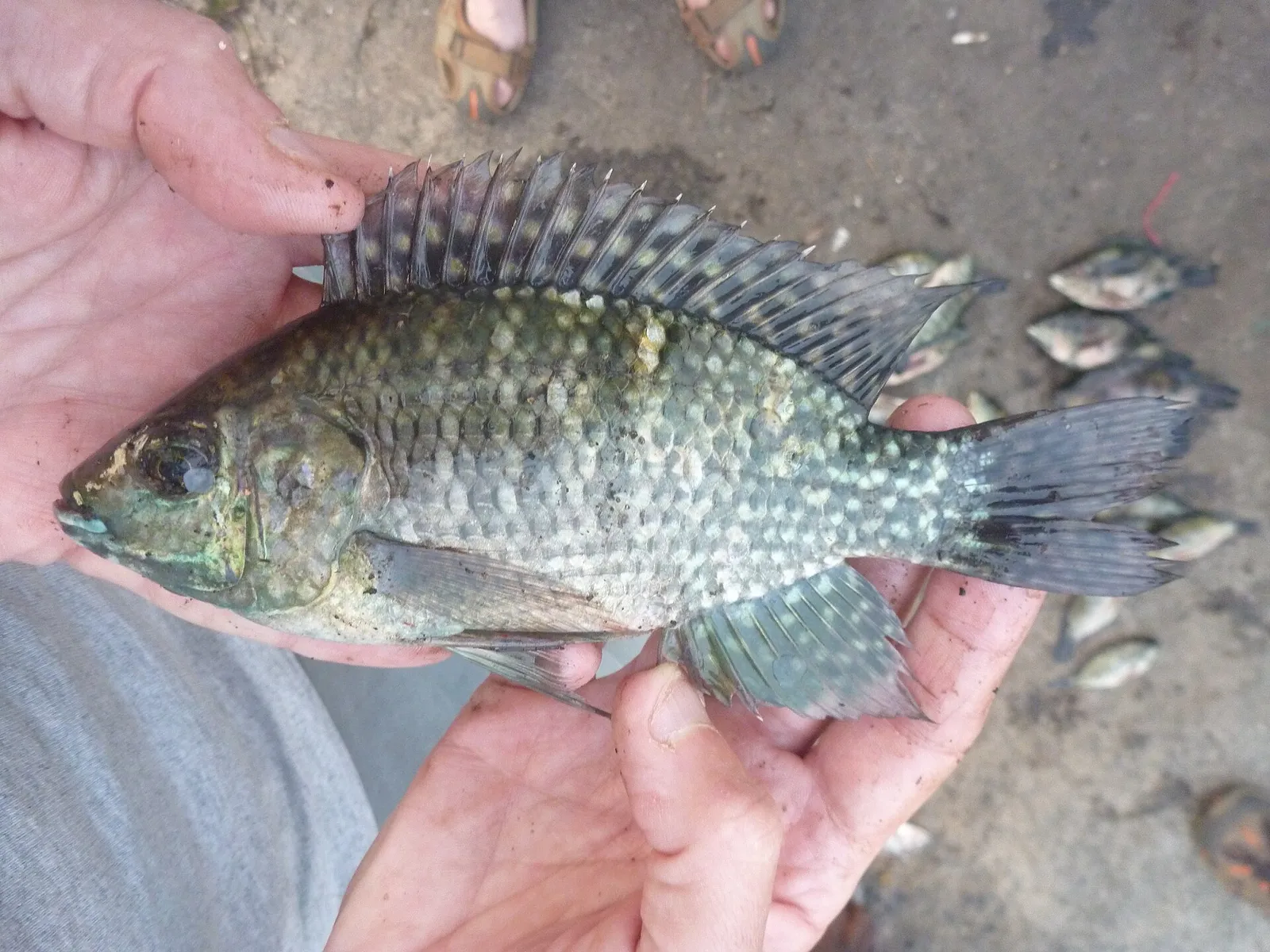
Taxonomy & naming
The blue-spotted tilapia was described by the British ichthyologist Ethelwynn Trewavas in 1933 as Tilapia leucosticta, from syntypes collected at Lake George, the Kazinga Channel and Lake Edward in the Albertine Rift. The Catalog of Fishes lists it as valid as Oreochromis leucostictus (Trewavas 1933), placing it in the cichlid subfamily Pseudocrenilabrinae alongside the rest of the tilapiine radiation. The move from Tilapia to Oreochromis followed Trewavas's own 1983 revision of the tilapiine genera, which split the substrate-spawning tilapias (Tilapia, Coptodon) from the maternal mouthbrooders (Oreochromis) — leucostictus is firmly in the latter camp.
The species epithet comes from the Greek leukostiktos, "marked with white spots," for the pale spangling on the male's body and fins; the common name simply trades "white" for "blue," since those spots take on a bluish cast in breeding dress. It is worth flagging that this fish is a genuine member of a species flock only in its native lakes. In Lake Tanganyika it is an interloper, and should never be confused with the lake's own endemic tilapiine, Oreochromis tanganicae — a larger, distinct species. Older literature occasionally muddied the water by referring to leucostictus as a Tilapia nigra x Tilapia zillii cross, a notion the modern taxonomy does not support.
Morphology
This is a small-to-medium tilapia with a deep, laterally compressed body, a small head and small jaws. FishBase gives a maximum of about 14.3 in standard length, but most fish are considerably smaller, and the species is known for breeding while still young and short — first maturity around 7.7 in, and sometimes far less. Fin counts run to 15–18 dorsal spines, 10–13 dorsal soft rays, 3–4 anal spines and 27–29 vertebrae, with 28–30 scales along the lateral line.
Color is where the fish earns its name, and it is strongly sex-linked. Males are dark — black ground color scattered with white-to-bluish spots across the flanks and into the soft dorsal, caudal and anal fins. Females are plainer: olive-toned with a pale belly, faint vertical barring, and darker anal and tail fins. The lower lip often shows a bluish-white tinge, and the genital papilla is a conspicuous bright white in both sexes. A courting male is unmistakable — the body deepens to a blue-black, the pale spots intensify, and the eye stands out with a bright amber iris crossed by a dark bar. None of this is flashy by Tanganyikan rock-cichlid standards; it is a workmanlike, swamp-and-lagoon fish that simply happens to spangle when it spawns.
Habitat
The blue-spotted tilapia is native to the Albertine Rift: Lakes Edward, George and Albert, the Kazinga Channel linking the first two, and the affluent rivers and streams of those lakes and the Semliki River. Its presence in the Aswa drainage is ambiguous — sources are uncertain whether it is native there or introduced. That native footprint sits well to the north and west of Lake Tanganyika; leucostictus is not a Tanganyikan endemic in any sense.
Its connection to Tanganyika is entirely human-mediated. From the 1950s onward, East African aquaculture and fisheries-enhancement programmes moved Oreochromis around the region freely, and the blue-spotted tilapia rode along. It has been widely introduced beyond its native range — most consequentially into Lake Victoria and Lake Naivasha in Kenya, where established populations now hybridize with and displace local tilapias. Surveys of Tanzanian catchments (Shechonge et al., 2019) found it established as the only exotic Oreochromis among the introduced tilapias they recorded, including in the Malagarasi watershed that drains to Lake Tanganyika; a Burundian checklist of the upper Malagarazi (Bigirimana et al., 2024) likewise lists it as an introduced Oreochromis, and it appears in occurrence datasets for the Tanganyika basin. Wherever it lives, it favors shallow, sheltered, inshore water — lagoons, swampy margins, papyrus fringe and muddy bottoms, almost always within the top 33 ft. In its native lakes it sits in warm water around 26–28 degrees C (79–82 degrees F) at a pH of roughly 7–9, and it is famously hardy: it tolerates heavy deoxygenation and has been recorded at temperatures as high as 38 degrees C (100 degrees F).
Feeding
Ecologically, the blue-spotted tilapia is a low-trophic-level grazer. It feeds chiefly on phytoplankton and detritus, with a trophic level estimated near 2.3 — essentially a primary consumer harvesting suspended algae and organic ooze rather than hunting other animals. In practice it is best described as an omnivore-detritivore, sweeping up algae, decaying organic matter and small invertebrates from the soft inshore bottom. That diet, combined with its tolerance for low oxygen and high temperature, lets it thrive in shallow, productive, sometimes stagnant water that excludes pickier fish.
It is mainly diurnal and occasionally forms loose schools. None of these traits are remarkable on their own, but together they make leucostictus an efficient generalist. The same combination that makes it a poor candidate for the aquarium trade makes it a formidable colonist: in the words of the management literature, when stocked alongside Nile tilapia it tends to help fill every available niche and competitively exclude native species. In a place like the Tanganyika basin, where the inshore community includes specialized endemic cichlids, a hardy, fast-breeding generalist sliding into the shallow margins is exactly the kind of ecological pressure conservationists worry about.
Mating
Like the rest of Oreochromis, the blue-spotted tilapia is a lekking, arena-spawning cichlid: reproduction turns on the male's nest rather than on any lasting pair bond. A ripe male establishes a territory over a particular patch of shallow bottom and digs a simple pit, or bower, by mouth — typically 6.5–8 in across, with neighboring nests a meter or so apart, in water anywhere from about 6 in to 10 ft deep. He defends that arena actively, driving off intruders, and displays to passing females in full blue-black spawning color, his pale spots intensifying and the amber eye flashing against its dark bar.
Females move through these clustered nests and choose among the displaying males; mating is brief and the male's parental investment essentially ends at fertilization. The single most consequential reproductive trait, though, is how early the fish breeds. The species is strongly prone to precocious maturity, courting and spawning while still small. That stunting tendency is the reason aquaculturists generally dislike it — a pond fish that matures at a few centimeters never reaches a useful plate size — but it is also exactly why an introduced population can establish and explode so quickly.
Breeding
The blue-spotted tilapia is a maternal mouthbrooder. Spawning is ovophilic — the female takes up the eggs almost immediately as they are laid and fertilized over the male's pit, so that the clutch is barely exposed on the substrate at all. From that moment the female alone carries the brood: she incubates the fertilized eggs in her buccal cavity and then shelters the free-swimming fry there, brooding them in quiet inlets and the papyrus fringe over shallow muddy bottoms.
Clutches are modest, on the order of a few hundred eggs as is typical for the genus, the trade-off for the security of oral incubation. The fry spend their earliest days in shallow, grassy, often deoxygenated swamp nurseries, sheltering in the mother's mouth when threatened and moving to deeper water as they grow. Combined with the species' early maturity, this protective brooding is what lets a small founding group seed a self-sustaining population: well-guarded young, a fast generation time, and a tolerance for the marginal swampy water where few competitors can follow.
In the aquarium
Be honest with yourself before considering this fish: it is not an aquarium cichlid in any meaningful hobby sense. FishBase notes a commercial aquarium use, but the blue-spotted tilapia is a drab, swamp-dwelling tilapia that breeds at a tiny size and offers little of the color or behavior that draws people to rift-lake cichlids. You will not find it in the trade the way you find mbuna or Tanganyikan shell-dwellers, and the searchable hobby forums are essentially silent on it — a telling absence, since keepers write at length about anything worth keeping.
If you did keep one, the requirements follow from its biology rather than from any care-sheet folklore: hard, alkaline freshwater (pH roughly 7–9), warm temperatures, and a lot of room, because even a stunted tilapia is a digging, territorial mouthbrooder that fouls and rearranges its tank. Males excavate pits and defend them, so expect substrate-level aggression around spawning. The more important point is a responsibility one: this is a documented invasive that hybridizes with native tilapias and has caused adverse ecological impact in several countries. It should never be released, and in many jurisdictions moving live Oreochromis is regulated for exactly that reason. For a hobbyist drawn to Tanganyika, the native cichlids are both more rewarding and far more appropriate.
Conservation
On its own account the blue-spotted tilapia is doing fine: the IUCN Red List assessed it as Least Concern on 30 March 2021 (assessment by Ntakimazi, Musinguzi, Natugonza, Twongo and Hanssens, under the Pan-Africa freshwater biodiversity assessment). It is widespread, adaptable and, if anything, expanding — the conservation concern attached to leucostictus is not about protecting it but about the harm it does elsewhere. As an introduced species it competes with native tilapias and hybridizes with them; studies have documented introgression involving leucostictus in East African waters, and it is repeatedly named among the introduced Oreochromis implicated in the decline of indigenous, often threatened, tilapia stocks.
That matters for Lake Tanganyika, where this fish is a non-native colonist rather than a member of the endemic flock. The lake is already under serious strain from forces that have nothing to do with tilapia stocking. Sediment cores analyzed by O'Reilly et al. (2003, Nature) indicate that climate warming has stabilized the lake's stratification and reduced deep mixing, cutting primary productivity by roughly 20% over the twentieth century — a change they link to an estimated 30% drop in fish yields. Cohen et al. (2016, PNAS) extended that paleoecological record, attributing a loss on the order of 38% of the lake's oxygenated benthic habitat to warming, alongside declines in commercially important fishes and endemic molluscs. Layered on top are shoreline sedimentation from deforestation and the immense four-nation pelagic fishery for clupeids (Stolothrissa, Limnothrissa) and their Lates predators, managed across Burundi, the DRC, Tanzania and Zambia through the Lake Tanganyika Authority. Into that stressed, shallow, warming littoral comes a hardy, low-oxygen-tolerant, fast-breeding generalist that thrives in exactly the inshore swamps and lagoons where native fish nurse their young. The blue-spotted tilapia itself is in no danger — but in the Tanganyika basin it is one more pressure on a lake that already has too many.