Taxonomy & naming
Exochochromis anagenys was described by Michael K. Oliver in 1989, with the description appearing in the landmark monograph on Malawian haplochromine genera by David H. Eccles and Ethelwynn Trewavas: Malawian Cichlid Fishes: The Classification of Some Haplochromine Genera (Lake Fish Movies, Herten, Germany, 1989). Oliver had coined the name in 1984, but Eccles and Trewavas made it formally available, hence the full citation is sometimes rendered 'Oliver in Eccles & Trewavas, 1989.' The specific epithet authorship is attributed to Oliver alone. No synonyms exist; the species was monotypic from inception. The holotype, USNM FISH USNM 304657, was collected by K. McKaye and colleagues in 1980 from Malawi and is deposited at the National Museum of Natural History, Smithsonian Institution (USNM), Washington D.C. Paratypes include USNM 304658 (McKaye et al. 1980) and USNM 304659 (S. Grant, 1975). The type locality is Thumbi West Island, Lake Malawi, Malawi (14°01′00″S, 34°48′23″E; depth approximately 131–164 ft, per Eschmeyer's Catalog of Fishes). Eccles and Trewavas erected the genus Exochochromis simultaneously to receive this single species; it has remained monotypic in all subsequent treatments, including Fryer and Iles (1972) background works and Konings's surveys of Malawi cichlids. Within the tribe Haplochromini, Exochochromis is placed in subfamily Pseudocrenilabrinae; its morphology — particularly the distinctive lower jaw structure and highly piscivorous trophic specialization — sets it apart from the mbuna rock-dwellers and sand-dwelling haplochromines that make up most of the lake's cichlid radiation. In the aquarium trade the species has been marketed under the informal labels 'Haplochromis Pholidophorus' and 'Haplochromis Torpedo Three Spot', neither of which carries taxonomic validity.
Morphology
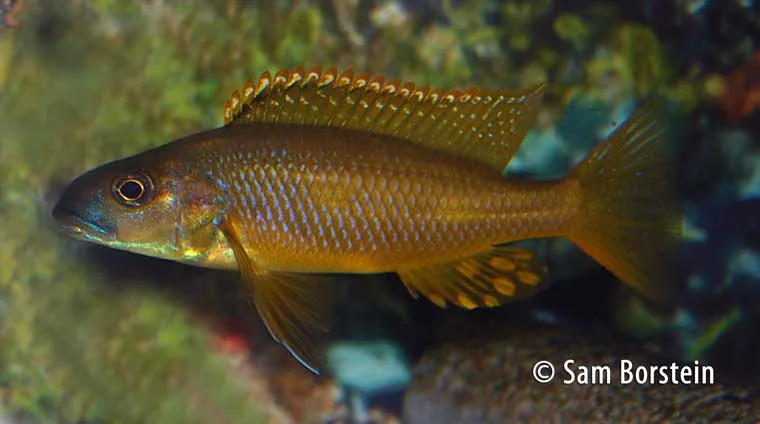
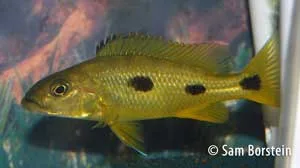
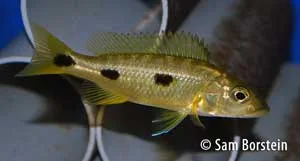
The threespot torpedo is a laterally compressed, strongly elongated cichlid built for speed. FishBase records a maximum standard length of 8 in, while malawi.si reports wild specimens reaching approximately 9.5 in total length; the difference reflects measurement convention (SL vs TL) and possibly regional and sex-related variation. The GCCA (Greater Chicago Cichlid Association) notes that males can approach a foot in length, with females smaller at roughly 8–9 in TL. The fish's most distinctive anatomical feature is the jaw profile: the upper jaw projects forward and the snout overhangs, while the tip of the lower jaw is set back behind the tip of the upper jaw — a recessed lower jaw that is the reverse of the prognathous condition seen in many piscivores. This is precisely the anatomy encoded in the specific epithet (see Etymology). The outer tooth row of the lower jaw is rolled outward so that the inner teeth are elevated, presenting an angled gripping surface well suited to seizing prey with a sideways strike. Three jet-black blotches are arrayed along each flank — one on the upper mid-body near the dorsal fin origin, one at mid-flank, and one near the caudal peduncle — giving the fish its common name and serving as recognition marks. Subdominant males, females, and juveniles wear a golden-yellow to warm-silver body with these three spots clearly contrasting. In dominant males a vivid electric-blue wash develops across the body and fins, more intense in individuals from the northern basin; fish from the south tend to remain more silvery. The fins are moderately sized and not produced into filaments; the caudal fin is slightly emarginate. The lateral line is well developed, the eye comparatively large. Sexual dimorphism, while present, is moderate in body shape: ripe females appear noticeably deeper-bodied.
Habitat
Exochochromis anagenys is endemic to Lake Malawi and widely distributed along the lake's rocky shores from the south to the far north. The IUCN assessment (Konings, Kazembe & Makocho 2018) describes it as occurring 'frequently over rocks, but also observed over the intermediate habitat; rarely observed over sandy habitats.' Its known range takes in Thumbi West Island (the type locality), the south-east arm of the lake, and Lundo Island in Tanzania (GBIF records); malawi.si regards it as widely distributed throughout the lake. FishBase gives a broad depth range of 16–413 ft, while the IUCN text characterises the species as occupying 16–164 ft for most of its lifecycle. This depth band spans the photic zone above the thermocline, consistent with a visual predator that relies on sight for hunting. Lake Malawi's waters are famously clear, warm, and alkaline: in-situ chemistry measured in the southern basin near its range core runs pH 7.7–8.6 and temperature 73–82 °F, with a general-hardness range of 7–30 dH listed for the species (FishBase; Konings 1990). The rocky habitat the species prefers is the same 'mbuna zone' where its principal prey concentrates, making it a natural ecological counterweight to the dense rock-dwelling cichlid communities.
Feeding
Exochochromis anagenys is a strict piscivore with a FishBase trophic level of 4.2 — among the highest recorded for Malawi cichlids. Its prey is documented as other cichlids, principally juvenile mbuna and smaller haplochromines; IUCN notes that 'it is a predator that hunts other cichlids by catching them with a sideways strike.' This lateral-lunge technique — a sudden sideways sweep of the head — differs from the direct head-on rush of many piscivores and allows the fish to sweep prey from the edge of rocky aggregations without fully entering confined crevices. The jaw anatomy — projecting upper jaw, recessed lower-jaw tip, teeth elevated on an outrolled lower surface — is directly adapted for grasping fish prey at an angle rather than end-on. The GCCA profile records that in the aquarium this predatory drive is strong enough to swallow remarkably large prey items; keepers routinely report that fish one might not expect to be at risk disappear from a shared tank. In nature the species appears to hunt diurnally, covering moderate distances over the rocky-intermediate transition zone. Despite its fearsome reputation, Rick Borstein's GCCA account notes that 'Exochochromis anagenys is not a very aggressive fish in the aquarium' — it is a hunter rather than a territory-holding brawler, a distinction that bears on aquarium husbandry.
Mating
Exochochromis anagenys is a haplochromine maternal mouthbrooder, and its social structure follows the typical polygamous pattern of Lake Malawi cichlids. Dominant males develop full nuptial coloration — the deep electric-blue of northern specimens or the more muted silver-blue of southern ones — and move through the rocky zone in active foraging while simultaneously being receptive to females. The IUCN assessment makes the notable observation that 'males may not be territorial as they continue to hunt in breeding colouration,' distinguishing this species from the strongly site-attached mbuna and many peacock cichlids. Courtship involves the male displaying to receptive females with lateral body presentations emphasising the blue coloration and the three spots; the female approaches, and spawning takes place over a rock or sandy patch. Conspecific male-male interactions can escalate, but full territorial defence of a fixed site does not appear to be part of the repertoire. In aquaria, malawi.si recommends at least 265 US gal and a minimum tank length of 98.5 in to give the fish sufficient room to establish a natural hierarchy without constant physical conflict.
Breeding
As a maternal mouthbrooder, the female of Exochochromis anagenys alone carries and broods the eggs and fry. After spawning, she picks up the eggs into her buccal cavity and holds them through hatching and early larval development; the male takes no further part in parental care beyond the spawn itself. Clutch sizes in captivity are reported as modest for a fish of this size: Rick Borstein (GCCA, 2011) stripped a first-time female of seven very large fry at the 'heads and tails' stage (partially yolk-absorbed, body and tail visible), describing them as 'some of the largest Malawian fry I've seen' — approximately 1 in total length. Free-swimming juveniles appear as miniature replicas of adults roughly ten days after stripping. The species is not easy to breed in captivity primarily because it takes eighteen months or more to grow to sexual maturity, requires large tanks throughout, and spawning is infrequent; Borstein notes that 'it does not appear to spawn that often.' Females incubation period in captivity is not precisely documented but is consistent with the 21–28 day range typical of large haplochromine maternal mouthbrooders at 77 °F. No wild breeding observations have been published, and clutch size in nature is unknown; the large fry size and apparently small brood suggest a K-selected strategy with high investment per offspring.
In the aquarium
Exochochromis anagenys is an uncommon species in the hobby — it surfaces occasionally in specialist cichlid shops and at cichlid conventions, where full-grown adults have sold for around USD 75 (≈ €70; GCCA, 2011). That rarity, combined with its eventual size and strict dietary requirements, makes it a fish for experienced Lake Malawi keepers rather than a general-audience choice. A single adult requires a minimum of roughly 130 US gal, and a pair or trio is better accommodated in 200 US gal or more; malawi.si recommends at least 265 US gal and a tank length of 98.5 in to allow natural movement and reduce conflict. The footprint matters as much as raw volume: this is a fish that moves through open water over rocky terrain, and a long, wide tank suited to midwater swimming is preferable to a tall, narrow one.
Water chemistry must reflect the alkaline, well-buffered conditions of Lake Malawi. A pH held between 7.8 and 8.4, a temperature between 23 and 81 °F, and general hardness in the range of 10–20 dH are appropriate targets, consistent with the species' documented wild chemistry. Efficient biological filtration with strong water movement is important: as a large, active predator the fish produces a substantial waste load, and dissolved-oxygen levels should be maintained high. Regular water changes of 25–30 % weekly help keep nitrates low and reduce the risk of Malawi bloat — a bacterial condition of the digestive tract and one of the most common preventable causes of death in Lake Malawi cichlids. The link between elevated nitrates, an overly rich or inappropriate diet, and bloat is well established in Malawi haplochromine husbandry. The threespot torpedo's fully piscivorous diet should not be replaced with high-protein pellet foods formulated for omnivores; feeder fish from disease-free sources, or larger carnivore pellets with appropriate protein composition, are preferable, and overfeeding must be avoided.
The tank should be furnished with a deep layer of fine sand and a substantial arrangement of rocks at each end, replicating the rocky-intermediate transition zone the species occupies in the lake. The central portion of the tank benefits from relatively open water to give the fish room to cruise. Floating or attached plastic plants can be used for aesthetic effect without ecological consequence, but dense rooted plantings are incongruous with this species' actual habitat and rarely survive the digging and fish-capture activity of a large haplochromine. Good lighting is not mandatory, but the species is a visual hunter and adequate illumination allows keepers to observe its full coloration.
Tankmate selection is the single most important husbandry decision. Exochochromis anagenys is a piscivore documented to take cichlids as prey in the wild, and its buccal capacity in captivity surprises many keepers — fish that appear too large to be swallowed disappear. Any fish substantially smaller than the threespot torpedo is at risk. Suitable companions are large, robust Lake Malawi haplochromines of comparable size, such as other large 'Hap' species in the 8 in-plus range, or large Aulonocara peacocks as dither fish — never small mbuna species, small tetras, or any fish the torpedo can fit in its mouth. Even then, the keeper should monitor for sustained aggression, particularly when males are in breeding colour. This species' temperament has been described as relatively non-aggressive outside of hunting context (Borstein, GCCA 2011), but that distinction collapses when a smaller fish enters its strike range.
Breeding in captivity is achievable but not straightforward. The fish reaches sexual maturity slowly — eighteen months or more from the fry stage — and spawning events are infrequent even in apparently well-conditioned pairs. The female broods the eggs buccally for roughly 21–28 days; the small brood of very large fry (approximately 1 in at the point of stripping) makes them easier to raise than the large broods of smaller-fry species. Early stripping at the 'heads and tails' stage into a tumbler or dedicated rearing vessel is standard practice and removes the risk of the female spitting prematurely under tank stress. Fry can be fed on appropriately sized carnivore foods immediately; they grow relatively slowly. Generalising from Malawi haplochromine practice where specific data for this species are absent: separating the female during and after the brood is advisable to allow her to recover condition before the next potential spawn.
Conservation
Exochochromis anagenys is assessed as Least Concern on the IUCN Red List (Konings, Kazembe & Makocho 2018; assessed 22 June 2018), on the grounds that the species has a widespread distribution throughout Lake Malawi, no evidence of major population decline, and occurrence within Lake Malawi National Park. The estimated area of occupancy is 471 mi² and the extent of occurrence approximately 11,429 mi²; population trend is unknown as no systematic surveys have been conducted. The IUCN assessment identifies overfishing via subsistence and small-scale fisheries as a potential threat and notes that the species is irregularly exported for the ornamental trade, where it commands a premium: GCCA (2011) reported full-grown adults selling for around USD 75 (≈ €70). These trade levels are not considered significant relative to the population. The lake-wide picture for Malawi cichlids is, however, more concerning. Chavula et al. (2023, Journal of Great Lakes Research) document that the Lake Malawi/Niassa/Nyasa basin faces growing pressure from catchment deforestation and resultant sedimentation, nutrient loading, and altered hydrology. Maruyama et al. (2011) demonstrated directly that sedimentation in rocky shoreline habitats reduces the abundance and diversity of rock-dwelling cichlids — precisely the community on which Exochochromis anagenys preys and within which it lives. A predator relying on dense, healthy mbuna populations is therefore indirectly exposed to any process that degrades the rocky substrate zone. The species occurs in Lake Malawi National Park, which provides some protection, but the park covers only a portion of the lake's shoreline. The long-term status of this predator is unlikely to diverge sharply from that of the mbuna species that form its prey base.