Taxonomy & naming
Geophagus surinamensis was described by the Berlin physician and naturalist Marcus Elieser Bloch in 1791, in his 'Naturgeschichte der ausländischen Fische,' as Sparus surinamensis — placed, like many early cichlids, in a seabream genus because the family Cichlidae did not yet exist as a concept. The single specimen Bloch worked from, a fish from Suriname, survives as the holotype ZMB 2825 in the Museum für Naturkunde in Berlin and was re-cataloged by Kullander & Nijssen (1989) and again by Paepke (1999). When Johann Jakob Heckel erected the genus Geophagus in 1840, surinamensis became its type species, so the name anchors not just one fish but the entire genus and, by extension, the colloquial 'eartheaters.'
That foundational status is exactly what made the name so troublesome. Through the nineteenth and most of the twentieth century, ichthyologists applied 'Geophagus surinamensis' to nearly every striped, sediment-sifting Geophagus across the Amazon, Orinoco and the Guianas — a convenient dustbin for a confusing group. The reckoning came with Sven Kullander's revisionary work, culminating in Kullander & Nijssen's 1989 monograph 'The Cichlids of Surinam,' which redescribed the species and demonstrated that the true Geophagus surinamensis is restricted to the coastal rivers of Suriname and French Guiana. Everything else that had borne the name was split off into a cascade of resurrected and newly described species — Geophagus brachybranchus, Geophagus harreri, Geophagus proximus, Geophagus altifrons, Geophagus megasema, Geophagus brokopondo, Geophagus argyrostictus and many more — so that what was once a single 'species' is now understood as the surinamensis species-group of well over a dozen members — one per major river system in some assessments, with every intermediate body shape and pattern in between, so that morphology alone often cannot settle the question of how many true species are involved. Because so many of these siblings are near-indistinguishable to the eye, workers increasingly lean on brood-care behaviour as a second diagnostic axis alongside anatomy: whether a population picks up its eggs immediately (ovophilous) or only after they have developed into larvae (larvophilous) has repeatedly turned out to track species boundaries that colour pattern alone obscures. Within the genus, surinamensis belongs to the surinamensis group sensu stricto (the eartheaters Kullander retained in Geophagus proper, as distinct from the steindachneri 'redhump' group and the brasiliensis complex, which other workers have treated as separate genera). It sits in the eartheater subfamily Geophaginae of the New World cichlids. The practical upshot for any reader: a fish sold as 'Geophagus surinamensis' in the aquarium trade is, more often than not, one of its congeners (commonly Geophagus altifrons or an undescribed 'red head' form), and museum or database records from the Orinoco and Amazon almost certainly refer to other species.
Morphology
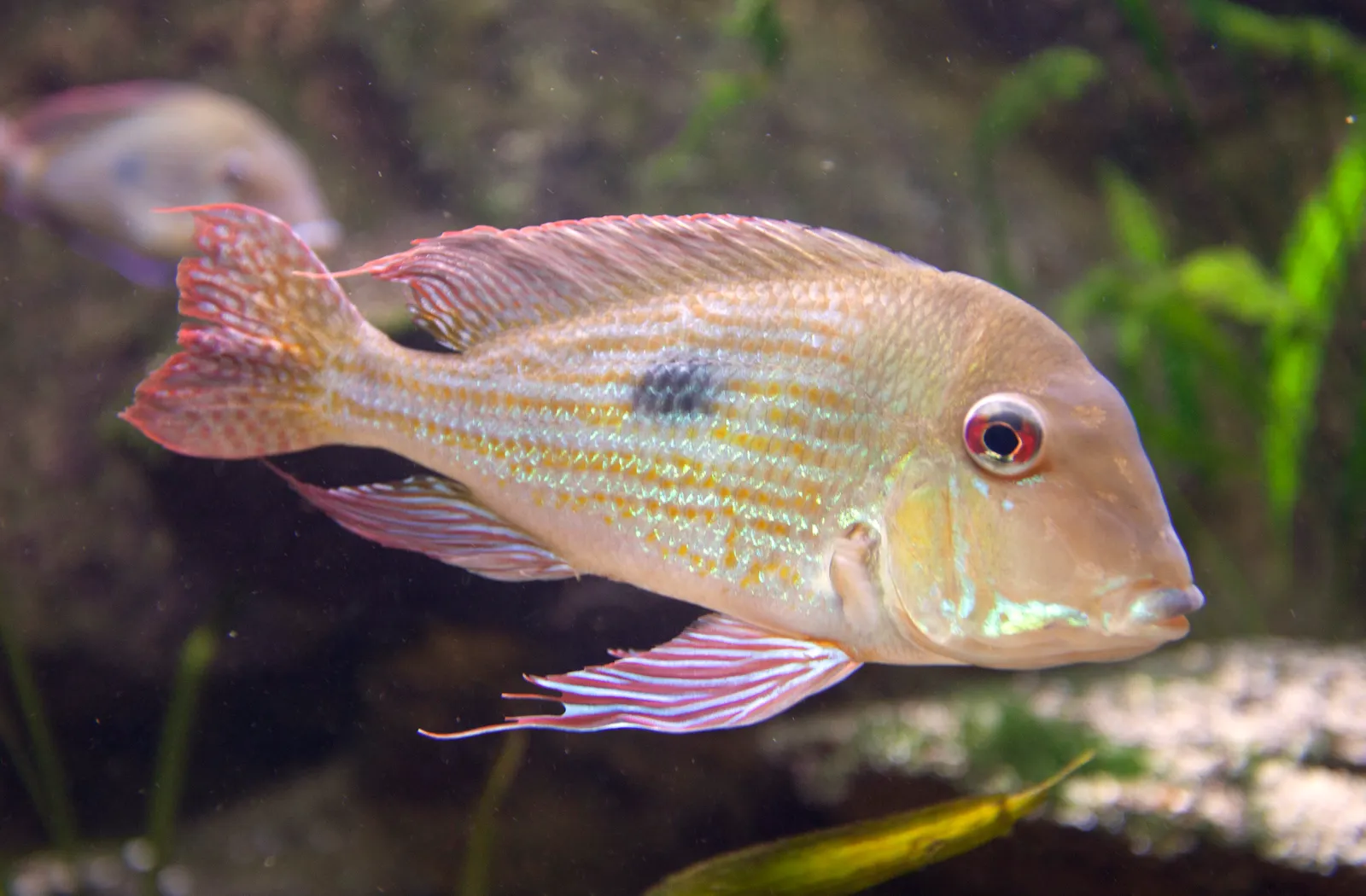
The redstriped eartheater is a moderately deep-bodied, laterally compressed cichlid with the gently sloping forehead and underslung, protrusible mouth typical of the genus. Size reports vary with how length is measured: FishBase lists a maximum of 7 in standard length (snout to tail base) but also cites a maximum of about 12 in total length, while aquarium fish are usually quoted at 8–10 in — the difference between a conservatively measured wild specimen and a well-fed adult including its tail. The base colour is a warm tan to olive overlaid with rows of iridescent blue-green to turquoise spangling on the flanks and across the unpaired fins, and the common name comes from the wavy reddish to red-brown longitudinal striping that runs along the body and into the head and gill cover. A single dark blotch sits on the midflank. Sexual dimorphism is subtle: males grow somewhat larger and develop slightly more extended dorsal and caudal fin tips and heavier facial markings, while ripe females are rounder and fuller in the body, but the sexes are difficult to separate reliably outside of breeding condition. Like its congeners it can produce sounds with its pharyngeal teeth, though whether this serves communication is unknown. Because so many lookalike congeners were long lumped under this name, colour alone is an unreliable guide to identity; secure identification rests on locality (a genuine Suriname/French Guiana origin) and on the meristic and morphometric characters set out by Kullander & Nijssen.
Habitat
In the strict, post-revision sense, Geophagus surinamensis is a fish of the Guiana Shield coastal drainages. FishBase records it from the Saramacca and Suriname Rivers in Suriname and the Marowijne (Maroni) River shared by Suriname and French Guiana; the IUCN assessment extends its probable natural range across the Coppename, Saramacca, Suriname, Maroni, Mana, Sinnamary and Approuague basins of Suriname and French Guiana. Records attributed to the species from the Orinoco basin of Venezuela and Colombia, from Guyana, and from Amazon tributaries in Brazil and Bolivia almost certainly represent congeners under the old broad name rather than true Geophagus surinamensis. The fish lives in black-water and clear-water rivers and their flooded plains, favouring lentic, low-current stretches, and it is characteristically found in the calm pools below and beside waterfalls and cascades — often alongside the larger congener Geophagus harreri, with which it shares those quiet zones. Seine-net surveys on the Maroni above the Maripasoula rapids have turned up Geophagus surinamensis in the same hauls as Guianacara and the pike cichlid Lugubria multispinosa, in fairly deep (around 71 in), murky, cover-poor water over a fine sandy bottom. It inhabits channels floored with mud and sand, the soft substrate its feeding behaviour depends on. Underwater field observation backs this up from a second river: in the Tapanahoni, a tributary of the Marowijne, divers have watched Geophagus surinamensis sharing quiet, slack-current stretches with Geophagus harreri and Guianacara over a bottom of fine sand and detritus, in tea-tinted water clear enough to see roughly 5 ft; the pike cichlids Saxatilia albopunctata and Lugubria multispinosa hold the same reach in deeper water, and Characidium works the gravel riffles nearby. In the Suriname River itself the species has been found in calm, pool-like widenings set off from the main current — quiet water rather than the channel proper — over fine sand, with warm (about 79 °F or higher), soft and distinctly acid conditions reported for that population (Mayland, 1995). Measured field chemistry for the genus and the species' soft-water Guiana habitats sits in the soft-to-moderate, slightly acidic to near-neutral range more broadly; FishBase gives a tolerance envelope of pH 6.0–8.0 and 5–19 dH and a tropical temperature band of about 72–77 °F, though most husbandry sources keep it warmer. The eastward limit of the species is not entirely settled: it is thought likely to reach the Mana drainage of French Guiana, but is apparently replaced further east, in the Sinnamary drainage, by a distinct, still-undescribed geophagine with an opercular spot that true surinamensis lacks. These are shallow river fish: they are taken in the upper few metres of the water column of rivers, marginal flooded forest and canals rather than in deep open water.
Feeding
Geophagus surinamensis is the archetypal eartheater. It feeds by taking mouthfuls of sand and soft sediment, sorting edible particles — small benthic invertebrates, insect larvae, detritus, algae and other organic matter — from the grit on its gill rakers and pharyngeal apparatus, then expelling the cleaned substrate through the gills and mouth. FishBase characterizes it as omnivorous with a tendency toward herbivory, and its estimated trophic level is low (around 2.3), consistent with a fish that grazes the bottom for a broadly vegetarian and invertebrate diet rather than hunting. Its protrusible jaws are the tool for this constant winnowing of the river floor. In its native rivers it is described as not especially abundant, sharing the quiet cascade pools and mud- and sand-bottomed channels with Geophagus harreri and functioning as a benthic forager of the soft-sediment zone.
Mating
Like most eartheaters, Geophagus surinamensis forms monogamous pairs that select and defend a spawning site, and pair formation grows out of the loose, semi-social aggregations the fish form outside of breeding. Both sexes share territorial defence, with the female focused closely on the chosen site and the male patrolling the surrounding ground. Courtship and pair-bond maintenance involve the lateral displays, fin-spreading and substrate cleaning typical of the genus. Because the sexes are hard to tell apart on sight, aquarists generally obtain a pair by raising a group of six or more young fish together and letting a bond form naturally — the standard approach for the genus, and one that also diffuses the moderate intraspecific aggression that flares as fish mature and pair off.
Breeding
Geophagus surinamensis is a biparental larvophilous (delayed) mouthbrooder — the reproductive mode that, in Kullander's sense, is characteristic of the true surinamensis group. The pair spawns on a cleaned flat surface, a stone or a depression dug in the sand, in the open substrate-spawning manner; the adhesive eggs are tended on the substrate for the first days. Then, as the eggs near hatching, one or both parents take the eggs and larvae up into the mouth, where the developing young are sheltered. FishBase, drawing on field observations, reports that the parents typically take the eggs into their mouths until hatching occurs about three days later, and that the free-swimming fry dart back into a parent's mouth at night or at any sign of danger; the adults continue to guard their brood for several weeks. This delayed, biparental mouthbrooding is the evolutionary intermediate between the ancestral open substrate-brooding of cichlids and the immediate (ovophilous) mouthbrooding seen in some other Geophagus such as Geophagus altifrons and Geophagus proximus. Clutches are moderate — FishBase resilience modelling assumes a fecundity on the order of 250 eggs — and the comparatively large, well-guarded young emerge as capable free-swimmers. Captive spawnings follow the same pattern and are reported by European aquarists in the older hobby literature.
In the aquarium
The redstriped eartheater is a rewarding but space-hungry aquarium fish, and the first hurdle for a keeper is simply getting a true one: most fish sold under this name are congeners such as Geophagus altifrons or an undescribed 'red head' Geophagus, so anyone specifically after Geophagus surinamensis should buy from documented Suriname or French Guiana stock — a diagnostic worth knowing is that the true species has no dark markings on the head at all, unlike proximus, argyrostictus, brachybranchus, harreri and taeniopareius, all of which carry some head pattern. Husbandry is otherwise the same across the surinamensis-group eartheaters. Because the species reaches 8–10 in and is best kept as a group of five or more to spread aggression and bring out natural behaviour, the realistic minimum is a long four-foot tank for a small group, with six feet and upward of 120 US gallons far better for a colony of adults — these are loosely social fish that need room to hold informal territories without constant friction.
The single non-negotiable furnishing is a deep bed of fine, soft sand. Eartheaters feed by taking the substrate into the mouth and sieving it, so sharp gravel both prevents the behaviour and can injure the gills; smooth silica sand lets the fish do what it is built to do. Décor can be simple — driftwood, smooth rounded stones and a few hardy plants (which they will dig around rather than uproot if rooted in pots or among rocks) — over an open sand floor. Mature, clean water and strong biological filtration matter: like other eartheaters the species is sensitive to accumulated dissolved waste and can develop head-and-lateral-line erosion under poor maintenance, so generous weekly water changes are standard advice. Aim for warm, soft-to-moderate water: roughly 75–86 °F, pH about 6.0–7.5, and low to moderate hardness; the fish tolerates harder, more neutral water but shows best colour and condition toward the softer, slightly acidic end of its range. Flow should be gentle, matching the calm pools it inhabits in the wild.
Temperament is peaceful by cichlid standards outside of breeding, escalating to moderate territoriality when pairs form. Suitable tankmates are other calm, similarly sized South Americans that occupy different zones — larger characins (silver dollars, larger tetras, headstanders), other peaceful geophagines, Mesonauta or severums, and robust mid-water dithers that won't be intimidated and won't nip. Avoid small fish that can be inhaled, aggressive substrate competitors, and persistent fin-nippers. Feeding is undemanding: a varied diet of quality sinking pellets, frozen and live foods (bloodworm, brine shrimp, daphnia, chopped earthworm) and some vegetable matter suits an omnivore that leans herbivorous; the fish will graze the sand continuously between meals. The common keeper mistakes are using gravel instead of sand, keeping too few fish in too small a tank, and letting nitrate climb.
Conservation
The IUCN Red List assesses Geophagus surinamensis as Least Concern (assessed and published 12 March 2023; assessors Lasso-Alcalá, Martínez, Mikolji & Quintero-T.), with a population trend judged stable. The assessment treats the species as naturally distributed through the coastal rivers of the Guiana Shield in Suriname and French Guiana and notes that the many records from the Orinoco, Amazon and Guyana basins likely reflect the long history of misidentification rather than the true species' range. The principal pressures the assessors identify across the Guiana Shield are mining (including the mercury contamination that accompanies gold extraction), deforestation, and the resulting contamination and siltation of the region's rivers — diffuse, basin-scale threats rather than anything targeting this fish in particular. The species is also harvested for the ornamental trade and is fished commercially at a local level, but not at a flagged population-level intensity. It carries no CITES listing. Two populations are established outside the native range as introductions — in southern Florida (U.S.A.) and in Singapore — a legacy of the aquarium trade rather than a conservation concern for the wild stock. As a fairly widespread Guiana-coast generalist, the redstriped eartheater is far less exposed than the region's many narrow-range endemics, but its long-term outlook is tied to the broader health of Guiana Shield rivers under expanding mining and deforestation.