Taxonomy & naming
The species was first described in 1936 by Lore Rose David, in the genus Limnochromis, from material collected in Lake Tanganyika and published in the Revue de Zoologie et de Botanique Africaines. The genus name Gnathochromis was erected later by Max Poll, in his 1981 revision of Limnochromis (Regan, 1920), combining the Greek gnathos (jaw) with chromis, an old name for a perch-like fish — a fitting nod to the animal's most conspicuous feature. The specific epithet permaxillaris likewise points at the jaw apparatus.
For decades Gnathochromis carried a second species, the haplochromine-like Gnathochromis pfefferi, and the pairing was always uneasy: the two fish look and behave nothing alike. Molecular work eventually confirmed that the genus was polyphyletic, with its members sitting in two distantly related tribes. A 2024 taxonomic revision by Haefeli, Schedel, Ronco, Indermaur and Salzburger (Zootaxa) resolved the conflict by moving 'G.' pfefferi into a new genus, Jabarichromis (tribe Tropheini), leaving Gnathochromis permaxillaris — the type species — as the sole member of Gnathochromis within the tribe Limnochromini. So the name you see today belongs to a genus that is now monophyletic and effectively monotypic. In the trade the fish is usually sold simply by its scientific name, sometimes tagged with a collection locality such as 'Kalubale', 'Kala Bay' or 'Kalala', and occasionally by the nickname 'vacuum-cleaner cichlid'.
Gnathochromis permaxillaris has long been grouped, informally, with a handful of other iridescent-scaled Limnochromini once lumped together in the old genus Limnochromis — among them Limnochromis auritus and the two Greenwoodochromis species. Ad Konings, writing before the modern revisions, distinguished the Greenwoodochromis pair from the true Limnochromis mainly by scale count (more than 48 scales in a horizontal row, versus a maximum of 40) and noted that permaxillaris, though placed in its own genus even then on the strength of its extraordinary jaw, clearly belonged to this same deepwater assemblage — a grouping since borne out by molecular work on the tribe.
Morphology
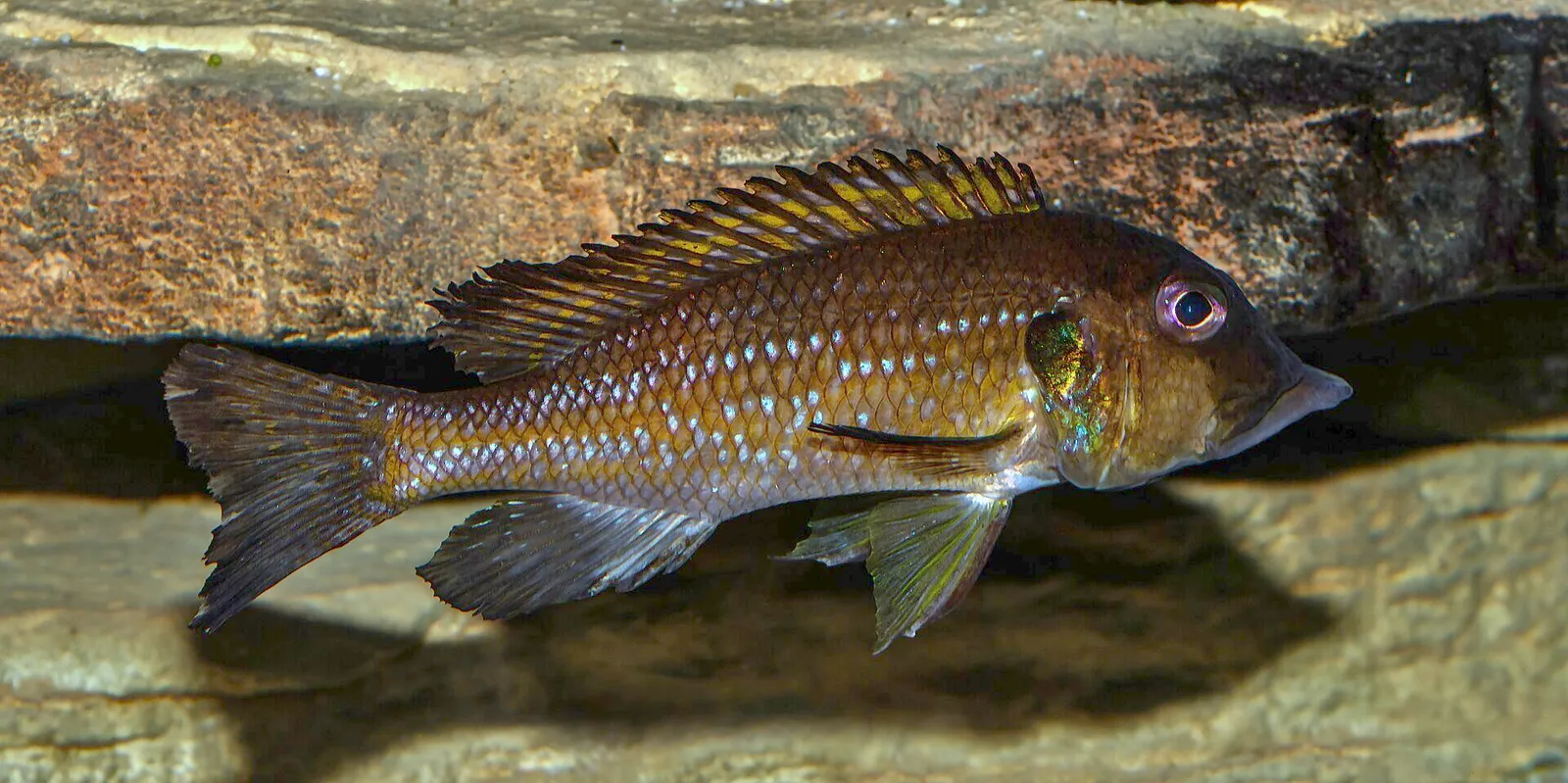
This is a moderately large, deep-bodied cichlid in fairly plain dress — silvery to pale grey-brown, sometimes with a faint sheen and subtle markings, the kind of coloration that reads as camouflage against open mud rather than display. The defining feature is the mouth. The upper lip is flattened and stretched far beyond the lower jaw, and the whole mouth is strongly protractile, so that when it opens it projects downward into a tube. Tellingly, this lip extension is absent in juveniles and develops only as the fish matures, which is why young specimens look like fairly ordinary limnochromines.
Reported maximum size depends on the source. FishBase and Seriously Fish list around 6 in (6 in) total length, a figure that traces back to the older checklist literature; Ad Konings, however, describes it in the Cichlids Yearbook as growing to over 7 in, and his own tabulated figures in Enjoying Cichlids give a maximum of 8 in — a substantially larger fish than the standard aquarium references suggest, with males running slightly bigger than females. Long-term keepers in smaller setups tend to see fish nearer the 6 in mark. External sexual dimorphism is limited but not entirely absent: beyond the size gap, Konings notes the genital opening (ventral aperture) of the female is noticeably larger than the male's, though with usually only a handful of specimens on hand to compare side by side, this is a difficult method to apply in practice, and the species remains a genuinely hard fish to sex with confidence.
Habitat
Gnathochromis permaxillaris is endemic to Lake Tanganyika and is recorded broadly around the lake — across waters bordering Burundi, the Democratic Republic of the Congo, Tanzania and Zambia — yet it is described everywhere as uncommon, never occurring in substantial numbers. It shows remarkably little geographic variation from one end of the lake to the other, which fits a deepwater animal: at depth there are few of the hard habitat barriers (rocky headlands, surge zones) that split shallow rock-dwellers into local races.
It is a fish of the soft floor. It lives over muddy and sandy bottoms, often near rocks or in the transitional zone where sediment meets rocky structure, and it is a genuinely deep-living species by aquarium standards. Tanganyikan field sources place it commonly between about 100 and 330 ft (98–328 ft) and probably deeper; Seriously Fish notes foraging recorded down to around 650 ft (656 ft), with vertical movements that appear to track the plankton it feeds on. In situ this is warm, hard, alkaline rift-lake water, roughly 75-79 deg F (24-26 deg C) at the depths it frequents, with the high pH (about 8.6-9.3) and conductivity characteristic of Tanganyika.
Feeding
Everything about this fish is built around sifting soft substrate. It hovers just above the bottom, extends that tube-like mouth straight down, and takes in a mouthful of mud or sand, expelling the sediment through the gills and retaining the small invertebrates and zooplankton living within it. Konings describes the hydrodynamics of the trick: the unusually wide gape spreads the inflow of water — drawn in through the extended gill covers — over a relatively large area, which weakens the current enough that only small, light particles get carried in with it, letting the fish work the mud continuously rather than gulping in a way that would stir up a cloud of unusable sediment. The mechanism is convergent with the unrelated South American eartheaters (Geophagus and kin) and with Tanganyika's own sand-sifters — independent solutions to the same problem of mining a living from loose sediment. Its diet in the wild is accordingly carnivorous and fine-grained: benthic micro-invertebrates and zooplankton rather than anything it has to chase or crush, consistent with an estimated trophic level around 3.4.
Within the lake's food web it occupies a specialist's niche that most of Tanganyika's showier cichlids ignore — the soft deepwater floor — and it belongs to the Limnochromini, a tribe of benthic deepwater cichlids that molecular work (Duftner, Koblmuller & Sturmbauer, 2005) identifies as biparental mouthbrooders and an old, relatively early-diverging part of the lake's radiation. Its low numbers are part of the picture: a scattered, low-density predator of small infauna rather than a schooling planktivore.
Mating
By Tanganyikan standards Gnathochromis permaxillaris is a calm, even retiring fish. It is not strongly aggressive, holds a loose territory without much fuss, and is typically found singly or in small groups rather than in dense shoals. Keepers consistently describe it as peaceful for its size, which squares with the field reports of low population density.
When a pair forms, courtship plays out over the soft bottom they inhabit. Accounts describe a pair excavating sand from beneath a rock or inside a cave and using it to partly wall off the entrance, preparing a spawning site before the eggs are laid. Because the species shows little reliable external sexual dimorphism and is genuinely difficult to sex by eye, deliberate pairing usually means raising a group and letting two fish sort themselves out — a slow approach made slower still by the years it takes the young to mature.
Breeding
Breeding is the unusual part. Like other Limnochromini, Gnathochromis permaxillaris is a biparental mouthbrooder — both sexes incubate. The pair spawns inside the prepared, partly walled-off site and then shares the brooding duty. A frequently repeated detail, corroborated across hobby and reference sources, is that the parents trade the clutch back and forth every couple of days, which spares either fish from prolonged starvation while carrying. Fry are released after roughly two weeks and continue to be guarded, taken back into the mouth when threatened.
The catch is time: the young grow slowly and can take up to three years to reach sexual maturity, and the diagnostic extended lip only appears as they mature. That slow timeline, plus the difficulty of sexing the fish, makes deliberate captive breeding a patient, multi-year project rather than a quick win.
In the aquarium
This is not a beginner's fish, and not because it is fierce. It is uncommon and usually expensive — wild stock has historically commanded high prices and shows up only sporadically — and it is sensitive to deteriorating water quality, so it punishes neglect. The non-negotiable requirement is a deep bed of fine to medium sand it can actually sift; a bare bottom or coarse gravel denies the animal its entire feeding behavior. A few rocks arranged into background caves and passages, dim lighting, open swimming space, and the usual hard, alkaline Tanganyikan water (roughly pH 7.5-9.0, temperature near the low-to-mid 70s deg F / 22-26 deg C) round out the setup.
On tank size, advice diverges. Older care notes (e.g. Seriously Fish) suggest a 48-in / ~30 US gal tank as a minimum, but given the fish's adult size, sand-sifting habit and the practice of keeping a group to let a pair form naturally, many keepers and Tanganyikan specialists recommend something considerably larger — on the order of 125 gal (~130 US gal) and up, with a footprint of at least 49 in. Provide dark, closed-ended pipe caves (plastic or clay pipework behind the rockwork works well) rather than open crevices; a settled pair sharing the same pipe is the best sign they are getting along. Newly acquired fish take time to adjust their feeding: they sift the bottom readily from the start but can be slow to learn to take food in mid-water, so persevere with sinking foods before assuming a fish is not eating. Two males will sometimes share a cave at first, but once acclimatized the dominant fish generally drives the weaker one out, so a pair (not a same-sex group) remains the safer long-term target. Diet should lean on live and frozen foods (the fish takes frozen readily), with dried foods a lesser component. It mixes well with calm, similarly hard-water tankmates — Cyprichromis, Paracyprichromis, Altolamprologus, Julidochromis, larger placid species such as Cyphotilapia, and Tanganyikan Synodontis — and poorly with boisterous fish like Malawi mbuna, which simply outcompete it. Two practical cautions from the community: more than one collection-locality 'morph' should not be mixed, as they can hybridize; and a sand-sifter shares the bottom uneasily with shell-dwellers, since its constant excavation disturbs their shells.
Conservation
The IUCN Red List assesses Gnathochromis permaxillaris as Least Concern, in an assessment published 25 February 2025 (Lake Tanganyika Fishes assessment, assessor Lloyd Haambiya). It is not targeted by any meaningful commercial fishery (its low density and depth make it a poor target), and the aquarium trade takes it only in small numbers, so direct collection pressure on the species is light. On its own terms, then, this fish is not currently considered threatened.
That verdict sits inside a lake under real strain, and the honest framing is to hold both facts at once. Lake Tanganyika is warming: O'Reilly et al. (2003, Nature, doi:10.1038/nature01833) linked rising surface temperatures to stronger stratification, weaker vertical mixing and an estimated ~20% drop in primary productivity, with knock-on declines of roughly 30% in fish yields. Cohen et al. (2016, PNAS, doi:10.1073/pnas.1603237113) found that warming has reduced the lake's oxygenated benthic habitat — on the order of a 38% loss — squeezing the very deep, soft-bottom zone where this species lives and feeds. Add the long-running sedimentation and nutrient loading from shoreline deforestation and agriculture (Cohen et al., 1993) degrading the littoral and sediment floor, and a basin-wide fishery — the clupeids Stolothrissa and Limnothrissa plus Lates — that feeds the four riparian nations and is managed jointly through the Lake Tanganyika Authority.
For Gnathochromis permaxillaris specifically, the relevant threat is not the net but the deep water itself: a benthic deepwater specialist whose food and habitat depend on a well-oxygenated, productive lake floor is exactly the kind of fish most exposed to warming-driven productivity loss and the shrinking of oxygenated benthos, even as it stays well off the fishery's radar. So the accurate statement is the careful one — the species is Least Concern today, but the deepwater habitat it occupies is among the parts of Tanganyika most sensitive to the changes already underway.