Taxonomy & naming
George Albert Boulenger described this fish in 1898, originally as Paratilapia furcifer, based on two specimens from Kinyamkolo (now Mpulungu) at the southern tip of Lake Tanganyika; the Catalog of Fishes and FishBase both carry it today as Cyathopharynx furcifer (Boulenger, 1898). The genus name joins the Greek kyathos, "cup," with pharynx, a reference to the cup-shaped lower pharyngeal bone of the group; the species epithet furcifer means "fork-bearer," for the deeply forked tail. The fish is placed in the tribe Ectodini, the lake's radiation of sand- and intermediate-zone cichlids that also includes the related featherfins Ophthalmotilapia and Aulonocranus.
The genus has a tangled history. Boulenger named more than one nominal species in or around Cyathopharynx, and over the years three taxonomic names were applied within it. Modern workers treat only Cyathopharynx furcifer as valid, with the others regarded as synonyms or unresolved. Crucially, the species is not a single uniform fish but a complex: Konings notes that there was "never any suggestion that more than one species would be involved" until he found two different forms of Cyathopharynx breeding side by side in Moliro Bay, Zaïre, and realised "there must be at least two species in this genus" (Konings, A. — Cichlids Yearbook vol. 5, Cichlid Press). Because the females of the two forms are indistinguishable underwater, sorting the names is genuinely hard. A 2012 genetic and morphological study (Takahashi and colleagues, in the International Journal of Evolutionary Biology) reached the same conclusion, finding two clearly distinct, co-occurring colour forms within what is called furcifer and arguing they likely represent two sympatric species, a question that can only be settled by re-examining the original type specimens. The IUCN assessment echoes the uncertainty, noting that the southern population may prove to be a separate species. In the hobby the picture is messier still: stock is traded under names like "foai," geographic tags such as "Kigoma" or "Burundi," and the undescribed northern form sometimes labelled Cyathopharynx sp. 'furcifer north.' A reader shopping for these fish should treat all of those as members of one poorly resolved complex rather than firmly settled species.
Morphology
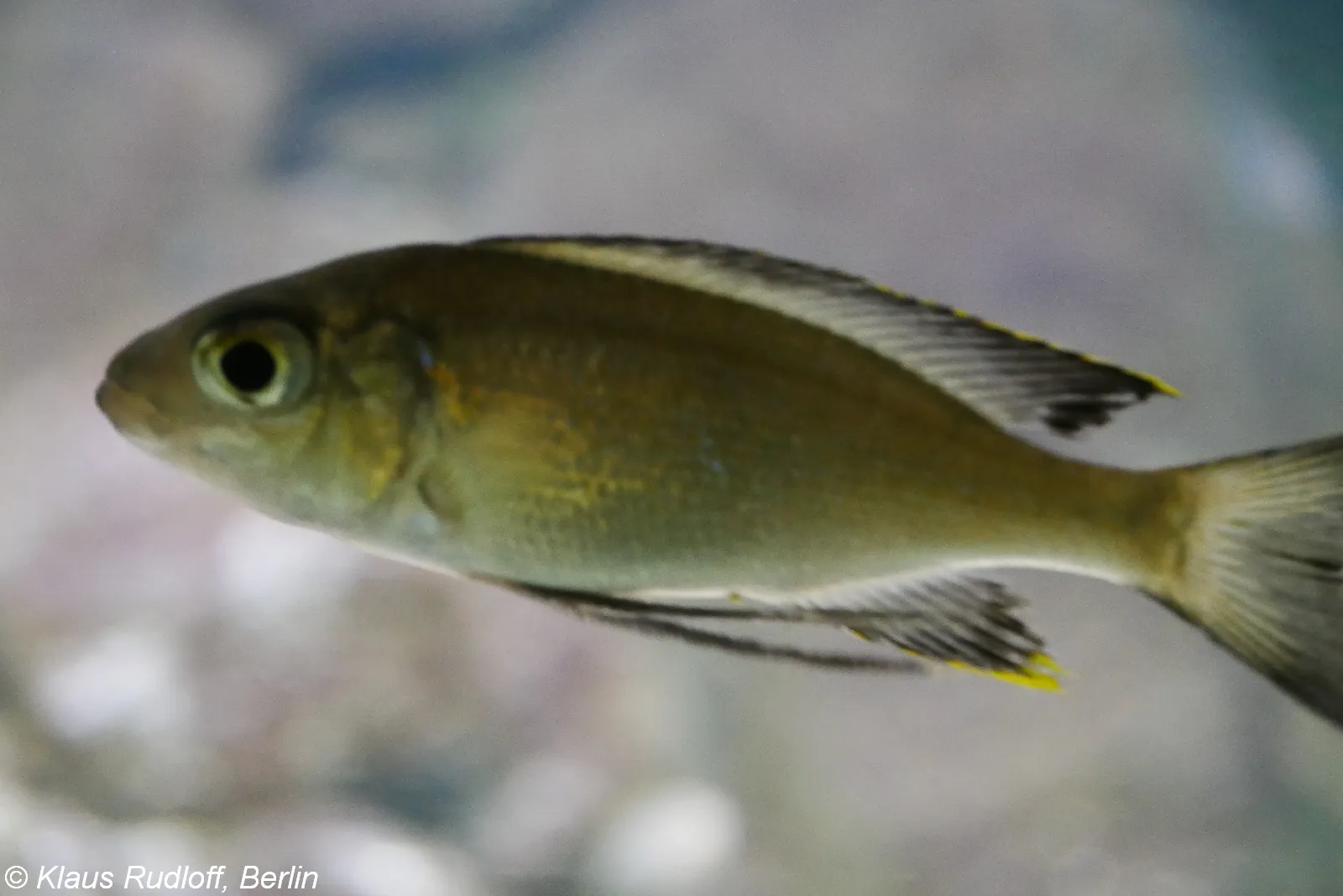
This is a moderately large, deep-bodied cichlid. FishBase lists a maximum of about 8 inches (8.5 in) total length; Konings reports territorial males reaching about 7 in maximum, with females "usually considerably smaller," commonly around 5 to 6 inches (4.5–6 in) (Konings, A. — Cichlids Yearbook vol. 1, Cichlid Press). Outside of breeding condition the fish is unremarkable: a tall, silvery, slightly drab cichlid that one keeper memorably called a "lazy sardine."
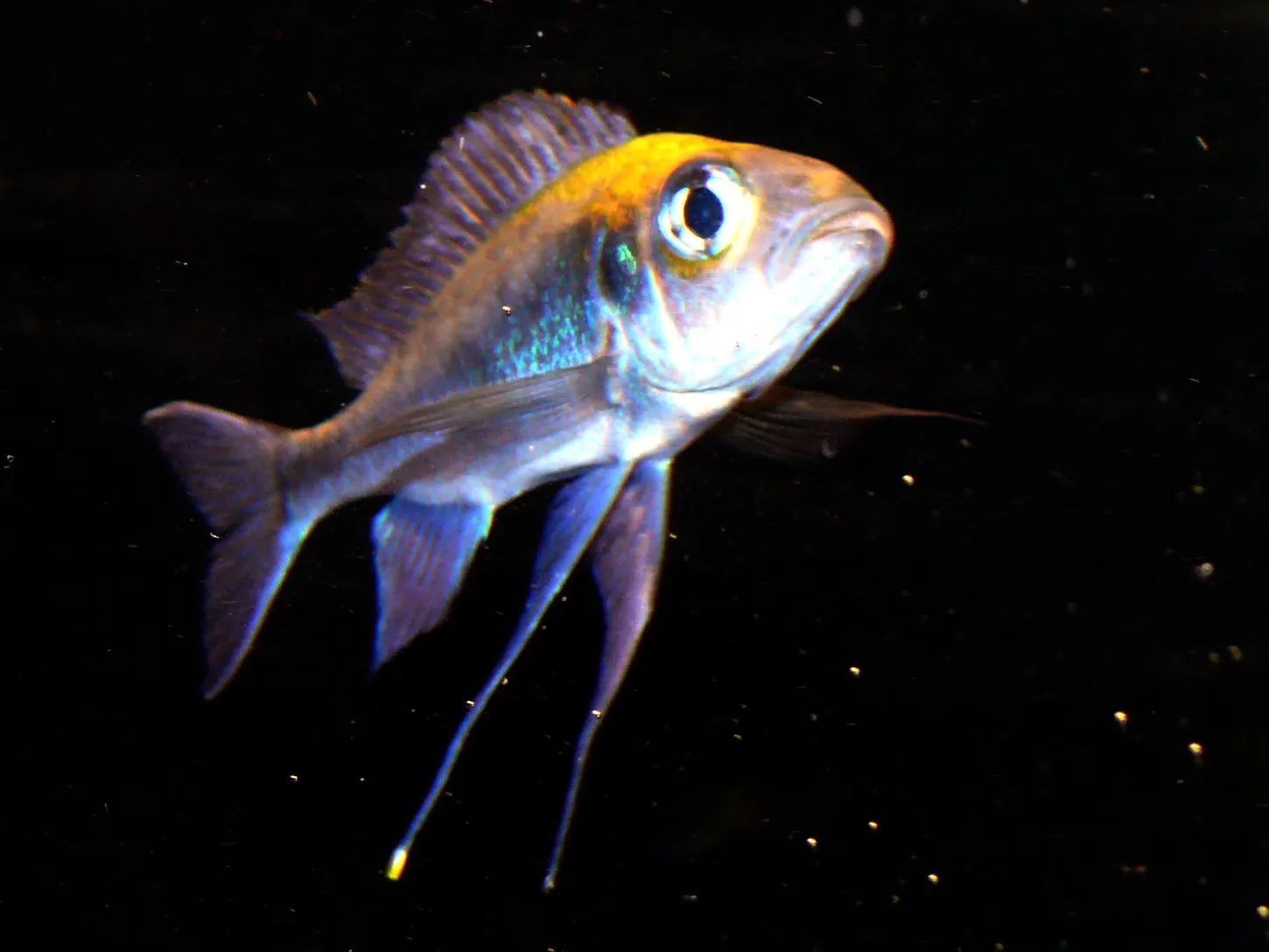
The transformation comes with dominance and courtship. A ripe male develops greatly elongated pelvic fins that trail well past the body, and a body that ignites with structural colour, deep metallic blues and greens overlaid on the head and flanks, often with a yellow or orange wash on the head and unpaired fins depending on the population. That colour is iridescent rather than pigment-based: it depends on light striking the fish at the right angle, so a male can look grey one moment and blaze blue-green the next as he turns. The hobbyist literature, citing the cichlidologist Paul Loiselle, compares the effect to a Morpho butterfly and notes that frontal lighting at a steep angle brings out the best of it, the practical reason keepers favour overhead or slightly raking light. Sexual dimorphism is strong: females and subordinate males stay silvery and short-finned, so a tank of "featherfins" can look like a tank of plain silver fish until a male colours up. The elongated, ribbon-like pelvics distinguish featherfins as a group; within them, furcifer is separated from Ophthalmotilapia by lacking the conspicuous yellow tassels on the pelvic-fin tips that ornament Ophthalmotilapia males. Because the species depends on rocky shores being nearby and those are not continuous around the lake, it has fragmented into roughly six geographical races, each with its own nuptial colour scheme, from the Ruziba and Burundi forms of the north to the southern populations off Zambia.
Habitat
Cyathopharynx furcifer is a lacustrine endemic, found only in Lake Tanganyika and nowhere else on Earth. Within the lake it is, in Konings's words, "known from most locations around the lake," recorded along the shores of all four riparian nations, Burundi, the Democratic Republic of the Congo, Tanzania, and Zambia, which is one reason the IUCN treats it as a single broadly distributed species despite the geographic colour variation.
Its preferred ground is the intermediate zone, the transition where rocky reef gives way to open sand. Konings describes it living "mainly over sandy areas in shallow water," but with the qualification that such sandy bays "must be close to rocky shores"; the reason the fish stays tied to nearby rock is unknown, but the dependence is real enough to have driven the species' geographical races (Konings, A. — Cichlids Yearbook vol. 1, Cichlid Press). Males set up and build on the sand, while the reefs and scattered rocks nearby provide cover and the females' refuge. The species is typically encountered over the upper part of the slope rather than in deep water: the IUCN assessment gives a depth band of roughly 66–82 ft for the populations considered, while field and hobby accounts of northern forms report animals from about 16 ft down to 82 ft, where the light is strong enough to fire the males' iridescence. In-situ conditions are those of the lake at large: hard, alkaline, mineral-rich water with a pH around 8.6 to 9.3 and a stable warmth of roughly 75 to 81 degrees Fahrenheit (24 to 27 degrees Celsius). Because it spawns on open sand at the edge of the reef, the fish belongs squarely to the lake's sand and intermediate-zone guild rather than to the rock-bound communities of the surge zone.
The requirement is really "rock plus open sand," not natural reef specifically: at a jetty near Resha, Burundi, built on steel girders, wire netting, and dumped rock, large males were seen building their sand craters right alongside the artificial foundations, using the man-made structure exactly as they would a natural rocky outcrop. The species also has at least one documented predator that exploits its schooling habit: the scale-eating mimic Perissodus straeleni, which elsewhere disguises itself among schools of Cyphotilapia frontosa, has been recorded actually attacking Cyathopharynx furcifer (and the much smaller Neolamprologus brichardi) in the wild.
Feeding
FishBase summarizes the adult as a gregarious, drifting plankton-picker that occurs off rocky slopes, and assigns it a trophic level near 3.4, the value of a fish that takes small animal and plant material rather than larger prey. The IUCN account likewise describes schools near the rocky slopes feeding on plankton. Some hobby and field sources lean more strongly herbivorous, describing furcifer as grazing diatoms and unicellular algae from the aufwuchs (the thin film of algae and microorganisms coating the substrate) and possessing the long, coiled intestine characteristic of plant-eating Tanganyikan cichlids.
The likely reconciliation is that this is a flexible micro-feeder: it picks suspended plankton from the water column and grazes fine algal and detrital material from the sand and rock, depending on what is available, which fits both its open-sand foraging and its association with the reef edge. It is not a predator of other fishes. Konings's husbandry note captures the dietary tension neatly: Cyathopharynx furcifer "needs a lot of food but only a little meat" (Konings, A. — Cichlids Yearbook vol. 1, Cichlid Press). Whatever the exact balance, the practical consequence for an aquarist is that its gut is built for modest, frequent intake of low-protein food, not heavy meaty feedings, a point that recurs across the care literature.
Mating
Mating is where this fish earns its reputation. Cyathopharynx furcifer runs a lek-style system: males congregate into large breeding colonies on the sand, and within his own small territory each male builds a nest, a broad crater or volcano-shaped mound of sand carried mouthful by mouthful. Konings, who calls these animals the lake's "fairytale cichlids," describes breeding colonies as "a spectacular sight; sometimes more than 100 colorful males are found together defending their nests," while the females remain in large schools close to the rocky coast (Konings, A. — Cichlids Yearbook vol. 1 and vol. 5, Cichlid Press). The nest's height varies with the depth at which it is built. Reported crater diameters in aquaria reach around 2 feet (23.5 in), and the wild structures can be larger still.
The males are not building a cradle for the eggs; the crater is a display object, and the male's body is a second one. He flashes the iridescent blue-and-gold nuptial colour and the long, yellow-tipped pelvic streamers that give the featherfins their name. Behavioral-ecology work by Schaedelin and Taborsky (in Animal Behaviour, 2006, and Behavioral Ecology and Sociobiology, 2010) showed that the craters are individually distinctive and actively maintained, that females prefer owners of large, well-kept craters, and that experimentally enlarging or shrinking a crater changed a male's mating success, evidence that the nest itself functions as a built ornament a female assesses, separate from the male's body. Karino's 1997 study (Ethology) found that females also prefer males with long, symmetric pelvic fins, the trailing "feathers" themselves. A receptive female visits a male over his crater, he leads her with a fast, almost frantic courtship dash to the center, and the spawning unfolds there. Because the rocky shores the schools depend on are not continuous around the lake, this lek system, replayed locally over and over, is the engine behind the species' roughly six distinctive geographical races.
Breeding
Cyathopharynx furcifer is a maternal mouthbrooder. Over the male's crater the female lays a small clutch, on the order of 10 to 40 or so eggs depending on her size, and takes them into her mouth to brood. As in other mouthbrooding Ectodini, fertilization happens in or near the female's mouth: the male's anal fin carries markings that stand in for eggs, and as the female mouths at these "egg-dummies" to gather what she takes for stray eggs, the male releases milt and the real clutch is fertilized inside her mouth.
From that point the female alone incubates and tends the young; the male contributes nothing but genes and a good crater, and a female may spawn with more than one male across a season. Rossiter and Yamagishi documented that the mating system is not rigid but plastic, shifting with local density and conditions. In the aquarium the species will breed, and tank-raised fish carry a useful quirk Konings notes: home-reared males "colour up at a relatively small size" and still acquire the full nuptial spectrum of their wild cousins, so a keeper does not need wild adults to see the display (Konings, A. — Cichlids Yearbook vol. 5, Cichlid Press). Outside spawning the fish are gregarious and males are only intermittently colorful, so the spectacular events are episodic rather than constant.
In the aquarium
Experienced Tanganyikan keepers are candid that this is not a beginner's fish, not because it is delicate but because getting the best out of it is hard. The recurring theme across forums and specialist accounts is space and patience. Males need room to hold separate territories and to run their violent courtship dashes; keepers report that males bump and injure their own faces and eyes against glass and decor when a tank is too short. The CRC account recommends something on the order of a 150-gallon (about 600-liter) tank for a group with several competing males, and biotope references suggest a minimum around 130 US gal with 265 US gal or more preferred to support natural lek behavior. A practical layout is a broad, deep bed of fine sand for nest building, with rockwork used to break sight lines and divide the floor into territories, kept as the dominant species in the tank.
Water should mirror the lake: hard, alkaline, pH in the 8s, warm and very clean, with the diligent water changes Tanganyikans demand. On feeding, the consensus advice is to go light and avoid protein-rich foods, exactly Konings's "a lot of food but only a little meat"; overfeeding is easy and is blamed for fish that bulk up fast but burn out young, with one long-term keeper noting a healthy lifespan of only around four years if pushed. The single most common frustration is color: well-kept males often refuse to show their full iridescence for long stretches, and wild-caught adults frightened by collection and shipping frequently never recover it, which is why keepers favor starting with a group of tank-raised juveniles that color up as they begin to compete around 4 inches (4 in) and, left undisturbed, will hold that color until something large or rough startles them. Konings puts a rough figure on the tank volume needed to see more than one colored male at once: only in very large setups, upward of about 200 gallons, can a second male be expected to hold full color alongside the first; in anything smaller, adding a second, smaller male typically just reinforces the dominant male's colors while the newcomer stays subdued. Keeping several males in competition, and triggering them with water changes, temperature shifts, or rescaping, is the usual route to spawning. Tankmates should be peaceful sand- or open-water Tanganyikans; keepers warn against boisterous or fin-nipping company such as jumbo Cyprichromis, Tropheus, Petrochromis, and the more aggressive featherfins like Ophthalmotilapia ventralis and nasuta, which can bully furcifer or out-compete it. One documented example of successful mixed-species housing comes from a 650-liter tank run at pH 8.5 that combined ten Burundi-form C. furcifer with a pair of Altolamprologus calvus and a breeding group of Benthochromis tricoti without incompatibility. Forum experience also stresses that aggression depends as much on group size and sex ratio as on tank dimensions; many keepers run one male with several females to keep the peace, while others deliberately keep two or more males because the rivalry sharpens breeding behavior. As always with community lore, treat single anecdotes as leads, not rules; the pattern that holds across many keepers is the one to trust.
Conservation
On its own account, Cyathopharynx furcifer is in good shape. The IUCN Red List assessed it as Least Concern in 2025 (assessor C. Sibomana), describing it as a very common, abundant, and widespread Tanganyika endemic with no major threats yet identified and an unknown population trend. The same assessment, however, lists real pressures, water pollution, sedimentation from agricultural and forestry runoff, and over-collection for the aquarium trade, where furcifer is a prized and internationally traded ornamental, and it flags a continuing decline in the quality of the species' habitat. It also notes that the fish occurs in no protected area and that better taxonomy and population monitoring are needed, a caution that matters given the unresolved species complex within "furcifer."
The larger story is the lake's. Lake Tanganyika is warming, and that warming is changing the ecosystem from the bottom up. O'Reilly and colleagues, in Nature in 2003, presented evidence that climate warming has strengthened the lake's stratification, weakened the seasonal mixing that lifts nutrients to the surface, and so depressed primary productivity, estimating a decline on the order of 20 percent with a correspondingly larger drop in potential fish yields. Cohen and colleagues, in PNAS in 2016, used roughly 1,500 years of sediment records to show that endemic fishes and molluscs began declining before commercial fishing arrived, in step with about 150 years of warming, and that reduced mixing had cut algal production and shrunk the oxygenated benthic habitat by some 38 percent in their study areas. Layered on top are catchment-scale problems, deforestation and shoreline development driving the sedimentation that smothers nearshore substrates, and the heavy commercial fishery on the open-water clupeid sardines and their Lates predators, with management split across four sovereign nations and coordinated, imperfectly, through the Lake Tanganyika Authority and its convention.
For a sand-and-intermediate-zone bower builder, these basin-level pressures bear on the fish in specific ways. Its entire breeding system depends on clean, workable sand at the reef edge in the well-lit shallows: sediment loading from eroding catchments can blanket and degrade exactly that substrate, dulling the light the males need for their iridescent displays and fouling the nesting grounds. Falling productivity in the upper water column thins the plankton this micro-feeder picks at. And because it commands a high price in the aquarium trade, localized collection can press individual reefs even where the lake-wide population looks secure. The honest summary is the one the data support: the species itself is Least Concern today, but the lake it cannot leave is under measurable strain, and furcifer's fortunes are tied to whether the shallow, sandy, sunlit margin it breeds on stays clean and productive.