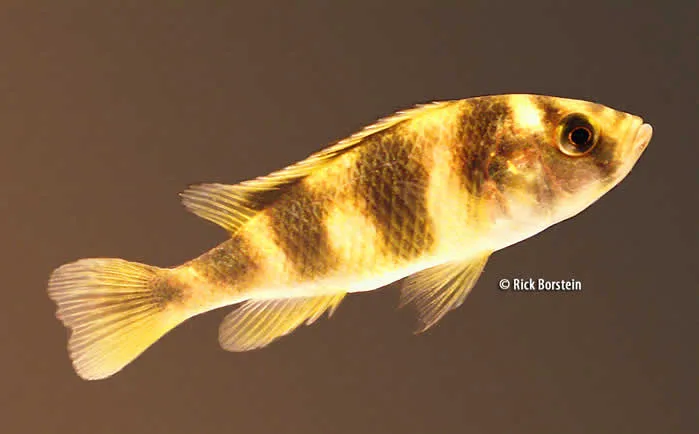
Taxonomy & naming
Haplochromis latifasciatus was described in 1929 by Charles Tate Regan, the British Museum (Natural History) ichthyologist whose 1922 monograph 'The cichlid fishes of Lake Victoria' had already established much of the early taxonomic framework for the lake's haplochromine flock; this later description extended that work with additional material. The epithet combines Latin latus ('broad') and fasciatus ('banded, striped'), presumably describing a prominent vertical bar or band in the species' colour pattern, though the precise diagnostic character intended by Regan is not confirmed in the sources available for this article. The CARES Preservation Program lists the species under the satellite-genus combination Astatotilapia latifasciata, reflecting a later twentieth-century reclassification of parts of the flock, while Catalog of Fishes currently retains it within the broad genus Haplochromis, as with most of the flock, pending a comprehensive phylogenetic revision.
Morphology
A verified maximum length and detailed morphometric account specific to Haplochromis latifasciatus are not confirmed in the sources available here — data sparse. If the epithet is descriptively accurate, a broad, well-defined vertical bar or band would be expected somewhere in the colour pattern, but this reading should be treated as an etymological inference rather than a confirmed morphological account. As in essentially the whole Lake Victoria flock, breeding males would be expected to carry more saturated colour and anal-fin egg-spot ocelli, with females and non-breeding fish plainer and more cryptic, but a species-specific colour description cannot be responsibly given without a verified primary source.
Habitat
Haplochromis latifasciatus is endemic to Lake Victoria, the vast, shallow equatorial lake shared by Tanzania, Uganda and Kenya. Specific figures for its depth range, water temperature or pH are not confirmed in the sources available for this article; broadly, Lake Victoria's surface waters run warm and alkaline, with typical values around 73–81 °F and pH 7.2–9.0, conditions shared by essentially the entire haplochromine flock. A precise account of the ecological guild and micro-habitat this species occupies within the lake is not available here and is not asserted.
Feeding
No species-specific dietary study for Haplochromis latifasciatus is confirmed in the sources available here. The Lake Victoria haplochromine flock as a whole diversified into a remarkable range of feeding specialists — algae scrapers, zooplanktivores, insectivores, molluscivores, piscivores and even scale- and eye-eating paedophages — and without a verified source, no particular guild can be responsibly assigned to this species.
Mating
No courtship behaviour has been documented specifically for Haplochromis latifasciatus. As in essentially the entire Lake Victoria haplochromine flock, mating would be expected to follow the classic polygynous, lek-like pattern: males establish and defend small display territories and court passing females using anal-fin egg-spots and nuptial colour, while females range more widely and choose among displaying males, with no pair bond formed. This account is drawn from flock-wide biology rather than from direct observation of the species.
Breeding
Haplochromis latifasciatus is presumed, on flock-wide grounds, to be a maternal (female-only) mouthbrooder, the reproductive mode essentially universal among Lake Victoria haplochromines: the female takes the fertilised eggs into her mouth immediately after spawning and incubates them alone for roughly two to three weeks before releasing free-swimming fry, receiving fertilisation via the male's anal-fin egg-spot display. No clutch size or species-specific breeding record for H. latifasciatus is confirmed in the sources available here — data sparse.
In the aquarium
Haplochromis latifasciatus has no documented, established history in the aquarium hobby comparable to the handful of Lake Victoria haplochromines — Pundamilia nyererei among them — that entered the trade and conservation breeding programmes before or during the lake's ecological collapse. No species-specific husbandry guidance can be responsibly given for H. latifasciatus without better-sourced information, and prospective keepers should not assume it is available in captivity.
Conservation
The CARES Preservation Program lists Haplochromis latifasciatus as Critically Endangered, one of the more severe categories CARES applies short of a species being presumed extinct or extinct in the wild. A specific IUCN Red List assessment for this species is not independently confirmed in the sources available for this article, but its listing sits within the best-documented modern vertebrate mass-decline event: from the late 1970s the introduced Nile perch (Lates niloticus) erupted across Lake Victoria, and over the following decade some 200 or more endemic haplochromine species disappeared or collapsed to a fraction of their former abundance across the lake's sub-littoral and offshore zones. That predation pressure combined with severe human-driven eutrophication — nutrient loading that caused algal blooms and deep-water deoxygenation — to devastate the flock as a whole. Many species have shown partial recovery as Nile perch numbers were subsequently fished down, but for a species carrying CARES's Critically Endangered classification, several of the flock's original species now survive mainly, or possibly only, through documented aquarium maintenance programmes rather than robust wild populations — precisely the situation the CARES model exists to hedge against.