Taxonomy & naming
The flag acara was described by Ernst Ahl, then curator at the Zoological Museum in Berlin, as Acara curviceps, on aquarium-trade material that traced back to the Amazon. The species had reached Germany in 1909 under the misapplied name "Acara thayeri" before Ahl recognised it as new. The date of the description carries a small but persistent wrinkle: the original is usually cited as 1923, but the cover of the relevant issue of the Mitteilungen aus dem Zoologischen Museum in Berlin states that it was actually distributed in February 1924, and Ahl's own first page notes only "received June 1923." Both years therefore appear in the literature; the holotype (ZMB 31324, a 2 in specimen) and several paratypes survive in Berlin, with the type locality given simply as "Amazonenstrom" (the Amazon River). Over the following century the fish was shuffled through Aequidens and the short-lived Parvacara before Sven Kullander erected the genus Laetacara in 1986 for a cluster of small, blunt-headed acaras. Felipe Ottoni, José Mattos and Ingo Schindler formally re-described the species in 2009 from the types and fresh Brazilian material, fixing its diagnosis: among its congeners only Laetacara curviceps and the more southerly Laetacara dorsigera carry a dark spot on the dorsal fin above the fifth trunk bar, and curviceps is separated from dorsigera by its deeper head, longer pelvic-fin spine, and the absence of a bright red belly in breeding fish. Within the New-World cichlids (subfamily Cichlinae) Laetacara sits in the tribe Cichlasomatini, close to the dwarf genera Nannacara and Cleithracara. Six species are currently recognised in the genus, of which curviceps is the type-region Amazonian one.
Morphology
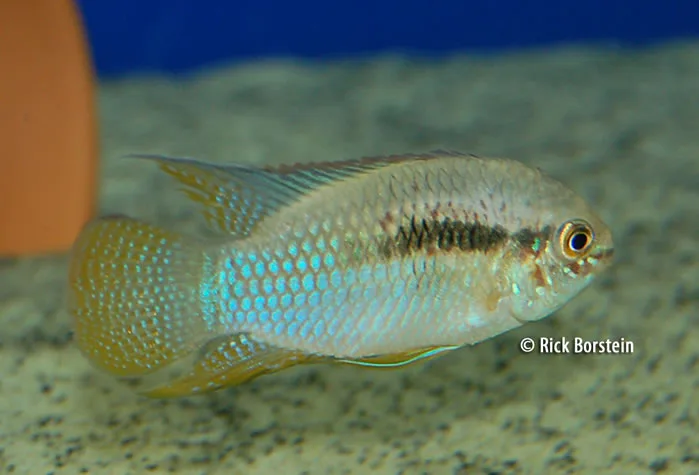
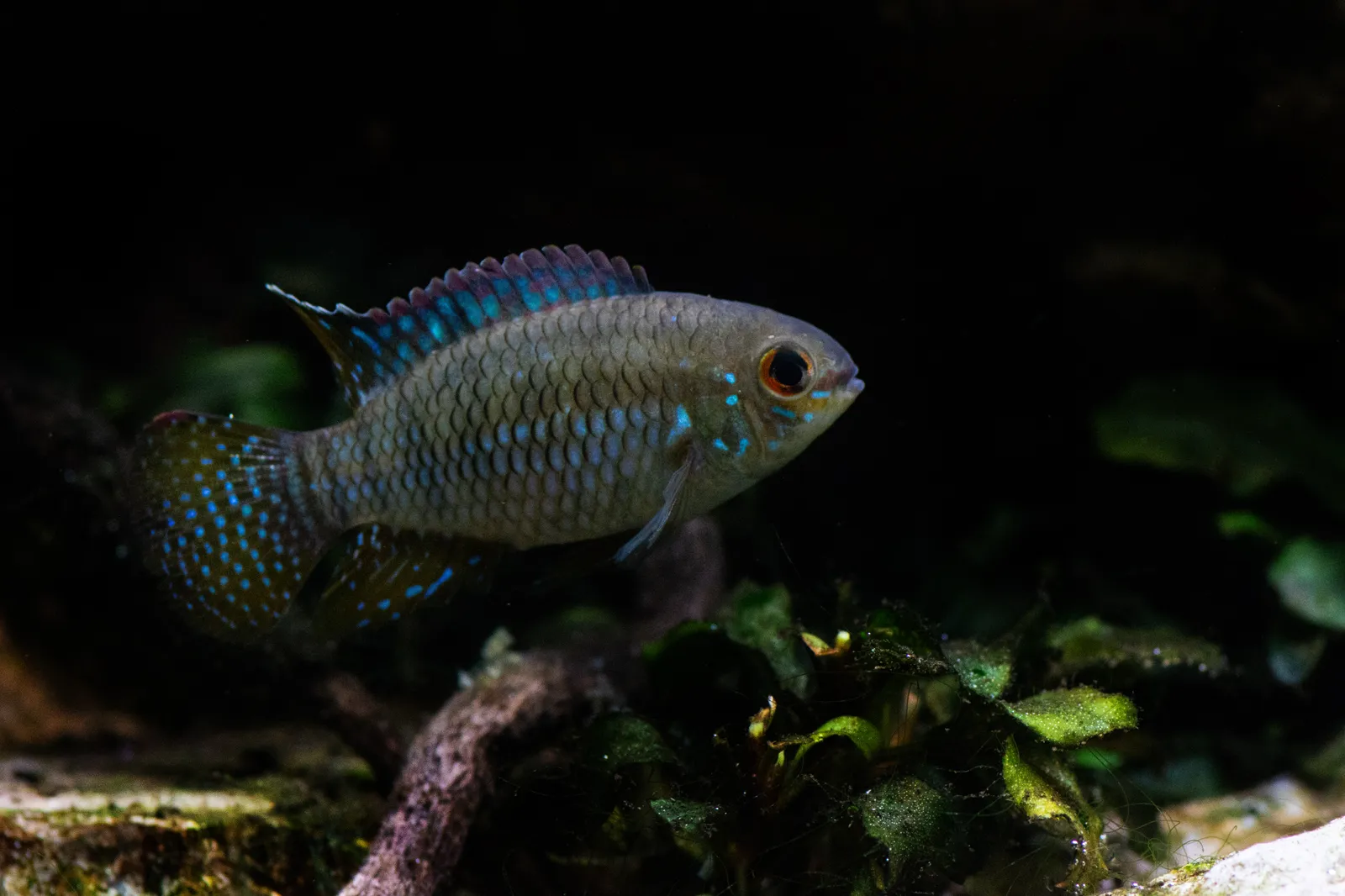
This is a small, deep-bodied and laterally compressed cichlid with the rounded, gently convex forehead that gives the genus its blunt-headed look. Reported size depends heavily on whether wild or aquarium fish are measured and how length is taken: FishBase lists a maximum of about 2 in standard length for males and 2.5 in for females, with an older figure of 4 in total length, while the hobby literature usually quotes a more realistic 3–3.5 in total for well-grown captive adults. In the 2009 re-description, non-type wild specimens ran 1–1.5 in SL and the larger type specimens reached 2 in SL — so this is genuinely a dwarf cichlid, usually under 2 in SL. The ground colour is a warm tan to olive-brown, broken by a horizontal dark band running from behind the eye to a bold spot at mid-flank, a series of faint vertical bars, and — in good condition — a dusting of iridescent blue-green flecks on the body and red or orange wash in the fins. The diagnostic flag-acara feature is the black spot on the dorsal fin above the fifth body bar (often with a second, fainter spot above the fourth). The common names trace two features: the "flag" of the spotted, sail-like dorsal, and the "smile" formed by the dark stripe that angles down and back from the corner of the mouth across the cheek. These fish change colour and pattern rapidly with mood, and breeding adults darken and intensify dramatically. Sexual dimorphism is modest — males grow slightly larger and develop somewhat longer dorsal and anal filaments, while ripe females are deeper-bodied — but the sexes are similarly coloured and can be hard to tell apart outside of breeding.
Habitat
Laetacara curviceps occurs in the lower portions of tributaries of the Amazon River in Brazil; the type and re-description material comes from the Parintins–Santarém region of the central-lower Amazon. It is a fish of quiet, shallow waters rather than the main river channel — small clearwater creeks with little current, ponds, and small floodplain lakes. Field observations by Stawikowski and Werner near Santarém describe beds densely carpeted with leaf litter and thickets of aquatic plants such as Cabomba, Myriophyllum and water hyacinth (Eichhornia), exactly the structured, soft-bottomed microhabitat a small substrate-brooding cichlid favours. The waters it lives in are classic Amazonian clearwaters: highly transparent, low in suspended sediment, warm, and soft. In-situ readings reported for the Santarém biotope were strikingly soft and acidic — pH around 5.2, conductivity of only about 10 µS/cm, and a temperature near 79 °F — while the broader clearwater envelope of the basin spans roughly pH 4.5–7.8. FishBase's husbandry figures (pH 5.2–7.5, dH 5–12, 72–79 °F) bracket this nicely. Because it inhabits creek margins, leaf-litter beds and the shallow edges of ponds and floodplain lakes, the species lives in very shallow water — typically the top metre or two — rather than at depth.
Feeding
The flag acara is a micro-predatory omnivore that forages over and through the soft bottom and the leaf litter of its creeks, taking small invertebrates — insect larvae, crustaceans and worms — along with some plant and detrital material. FishBase places it at a trophic level of about 3.2, consistent with a small carnivore-leaning omnivore rather than a dedicated herbivore or sand-sifter. It does not excavate or sift substrate in the obsessive manner of the true eartheaters; instead it picks and snaps at prey among litter and vegetation. In the aquarium this translates into an undemanding feeder that accepts virtually all standard foods, though live and frozen invertebrates — bloodworm, Daphnia and brine shrimp — bring out the best colour and are the standard conditioning diet for breeders. In its native community it occupies the small-invertivore guild of the structured creek margins, sharing that zone with other dwarf cichlids, small characins and catfishes.
Mating
Laetacara curviceps is monogamous and forms stable, comparatively peaceable pairs — a large part of its appeal as a dwarf cichlid. Pairs tend to form early, often from a group of young fish allowed to pair off, and a bonded pair can remain together over a long period. Courtship and pair maintenance involve the typical cichlid repertoire of lateral displays, fin-spreading (the "flag" dorsal is shown off to advantage here), mouth-to-mouth sparring and shared excavation, with both fish intensifying in colour as spawning approaches. Territoriality is real but mild by cichlid standards: a breeding pair will clear and defend a modest patch around the chosen spawning site and drive off intruders, but they are not the destructive, plant-uprooting tyrants that larger cichlids become. This restraint is exactly why the species can sometimes be bred successfully even in a community tank, and why it has long been recommended as a first cichlid for aquarists wanting to watch natural pair-bonding and brood care without the violence.
Breeding
Breeding is the classic biparental substrate-spawning pattern of the dwarf acaras, and the species is famously willing to do it. Aquarium observations confirm a monogamous open or semi-open spawner: the pair cleans a flat surface — a horizontal leaf, a flat stone, a piece of bogwood, or the floor of a flowerpot — and the female deposits her eggs there while the male follows to fertilise them. Clutches are modest, with roughly 150–300 eggs reported (FishBase cites about 300). Both parents share care throughout: the female typically fans and tends the eggs while the male patrols and defends the territory, and after the eggs hatch the pair moves the wrigglers to pre-dug pits and guards the free-swimming fry as a tight school, leading them around the tank to forage. The species is noted as making an excellent, attentive parent, and pairs will often raise successive broods. Soft, warm, slightly acidic water and a rich live-food diet are the usual triggers; wild-caught stock in particular is reported to want soft, acidic conditions to spawn reliably, while long-domesticated lines are considerably more forgiving. Fry are easily started on newly hatched brine shrimp and microworm.
In the aquarium
The flag acara is one of the most beginner-friendly New-World cichlids and has been in the hobby continuously, in waves of popularity, since 1909. A single pair is comfortable in a tank of around 23.5–31.5 in length (roughly 20–30 US gal), with more room welcome if tankmates are kept; the fish is small, peaceful and not a digger that wrecks aquascapes, so it suits a well-planted community.
The ideal setup mirrors its leaf-littered clearwater creeks: a soft or fine substrate, generous planting (the species will not uproot plants), and plenty of structure — driftwood, roots, leaf litter, and a few flat stones, caves or upturned flowerpots that double as spawning sites and refuges. Subdued lighting and some floating cover suit it and encourage natural colour and behaviour. Filtration should provide clean, well-oxygenated water without a strong current, since this is a fish of calm waters.
For water chemistry, the species is adaptable: maintenance anywhere from soft and acidic to moderately hard and near-neutral works for domesticated stock, with a practical target of pH about 6.0–7.5 and a temperature of 75–82 °F. Soft, acidic water (pH around 6.0–6.5, low hardness) is genuinely worthwhile if you intend to breed, especially with wild-caught fish, and warmer temperatures within the range encourage spawning. Diet is easy — good flake or small pellets supplemented generously with live and frozen invertebrates such as bloodworm, Daphnia and brine shrimp keeps the fish coloured up and in breeding condition.
The flag acara is genuinely peaceful and makes a good community fish, the main caveat being not to house it with anything large enough to eat it or aggressive enough to harass it; small-to-medium peaceful South-American tetras, pencilfish, small catfishes (Corydoras) and other calm dwarf cichlids are ideal companions. The principal husbandry mistakes are crowding it with boisterous tankmates, neglecting water changes (like most soft-water Amazonians it dislikes accumulated dissolved waste), and — for those buying mixed imports — confusing it with its congeners, since several Laetacara species look similar and the captive stocks have long been blended across geographic races. Getting collection or identification data from the supplier where possible is worthwhile.
Conservation
The IUCN Red List assesses Laetacara curviceps as Least Concern (assessed 7 November 2018, published 2018, by the Brazilian Instituto Chico Mendes de Conservação da Biodiversidade, ICMBio). The species is widespread across the lower Amazon, has no documented major threats at the species level, and carries no CITES listing. It is harvested for the ornamental aquarium trade but is also long-established as a captive-bred fish, which relieves pressure on wild populations. As with all lowland Amazonian fishes, the broader backdrop is one of mounting freshwater pressure across the basin — deforestation, dam construction, mining and altered flood-pulse dynamics degrade the creeks and floodplain habitats these small cichlids depend on — but none of these is documented as a present, species-level danger to this widespread and adaptable dwarf cichlid.