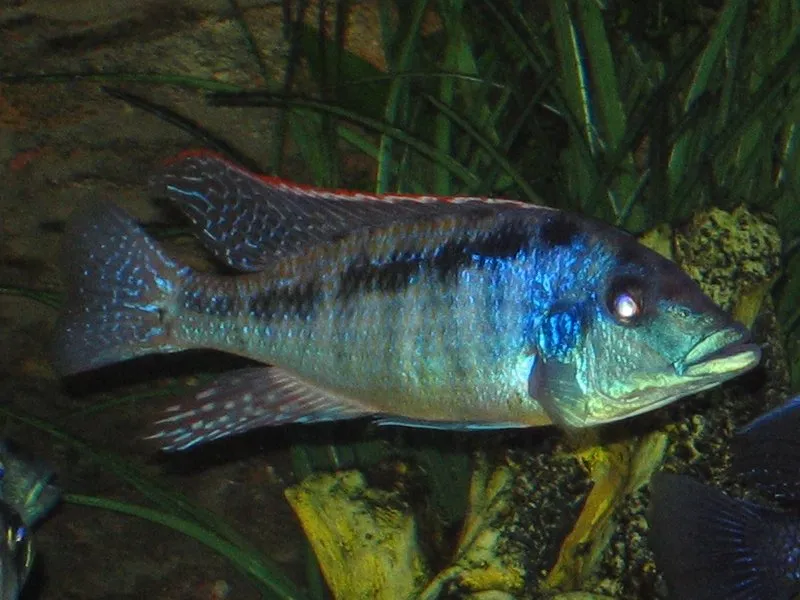
Taxonomy & naming
Lichnochromis acuticeps was described by the British ichthyologist Ethelwynn Trewavas in 1935 in her landmark synopsis of the cichlid fishes of Lake Nyasa, published in the Annals and Magazine of Natural History (Series 10, vol. 16, pp. 65–118). Trewavas erected the genus Lichnochromis at the same time, with acuticeps as its sole and type species — a status the genus retains to this day, making it one of the cleanest monotypic cases in the lake's diverse haplochromine radiation. The holotype (catalogue number BMNH 1935.6.14.2283), a specimen of 5 in total length, was taken from Deep Bay, now known as Chilumba, on the northwestern shore of the lake in Malawi. A second specimen collected by M.K. Oliver in 1971 from the same region was, at the time, only the third known individual of the species; observations since have confirmed it is present across most of the lake's shoreline, despite rarely appearing in museum collections or catch surveys. Eschmeyer's Catalog of Fishes (valid-name entry updated May 2026) recognizes the name as Lichnochromis acuticeps Trewavas 1935 without synonym, and the species is referenced in Eccles and Trewavas (1989) and Konings (2016). M.K. Oliver has noted the close morphological affinities between Lichnochromis and Mylochromis — particularly Mylochromis lateristriga — suggesting they share a recent common ancestor; if phylogenetics confirm this, multiple Mylochromis species may eventually be transferred to Lichnochromis, but no formal revision has appeared. The trade name 'Malawi gar' refers to the elongate, gar-like body profile, though the fish bears no relationship to true gars (Lepisosteidae).
Morphology
Lichnochromis acuticeps is one of the most distinctively shaped cichlids in Lake Malawi. The body is strongly laterally compressed and elongated, narrowing into a particularly slim head that terminates in an acutely pointed snout and a small, narrow-gape mouth equipped with fleshy but non-lobed lips. This extreme lateral compression — more pronounced than in any closely related haplochromine — is the structural key to the fish's ecology: it literally allows the animal to slide sideways into gaps between boulders that would be inaccessible to a normally proportioned cichlid. FishBase records maximum size as 5.5 in TL (Maréchal 1991), while the malawi.si database and multiple experienced keepers report imports and aquarium specimens reaching closer to 8 in TL; the holotype itself was 5 in (5 in) TL. Sexual dimorphism is pronounced. Males are larger than females, develop more elongated dorsal and anal fins, and in full breeding dress display a striking blue-and-yellow coloration across the flanks, with darker barring that can intensify or fade depending on social context. The dominant male in a group typically holds this coloration almost continuously. Females and subordinate males are silvery-grey to pale tan, with a melanin pattern that reads as a narrow but distinct diagonal line running from the nape to the upper part of the caudal peduncle; in some individuals this line breaks up into a series of small dots, which mark the points where a set of vertical bars — rarely displayed openly — cross the diagonal. The Springer phylogenomic study by Ahi et al. (2018) noted that Lichnochromis acuticeps exhibits slightly hypertrophied lips, placing it among a group of Malawi cichlids in which lip expansion has apparently evolved multiple times as an adaptation to foraging in rock crevices; Konings suggests the mechanism directly, proposing that the abrasive action of rock every time the mouth is driven into a gap between rock and sand may stimulate the thickening, with the resulting fleshy lips serving to seal the gap and boost the suction the fish generates while extracting prey. The fish has been reported in two informal color-forms by hobbyists: one with the lower jaw prominently jutting forward (a rounded profile, recorded from the Tanzanian shore around Nkanda) and another with a more symmetrical, V-shaped snout (associated with specimens from the Malawian side of the lake); whether these represent geographically isolated populations or intraspecific variation has not been formally examined.
Habitat
Lichnochromis acuticeps occurs around the entire perimeter of Lake Malawi, the lake spanning parts of Malawi, Tanzania, and Mozambique. The malawi.si database, which documents the species at multiple named locations including Nkhata Bay, Nkanda, and Gome Rock, describes it as a sand-dwelling species typically found at depths of 16–49 ft in the intermediate zone — the transitional habitat where rocky outcrops or scattered boulders give way to open sandy substrate. This zone, sometimes called the sand–rock interface by Konings, is particularly productive for crevice-feeding haplochromines because invertebrates and small fish shelter in the gaps between rock faces and the sandy floor. The fish has been observed at Nkhata Bay on the Malawian shore and at various Tanzanian sites, consistent with a lake-wide distribution. Lake Malawi itself occupies the southern end of the East African Rift and is renowned for its extraordinary cichlid diversity, exceptionally clear water, and stable chemistry: surface temperatures typically range from about 75 °F in the cooler austral winter months (June–August) to around 82–84 °F at peak austral summer, with pH sustained between roughly 7.7 and 8.6 by the lake's moderate carbonate buffering, and general hardness in the range of 4–6 dGH (Konings 1995; malawi.si). Depth data sourced from FishBase and malawi.si confirm the species as a shallow- to intermediate-depth fish; no records place it below about 66 ft.
Feeding
The feeding strategy of Lichnochromis acuticeps is one of the most specialized among Lake Malawi haplochromines, and the entire body plan is an adaptation to execute it. As documented by Oliver (malawicichlids.com, citing Eccles and Trewavas 1989 and Konings 1995), the fish wanders along rocky shores and the intermediate zone, working the gaps between boulders and the sand floor at a deliberate, unhurried pace. On detecting a crevice with potential prey, it turns its body through a full 90 degrees, using lateral compression to slip the pointed head deep into a horizontal crack that a more conventionally shaped fish could not enter. The targets are principally insect larvae (chironomid midges and other benthic invertebrates) sheltering in these recesses, along with fish fry — very often young Mbuna, since Mbuna dominate the rocky habitat this species works. Other laterally compressed Malawi cichlids feed in a broadly similar way — Protomelas ornatus is the standard comparison — but Lichnochromis has the thinnest body and the most sharply pointed snout of the group, letting it reach deeper into narrow gaps than any of these convergent crevice-feeders. The malawi.si species account corroborates this, describing the fish as using its elongate pointed mouth to extract living organisms from rock crevices, inserting the snout deeply while bending the body. The cichlid-forum.com species profile notes that in captivity the fish does not prey on tank mates, suggesting the crevice-rolling behavior is finely attuned to specific prey-detection cues rather than a generalized predatory drive. One keeper in the ACE forums observed the fish taking pellets directly from fingers in a crevice-feeding motion, mirroring exactly what it does in the wild. FishBase estimates the trophic level at 3.4, consistent with a carnivore of invertebrates and small vertebrates. The CRC genus page lists the feeding guild as insectivorous and piscivorous.
Mating
Breeding behaviour has, importantly, never been documented in the wild. Konings, after extensive diving surveys specifically targeting this species, reported that it proved impossible to observe breeding behaviour, or even to find an adult in full breeding dress, in situ — every wild sighting involved solitary, presumably non-breeding individuals. That is a meaningful gap: it means everything described below about courtship comes from aquarium observation, not field study, and should be read with that caveat rather than as confirmed lake behaviour.
In captivity, breeding in Lichnochromis acuticeps follows the standard haplochromine pattern of male display and female incubation, but with some quirks that separate it from many mbuna and peacock cichlids. The malawi.si account, drawn from aquarium keeping, states that males select a spawning site against a rock and court females through displaying and quivering movements. The courtship site is typically sandy substrate adjacent to a rock, not an open arena or a prepared pit. Unlike the extravagant bower-builders among sand-dwelling haplochromines, males of this species do not excavate extensive craters; instead they defend a territory bounded on one side by a rock, which also gives the narrow body somewhere to anchor during the lateral roll of spawning. Hobbyists in Australia (ACE forums, 2012) report that dominant males hold their blue-and-yellow breeding coloration almost continuously once established, and that the male's strategy in the aquarium is essentially to wait in or near his preferred territory and display intensively when a ripe female approaches — a relatively passive courtship compared with the energetic chasing seen in species like Aulonocara. Females have a clear pecking order among themselves and will compete and squabble, which is relevant to tank management. Spawning is described as lasting several hours, with egg deposition completing within about an hour (malawi.si) — again, an aquarium record rather than a wild one.
Breeding
Lichnochromis acuticeps is a maternal mouthbrooder, as confirmed by the cichlid-forum.com species profile, malawi.si, and multiple keeper accounts. After spawning over a sandy substrate near a rock, the female collects the eggs in her buccal cavity and incubates them there through hatching and early fry development. In the aquarium, females have been photographed displaying clear distension of the buccal area during holding; one keeper in the ACE forum observed a female holding for at least 12 days before she swallowed the brood. Incubation at typical Lake Malawi aquarium temperatures (79–82 °F) probably runs 21–28 days, as is typical for large Lake Malawi haplochromines, but no published study has documented the precise duration for this species. Clutch size appears small relative to the fish's body size: one keeper noted that at 4.5 in size the fish produced perhaps 10 or fewer large eggs — consistent with the hobbyist observation that the eggs are noticeably large. This likely reflects investment in yolk-rich, better-provisioned offspring rather than sheer numbers.
The species is widely regarded among experienced keepers as notoriously difficult to get to breed and hold successfully, and part of the explanation is historical rather than purely biological: Konings notes that over roughly fifteen years of sporadic export, almost every shipment consisted of a single male specimen. A trade that essentially never supplied females made establishing a breeding group all but impossible for most of that period, so at least some of the species' reputation for difficulty likely reflects a supply bottleneck as much as any inherent husbandry challenge — though genuinely getting a settled colony to spawn on demand does still seem to take patience. Some keepers suggest seasonal or environmental triggers (possibly linked to water chemistry changes associated with rainfall, as with many Lake Malawi species), but this is inference rather than documented fact, since — as noted above — breeding has never actually been observed in the wild to confirm any seasonal pattern. Once a pair or colony settles in, however, successful holders will spawn again. The male's habit of waiting in a fixed territory rather than actively chasing females has been noted by several keepers as unusual and initially misleading — new owners may mistake inactivity for disinterest when the fish is actually courting.
In the aquarium
Lichnochromis acuticeps is rarely kept in the hobby — an honest assessment shared by experienced Malawi keepers on the ACE forums and cichlid-forum.com alike. It appears sporadically in the trade, mostly as an occasional export from Tanzanian collectors, and finding captive-bred specimens is more difficult than for common Haps or peacocks. That said, the fish is not especially delicate once established, and its distinctive shape and hunting behavior make it genuinely rewarding to observe in a well-planned tank. Prospective keepers should approach it as a large, predatory haplochromine rather than a community fish.
A minimum tank of around 55 US gallons is the practical floor, and larger is strongly preferred for a pair or a colony of one male and two or three females — a group that allows natural social dynamics and improves the chances of breeding. Because the fish is elongate and active in open water between foraging bouts, horizontal swimming space matters more than depth; a footprint of at least 120 × 17.5 in is sensible. Décor should replicate the intermediate zone: a substrate of fine sand, several substantial rock formations placed at the margins of the tank to create crevices and shelter, and an open sandy area in the centre. The fish does not need dense planting, and robust African Vallisneria can be added without harm if desired, but most keepers keep this species in the typical unplanted Malawi style.
Water chemistry must match Lake Malawi's stable, alkaline, well-buffered conditions. Target pH 7.8–8.6, general hardness 4–6 dGH, carbonate hardness in the range of 6–10 dKH, and temperature 75–82 °F. These parameters can be achieved with proprietary Malawi buffer salts or by using a mix of Epsom salt and sodium bicarbonate; starting from reverse osmosis water gives the most control. Stable chemistry is more important than chasing a specific value — sudden drops in pH are one of the known triggers for Malawi bloat, the bacterial/flagellate gut condition that is the single most common cause of losses in large Lake Malawi Haps. Good biological filtration with strong oxygenation and regular (25–30%) weekly water changes are essential maintenance habits.
Lichnochromis acuticeps will eat any fish it can fit into its mouth, which at 8 in adult size includes surprisingly large tankmates. Small tetras, livebearers, dwarf cichlids, and juvenile Mbuna are all at real risk. Suitable companions are other large Lake Malawi haplochromines of similar or greater size — peacocks (Aulonocara), mid-sized Haps such as Copadichromis, or robust, similarly-sized cichlids — provided aggression levels are manageable. Mixing with Mbuna is possible with care, as Mbuna's typical aggression toward Haps can itself be a stressor, but the greater risk runs in the other direction: the Lichnochromis will target small Mbuna as prey. A diet of quality cichlid pellets, frozen Mysis shrimp, and occasional larger meaty items like earthworms keeps condition good; the fish will feed readily from the surface once settled.
As a maternal mouthbrooder, breeding is possible in a species tank or in a colony with appropriate ratio of females to males. The male holds a territory near a rock and displays to ripe females in the manner described above; spawning takes place on sand at the rock's edge. The female should be moved to a separate brooding tank once holding is confirmed, or the tank furnished with enough structure that she can retreat from male harassment during the 21–28 day incubation period. Clutches are small, likely in the range of 10–20 large eggs, and fry are relatively robust. The species is considered notoriously difficult to condition to spawn in captivity, and some keepers report success only after seasonal temperature fluctuations that mimic the lake's natural cycles — generalizing from the broader experience with slow-to-breed large Malawi Haps, slightly cooling the tank by a degree or two for several weeks before returning to peak temperature can sometimes prompt breeding activity, though this has not been rigorously documented for this species specifically.
Conservation
The IUCN Red List assessed Lichnochromis acuticeps as Least Concern in its evaluation dated 20 June 2018 (assessors: Jacqueline Kazembe and Ad Konings). The justification rests on a lake-wide distribution across all three riparian countries — Malawi, Tanzania, and Mozambique — with no documented population decline or targeted exploitation pressure. The species is collected for the ornamental trade in small numbers, appears in the aquarium hobby primarily as an occasional export from Tanzanian sites, and carries no CITES listing. Its low abundance in museum records and catch surveys probably reflects its crevice-feeding lifestyle and preference for rocky shore habitat rather than genuine rarity; M.K. Oliver's 1971 collection was at the time only the third recorded specimen, yet subsequent surveys at Nkhata Bay and Tanzanian sites have found it reliably. The wider context for Lake Malawi cichlids is more concerning. Chavula et al. (2023, Journal of Great Lakes Research 49:102241) and the IUCN Lake Malawi/Niassa/Nyasa assessment document a range of systemic pressures on the lake: unsustainable artisanal and commercial fishing that has heavily reduced populations of several large-bodied haplochromines; sedimentation driven by deforestation in the catchment, which smothers rocky and sandy habitats critical to crevice feeders; eutrophication near river mouths and populated shores; and climate change effects including warming surface temperatures and changes to seasonal stratification and productivity. For a crevice specialist dependent on the rocky intermediate zone, sedimentation of boulder habitats represents the most direct structural threat. The species itself is currently stable and not in immediate danger, but the lake's trajectory bears watching.