Taxonomy & naming
The karomo was described by the Belgian ichthyologist Max Poll in 1948 as Tilapia karomo, working from material gathered during the Belgian hydrobiological mission to Lake Tanganyika of 1946–1947. Poll published the new species in the Bulletin de l'Institut Royal des Sciences Naturelles de Belgique, and the type material came from the Malagarasi system at the lake's eastern edge rather than the open lake itself. The species epithet is not Latin at all: "karomo" is the local Swahili-area vernacular name for the fish, which Poll simply adopted.
Like most of the African tilapias, the karomo has been shuffled between genera as that large, unwieldy assemblage was broken up. Ethelwynn Trewavas, in her 1983 monograph on the tilapiine genera Sarotherodon, Oreochromis and Danakilia, placed it in Oreochromis — the genus of maternal mouthbrooders — and the combination Oreochromis karomo (Poll, 1948) is the valid name recognized today by Eschmeyer's Catalog of Fishes and FishBase. Older literature lists it as Tilapia karomo or Sarotherodon karomo; both are now treated as synonyms. It belongs to a small cluster of Oreochromis species native to Tanzanian catchments, and shares the Malagarasi basin with a second narrow endemic, the Malagarasi tilapia (Oreochromis malagarasi).
Morphology
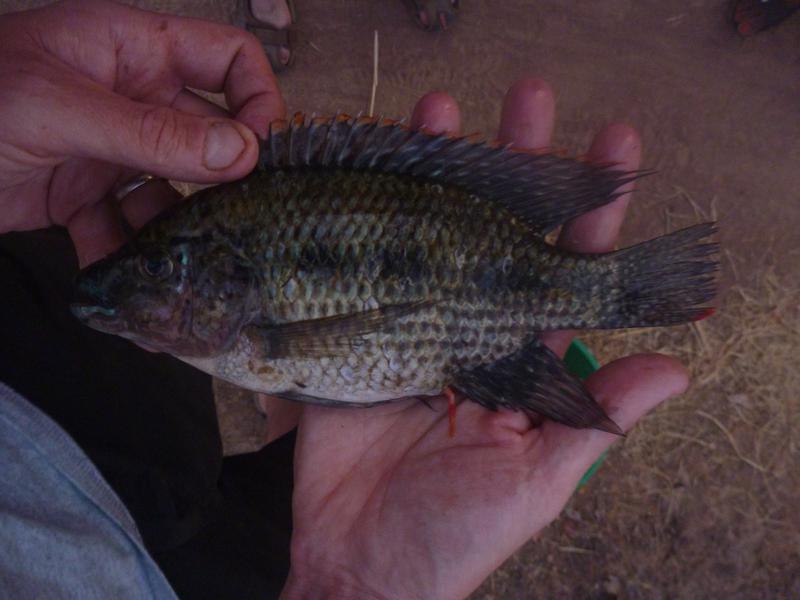
The karomo is a short, deep-bodied tilapia that reaches about 11 in (11 in) in standard length. Its most distinctive feature is the head: the jaws are drawn forward into a long snout, with the broad tooth-bands meeting in a roughly horizontal plane and the teeth themselves tricuspid, slender-shafted and curved at the crown — an arrangement suited to rasping and scooping rather than seizing prey. Fin counts run to 15–16 dorsal spines and 12–13 soft rays, with three anal spines.
Color is strongly tied to sex and breeding state, which makes this an easy fish to misread out of season. Females and non-breeding males are a fairly plain dark green to olive above, paler below, marked by three large blotches along the flank. A ripening male darkens, his dorsal fin picking up orange lappets. A fully ripe, displaying male is transformed: purplish-blue on the body with dark spots on the flank scales, a blue-green head, bright blue lips, and blue-white stripes and spots across the dorsal, anal and tail fins, the dorsal and tail edged in broad orange. Most striking of all is a long, branched orange-to-red "tassel" hanging from the genital region — a soft, non-glandular ornament that, as the early field workers noted, exaggerates the male's movements and apparent size during courtship.
Habitat
The karomo is endemic to the lower Malagarasi River and its delta in western Tanzania — the basin that drains roughly a third of Lake Tanganyika's watershed and is the lake's largest single inflow. Crucially for a fish whose name traces to a Tanganyika expedition, it does not live in the lake itself; surveys, including Ad Konings' fieldwork, have never recorded it from Lake Tanganyika proper. Instead it occupies the swampy lowland reaches up to about 62 mi upstream from the lake, the river's delta, and connected floodplain waterbodies, historically including Lakes Nyamagoma and Sagara.
This is a wetland fish, not a rift-lake rock-dweller. It favors shallow, standing or slow-flowing water — marginal vegetation, swamps fringing the main channel, lagoons and ponds — where it can shelter among water plants. FishBase records a tropical temperature preference of roughly 72–82°F (72–82 °F), consistent with the warm, low-gradient swamps it inhabits. The early observers also noted that young fish sometimes "skittered" at the surface near the spawning grounds, a behavior that hints at episodes of low dissolved oxygen in these weed-choked backwaters.
Feeding
As a member of Oreochromis, the karomo sits low on the food web, and FishBase places it at a trophic level near 2.0 — that of a primary consumer. Its diet is built mainly around plankton, the suspended algae and micro-invertebrates of the swamp water, which the broad, fine tooth-bands and forward-projecting jaws are well suited to harvesting. Field observers also watched males scoop up algal debris from the bottom and move into adjacent weed beds to rasp epiphytic algae from plant surfaces, so the species blends filter-style plankton feeding with bottom and surface grazing.
In its swampy setting the karomo is a forage and food fish rather than a predator. It is at times gregarious, forming loose schools, and is mainly active by day. Within the wider Malagarasi fish community it is one of several tilapias, and it has long been an important component of the local swamp fishery — valued, by all accounts, as excellent eating — which makes it both an ecological grazer and an economic resource for the people of the delta.
Mating
The karomo's courtship is unusually well documented for an obscure swamp endemic, thanks to a classic 1956 field study by Rosemary Lowe (later Lowe-McConnell), who watched it spawn in natural waters rather than aquaria. Breeding males gather on communal spawning grounds — a lek — each defending a small territory. At its center the male builds a nest: a clean plaque of fine sand only about 4–6 in (4–6 in) across — far smaller than the fish itself — ringed by a low ridge and raised on a mound that can be roughly a foot (12 in) high and up to a yard (3 ft) wide at the base. He keeps the sand scrupulously clean by mouthing, nosing and fanning it, so the bright plaque is visible from a distance, and he largely stops feeding while on station. Territorial males squabble little with their close neighbors but will drive off other species, including catfish (Clarias) and other cichlids.
Courtship itself is brief and not especially elaborate. Females cruise the spawning grounds singly or in small shoals; a male meets an arriving female, leads her to his nest, and displays with snout-shaking ("nose-wagging") and by dragging his long, branched orange genital tassel across the sand — a soft ornament that exaggerates his apparent size and movements. The whole spawning act is often over in under five minutes.
Breeding
The karomo is a maternal (female) mouthbrooder. On the male's sand plaque the female lays a batch of eggs and immediately takes them into her mouth while the male trails his tassel over the nest — and tellingly, observers could not confirm whether fertilization happens in the water or in the female's mouth. A single female may lay two, three or more batches before leaving, with larger females carrying more eggs. She then retreats into the water plants to brood the clutch in her mouth, probably producing three or four broods in succession over a season.
The young develop in the mother's buccal cavity until well past hatching: larval young of about 0.5 in, still bearing yolk sacs, have been recovered from brooding females. Once released, juveniles of 0.8–2.4 in (1–2.5 in) shoal in the shallows among marginal vegetation. As in other Oreochromis, all parental care is the female's; the male contributes only the nest and his genes, and takes no part in guarding eggs or fry.
In the aquarium
Honestly, the karomo is barely an aquarium fish at all. It has no established presence in the ornamental trade — FishBase notes a nominal aquarium use, but you will not find it stocked in shops, and the handful of images in circulation come from fish freshly netted in the Malagarasi, not from hobby tanks. Its status as an Endangered, narrowly endemic species is reason enough to leave wild stock where it is rather than chase it as a curiosity.
For the sake of completeness: were a keeper ever to encounter it, this is a robust, deep-bodied tilapia approaching a foot long, and like other Oreochromis it would demand a large tank measured in hundreds of gallons, warm water in the high 70s°F (mid-20s°C), and tankmates chosen for a digging, plant-grazing mouthbrooder that will rework a sandy bottom and become territorial when ripe males come into color. Its real interest is in the swamp, not the glass box — and the more useful takeaway for hobbyists is that the genus's familiar farmed tilapias are very different fish from this fragile wild endemic, which should not be confused with them.
Conservation
The IUCN Red List assesses Oreochromis karomo as Endangered (EN B1ab(iii,v)), in a 2025 reassessment dated 13 March 2025; this upgraded the status from the Critically Endangered listing the species had carried since 2006, though FishBase and some hobby pages still echo the older "critically endangered" line. The case for listing is geographic: the karomo is confined to the lower Malagarasi and a few connected waterbodies, an estimated extent of occurrence of only about 579 mi² across just two to five locations, with a population now in decline. Once locally common in the inland swamps, it has become hard to find — recent fishers report it absent from Lake Sagala and the lower river, persisting mainly around Lake Nyamagoma, where in a mixed catch of thirty fish only a handful might be karomo. The direct pressures are unsustainable fishing on a prized food fish and the steady conversion of its wetland habitat, as farming and grazing expand into the river margins and delta and bring sedimentation, nutrient loading and agrochemical runoff.
Those threats sit inside the wider story of the Lake Tanganyika basin, of which the Malagarasi is the largest tributary. The lake itself faces a different but related strain: O'Reilly and colleagues (2003, Nature, doi:10.1038/nature01833) documented that a warming climate and reduced mixing have cut primary productivity by roughly 20%, with knock-on declines on the order of 30% in fish yields, while Cohen and colleagues (2016, PNAS, doi:10.1073/pnas.1603237113) estimated a roughly 38% loss of oxygenated benthic habitat — pressures layered on top of shoreline sedimentation degrading littoral habitats and an intense pelagic fishery for clupeids (Stolothrissa and Limnothrissa) and Lates that feeds four nations. Those basin-scale forces fall hardest on the lake's deep and open-water species, not on a shallow swamp endemic like the karomo. For this fish the operative threats are local and tractable: protecting its wetland habitat and fishing it sustainably. It has been the subject of an awareness-and-sustainable-fishing project funded by the Mohamed bin Zayed Species Conservation Fund and a Rufford-supported pollution-monitoring effort along the Malagarasi, and it gains some indirect cover from the Lake Tanganyika Authority's four-country governance of the basin, whose convention bars the aquaculture of non-native species — a guard against the introduced and hybridizing tilapias that menace Tanzania's native Oreochromis. Continued population monitoring and real habitat protection, the assessors stress, are what this species now needs.