Taxonomy & naming
Oreochromis esculentus was described by Michael Graham in 1928 as Tilapia esculenta, from material collected during his fisheries survey of Lake Victoria (Victoria Nyanza). The holotype, an adult from the Kenyan waters of the lake, is held at the Natural History Museum, London as BMNH 1928.5.24.99, alongside a large paratype series. Eschmeyer's Catalog of Fishes lists it as valid in the genus Oreochromis, in the cichlid subfamily Pseudocrenilabrinae; Sarotherodon esculentus appears in older literature as the species was shuffled among the tilapiine genera before Trewavas's 1983 revision settled the maternal mouthbrooders into Oreochromis.
The specific epithet is unusually candid. Graham chose esculenta — Latin for "edible" — explicitly, in his own words, to record that this was the important edible commercial species of Lake Victoria. The genus name blends Latin aurum (gold) with the Greek chromis, an old name for a perch-like fish. In English it is the Singida (or Singidia) tilapia or Graham's tilapia; across its East African range it is best known by the Bantu name ngege. Within the original Lake Victoria flock it occupied the offshore plankton-feeding niche, complementing the more inshore Oreochromis variabilis — a partition that introduced Nile tilapia (Oreochromis niloticus) and Oreochromis leucostictus have since overwritten.
Morphology
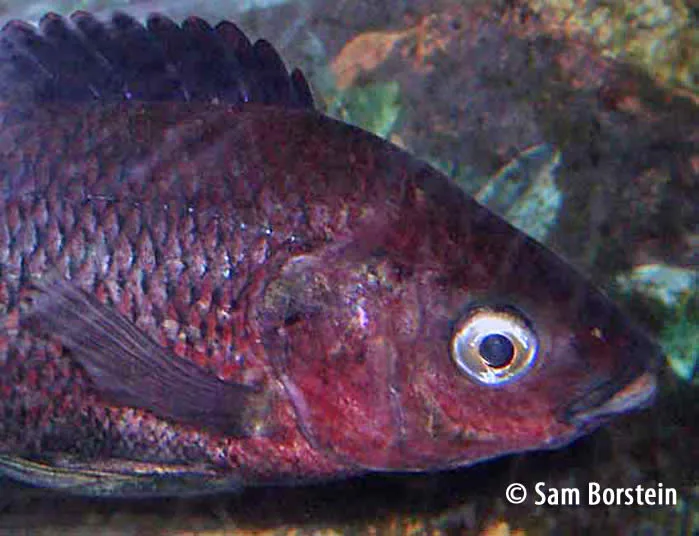
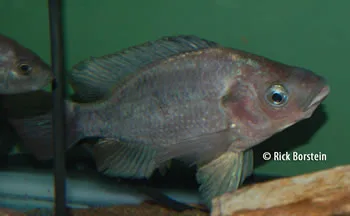
This is a big, deep-bodied tilapia built along sober lines rather than flashy ones. Reports of maximum size vary with the source: FishBase, following Trewavas, gives a maximum of about 20 in standard length and 2.5 kg (5.5 lb), with a common length nearer 12 in, while the IUCN assessment cites a more conservative maximum of 10 in SL — a genuine discrepancy worth flagging rather than averaging, likely reflecting the difference between historical record fish and what surveys turn up today. The head is small and rounded with a short snout, a forward-facing mouth, and a relatively small eye for the body.
Coloration is plain by cichlid standards and that plainness is itself diagnostic: the species generally lacks the dark vertical bars, midlateral spots, and caudal-fin striping seen in many congeners. Females and non-territorial males are a pale grey, whitening on the belly. Breeding males transform, flushing reddish-pink over the head and flanks, with dark fins edged in red or pink and a reddish caudal region. Two ID points matter where it overlaps with other tilapias: unlike Oreochromis niloticus it shows no vertical stripes on the tail fin and carries finer teeth and a longer lower pharyngeal bone; and unlike the Rukwa endemic Oreochromis rukwaensis, mature Oreochromis esculentus males do not develop conspicuously enlarged jaws. Fin counts run to 16–18 dorsal spines and 3 anal spines.
Habitat
Naturally, Oreochromis esculentus belongs to the Lake Victoria and Lake Kyoga basins — Lake Victoria itself, Lakes Kyoga and Kwania, Lake Nabugabo, the Victoria Nile above Murchison Falls, and associated waters in Tanzania, Uganda, and Kenya. That native range is now largely hollowed out: the species was depleted from the main lake bodies in the 1970s and survives there only marginally, with its remaining natural strongholds in the smaller satellite lakes ringing the basins. In the original lakes the species favors sheltered inshore water less than 66 ft deep over soft, algae-rich mud, and it is notably hardy physiologically, tolerating dissolved oxygen below 1 ppm and high carbon dioxide — a useful trait in shallow, sometimes deoxygenated tropical lakes prone to mixing events and warm, stratified spells.
Its presence at Lake Rukwa is the result of human translocation, not natural dispersal. Beginning in the mid-twentieth century, ngege was moved widely across Tanzania to stock productive waters, and Shechonge and colleagues (2019) documented just how thoroughly these deliberate introductions colonized catchments far from Lake Victoria — among them Lake Rukwa, the Nyumba ya Mungu reservoir, the Pangani catchment, and the Malagarasi. Lake Rukwa is a demanding host: an endorheic (no-outlet) lake in Tanzania's Western Rift, shallow (roughly 33–49 ft at most), strongly alkaline at pH 8–9, and sodium-rich, with conductivity around 2,000 microsiemens. The warm, plankton-laden, soft-bottomed reaches of Rukwa broadly echo the species' preferred inshore mud, which is part of why the stocking took.
Feeding
Oreochromis esculentus is, at heart, a grazing machine for open water. It is a phytoplankton specialist that feeds by the mucus-trap mechanism: a sheet of mucus in the buccal cavity snares fine particles, which the pharyngeal teeth then comb free and pass to the gut. Trewavas characterized it as non-selective at the level of individual particles — anything small enough to be caught is swallowed — yet selective at the scale of the lake, because the schools track concentrations of diatoms. The diet is therefore overwhelmingly phytoplankton, dominated by diatoms, supplemented by some higher plant material, insects and their larvae, small crustaceans, and worms; its low trophic level (about 2.5) places it near the base of the food web.
That ecology dovetails with Lake Rukwa, where the phytoplankton community is itself diatom-dominated — surveys there record genera such as Cyclotella, Coscinodiscus, and Navicula prevailing in the open water, exactly the sort of food a mucus-trap plankter exploits. The fish is mainly diurnal and occasionally schools as it follows shifting plankton blooms across open water.
Mating
The mating system is lek-like and male-driven, in the classic Oreochromis pattern. A male excavates a simple crater-shaped spawning pit — roughly 12 in across and 4 in deep, lacking a raised wall — in shallow water, and defends that territory for weeks or, intermittently, for months, feeding little while he guards it. These pits cluster on suitable shallow ground, so that displaying, courting males effectively form a lek that visiting females move through.
Females visit only briefly. A female enters a male's pit, spawns, takes the fertilized eggs into her mouth, and leaves the breeding ground almost immediately, so the sexes spend very little time together and pair-bonding is absent. Reproduction is tied to the rains, with peak spawning concentrated in the wettest months — a sensible strategy in a system where wet-season inflow refreshes the nursery habitat into which the brooding females will retreat.
Breeding
Oreochromis esculentus is a maternal mouthbrooder: after spawning, the female alone carries the fertilized eggs and developing young in her buccal cavity, and the male contributes no parental care beyond fertilization and the spawning site. Brooding females retreat to the shelter of weed beds, swampy margins, and papyrus-swamp channels, which double as nurseries. A single female may produce a succession of three or more broods within a spawning season, fecundity running to the order of several hundred eggs per brood in the genus-typical range for a fish of this size.
The young are released and guarded as a school in the sheltered nursery water, becoming independent at about 0.5 in — by which point the yolk sac is used up and they have begun to feed for themselves. They remain in the swampy nursery channels until roughly 4.5 in, when they move out to open water to take up the adult planktivorous life.
In the aquarium
Honestly, almost nobody keeps this fish in a home aquarium, and that absence is the most useful thing a hobbyist can be told about it. Oreochromis esculentus is a food fish and a fisheries-science subject, not an ornamental — it has no trade in the cichlid hobby, it is rarely if ever offered, and as a Near Threatened native its wild collection for the tank is neither sensible nor warranted. It also simply isn't built for glass: a plain-colored planktivore that reaches a foot or more and naturally schools and ranges over open water has little to offer a display tank and a great deal to demand of one.
If the genus's general husbandry is a guide, anyone who did encounter it should expect the standard large-Oreochromis realities — a very large tank measured in hundreds of gallons, robust filtration to match a heavy-feeding herbivore's waste load, and warm water (roughly 73–82 °F). Like its relatives it would be tolerant of hard, alkaline water and low oxygen, and males would be territorial when in breeding condition. But the real point stands: this is a fish to understand as a wild and cultured food and aquaculture resource, and to meet on a research station or at a Tanzanian landing site rather than in a living room.
Conservation
The IUCN Red List assesses Oreochromis esculentus as Near Threatened (criterion A2bcde), assessed on 30 March 2021 and published in 2022 by Natugonza and Musinguzi, with a decreasing population trend. That category marks a partial recovery in status on paper rather than in fortune: the species was listed as Critically Endangered in 2006 and Vulnerable in 1996, and the 2021 reassessment to Near Threatened reflects a re-evaluation of its wide (if thinned) distribution and surviving satellite-lake populations, with a suspected decline of about 20% over the preceding decade. In its native Lake Victoria and Kyoga basins it has been hammered by predation from the introduced Nile perch, competition and hybridization with introduced Nile tilapia, overfishing, and catchment-driven siltation and eutrophication — the textbook case of native cichlid loss in the African Great Lakes. There is no targeted aquarium-trade pressure; the threats are ecological and fishery-based.
At Lake Rukwa the species sits in a different and somewhat paradoxical position. Here it is an introduction rather than a native, and it forms a substantial part of an artisanal fishery alongside the lake's own endemic Rukwa tilapia, Oreochromis rukwaensis, which is itself IUCN Vulnerable. The lake's pressures are real but distinct from Victoria's. Rukwa is a shallow, alkaline, endorheic Rift lake whose level and area swing dramatically with rainfall — at high water it is a single body, but in dry phases it has historically split into two basins, and the shallow northern basin can dry out entirely. Those swings expose its fish to fluctuating salinity, shrinking habitat, and the risk of crowding and fish kills as water retreats. On top of that natural variability, the catchment is changing: expanding agriculture, livestock, and mining around the basin add siltation, nutrients, and untreated effluent, while a growing riparian population intensifies fishing. For a hardy, fast-maturing planktivore, the Rukwa population is unlikely to share the near-extinction trajectory the species suffered in Lake Victoria — but it lives in a genuinely strained, climate-sensitive lake, and its fate there is bound up with the same water-level instability and catchment degradation that threatens Rukwa's endemic fishes.